
BuddhistCatholicContemplativeEvangelicalGeneral ChristianHinduJewishLatter-day SaintMuslimNew VisionsProgressive Christian
Beliefs
- Buddhist
- Catholic
- Contemplative
- Evangelical
- General Christian
- Hindu
- Jewish
- Latter-day Saint
- More Voices
- Muslim
- New Visions
- Pagan
- Progressive Christian
Topics
- Religion News
- Food and Religion
- Sports and Religion
- Religious Art
- Religious Music and Entertainment
- Religious Events
- History and Religion
- Style and Religion
- Politics and Religion
- Women in Religion
- Recreation Outdoors and Religion
- Business Finance and Religion
- Careers Workplace and Religion
- Education and Religion
- Family Parenting and Religion
- Health Fitness and Religion
- Home and Religion
- Relationships and Religion
- Technology and Religion
- Travel and Religion
Columnists
- Buddhist Columnists
- Business Finance and Religion Columnists
- Careers Workplace and Religion Columnists
- Catholic Columnists
- Contemplative Columnists
- Education and Religion Columnists
- Evangelists Columnists
- Family Parenting and Religion Columnists
- General Christian Columnists
- Health Fitness and Religion Columnists
- Hindu Columnists
- History and Religion Columnists
- Home and Religion Columnists
- Jewish Columnists
- More Voices Columnists
- Latter Day Columnists
- Muslim Columnists
- New Visions Columnists
- Nonreligious Columnists
- Pagan Columnists
- Politics and Religion Columnists
- Progressive Columnists
- Recreation Outdoors and Religion Columnists
- Relationships and Religion Columnists
- Religion News Columnists
- Religious Art Columnists
- Religious Events Columnists
- Religious Music and Entertainment Columnists
- Sports and Religion Columnists
- Style and Religion Columnists
- Technology and Religion Columnists
- Travel and Religion Columnists
- Women in Religion Columnists
Resource Library
- 2026 Calendar
- Library of World Religions
- The 100 Most Holy Places on Earth
- Patheos Answers
- Podcasts
- Videos
- Faith Leaders Database
- Anglican Episcopalian
- Bahai
- Baptist
- Buddhism
- Christianity
- Confucianism
- Eastern Orthodoxy
- Hinduism
- Holiness and Pentecostal
- ISKCON
- Islam
- Judaism
- Lutheran
- Methodist
- The Church of Jesus Christ of Latter-day Saints
- New Age
- Paganism
- Presbytarian and Reformed
- Protestantism
- Religion Behind the Scenes
- Roman Catholic
- Scientology
- Shia Islam
- Sikhism
- Sufism
- Sunni Islam
- Taoism
- Zen
- See all religions
Research Tools
 Ad-Free & Subscriber Log-In Subscription Support
Ad-Free & Subscriber Log-In Subscription Support
Follow Patheos 

- Trending:
- Forgiveness
- |
- Marriage
- |
- Consciousness
- |
- Death Penalty
- |
- Election
- |
- Halloween
 Good Letters
-
Contributors
- Home
- Catholic
- Little Houses
Little Houses
Last updated on: March 13, 2013 at 1:00 am by Caroline Langston
Little Houses 2013-03-11T09:38:52-07:00 Caroline Langston
Patheos Explore the world's faith through different perspectives on religion and spirituality! Patheos has the views of the prevalent religions and spiritualities of the world.
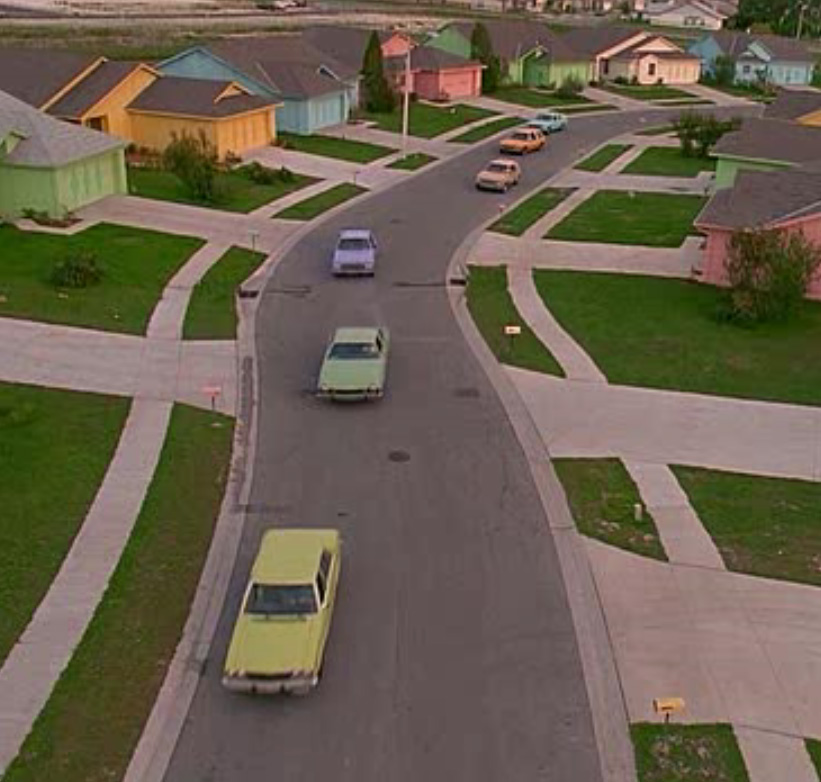 For Peter and Jackie Cooley, who live in one.
“So what do you know about East Pines?” I directed the question about a nearby neighborhood to an acquaintance whom I know solely as a friend on Facebook, a local historian who has written widely on the postwar country music scene in Prince George’s County and the “haunted boy of Cottage City,” who was the inspiration for The Exorcist.
“Not much,” he typed back. “You could check the Prince George’s archives.”
It was a response that was both a surprise and not. A surprise that even an expert on these old inside-the-Beltway neighborhoods knew nothing about this particular one, and at the same time, a confirmation of the neighborhood’s generally unassuming quality—it is a place that appears as though it is used to being forgotten.
East Pines has not, however, been forgotten by me, and my thinking about the place has recently begun to border on mild obsession, the subject of lunchtime Google searches trying to track real estate values and whether or not there’s still an active homeowner’s association. Sometimes after dropping the children off at school, I will make an unexpected turn onto East Pine Drive, and for a few quite moments, wander its eerily quiet, meandering lanes.
The neighborhood straddles the Baltimore-Washington Parkway along a stretch of inner-ring Prince George’s that is both wooded and interspersed with tired, half-century-old commercial strips, now given to pawn shops and medical equipment stores and Plexiglass-countered Chinese carryouts, though Pizza Oven proudly proclaims that it has been in the same location since September 1957.
Beyond the fluorescent lights, up the hills and through the trees, the little houses stairstep up the curving roads, almost identical, and from the looks of them, they are little more than a thousand square feet apiece. Even before we moved into a neighborhood nearby, we would sometimes be driving back from my in-laws’ house in Baltimore, when I would glance at the yellow lights glowing through the windows, and strain to see if I could catch a glimpse of any human framed inside them.
These are neither the airy 1920s Craftsman bungalows of nearby communities Riverdale or the above-mentioned Cottage City, nor are they the brick 1940s Colonials in the neighborhood where I live, with their thin veneer of gentility and social pretension: “The Chevy Chase of Prince George’s County,” my neighborhood is sometimes, with tongue in cheek, called.
It goes without saying that these small houses are not the “tiny” houses, or the “not-so-big” houses that have been in vogue among the cognoscenti during the last fifteen years (I love them, too)—with their bare, curated spaces, gleaming blond wood floors and spare handcrafted artworks, giving the atmosphere of an Ingmar Bergman film.
No, these houses are as plain as plain, metal- or asbestos-sided, sometimes painted the colors of Sweet-Tarts, but invariably looking washed-out. As writer D.J. Waldie noted about his own similar neighborhood, Lakewood, California, in Holy Land, “Middle class houses are the homes of people who would not live here.”
As it happens, I grew up around these kinds of houses.
But I did not grow up in one myself: Our house started out the little bungalow, but then had been added onto two or three times, so that it was at the same time both overweening and Puritan, the dining room giant and expensively-furnished but utterly plain, and the collections of books and records and magazines—Norman Mailer, Billy Graham, a volume called “Sex Before Marriage” found in an upstairs drawer—bespeaking of psychological dichotomies I still don’t understand.
It was Mrs. Rubynelle Cowsert’s house down the street that fascinated me, and still occasionally lights up my dreams. The small house with the Duncan Phyfe sofa, the afternoon tea served in good china, accompanied by cookies on a plate at the polished formal dining table in the tiny formal dining room.
Back then no one assumed that a formal dining room was only for the wealthy, that the middle class would be expected to eat in front of the TV, or on high stools at the counter.
It goes without saying that the houses of East Pines are largely populated by immigrants now, either from Latin America or West Africa, or with African-Americans who came in an earlier wave. Here and there are still representatives of the old white, working class Prince George’s who didn’t get the message that it was time to move even further out—the “white people that time forgot,” I always think of them.
But it’s not the loss of white hegemony I’m haunted by, that keeps me circling these streets, trying to distinguish one house from another: There are blasted-out front yards, leaning trees, and buckling sidewalks, snaggletooth windows either blank or covered by the telltale swag of acrylic blankets tacked to the frames, on the one hand. On the other hand, there are neat little bungalows with new vinyl siding, a plaster Virgin Mary in the yard, and a line of tulips up to the porch.
I identify with the new East Pines, in the end, as much or more than I do with the old: I am an immigrant to this area as much as anyone else.
I think it is an apocalyptic vision I see in these overgrown hills, a concrete manifestation of the truth that as we live our death, our needs for shelter must only grow smaller, until we surrender everything—finally the body itself—before God. We have no other help, Orthodox Christians chant about the cross during Lent.
These wooden houses are nothing less than testaments to human longing and struggle, and the modest ways in which these little houses help to frame and contain those passions—via little living rooms, tiny formal dining rooms, arched telephone nooks in the hall, and ironing boards that fold down from the wall on a hinge.
Monuments to memories eternal.
Previous Post

March 12, 2013
The Hobbit, the Holy Spirit, and Calculus
Next Post
March 14, 2013 It Ain’t All Bluegrass, Blues, and Ribs
Browse Our Archives
Select a Category A. G. Harmon Alissa Wilkinson Allison Backous Art Authors Brad Fruhauff Bradford Winters Bryan Bliss Caroline Langston Chad Thomas Johnston Chris Hoke Christiana N. Peterson Culture D.G. Myers D.L. Mayfield Daniel Bowman Jr. David Griffith Elizabeth Duffy Faith Film Greg Wolfe Guest Contributor Interview Jan Vallone Jeffrey Overstreet Jessica Eddings-Roeser Jessica Mesman Griffith Kelly Foster Lindsey Crittenden Morgan Meis music Natalie Vestin Nick Olson Peggy Rosenthal Personal Reflection Poetry Friday Reflection Relationships Review Richard Chess Richard Cole Sara Zarr Shannon Huffman Polson Sonya Bilocerkowycz Tania Runyan Tony Woodlief Topical Categories Uncategorized Vic Sizemore Writing
Select a Month October 2018 September 2018 August 2018 July 2018 June 2018 May 2018 April 2018 March 2018 February 2018 January 2018 December 2017 November 2017 October 2017 September 2017 August 2017 July 2017 June 2017 May 2017 April 2017 March 2017 February 2017 January 2017 December 2016 November 2016 October 2016 September 2016 August 2016 July 2016 June 2016 May 2016 April 2016 March 2016 February 2016 January 2016 December 2015 November 2015 October 2015 September 2015 August 2015 July 2015 June 2015 May 2015 April 2015 March 2015 February 2015 January 2015 December 2014 November 2014 October 2014 September 2014 August 2014 July 2014 June 2014 May 2014 April 2014 March 2014 February 2014 January 2014 December 2013 November 2013 October 2013 September 2013 August 2013 July 2013 June 2013 May 2013 April 2013 March 2013 February 2013 January 2013 December 2012 November 2012 October 2012 September 2012 August 2012 July 2012 June 2012 May 2012 February 2008
Follow Us!
TAKE THE
Religious Wisdom Quiz
Which Christian group is associated with the "Anabaptist" tradition?
Select your answer to see how you score.
Episcopalians Calvinists Lutherans Mennonites
Related posts from Good Letters


Leonard Cohen’s Holy and Broken Hallelujah

Ready or Not for the Days of Awe

TRENDING AT PATHEOS Catholic

Rejecting Doom: Christian Hope And Human Action
Christianity is a religion of hope. We are to have hope and...

It’s What Comes From Within Which Matters
One of the most difficult things for us to understand is why...

Why I Choose the Eucharist Over the Sermon
Choose the Eucharist, Not the Sermon What are we supposed to get...

5 Design Elements Found in Spiritually Rooted Homes
Putting Spirituality Into Home Decor Our homes are more than our living...

Credo: A Story of God Told with the...
About 10 years ago, I began to imagine a personal "Credo" that...

The Anatomy of Divine Revelation in Catholic Thought
The claim that God has made Himself known to human beings is...
view all Catholic blogs
Ad-Free & Subscriber Log-In Subscription Support
- About Us
- 2026 Calendar
- Videos
- Podcasts
- Library of World Religions
- Faith In Media Tracker
- Advertise With Us
- Write for Us
- Privacy Policy
- Terms of Service
- Do Not Sell My Data
- Contact Us
- Radiant Digital
- Manage Newsletter Subscriptions
- Unsubscribe From Notifications
- Sitemap
Copyright 2008-2026, Patheos. All rights reserved.
Subscription Support Ad-Free & Subscriber Log-In
Follow Patheos