
BuddhistCatholicContemplativeEvangelicalGeneral ChristianHinduJewishLatter-day SaintMuslimNew VisionsProgressive Christian
Beliefs
- Buddhist
- Catholic
- Contemplative
- Evangelical
- General Christian
- Hindu
- Jewish
- Latter-day Saint
- More Voices
- Muslim
- New Visions
- Pagan
- Progressive Christian
Topics
- Religion News
- Food and Religion
- Sports and Religion
- Religious Art
- Religious Music and Entertainment
- Religious Events
- History and Religion
- Style and Religion
- Politics and Religion
- Women in Religion
- Recreation Outdoors and Religion
- Business Finance and Religion
- Careers Workplace and Religion
- Education and Religion
- Family Parenting and Religion
- Health Fitness and Religion
- Home and Religion
- Relationships and Religion
- Technology and Religion
- Travel and Religion
Columnists
- Buddhist Columnists
- Business Finance and Religion Columnists
- Careers Workplace and Religion Columnists
- Catholic Columnists
- Contemplative Columnists
- Education and Religion Columnists
- Evangelists Columnists
- Family Parenting and Religion Columnists
- General Christian Columnists
- Health Fitness and Religion Columnists
- Hindu Columnists
- History and Religion Columnists
- Home and Religion Columnists
- Jewish Columnists
- More Voices Columnists
- Latter Day Columnists
- Muslim Columnists
- New Visions Columnists
- Nonreligious Columnists
- Pagan Columnists
- Politics and Religion Columnists
- Progressive Columnists
- Recreation Outdoors and Religion Columnists
- Relationships and Religion Columnists
- Religion News Columnists
- Religious Art Columnists
- Religious Events Columnists
- Religious Music and Entertainment Columnists
- Sports and Religion Columnists
- Style and Religion Columnists
- Technology and Religion Columnists
- Travel and Religion Columnists
- Women in Religion Columnists
Resource Library
- 2026 Calendar
- Library of World Religions
- The 100 Most Holy Places on Earth
- Patheos Answers
- Podcasts
- Videos
- Faith Leaders Database
- Anglican Episcopalian
- Bahai
- Baptist
- Buddhism
- Christianity
- Confucianism
- Eastern Orthodoxy
- Hinduism
- Holiness and Pentecostal
- ISKCON
- Islam
- Judaism
- Lutheran
- Methodist
- The Church of Jesus Christ of Latter-day Saints
- New Age
- Paganism
- Presbytarian and Reformed
- Protestantism
- Religion Behind the Scenes
- Roman Catholic
- Scientology
- Shia Islam
- Sikhism
- Sufism
- Sunni Islam
- Taoism
- Zen
- See all religions
Research Tools
 Ad-Free & Subscriber Log-In Subscription Support
Follow Patheos 

- Trending:
- Advent
- |
- Forgiveness
- |
- Thanksgiving
- |
- Election
- |
- Seasonal Holidays
- |
- Marriage
 Good Letters
-
Contributors
- Home
- Catholic
- A Conversation with Gene Luen Yang: Part 1
A Conversation with Gene Luen Yang: Part 1
Last updated on: February 26, 2018 at 3:30 am by Image
A Conversation with Gene Luen Yang: Part 1 2018-02-20T13:21:56-07:00 Image
Patheos Explore the world's faith through different perspectives on religion and spirituality! Patheos has the views of the prevalent religions and spiritualities of the world.
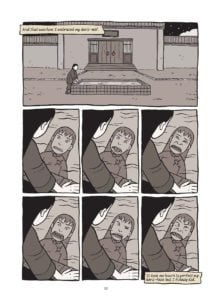
PART 4. Gene Luen Yang. Saints, 2013. First Second Books.
Gene Luen Yang is the MacArthur genius grant–winning author of graphic novels including Boxers and Saints and American Born Chinese. He also writes graphic novels for kids (the Secret Coders series) and for major comic book publishers (Avatar, The New Super-Man). He is profiled in Image issue #95.
Image: In Boxers and Saints, the two central characters are wonderful because they’re flawed—their flaws are part of what make them so interesting to read about. Do you think it’s hard to make an entirely good character interesting or likeable? Do you consciously avoid writing heroes who are too good?
Gene Luen Yang: First, thanks so much for reading my books and taking the time to have this exchange with me.
I don’t think I have to consciously avoid writing characters that are “too good.” I’m a flawed human being surrounded by flawed human beings. Flawed humanity is all I know!
I get what you’re asking, though. American comic books started off with idealized hero after idealized hero. Superman’s the classic example. He always does the right thing, right? And in those early issues, at least, he never even gets tempted to do the wrong thing. It’s almost a tautology. Whatever Superman does is right, and whatever is right is what Superman does.
I don’t think flawless characters work for a modern audience. We are more cynical, in part because we have more information. When someone is presented as a moral paragon, we hold our collective breath and wait for the mask to fall. Sooner or later, social media is going to expose their clay feet. We only believe in a person’s heroism if we’re shown their flaws up front, so we can be confident there won’t be any surprises down the line.
I’m not sure if that’s a good thing or a bad thing. I guess I’d lean towards good. Truth is truth, right? And it seems to me that flaws and real, bones-deep goodness aren’t mutually exclusive. Grace is often expressed through brokenness.
Image: Boxers and Saints beautifully illustrates the complicated and ambivalent legacy of Christian missionary work in China—we see the full horror but also the full humanity of all the participants. How did you hear that history described in your own family and community? Did your feelings about that history change as you wrote the books?
GLY: Catholicism in my family does not date back to the Boxer Rebellion. My mother converted after she came to the United States in the late 1960s. She spent a part of her childhood in Hong Kong, where the Catholic schools were the cheapest. Her family was going through a difficult time financially, so that’s where she was sent.
She told me that after she came to America, walking into a Catholic church felt like going home, so she signed up for RCIA and began the process of joining the church.
I grew up in a Chinese Catholic community, and there were a few families where Catholicism went back to the time of the Boxer Rebellion and even before. As a kid, I thought Chinese culture and Catholicism went hand-in-hand. Whenever folks around me were talking about Jesus and God and prayer, they were doing it in Chinese.
There were hints of tension, though. There are actually two Catholic churches in China: an “underground” church that pledges fidelity to Rome and a “patriotic” church that’s approved by the state. We had an American priest who had spent his entire vocation working with Chinese people, and he was willing to maintain a connection with the patriotic church.
We also had a few Chinese Jesuits who had each spent a couple of decades in re-education camps because of their faith. They saw any contact with the patriotic church as a betrayal. I held all these priests in the highest regard. I believed, and still believe, that they were all good men. But I do remember overhearing whispered conversations among adults about their disagreements with each other—and these were not polite disagreements. They were intense, vehement disagreements.
I didn’t really get to know the history of Christian missionaries in China until I began researching for Boxers and Saints. There are some great books out there, but my favorite was The Origins of the Boxer Uprising by Joseph Esherick. I loved that book, though I was disappointed by one oversight.
The author analyzes why many Chinese converted to Christianity around the turn of the century. He talks a lot about the political and cultural factors. For instance, some converts, like a few of my characters in Boxers and Saints, were criminals who wanted to escape the Chinese justice system.
The author never gets into the spiritual factors, though. At least some of the conversions must have been responses to experiences of the numinous, right? I’m not a historian and I haven’t done any research on this. Really, all I have are stories that floated around my home church community.
And, of course, we can debate what a numinous experience actually is, what’s really happening in the brain, but when you are talking about Christianity among non-European people, portraying all converts as victims of brutality is as bad as denying that the missionaries were sometimes incredibly brutal. Both absolutes deny humanity. Non-western people can have profound, life-changing experiences within western religious settings.
I was trying to get at both sides in Boxers and Saints. That’s why there are two volumes.
This post is a web exclusive feature accompanying Image issue #95. To be continued tomorrow.


Next Post

February 27, 2018 A Conversation with Gene Luen Yang: Part 2
Browse Our Archives
Select a Category A. G. Harmon Alissa Wilkinson Allison Backous Art Authors Brad Fruhauff Bradford Winters Bryan Bliss Caroline Langston Chad Thomas Johnston Chris Hoke Christiana N. Peterson Culture D.G. Myers D.L. Mayfield Daniel Bowman Jr. David Griffith Elizabeth Duffy Faith Film Greg Wolfe Guest Contributor Interview Jan Vallone Jeffrey Overstreet Jessica Eddings-Roeser Jessica Mesman Griffith Kelly Foster Lindsey Crittenden Morgan Meis music Natalie Vestin Nick Olson Peggy Rosenthal Personal Reflection Poetry Friday Reflection Relationships Review Richard Chess Richard Cole Sara Zarr Shannon Huffman Polson Sonya Bilocerkowycz Tania Runyan Tony Woodlief Topical Categories Uncategorized Vic Sizemore Writing
Select a Month October 2018 September 2018 August 2018 July 2018 June 2018 May 2018 April 2018 March 2018 February 2018 January 2018 December 2017 November 2017 October 2017 September 2017 August 2017 July 2017 June 2017 May 2017 April 2017 March 2017 February 2017 January 2017 December 2016 November 2016 October 2016 September 2016 August 2016 July 2016 June 2016 May 2016 April 2016 March 2016 February 2016 January 2016 December 2015 November 2015 October 2015 September 2015 August 2015 July 2015 June 2015 May 2015 April 2015 March 2015 February 2015 January 2015 December 2014 November 2014 October 2014 September 2014 August 2014 July 2014 June 2014 May 2014 April 2014 March 2014 February 2014 January 2014 December 2013 November 2013 October 2013 September 2013 August 2013 July 2013 June 2013 May 2013 April 2013 March 2013 February 2013 January 2013 December 2012 November 2012 October 2012 September 2012 August 2012 July 2012 June 2012 May 2012 February 2008
Follow Us!
TAKE THE
Religious Wisdom Quiz
What is the Christian attitude toward one's enemies?
Select your answer to see how you score.
Fight them Mock them Ignore them Love them
Related posts from Good Letters

A Conversation with Alicia Ostriker: Part 1

A Conversation with Alicia Ostriker: Part 2

A Conversation with Welcome Wagon’s Vito Aiuto, Part...

A Conversation with Welcome Wagon’s Vito Aiuto, Part...
TRENDING AT PATHEOS Catholic

How Discretion Guides Us Away From Extremes
Prudence is an important virtue for all of us. While we should...

Bad Survey Questions Distort Eucharistic Theology
It seems to be the newest thing: someone conducts a bad survey...

If Baptism Washes Away Sin, Why Do Catholics...
The seven sacraments stand as the foundation of Catholic ecclesial life. The...

The Power of Setting a Good Example
Remember last August when the Chicago White Sox hosted a "Pope Hat...

A Catholic Critique of Biblical Unitarianism
If the statistics are to be believed, Unitarianism is rising worldwide. Although...

How Grandma Tourism Helps Grandparents Live Their Vocation
Grandma, The New Travel Influencer What started as a nostalgia-inspired social media...
view all Catholic blogs
Ad-Free & Subscriber Log-In Subscription Support
- About Us
- 2026 Calendar
- Videos
- Podcasts
- Library of World Religions
- Faith In Media Tracker
- Advertise With Us
- Write for Us
- Privacy Policy
- Terms of Service
- Do Not Sell My Data
- Contact Us
- Radiant Digital
- Manage Newsletter Subscriptions
- Unsubscribe From Notifications
- Sitemap
Copyright 2008-2026, Patheos, part of the Radiant Digital network of media brands. All rights reserved.
Subscription Support Ad-Free & Subscriber Log-In
Follow Patheos