
BuddhistCatholicContemplativeEvangelicalGeneral ChristianHinduJewishLatter-day SaintMuslimNew VisionsProgressive Christian
Beliefs
- Buddhist
- Catholic
- Contemplative
- Evangelical
- General Christian
- Hindu
- Jewish
- Latter-day Saint
- More Voices
- Muslim
- New Visions
- Pagan
- Progressive Christian
Topics
- Religion News
- Food and Religion
- Sports and Religion
- Religious Art
- Religious Music and Entertainment
- Religious Events
- History and Religion
- Style and Religion
- Politics and Religion
- Women in Religion
- Recreation Outdoors and Religion
- Business Finance and Religion
- Careers Workplace and Religion
- Education and Religion
- Family Parenting and Religion
- Health Fitness and Religion
- Home and Religion
- Relationships and Religion
- Technology and Religion
- Travel and Religion
Columnists
- Buddhist Columnists
- Business Finance and Religion Columnists
- Careers Workplace and Religion Columnists
- Catholic Columnists
- Contemplative Columnists
- Education and Religion Columnists
- Evangelists Columnists
- Family Parenting and Religion Columnists
- General Christian Columnists
- Health Fitness and Religion Columnists
- Hindu Columnists
- History and Religion Columnists
- Home and Religion Columnists
- Jewish Columnists
- More Voices Columnists
- Latter Day Columnists
- Muslim Columnists
- New Visions Columnists
- Nonreligious Columnists
- Pagan Columnists
- Politics and Religion Columnists
- Progressive Columnists
- Recreation Outdoors and Religion Columnists
- Relationships and Religion Columnists
- Religion News Columnists
- Religious Art Columnists
- Religious Events Columnists
- Religious Music and Entertainment Columnists
- Sports and Religion Columnists
- Style and Religion Columnists
- Technology and Religion Columnists
- Travel and Religion Columnists
- Women in Religion Columnists
Resource Library
- 2026 Calendar
- Library of World Religions
- The 100 Most Holy Places on Earth
- Patheos Answers
- Podcasts
- Videos
- Faith Leaders Database
- Anglican Episcopalian
- Bahai
- Baptist
- Buddhism
- Christianity
- Confucianism
- Eastern Orthodoxy
- Hinduism
- Holiness and Pentecostal
- ISKCON
- Islam
- Judaism
- Lutheran
- Methodist
- The Church of Jesus Christ of Latter-day Saints
- New Age
- Paganism
- Presbytarian and Reformed
- Protestantism
- Religion Behind the Scenes
- Roman Catholic
- Scientology
- Shia Islam
- Sikhism
- Sufism
- Sunni Islam
- Taoism
- Zen
- See all religions
Research Tools
 Ad-Free & Subscriber Log-In Subscription Support
Ad-Free & Subscriber Log-In Subscription Support
Follow Patheos 

- Trending:
- Forgiveness
- |
- Marriage
- |
- Consciousness
- |
- Death Penalty
- |
- Election
- |
- Halloween
 Good Letters
-
Contributors
- Home
- Catholic
- Thin Places, Part 2
Thin Places, Part 2
Last updated on: May 10, 2016 at 1:00 am by Alissa Wilkinson
Thin Places, Part 2 2016-05-05T12:04:51-07:00 Alissa Wilkinson
Patheos Explore the world's faith through different perspectives on religion and spirituality! Patheos has the views of the prevalent religions and spiritualities of the world.
Continued from yesterday. Read Part 1 here.
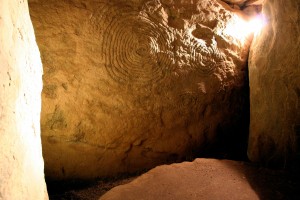 In the rocky cave-like interior at Newgrange, the air felt damp in my nostrils. It smelled of dirt. The passage was narrow, but it opened into a slightly wider room where a number of us could gather.
“We don’t know what they did here,” the guide told us. “All we know is that for seventeen minutes a year, at the winter solstice, the light shines in through that little opening above the door”—he pointed to a small rectangular opening—“and illuminates this little room.”
He told us you can enter a lottery to get tickets to be in there for those seventeen minutes per year, but so that we could see what it would be like, they’d shine a flashlight in through the hole, mimicking the sun’s movement.
“Ready?” he asked.
A flashlight shone in, and for a few brief moments, the chamber was flooded with light. I looked at the walls around me: plain white rock, cold to the touch, a handful of nicks and scratches here and there left by tourists in the past. What did they do in here in seventeen minutes per year? I wondered. I waited for a sense of awe to break over me, but all I did was squint when the beam hit me.
After it was over, we squeezed out and started back for the visitor’s center. As we picked our way back down the gravelly path, I heard others behind me marveling over the experience. I blew hot air on my palms and wondered where I could get a hot cup of coffee.
I suppose Weiner would say that for me, the Hill of Tara and Newgrange were thick, grey, and unremarkable because I violated all of his rules for experiencing The Divine. I had some expectations; at minimum, I expected the Hill of Tara to be a little more hilly. I assumed a Neolithic tomb would have some dead bodies in it. And I got there not by wandering, but because a Lonely Planet guidebook and my husband led me.
Then again, I wasn’t expecting a spiritual experience at all. I was expecting a historical experience, or maybe an anthropological experience. And that’s what I got.
History is often mundane, dusty, and far less transporting to the average person than a ruby-red sunrise. Uncovering the everyday thin places is dry, hard work: stacking stones on top of each other, braving blisters and fingernail dirt and mildew, tripping over lumps in the ground. And sometimes you get there, and after all that trekking and stacking, they’re still thick.
The truth, I think, is that if I, mere visitor, was to have a “flirtation with the Divine” on the Hill or Newgrange—it would sort of be cheating. All I did was get on a plane for six hours and a bus for another hour or so. I didn’t really even know what we were going to see when I boarded the bus. I was, at best, mildly interested.
At my church these days, we celebrate the Eucharist every week. Sometimes I help set up and clean up the table. Members of the church bake the bread and take turns bringing it, so sometimes it’s sourdough; sometimes it’s whole wheat; once it had raisins in it. Occasionally someone makes a delicious challah. We add a big bottle of port wine.
Before service we slice the loaf halfway to make it easy for our pastor to rip it in half later in the service, and we pour the wine into a crystal decanter. After it’s all said and done and taken, we clean out the cups and give the leftover bread to the children, who are always clamoring for it.
I know what I believe, though the older I get, the more willing I am to admit that often, I barely believe any of it. Yet one thing I cling to is this: somewhere in between pre-slicing and wiping out the bread plate, there is a thin place. This mundane bread and inexpensive wine, gifts of God, become an offering back to him.
In our ritual, we lift the wine and the bread, like a sacrifice, and then we eat it. We eat God, a little, somehow.
But it’s just bread and wine. Though I know how sacred this is, it still feels almost banal. So, although I come away from the table with a heart brimming with joy sometimes, more often I walk away preoccupied, already thinking of the week ahead.
But I choose to believe—I have to believe—that I have, right there, experienced a thin place. I have received the gift of God and swallowed it, and now, it is part of me, whether or not I was paying attention.
Lately, I’m finding my belief surfaces in places that are more and more mundane. I’m still struck by exceptional beauty—seeing the mountains as I fly into Los Angeles, eating a crisp late summer meal of baguette and brie and apples while I sit below the Eiffel Tower, discovering wild waves breaking against the cliff coasts of Whidbey Island, reveling in the crash and flash of a storm rolling in over the New Mexican desert.
But the tight joy I experience then is ringed with sadness. I know that I might return to those places, but I’ll never experience that particular flash of wonder again. In the midst of a weekend with friends or a holiday, I already feel the loss that will come when it’s over. These are moments of transcendent beauty—but not, for me, thin places.
Where my world gets thin is in the banal repetition of the weekly Eucharist. And this fact teaches me to seek belief in my real life, the one that wears me out: roll out of bed too early, go running, shower, ride the subway to work, grade hundreds of essays, teach classes, answer emails, edit articles, try to write, try to pray, fail, mess up, collapse on the couch, collapse into bed, rinse and repeat, rinse and repeat.
Salvation is exceptional, but I am also being saved every day. I am saved in the interstitial moments, the ones spliced in with the ordinary repetitive boring stuff.
I believe best in flashes: the dear one across the table from me at a pub; the eyes of a student who’s listening intently to my lecture; the cup of coffee, the light falling across the path, the smile of someone I love, the pillow I rest my head on at night.
My doubt falls away, and I see God, a little, there, and I think God sees me too.
This post originally appeared in In Earnest magazine.
Alissa Wilkinson is Christianity Today’s chief film critic and an assistant professor of English and humanities at The King’s College in New York City. She taught the “Spirituality and Food” seminar at the Glen Workshop in 2015 and tweets at @alissamarie.

Previous Post

May 9, 2016
Thin Places, Part 1
Next Post
May 11, 2016 My Prayer Is Not Prayer
Browse Our Archives
Select a Category A. G. Harmon Alissa Wilkinson Allison Backous Art Authors Brad Fruhauff Bradford Winters Bryan Bliss Caroline Langston Chad Thomas Johnston Chris Hoke Christiana N. Peterson Culture D.G. Myers D.L. Mayfield Daniel Bowman Jr. David Griffith Elizabeth Duffy Faith Film Greg Wolfe Guest Contributor Interview Jan Vallone Jeffrey Overstreet Jessica Eddings-Roeser Jessica Mesman Griffith Kelly Foster Lindsey Crittenden Morgan Meis music Natalie Vestin Nick Olson Peggy Rosenthal Personal Reflection Poetry Friday Reflection Relationships Review Richard Chess Richard Cole Sara Zarr Shannon Huffman Polson Sonya Bilocerkowycz Tania Runyan Tony Woodlief Topical Categories Uncategorized Vic Sizemore Writing
Select a Month October 2018 September 2018 August 2018 July 2018 June 2018 May 2018 April 2018 March 2018 February 2018 January 2018 December 2017 November 2017 October 2017 September 2017 August 2017 July 2017 June 2017 May 2017 April 2017 March 2017 February 2017 January 2017 December 2016 November 2016 October 2016 September 2016 August 2016 July 2016 June 2016 May 2016 April 2016 March 2016 February 2016 January 2016 December 2015 November 2015 October 2015 September 2015 August 2015 July 2015 June 2015 May 2015 April 2015 March 2015 February 2015 January 2015 December 2014 November 2014 October 2014 September 2014 August 2014 July 2014 June 2014 May 2014 April 2014 March 2014 February 2014 January 2014 December 2013 November 2013 October 2013 September 2013 August 2013 July 2013 June 2013 May 2013 April 2013 March 2013 February 2013 January 2013 December 2012 November 2012 October 2012 September 2012 August 2012 July 2012 June 2012 May 2012 February 2008
Follow Us!
TAKE THE
Religious Wisdom Quiz
How long did David reign as king?
Select your answer to see how you score.
25 years 40 years 33 years 50 years
Related posts from Good Letters


Morning in a Forgotten Neighborhood


TRENDING AT PATHEOS Catholic

Rejecting Doom: Christian Hope And Human Action
Christianity is a religion of hope. We are to have hope and...

It’s What Comes From Within Which Matters
One of the most difficult things for us to understand is why...

Why I Choose the Eucharist Over the Sermon
Choose the Eucharist, Not the Sermon What are we supposed to get...

5 Design Elements Found in Spiritually Rooted Homes
Putting Spirituality Into Home Decor Our homes are more than our living...

Credo: A Story of God Told with the...
About 10 years ago, I began to imagine a personal "Credo" that...

The Anatomy of Divine Revelation in Catholic Thought
The claim that God has made Himself known to human beings is...
view all Catholic blogs
Ad-Free & Subscriber Log-In Subscription Support
- About Us
- 2026 Calendar
- Videos
- Podcasts
- Library of World Religions
- Faith In Media Tracker
- Advertise With Us
- Write for Us
- Privacy Policy
- Terms of Service
- Do Not Sell My Data
- Contact Us
- Radiant Digital
- Manage Newsletter Subscriptions
- Unsubscribe From Notifications
- Sitemap
Copyright 2008-2026, Patheos. All rights reserved.
Subscription Support Ad-Free & Subscriber Log-In
Follow Patheos