
BuddhistCatholicContemplativeEvangelicalGeneral ChristianHinduJewishLatter-day SaintMuslimNew VisionsProgressive Christian
Beliefs
- Buddhist
- Catholic
- Contemplative
- Evangelical
- General Christian
- Hindu
- Jewish
- Latter-day Saint
- More Voices
- Muslim
- New Visions
- Pagan
- Progressive Christian
Topics
- Religion News
- Food and Religion
- Sports and Religion
- Religious Art
- Religious Music and Entertainment
- Religious Events
- History and Religion
- Style and Religion
- Politics and Religion
- Women in Religion
- Recreation Outdoors and Religion
- Business Finance and Religion
- Careers Workplace and Religion
- Education and Religion
- Family Parenting and Religion
- Health Fitness and Religion
- Home and Religion
- Relationships and Religion
- Technology and Religion
- Travel and Religion
Columnists
- Buddhist Columnists
- Business Finance and Religion Columnists
- Careers Workplace and Religion Columnists
- Catholic Columnists
- Contemplative Columnists
- Education and Religion Columnists
- Evangelists Columnists
- Family Parenting and Religion Columnists
- General Christian Columnists
- Health Fitness and Religion Columnists
- Hindu Columnists
- History and Religion Columnists
- Home and Religion Columnists
- Jewish Columnists
- More Voices Columnists
- Latter Day Columnists
- Muslim Columnists
- New Visions Columnists
- Nonreligious Columnists
- Pagan Columnists
- Politics and Religion Columnists
- Progressive Columnists
- Recreation Outdoors and Religion Columnists
- Relationships and Religion Columnists
- Religion News Columnists
- Religious Art Columnists
- Religious Events Columnists
- Religious Music and Entertainment Columnists
- Sports and Religion Columnists
- Style and Religion Columnists
- Technology and Religion Columnists
- Travel and Religion Columnists
- Women in Religion Columnists
Resource Library
- 2026 Calendar
- Library of World Religions
- The 100 Most Holy Places on Earth
- Patheos Answers
- Podcasts
- Videos
- Faith Leaders Database
- Anglican Episcopalian
- Bahai
- Baptist
- Buddhism
- Christianity
- Confucianism
- Eastern Orthodoxy
- Hinduism
- Holiness and Pentecostal
- ISKCON
- Islam
- Judaism
- Lutheran
- Methodist
- The Church of Jesus Christ of Latter-day Saints
- New Age
- Paganism
- Presbytarian and Reformed
- Protestantism
- Religion Behind the Scenes
- Roman Catholic
- Scientology
- Shia Islam
- Sikhism
- Sufism
- Sunni Islam
- Taoism
- Zen
- See all religions
Research Tools
 Ad-Free & Subscriber Log-In Subscription Support
Ad-Free & Subscriber Log-In Subscription Support
Follow Patheos 

- Trending:
- Forgiveness
- |
- Marriage
- |
- Consciousness
- |
- Death Penalty
- |
- Election
- |
- Halloween
 Good Letters
-
Contributors
- Home
- Catholic
- The Lone Ranger’s Easter Narrative
The Lone Ranger’s Easter Narrative
Last updated on: May 12, 2016 at 12:28 pm by Peggy Rosenthal
The Lone Ranger’s Easter Narrative 2016-05-12T12:28:57-07:00 Peggy Rosenthal
Patheos Explore the world's faith through different perspectives on religion and spirituality! Patheos has the views of the prevalent religions and spiritualities of the world.
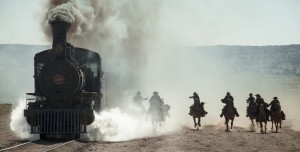
His back to us and to the camera, the hero walks silently away. His work in this particular community is done. He has restored the community to its better self.
This is the closing image of the classic 1947 film The Bishop’s Wife, which I watched recently. Cary Grant as the angel Dudley—sent to guide the bishop away from his egotistical ways and back into the arms of his neglected wife—has effected this conversion not only in the bishop but in other characters as well.
And as I watched Dudley walk away from us and from the community where he has intervened for the good, I suddenly thought: I’ve seen this scene before. My husband and I are on a kick of viewing 1940s and 1950s Westerns, which often end this way (though the departing hero might be on horseback rather than walking).
“Shane! Come back!” is the famous plea at the very end of Shane (1953). It’s much the same as the legendary ending of John Ford’s The Searchers (1956), with the John Wayne character—having rescued the young girl who’d been kidnapped by Indians and returned her to her family—walking slowly away from us and from the family, into the wilderness.
Then there’s The Lone Ranger TV series of 1949-1957, which my husband and I are also watching. (Don’t worry: we’re not bingeing. We restrict ourselves to one episode per evening.) Each episode ends identically: the Lone Ranger has restored justice to the frontier town that had been overtaken by outlaws. As the key “good” characters chat in smiling relief, Tonto and the Lone Ranger slip silently away from us and from the town. The final shot is of them riding off into the distance.
It might seem odd to place The Lone Ranger in the same category as the The Bishop’s Wife. Dudley effects an inner conversion on the characters who had gone astray. The Lone Ranger, while occasionally moving a “bad guy,” or a conflicted guy, to inner conversion, is most often restoring the externals of justice: the bad guys end up behind bars.
Still, there’s a deus ex machina methodology in both cases (literally in Dudley’s case, since he’s an angel sent from above to do his job).
Now you’re probably wondering why I’m devoting so much time to these “good conquers evil” tales. I’m wondering, too. Part of the fun of watching The Lone Ranger is simply its silliness: it’s my half-hour escape at the end of each day. But there’s something more about all these 1940s-1950s Westerns, and about The Bishop’s Wife too. They’re all, I’d say, art shaping itself to a very human longing: the longing for a restoration where evil is indeed conquered by good.
It’s no accident that this is the Christian narrative as well, which we celebrate especially at Easter.
The tough facts of our real human lives—as individuals and as communities, whether local or global—are of course messy, complex, a tangle of good and bad motivations and actions. But I don’t think this makes the “triumph of good” stories mere fantasy. They represent our deepest desire: we ache for the good in ourselves and in our world to win out.
When I get snippety with my husband, I ache for this evil habit to be transformed by my better self. When terrorists bomb yet another target, we ache for the Lone Ranger to come and wipe them all out in a half hour.
I don’t want to get too heavy here. The Bishop’s Wife is a delightful comedy. The Westerns I’ve been talking about aren’t meant to be deep. But the light, and even sometimes frivolous, entertainment that these films offer connects by a sort of Wi-Fi to a need at our core.
That’s why they’ve become classics. Initially, the Western cowboy genre as it developed in the 1940s and 1950s might have been expressing the post-war triumphant relief of the U.S. and its allies at having defeated the definitely evil Nazis. But that historical context has faded, while these films have held up now for sixty to seventy years.
Finally, I want to return to the image I began with, the image that closes these films. Why, I’m wondering, must the figure who has brought about good then slip silently away? I think maybe it’s because he can’t have an ego.
“This mask stands for justice,” the Lone Ranger says in nearly every episode. Justice must get our final attention, not its human (or in Dudley’s case, angelic) agent.
And yet it’s not only that he can’t have an ego. Leaving aside the Lone Ranger, whom we never get inside of at all (he’s wonderfully, consistently superficial), these other heroic figures have made some sort of personal sacrifice in the course of bringing restoration to the community. As they walk away, solitary, they’re aware of what they’ve chosen to give up in order to effect the good of others.
It’s their Passion and Crucifixion, we might say.
Image above is reproduced by the U.S. Departure of Agriculture, licensed by Creative Commons.
Peggy Rosenthal is director of Poetry Retreats and writes widely on poetry as a spiritual resource. Her books include Praying through Poetry: Hope for Violent Times (Franciscan Media), and The Poets’ Jesus (Oxford). See Amazon for a full list. She also teaches an online course, “Poetry as a Spiritual Practice,” through Image’s Glen Online program.

Previous Post

May 3, 2016
Canada: Detroit’s Southerly Neighbor
Next Post
May 5, 2016 Evil’s Share
Browse Our Archives
Select a Category A. G. Harmon Alissa Wilkinson Allison Backous Art Authors Brad Fruhauff Bradford Winters Bryan Bliss Caroline Langston Chad Thomas Johnston Chris Hoke Christiana N. Peterson Culture D.G. Myers D.L. Mayfield Daniel Bowman Jr. David Griffith Elizabeth Duffy Faith Film Greg Wolfe Guest Contributor Interview Jan Vallone Jeffrey Overstreet Jessica Eddings-Roeser Jessica Mesman Griffith Kelly Foster Lindsey Crittenden Morgan Meis music Natalie Vestin Nick Olson Peggy Rosenthal Personal Reflection Poetry Friday Reflection Relationships Review Richard Chess Richard Cole Sara Zarr Shannon Huffman Polson Sonya Bilocerkowycz Tania Runyan Tony Woodlief Topical Categories Uncategorized Vic Sizemore Writing
Select a Month October 2018 September 2018 August 2018 July 2018 June 2018 May 2018 April 2018 March 2018 February 2018 January 2018 December 2017 November 2017 October 2017 September 2017 August 2017 July 2017 June 2017 May 2017 April 2017 March 2017 February 2017 January 2017 December 2016 November 2016 October 2016 September 2016 August 2016 July 2016 June 2016 May 2016 April 2016 March 2016 February 2016 January 2016 December 2015 November 2015 October 2015 September 2015 August 2015 July 2015 June 2015 May 2015 April 2015 March 2015 February 2015 January 2015 December 2014 November 2014 October 2014 September 2014 August 2014 July 2014 June 2014 May 2014 April 2014 March 2014 February 2014 January 2014 December 2013 November 2013 October 2013 September 2013 August 2013 July 2013 June 2013 May 2013 April 2013 March 2013 February 2013 January 2013 December 2012 November 2012 October 2012 September 2012 August 2012 July 2012 June 2012 May 2012 February 2008
Follow Us!
TAKE THE
Religious Wisdom Quiz
Who asked Jesus, "What is truth?"
Select your answer to see how you score.
Pilate Judas Caiaphas Peter
Related posts from Good Letters




TRENDING AT PATHEOS Catholic

Rejecting Doom: Christian Hope And Human Action
Christianity is a religion of hope. We are to have hope and...

It’s What Comes From Within Which Matters
One of the most difficult things for us to understand is why...

Why I Choose the Eucharist Over the Sermon
Choose the Eucharist, Not the Sermon What are we supposed to get...

5 Design Elements Found in Spiritually Rooted Homes
Putting Spirituality Into Home Decor Our homes are more than our living...

Credo: A Story of God Told with the...
About 10 years ago, I began to imagine a personal "Credo" that...

The Anatomy of Divine Revelation in Catholic Thought
The claim that God has made Himself known to human beings is...
view all Catholic blogs
Ad-Free & Subscriber Log-In Subscription Support
- About Us
- 2026 Calendar
- Videos
- Podcasts
- Library of World Religions
- Faith In Media Tracker
- Advertise With Us
- Write for Us
- Privacy Policy
- Terms of Service
- Do Not Sell My Data
- Contact Us
- Radiant Digital
- Manage Newsletter Subscriptions
- Unsubscribe From Notifications
- Sitemap
Copyright 2008-2026, Patheos. All rights reserved.
Subscription Support Ad-Free & Subscriber Log-In
Follow Patheos