
BuddhistCatholicContemplativeEvangelicalGeneral ChristianHinduJewishLatter-day SaintMuslimNew VisionsProgressive Christian
Beliefs
- Buddhist
- Catholic
- Contemplative
- Evangelical
- General Christian
- Hindu
- Jewish
- Latter-day Saint
- More Voices
- Muslim
- New Visions
- Pagan
- Progressive Christian
Topics
- Religion News
- Food and Religion
- Sports and Religion
- Religious Art
- Religious Music and Entertainment
- Religious Events
- History and Religion
- Style and Religion
- Politics and Religion
- Women in Religion
- Recreation Outdoors and Religion
- Business Finance and Religion
- Careers Workplace and Religion
- Education and Religion
- Family Parenting and Religion
- Health Fitness and Religion
- Home and Religion
- Relationships and Religion
- Technology and Religion
- Travel and Religion
Columnists
- Buddhist Columnists
- Business Finance and Religion Columnists
- Careers Workplace and Religion Columnists
- Catholic Columnists
- Contemplative Columnists
- Education and Religion Columnists
- Evangelists Columnists
- Family Parenting and Religion Columnists
- General Christian Columnists
- Health Fitness and Religion Columnists
- Hindu Columnists
- History and Religion Columnists
- Home and Religion Columnists
- Jewish Columnists
- More Voices Columnists
- Latter Day Columnists
- Muslim Columnists
- New Visions Columnists
- Nonreligious Columnists
- Pagan Columnists
- Politics and Religion Columnists
- Progressive Columnists
- Recreation Outdoors and Religion Columnists
- Relationships and Religion Columnists
- Religion News Columnists
- Religious Art Columnists
- Religious Events Columnists
- Religious Music and Entertainment Columnists
- Sports and Religion Columnists
- Style and Religion Columnists
- Technology and Religion Columnists
- Travel and Religion Columnists
- Women in Religion Columnists
Resource Library
- 2026 Calendar
- Library of World Religions
- The 100 Most Holy Places on Earth
- Patheos Answers
- Podcasts
- Videos
- Faith Leaders Database
- Anglican Episcopalian
- Bahai
- Baptist
- Buddhism
- Christianity
- Confucianism
- Eastern Orthodoxy
- Hinduism
- Holiness and Pentecostal
- ISKCON
- Islam
- Judaism
- Lutheran
- Methodist
- The Church of Jesus Christ of Latter-day Saints
- New Age
- Paganism
- Presbytarian and Reformed
- Protestantism
- Religion Behind the Scenes
- Roman Catholic
- Scientology
- Shia Islam
- Sikhism
- Sufism
- Sunni Islam
- Taoism
- Zen
- See all religions
Research Tools
 Ad-Free & Subscriber Log-In Subscription Support
Ad-Free & Subscriber Log-In Subscription Support
Follow Patheos 

- Trending:
- Forgiveness
- |
- Marriage
- |
- Consciousness
- |
- Death Penalty
- |
- Election
- |
- Halloween
 Good Letters
-
Contributors
- Home
- Catholic
- Purple Light in Sarajevo
Purple Light in Sarajevo
Last updated on: May 24, 2016 at 1:00 am by Natalie Vestin
Purple Light in Sarajevo 2016-05-17T13:14:37-07:00 Natalie Vestin
Patheos Explore the world's faith through different perspectives on religion and spirituality! Patheos has the views of the prevalent religions and spiritualities of the world.
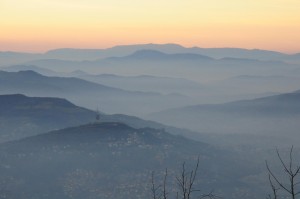 My fellowship liaison, Sevko, drove, and his gaze flicked across teenagers spilling over the sidewalks. The center of town spread within the cradle of the mountains, lit by the pink and blue haze of underground clubs. Gray office and apartment buildings faced the street, many of them gashed open, levels of exposed brick and wood open to view.
As we drove, it was hard not to notice that this place was beautiful and that the air tasted like all air that lives near mountains. It was hard not to notice that the mountains were built with cemeteries, ridges and floes of graves cupping the city.
I was in Sarajevo as part of a month-long fellowship to study environmental policy. I’d grown uncomfortable with the lack of humanism in environmental debates in the U.S., and I wanted love of people and love of nature in the same breath.
Sevko interrupted my sleepy trance occasionally to point at something outside. Looking at the shadows carved under my eyes, my unwashed ponytail, he asked, “You know about purple light?” I turned to stare out the window, and he said, “No. Purple light around head. Everything is going to be okay.”
On my second day in the city, Sevko took our group of fellows to Herzegovina for a quiet afternoon away from meetings in the capital. We climbed to the south until snow and spills of rock faded beneath us and we were in Medjugorje.
Sevko led us to the foot of Crnica and announced, “We’re climbing a mountain today!” When we looked skeptical and tired, he circled his hands around his head in a halo. “Imagine purple light around head.”
When we reached a leveled-off portion of Crnica where we could stand, Sevko waited until we regained our breath and explained that in the 1980s, five teenagers playing on Crnica saw a vision of the Virgin Mary, whom they described later as being not much older than themselves. The vision warned them that war was coming and pleaded for peace between men and peace between God and men.
Sevko’s friend, Edisa, standing behind us, shielded her mouth from the statue of Mary and muttered, “Anyone who was paying attention to anything knew war was coming.”
Sevko looked broken-hearted and said, “Why can’t it be real? What’s wrong with having stories if they help bring people together?”
The children on Crnica were playing, hopping from rock to rock, watching the light wane and feeling the air cool. And then they saw something. Or they decided that it would be really cool if they saw something. Or they felt the shadow of war filling their parents and brushing nervously against their skin, and they came up with something to give the town a little hope, a part in a greater destiny.
The truth of the story might have to do with salvation, a beautiful place in nature where the world begged to be protected.
As we rested, a young man carrying a guitar on his back finished the climb on his knees, his pants rolled up around his thighs. He sat on a boulder near the statue of Mary and wept, head in hands squeezed between his bleeding knees. I wondered if he cried because this was a place designated for the sacred, the manifestation of a form of God, in a country covered with shrapnel scars that people called rosebuds.
I wondered if he cried because of what those teenagers did or did not hear, that wish for peace between men and men, that plea for peace between God and men, and the realization that here, next to these trees and funny-looking rocks, it was so easy to believe in such a request.
I stayed in a hotel room in the city’s center for the duration of my fellowship there, from which I could hear the recording of the muezzin a block away. When I needed time outside away from my studies, I walked to the mosque’s large, walled courtyard.
The mosque was built in the 1500s by Gazi Husrev-bey, who noted the power of a beautiful space in his legacy, stating, “Good deeds drive away evil, and one of the most worthy of good deeds is the act of charity, and the most worthy act of charity is one which lasts forever. Of all charitable deeds, the most beautiful is one that continually renews itself.”
Think onion domes and tall minarets and green calligraphy on white walls and wide courtyards with gardens. The mosque was shelled during the siege of Sarajevo, and damaged areas were rebuilt in 1996 and 2000. Water from a hot spring poured out of one courtyard wall, and passersby trapped it in their cupped palms to bring it to their mouths for a drink.
Kind women wrapped silky green fabric around my head to match my bright coat and let me walk around and look at the trees. I could see why God might live everywhere if you were paying attention, in a place where trees and water and people continued to praise fragile flesh and the earth’s power to overrule the worst atrocities with a stubborn continuance of creation.
On our last night in the city, Sevko and Edisa took our group to a restaurant built on a mountain ledge. We faced the windows, gazing down into the lights of Sarajevo and growing drowsy with brandy and meat, while Sevko told us about the purple light around our heads.
When he converted to Hinduism after the war, his teacher said that any time he encountered horror, he must imagine purple light around his head. Sevko did this for a month, responding to the physical and emotional scars of his city with an imaginary halo. At the end of the month, his teacher told him, “Look at how much energy you spent imagining purple light around your head. Imagine if you devoted all that energy to helping people heal, envisioning the world as a kinder place.”
I thought of this conversation in the weeks ahead, holding in my mind the shelled houses of God, massive structures covered in domes and calligraphy, and soft open places blanketed by pine needles and broken ram’s horns, always quiet places where something like peace was a vision away.
Image above is by Lazhar Neftien, licensed by Creative Commons.
Natalie Vestin is a health scientist and writer from Saint Paul. Her essays have appeared in The Normal School, Iowa Review, Prairie Schooner, and elsewhere. Her chapbook Shine a Light, the Light Won’t Pass is forthcoming from Miel Books.

Previous Post

May 23, 2016
The Prophet of Uninterrupted Complaint
Next Post
May 25, 2016 Impounded by Poetry
Browse Our Archives
Select a Category A. G. Harmon Alissa Wilkinson Allison Backous Art Authors Brad Fruhauff Bradford Winters Bryan Bliss Caroline Langston Chad Thomas Johnston Chris Hoke Christiana N. Peterson Culture D.G. Myers D.L. Mayfield Daniel Bowman Jr. David Griffith Elizabeth Duffy Faith Film Greg Wolfe Guest Contributor Interview Jan Vallone Jeffrey Overstreet Jessica Eddings-Roeser Jessica Mesman Griffith Kelly Foster Lindsey Crittenden Morgan Meis music Natalie Vestin Nick Olson Peggy Rosenthal Personal Reflection Poetry Friday Reflection Relationships Review Richard Chess Richard Cole Sara Zarr Shannon Huffman Polson Sonya Bilocerkowycz Tania Runyan Tony Woodlief Topical Categories Uncategorized Vic Sizemore Writing
Select a Month October 2018 September 2018 August 2018 July 2018 June 2018 May 2018 April 2018 March 2018 February 2018 January 2018 December 2017 November 2017 October 2017 September 2017 August 2017 July 2017 June 2017 May 2017 April 2017 March 2017 February 2017 January 2017 December 2016 November 2016 October 2016 September 2016 August 2016 July 2016 June 2016 May 2016 April 2016 March 2016 February 2016 January 2016 December 2015 November 2015 October 2015 September 2015 August 2015 July 2015 June 2015 May 2015 April 2015 March 2015 February 2015 January 2015 December 2014 November 2014 October 2014 September 2014 August 2014 July 2014 June 2014 May 2014 April 2014 March 2014 February 2014 January 2014 December 2013 November 2013 October 2013 September 2013 August 2013 July 2013 June 2013 May 2013 April 2013 March 2013 February 2013 January 2013 December 2012 November 2012 October 2012 September 2012 August 2012 July 2012 June 2012 May 2012 February 2008
Follow Us!
TAKE THE
Religious Wisdom Quiz
Who was thrown into a muddy cistern for prophesying Jerusalem's fall?
Select your answer to see how you score.
Jeremiah Baruch Isaiah Micah
Related posts from Good Letters


Morning in a Forgotten Neighborhood


Poetry Friday: "The Burned Butterfly"
TRENDING AT PATHEOS Catholic

Rejecting Doom: Christian Hope And Human Action
Christianity is a religion of hope. We are to have hope and...

It’s What Comes From Within Which Matters
One of the most difficult things for us to understand is why...

Why I Choose the Eucharist Over the Sermon
Choose the Eucharist, Not the Sermon What are we supposed to get...

5 Design Elements Found in Spiritually Rooted Homes
Putting Spirituality Into Home Decor Our homes are more than our living...

Credo: A Story of God Told with the...
About 10 years ago, I began to imagine a personal "Credo" that...

The Anatomy of Divine Revelation in Catholic Thought
The claim that God has made Himself known to human beings is...
view all Catholic blogs
Ad-Free & Subscriber Log-In Subscription Support
- About Us
- 2026 Calendar
- Videos
- Podcasts
- Library of World Religions
- Faith In Media Tracker
- Advertise With Us
- Write for Us
- Privacy Policy
- Terms of Service
- Do Not Sell My Data
- Contact Us
- Radiant Digital
- Manage Newsletter Subscriptions
- Unsubscribe From Notifications
- Sitemap
Copyright 2008-2026, Patheos. All rights reserved.
Subscription Support Ad-Free & Subscriber Log-In
Follow Patheos