
BuddhistCatholicContemplativeEvangelicalGeneral ChristianHinduJewishLatter-day SaintMuslimNew VisionsProgressive Christian
Beliefs
- Buddhist
- Catholic
- Contemplative
- Evangelical
- General Christian
- Hindu
- Jewish
- Latter-day Saint
- More Voices
- Muslim
- New Visions
- Pagan
- Progressive Christian
Topics
- Religion News
- Food and Religion
- Sports and Religion
- Religious Art
- Religious Music and Entertainment
- Religious Events
- History and Religion
- Style and Religion
- Politics and Religion
- Women in Religion
- Recreation Outdoors and Religion
- Business Finance and Religion
- Careers Workplace and Religion
- Education and Religion
- Family Parenting and Religion
- Health Fitness and Religion
- Home and Religion
- Relationships and Religion
- Technology and Religion
- Travel and Religion
Columnists
- Buddhist Columnists
- Business Finance and Religion Columnists
- Careers Workplace and Religion Columnists
- Catholic Columnists
- Contemplative Columnists
- Education and Religion Columnists
- Evangelists Columnists
- Family Parenting and Religion Columnists
- General Christian Columnists
- Health Fitness and Religion Columnists
- Hindu Columnists
- History and Religion Columnists
- Home and Religion Columnists
- Jewish Columnists
- More Voices Columnists
- Latter Day Columnists
- Muslim Columnists
- New Visions Columnists
- Nonreligious Columnists
- Pagan Columnists
- Politics and Religion Columnists
- Progressive Columnists
- Recreation Outdoors and Religion Columnists
- Relationships and Religion Columnists
- Religion News Columnists
- Religious Art Columnists
- Religious Events Columnists
- Religious Music and Entertainment Columnists
- Sports and Religion Columnists
- Style and Religion Columnists
- Technology and Religion Columnists
- Travel and Religion Columnists
- Women in Religion Columnists
Resource Library
- 2026 Calendar
- Library of World Religions
- The 100 Most Holy Places on Earth
- Patheos Answers
- Podcasts
- Videos
- Faith Leaders Database
- Anglican Episcopalian
- Bahai
- Baptist
- Buddhism
- Christianity
- Confucianism
- Eastern Orthodoxy
- Hinduism
- Holiness and Pentecostal
- ISKCON
- Islam
- Judaism
- Lutheran
- Methodist
- The Church of Jesus Christ of Latter-day Saints
- New Age
- Paganism
- Presbytarian and Reformed
- Protestantism
- Religion Behind the Scenes
- Roman Catholic
- Scientology
- Shia Islam
- Sikhism
- Sufism
- Sunni Islam
- Taoism
- Zen
- See all religions
Research Tools
 Ad-Free & Subscriber Log-In Subscription Support
Ad-Free & Subscriber Log-In Subscription Support
Follow Patheos 

- Trending:
- Forgiveness
- |
- Marriage
- |
- Consciousness
- |
- Death Penalty
- |
- Election
- |
- Halloween
 Good Letters
-
Contributors
- Home
- Catholic
- Impounded by Poetry
Impounded by Poetry
Last updated on: May 25, 2016 at 1:00 am by Guest Contributor
Impounded by Poetry 2016-05-17T13:43:50-07:00 Guest Contributor
Patheos Explore the world's faith through different perspectives on religion and spirituality! Patheos has the views of the prevalent religions and spiritualities of the world.
By Cathy Warner
 After one glass of wine, one poetry reading, and two hours, my bill totaled $452.21, and I hadn’t even bought Paul Nelson’s book.
At least the tow truck driver was apologetic. “I waited as long as I could before I hooked up your car. I just got here ten minutes before you.”
I could tell he thought the sort of person who drove a fifteen-year-old minivan with a Coexist bumper sticker was the sort of person who’d only park in a posted We Tow Unauthorized Vehicles lot in an emergency. So he had dawdled, waiting for me to come running, shouting “wait!” offering a profuse apology and compelling excuse (a flight, a funeral, brain surgery), whereupon he could issue a warning and return to his dinner.
But there I was, a willful and flagrant violator, who’d parked her car at 7 p.m., and hadn’t returned until nine.
My excuse was flimsy: I was late; the restaurant lot and street parking were full; I didn’t know where else to park.
He kindly offered suggestions, all of which seemed reasonable, and none of which crossed my mind at the time. At the time, the empty lot across the street beckoned like an oasis—an oasis with We Tow signs ringing the perimeter.
“Since they closed at five, it’ll be okay,” I told myself when I parked, and repeated to Ron from Bethel Towing.
“They can tow you anytime if it’s signed,” he said, “Plus the owner lives onsite.”
I imagined the owner—George C. Scott as Scrooge—in the gabled attic, fuming at my blatant disregard of his rules, intent on teaching me a lesson, as if I were a lawless “ask forgiveness later,” not an “ask permission first” person.
I’m the daughter of a sheriff who crafted an aerodynamic paddle for disciplining me. I’ve known since birth: don’t do the crime if you’re not prepared to serve the time.
I’ve accidently run red lights and stop signs, but in thirty-eight years of driving, I’ve received only one ticket: for a left turn at a posted No left turn. I broke the law to avoid becoming lost, and no sooner had I rounded the corner than a motorcycle cop materialized, siren blaring, lights flashing.
For the sake of a poetry reading I parked where I did, sending an F-U to the property owner and public order. I waltzed in, sat down, and lifted my glass: To poets, we the special and set apart, for whom the rules don’t apply.
I listened as Paul Nelson swept me to the San Juan Islands’ Pig War—one pig the only casualty because a British admiral refused a direct order to send troops ashore. From there Nelson sailed south into Puget Sound to the town of Slaughter and marched us into the experience of Japanese strawberry farmers, herded into relocation camps like criminals during World War 2.
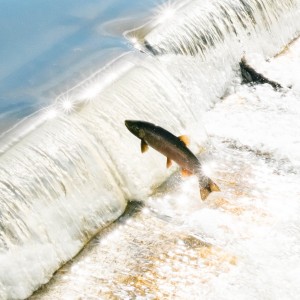
Another poet read about salmon returning to the Elwha River in Olympic National Park. After a hundred years of throwing themselves fruitlessly against the dam, their way to spawning grounds has cleared, and now a man camps near a quiet pool where salmon lay eggs, self-appointed guardian of their safety.
At twilight I returned from poetry of wars and water to the glaring reality of an empty parking lot, blinking in case my car’s disappearance was a mirage. I hitched a ride to the grungy lobby of Bethel Towing, trying not to act as guilty as I felt.
When I am deliberately disobedient, I am caught. Always.
It was trivial, this incident, compared to the plight of millions who pummel against the punishing world daily, wrongly penalized and suffering. But still, I felt like a salmon, hurtling toward a concrete barrier. If I couldn’t keep my car out of impound, how could I change anything, save anyone, including myself?
The poetry-fueled desire to be noble and heroic—standing up for injustice, tearing down dams, unleashing a river of beauty into the world—fizzled under fluorescent lights and grimy carpet. Who was I fooling? My disobedience has never been civil—protesting evil or oppression, risking arrest for the greater good—my disobedience has never served anyone but me.
Avoiding eye contact, I stared at Ron’s grease-streaked arms as he filled out forms and slid them to me for signature. He handed back the Impounded Vehicle Hearing Request saying, “You forgot to sign this.”
I had ten days to request a hearing to contest the validity of the impoundment, as if any judge would waive the penalty on a plea of narcissism.
Though I flaunt rules when it serves me, I do believe in judgment. Selfishness has a price, and often I’m waiting to find which floor my elevator-to-hell will open on, beating myself up in advance for good measure.
That I could—not that I would—appeal for mercy meant there was a remote chance punishment doesn’t always fit the crime; that we humans might act like God on occasion, opting for mercy and pardon when penalty is due.
But did that apply to me? My thoughts about my actions are murky and as difficult to follow as the Apostle Paul’s I-do-what-I-don’t-want-to-do-law-and-freedom discourse in Romans 7.
I paid my fine and Ron escorted me by flashlight to redeem my van, parked so close to the fence that I brushed against electrified wires (thankfully dead). I drove away gulping, fighting off the shame of my folly, and asking myself if, instead of adding car impounded to my long list of moral failures, I might consider that though I’m selfish, a sinner, I’m also simply human.
“The Japanese have a saying,” the poet Paul Nelson said that night, and I wrote down the English translation, not knowing how soon I’d need it:
What has been done cannot be helped.
Image above is by Taomeister, licensed by Creative Commons.
Cathy Warner is a writer, workshop leader, editor, and home renovator in West Puget Sound. She is author of the poetry volume Burnt Offerings and shares the job of Good Letters literary editor. Find her at cathywarner.com.

Previous Post

May 24, 2016
Purple Light in Sarajevo
Next Post
May 26, 2016 Odd Northern Indiana
Browse Our Archives
Select a Category A. G. Harmon Alissa Wilkinson Allison Backous Art Authors Brad Fruhauff Bradford Winters Bryan Bliss Caroline Langston Chad Thomas Johnston Chris Hoke Christiana N. Peterson Culture D.G. Myers D.L. Mayfield Daniel Bowman Jr. David Griffith Elizabeth Duffy Faith Film Greg Wolfe Guest Contributor Interview Jan Vallone Jeffrey Overstreet Jessica Eddings-Roeser Jessica Mesman Griffith Kelly Foster Lindsey Crittenden Morgan Meis music Natalie Vestin Nick Olson Peggy Rosenthal Personal Reflection Poetry Friday Reflection Relationships Review Richard Chess Richard Cole Sara Zarr Shannon Huffman Polson Sonya Bilocerkowycz Tania Runyan Tony Woodlief Topical Categories Uncategorized Vic Sizemore Writing
Select a Month October 2018 September 2018 August 2018 July 2018 June 2018 May 2018 April 2018 March 2018 February 2018 January 2018 December 2017 November 2017 October 2017 September 2017 August 2017 July 2017 June 2017 May 2017 April 2017 March 2017 February 2017 January 2017 December 2016 November 2016 October 2016 September 2016 August 2016 July 2016 June 2016 May 2016 April 2016 March 2016 February 2016 January 2016 December 2015 November 2015 October 2015 September 2015 August 2015 July 2015 June 2015 May 2015 April 2015 March 2015 February 2015 January 2015 December 2014 November 2014 October 2014 September 2014 August 2014 July 2014 June 2014 May 2014 April 2014 March 2014 February 2014 January 2014 December 2013 November 2013 October 2013 September 2013 August 2013 July 2013 June 2013 May 2013 April 2013 March 2013 February 2013 January 2013 December 2012 November 2012 October 2012 September 2012 August 2012 July 2012 June 2012 May 2012 February 2008
Follow Us!
TAKE THE
Religious Wisdom Quiz
According to Romans, what is the gift of God?
Select your answer to see how you score.
Eternal life in Christ Jesus Salvation The Holy Spirit Grace
Related posts from Good Letters


Morning in a Forgotten Neighborhood


TRENDING AT PATHEOS Catholic

Rejecting Doom: Christian Hope And Human Action
Christianity is a religion of hope. We are to have hope and...

It’s What Comes From Within Which Matters
One of the most difficult things for us to understand is why...

Why I Choose the Eucharist Over the Sermon
Choose the Eucharist, Not the Sermon What are we supposed to get...

5 Design Elements Found in Spiritually Rooted Homes
Putting Spirituality Into Home Decor Our homes are more than our living...

Credo: A Story of God Told with the...
About 10 years ago, I began to imagine a personal "Credo" that...

The Anatomy of Divine Revelation in Catholic Thought
The claim that God has made Himself known to human beings is...
view all Catholic blogs
Ad-Free & Subscriber Log-In Subscription Support
- About Us
- 2026 Calendar
- Videos
- Podcasts
- Library of World Religions
- Faith In Media Tracker
- Advertise With Us
- Write for Us
- Privacy Policy
- Terms of Service
- Do Not Sell My Data
- Contact Us
- Radiant Digital
- Manage Newsletter Subscriptions
- Unsubscribe From Notifications
- Sitemap
Copyright 2008-2026, Patheos. All rights reserved.
Subscription Support Ad-Free & Subscriber Log-In
Follow Patheos