
BuddhistCatholicContemplativeEvangelicalGeneral ChristianHinduJewishLatter-day SaintMuslimNew VisionsProgressive Christian
Beliefs
- Buddhist
- Catholic
- Contemplative
- Evangelical
- General Christian
- Hindu
- Jewish
- Latter-day Saint
- More Voices
- Muslim
- New Visions
- Pagan
- Progressive Christian
Topics
- Religion News
- Food and Religion
- Sports and Religion
- Religious Art
- Religious Music and Entertainment
- Religious Events
- History and Religion
- Style and Religion
- Politics and Religion
- Women in Religion
- Recreation Outdoors and Religion
- Business Finance and Religion
- Careers Workplace and Religion
- Education and Religion
- Family Parenting and Religion
- Health Fitness and Religion
- Home and Religion
- Relationships and Religion
- Technology and Religion
- Travel and Religion
Columnists
- Buddhist Columnists
- Business Finance and Religion Columnists
- Careers Workplace and Religion Columnists
- Catholic Columnists
- Contemplative Columnists
- Education and Religion Columnists
- Evangelists Columnists
- Family Parenting and Religion Columnists
- General Christian Columnists
- Health Fitness and Religion Columnists
- Hindu Columnists
- History and Religion Columnists
- Home and Religion Columnists
- Jewish Columnists
- More Voices Columnists
- Latter Day Columnists
- Muslim Columnists
- New Visions Columnists
- Nonreligious Columnists
- Pagan Columnists
- Politics and Religion Columnists
- Progressive Columnists
- Recreation Outdoors and Religion Columnists
- Relationships and Religion Columnists
- Religion News Columnists
- Religious Art Columnists
- Religious Events Columnists
- Religious Music and Entertainment Columnists
- Sports and Religion Columnists
- Style and Religion Columnists
- Technology and Religion Columnists
- Travel and Religion Columnists
- Women in Religion Columnists
Resource Library
- 2026 Calendar
- Library of World Religions
- The 100 Most Holy Places on Earth
- Patheos Answers
- Podcasts
- Videos
- Faith Leaders Database
- Anglican Episcopalian
- Bahai
- Baptist
- Buddhism
- Christianity
- Confucianism
- Eastern Orthodoxy
- Hinduism
- Holiness and Pentecostal
- ISKCON
- Islam
- Judaism
- Lutheran
- Methodist
- The Church of Jesus Christ of Latter-day Saints
- New Age
- Paganism
- Presbytarian and Reformed
- Protestantism
- Religion Behind the Scenes
- Roman Catholic
- Scientology
- Shia Islam
- Sikhism
- Sufism
- Sunni Islam
- Taoism
- Zen
- See all religions
Research Tools
 Ad-Free & Subscriber Log-In Subscription Support
Ad-Free & Subscriber Log-In Subscription Support
Follow Patheos 

- Trending:
- Forgiveness
- |
- Marriage
- |
- Consciousness
- |
- Death Penalty
- |
- Election
- |
- Halloween
 Good Letters
-
Contributors
- Home
- Catholic
- The Wounds of Resurrection
The Wounds of Resurrection
Last updated on: April 19, 2016 at 1:00 am by Christiana N. Peterson
The Wounds of Resurrection 2016-04-12T11:09:34-07:00 Christiana N. Peterson
Patheos Explore the world's faith through different perspectives on religion and spirituality! Patheos has the views of the prevalent religions and spiritualities of the world.
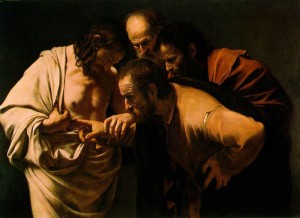 As my husband prepared for an Easter sermon a few weeks ago, our dinnertime conversations during Lent turned to Jesus’s appearance to the disciples after his resurrection, to the episode where poor Thomas is saddled with his unfortunate moniker. Carravaggio painted a terribly potent picture of Thomas probing Jesus’s wounds, his lord’s flesh curving over the doubter’s finger.
With its emphasis on suffering, broken bodies, deprivation, and wounds, Lent’s focus isn’t far from the realities since my father’s cancer diagnosis a year ago: surgery, chemotherapy, radiation, the failure of his natural killer cells.
When you have a loved one with cancer, you enter the cloud of unknowing, or perhaps it’s a club of unknowing, a society of those wedged in the grief and emotional confusion that a non-linear illness brings to all who are involved. In this club you might become more familiar with the less famed side effects of chemo like neuropathy and a sensitivity to hot or cold, with the comments people make in an effort at sympathy, or with the ebb and flow of sadness, guilt, and normal life.
Lent puts us in mind of those wounds and scars, of bodies failing, of death. But when Easter comes, and we celebrate resurrection, it sometimes feels like those wounds are mended too quickly. Or perhaps they were never really healed.
For my father, the idea of a resurrected body, as his falters, is good news. But I know it’s not the same for everyone. The proliferation of ideas about what happens after we die gives a different perspective of what some long for. If you Google “heaven,” the first hundred images are of a bright holy opening in a cumulonimbus cloud.
Searching for “life after death” bombards you with creepy pictures of ghostly figures disconnecting from their bodies. Maybe the soul floating up to heaven, at long last separate from the diseased material it clung to, comforts some people in a way that resurrection, or at least our vaguely Christian ideas of resurrection, does not.
Many Christians, if we think about resurrection much at all, tend to imagine our future resurrected bodies a bit Platonically: the best images of ourselves, at our most beautiful and healthy. But I wonder if that’s how it will be.
As I thought about scars and wounds during Lent, it struck me that Jesus’s resurrected body betrays the myth of our vague views of resurrection. Carravaggio was depicting a clearer version of a resurrected body: Jesus’s new body wasn’t whole and pristine, but riddled with scars and even open wounds.
St. Francis was the first known saint to receive the stigmata, a mystical bodily empathy with the wounds of the crucified and risen Christ. His friend Brother Leo, who recounted the story, was with him when they went to a mountaintop to pray and meditate, when the days of prayer lead to a vision of seraphs that left Francis with the gashes in his hands that would fester until his death.
When a fellow brother sought to pray for Francis, asking that his suffering be lessened, Francis quickly rebuked him and, though weak from his pains, got on his knees and prayed:
“Lord, I thank Thee for the sufferings Thou art sending me. Send me more, if it be Thy good pleasure. My pleasure is that You afflict me and spare me not, for the fulfillment of Thy holy will is the greatest consolation of my life.”
St. Francis was echoing Paul in Philippians 3, who, in his religious fervor, wanted to “know Christ and the power of his resurrection and [the] sharing of his sufferings by being conformed to his death.” Or as The Message puts it: “I gave up all that inferior stuff so I could know Christ personally, experience his resurrection power, be a partner in his suffering, and go all the way with him to death itself.”
The idea of being a partner with Jesus in suffering doesn’t make me as uncomfortable as it used to. It’s not that I have sought out suffering. On the contrary, I’ve tried to avoid it most of my life. But suffering comes to us whether we choose it or not. I would say it’s just part of being human, but that makes being human seem base, something to shrug off like the ghostly souls who leave their bodies behind.
If Jesus didn’t shrug off his suffering, maybe we don’t need to see our scars and wounds as things that need to be erased in the resurrection. N.T. Wright says that “the risen Jesus was more human, not less, than he was before.” For the abused and mistreated, the sick and dying, the anxious and depressed, our emotional and physical wounds, whatever form they take in resurrection, could be striking reminders that we are not less because of our hurts.
I wonder about my father in the resurrection. Will he have his surgery scars? Will St. Francis still have his stigmata wounds? Maybe this kind of resurrection is still not good news to everyone. Maybe it’s a horrifying thought, but I wonder if all of our wounds will be on full display and if we will examine one another like Thomas did, not in sick fascination, but as a way to see God’s glory in the prominence of our true humanity.
Caravaggio’s Doubting Thomas produced above is taken by Rodney, licensed by Creative Commons.
Christiana N. Peterson grew up in Texas and received a PhD in Creative Writing from St. Andrews University in Scotland. She has published pieces on death, fairytales and farm life at Art House America, her.meneutics, and cordella. She lives with her family in the rural Midwest where she is learning the joys and challenges of church and farm life. You can find more of Christiana’s writing on her blog at christiananpeterson.com and follow her on twitter.

Previous Post

April 18, 2016
Conference Envy: A Survival Guide
Next Post
April 20, 2016 Flying into Fear, Part 1
Browse Our Archives
Select a Category A. G. Harmon Alissa Wilkinson Allison Backous Art Authors Brad Fruhauff Bradford Winters Bryan Bliss Caroline Langston Chad Thomas Johnston Chris Hoke Christiana N. Peterson Culture D.G. Myers D.L. Mayfield Daniel Bowman Jr. David Griffith Elizabeth Duffy Faith Film Greg Wolfe Guest Contributor Interview Jan Vallone Jeffrey Overstreet Jessica Eddings-Roeser Jessica Mesman Griffith Kelly Foster Lindsey Crittenden Morgan Meis music Natalie Vestin Nick Olson Peggy Rosenthal Personal Reflection Poetry Friday Reflection Relationships Review Richard Chess Richard Cole Sara Zarr Shannon Huffman Polson Sonya Bilocerkowycz Tania Runyan Tony Woodlief Topical Categories Uncategorized Vic Sizemore Writing
Select a Month October 2018 September 2018 August 2018 July 2018 June 2018 May 2018 April 2018 March 2018 February 2018 January 2018 December 2017 November 2017 October 2017 September 2017 August 2017 July 2017 June 2017 May 2017 April 2017 March 2017 February 2017 January 2017 December 2016 November 2016 October 2016 September 2016 August 2016 July 2016 June 2016 May 2016 April 2016 March 2016 February 2016 January 2016 December 2015 November 2015 October 2015 September 2015 August 2015 July 2015 June 2015 May 2015 April 2015 March 2015 February 2015 January 2015 December 2014 November 2014 October 2014 September 2014 August 2014 July 2014 June 2014 May 2014 April 2014 March 2014 February 2014 January 2014 December 2013 November 2013 October 2013 September 2013 August 2013 July 2013 June 2013 May 2013 April 2013 March 2013 February 2013 January 2013 December 2012 November 2012 October 2012 September 2012 August 2012 July 2012 June 2012 May 2012 February 2008
Follow Us!
TAKE THE
Religious Wisdom Quiz
Who saw a vision of wheels within wheels by the Kebar River?
Select your answer to see how you score.
Ezekiel Jonah Micah Daniel
Related posts from Good Letters


Morning in a Forgotten Neighborhood


TRENDING AT PATHEOS Catholic

Rejecting Doom: Christian Hope And Human Action
Christianity is a religion of hope. We are to have hope and...

It’s What Comes From Within Which Matters
One of the most difficult things for us to understand is why...

Why I Choose the Eucharist Over the Sermon
Choose the Eucharist, Not the Sermon What are we supposed to get...

5 Design Elements Found in Spiritually Rooted Homes
Putting Spirituality Into Home Decor Our homes are more than our living...

Credo: A Story of God Told with the...
About 10 years ago, I began to imagine a personal "Credo" that...

The Anatomy of Divine Revelation in Catholic Thought
The claim that God has made Himself known to human beings is...
view all Catholic blogs
Ad-Free & Subscriber Log-In Subscription Support
- About Us
- 2026 Calendar
- Videos
- Podcasts
- Library of World Religions
- Faith In Media Tracker
- Advertise With Us
- Write for Us
- Privacy Policy
- Terms of Service
- Do Not Sell My Data
- Contact Us
- Radiant Digital
- Manage Newsletter Subscriptions
- Unsubscribe From Notifications
- Sitemap
Copyright 2008-2026, Patheos. All rights reserved.
Subscription Support Ad-Free & Subscriber Log-In
Follow Patheos