
BuddhistCatholicContemplativeEvangelicalGeneral ChristianHinduJewishLatter-day SaintMuslimNew VisionsProgressive Christian
Beliefs
- Buddhist
- Catholic
- Contemplative
- Evangelical
- General Christian
- Hindu
- Jewish
- Latter-day Saint
- More Voices
- Muslim
- New Visions
- Pagan
- Progressive Christian
Topics
- Religion News
- Food and Religion
- Sports and Religion
- Religious Art
- Religious Music and Entertainment
- Religious Events
- History and Religion
- Style and Religion
- Politics and Religion
- Women in Religion
- Recreation Outdoors and Religion
- Business Finance and Religion
- Careers Workplace and Religion
- Education and Religion
- Family Parenting and Religion
- Health Fitness and Religion
- Home and Religion
- Relationships and Religion
- Technology and Religion
- Travel and Religion
Columnists
- Buddhist Columnists
- Business Finance and Religion Columnists
- Careers Workplace and Religion Columnists
- Catholic Columnists
- Contemplative Columnists
- Education and Religion Columnists
- Evangelists Columnists
- Family Parenting and Religion Columnists
- General Christian Columnists
- Health Fitness and Religion Columnists
- Hindu Columnists
- History and Religion Columnists
- Home and Religion Columnists
- Jewish Columnists
- More Voices Columnists
- Latter Day Columnists
- Muslim Columnists
- New Visions Columnists
- Nonreligious Columnists
- Pagan Columnists
- Politics and Religion Columnists
- Progressive Columnists
- Recreation Outdoors and Religion Columnists
- Relationships and Religion Columnists
- Religion News Columnists
- Religious Art Columnists
- Religious Events Columnists
- Religious Music and Entertainment Columnists
- Sports and Religion Columnists
- Style and Religion Columnists
- Technology and Religion Columnists
- Travel and Religion Columnists
- Women in Religion Columnists
Resource Library
- 2026 Calendar
- Library of World Religions
- The 100 Most Holy Places on Earth
- Patheos Answers
- Podcasts
- Videos
- Faith Leaders Database
- Anglican Episcopalian
- Bahai
- Baptist
- Buddhism
- Christianity
- Confucianism
- Eastern Orthodoxy
- Hinduism
- Holiness and Pentecostal
- ISKCON
- Islam
- Judaism
- Lutheran
- Methodist
- The Church of Jesus Christ of Latter-day Saints
- New Age
- Paganism
- Presbytarian and Reformed
- Protestantism
- Religion Behind the Scenes
- Roman Catholic
- Scientology
- Shia Islam
- Sikhism
- Sufism
- Sunni Islam
- Taoism
- Zen
- See all religions
Research Tools
 Ad-Free & Subscriber Log-In Subscription Support
Ad-Free & Subscriber Log-In Subscription Support
Follow Patheos 

- Trending:
- Forgiveness
- |
- Marriage
- |
- Consciousness
- |
- Death Penalty
- |
- Election
- |
- Halloween
 Good Letters
-
Contributors
- Home
- Catholic
- Charles of the Desert
Charles of the Desert
Last updated on: April 12, 2016 at 1:00 am by Guest Contributor
Charles of the Desert 2016-04-06T16:19:39-07:00 Guest Contributor
Patheos Explore the world's faith through different perspectives on religion and spirituality! Patheos has the views of the prevalent religions and spiritualities of the world.
By Rebecca A. Spears
 One early June, traveling to a wedding in San Diego, I’d taken the long way from Dallas by train. I wanted to see the Southwestern deserts. Two days later Amtrak’s Sunset Limited broke down in the Mojave Desert.
Pretty quickly it became clear: We are not so great. Nature is. God is.
Perhaps this is one reason why Charles de Foucauld went to live in the Sahara: not only to offer the people there hospitality and love as Jesus had, but also as a way to empty himself of the temptations of civilized life, allowing himself to be humbled by the vast universe.
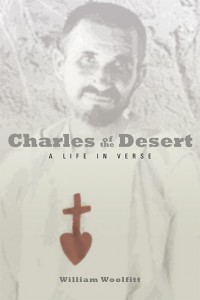
The Christian hermit and martyr Charles of the Desert (1858-1916) is a complex, puzzling character. William Kelley Woolfitt’s new book of poems Charles of the Desert develops a full portrait of this mystifying cleric from childhood in 1863 to his last day in Algeria’s Hoggar Mountains. The poems, written in first person, proceed on a timeline, zigzagging geographically from France to the Holy Land to Algeria.
For over a decade, Père Charles lived a stringent life in the Sahara, a life that would kill most of us. He lived and worked among the Tuaregs, who saw him at best as an eccentric, at worst as an enemy. In 1916, he was assassinated by rebels attempting to rob and kidnap him. He left to the world a four-volume dictionary of the Tuareg language, a new order—the Little Brothers and Little Sisters of Jesus—and a public fascination for his austere life among the Muslims, whom he hadn’t been able to convert.
How hard his life must have been. Yet by some firsthand accounts, he was “luminous,” “peaceful,” and “pure.”
Charles’s young life, marked by the early loss of his parents, makes me wonder if his initial impulses toward the holy life were to satisfy not only a need to glorify God and do God’s work, but also to seek parents in the Mother Superior and the Abbot.
In Woolfitt’s poems I find a child who couldn’t know or understand his father. That man is described as “whip-like” and “half-lizard,” someone whose “whims enslave him.” He appears more like a “Weather Formation” in the young boy’s mind.
Charles’s mother seems to have languished and died, after a miscarriage and postpartum depression. Charles sees her as “Harp Seal, as Sacristan.” With his mother, Charles has an early memory of compassion for Jesus, “the man who hung on the church wall,” “the pale, poor eggshell man.” The child wishes to bring a blanket for him, but forgets to carry out this kindness.
Woolfitt’s formal poems are intriguing for the ways they develop Charles and those around him. Besides the innocent child, we also see the mischievous Charles asking a fictionalized sister Beatrix to “steal for me,” not just any small thing but “the gilded china baby” at grandfather’s house. For this, the boy is sent into the yard, shivering as he waits for his grandfather’s “lashes to mark me, while [grandfather] quakes // like a man waiting for grief to pass.” The older man’s grief at having lost his daughter, Charles’s mother, doesn’t extend to compassion for Charles and his sister.
Woolfitt adeptly draws the children’s hard life with their grandfather, so that when Charles declares, “We are not safe, sister,” in “The House of Bones,” I believe him. Charles grows to despise the old man.
The poems show us Charles’s lifelong allies, his sister and an older cousin, Marthe (also fictionalized)—beautiful and devoted to her faith. In her presence, Charles’s faith “rose like a tongue of flame,” but he “had nothing to feed it.” “Summer in Giverny,” a prose poem, defines an important moment in the boy’s development. This is the second time we see Charles’s wonder of God and adoration of Christ.
Yet his conversion is drawn out. After grueling trials at a Jesuit boarding school, Charles is sent on to military training and soldiering. On his own time, Charles becomes a “Gold Eater” who takes and takes—keeping a prostitute, eating and drinking to excess, and gambling.
Three years later, after he’s published a travelogue and “rooster-struts” the streets of Paris, Charles feels trapped by the excesses of his life. So that in “The Pangs of Wanting,” he longs to have faith. This poem marks the beginning of Charles’s conversion. At communion, Charles declares, “I almost vomit; I almost sing.”
Woolfitt’s poems are marked by a physicality of diction, the blunt words juddering next to the softer expressions. The poems also connect strong metaphors to intense moments in Charles’s life. He makes a trek to Jerusalem “At the Ruins of Pilate’s Palace,” and seeing where Pilate “gave Christ to the throngs,” Charles presses his hand down “and, groove[s] / my skin with the grains of the paving stones.”
Back in France, living as a monk, he studies the breviary and learns to love the natural world; yet he cannot love himself, acutely declaring “I am foul matter.”
The poems also unveil the many iterations of Charles, as he searches for an authentic identity: Charles the profligate, the soldier, the injured child, the peasant. We also encounter Charles the escapee, the refugee, and the wanderer, before he finally becomes the devoted priest.
In a startling late moment, Charles cleanses himself with sand (“Desert Bath at Sunset”) and resolves not to despise what God has given him: “Your bruise-red sun / embers the tamarind tree.” He considers Teresa of Avila’s metaphors for the soul and finds them wanting. In his desert ministry, he finds the earth is “a malicious father.”
Late in life, Charles becomes despondent: “The ground is iron that I cannot sow,” while the Tuareg’s language continues to evade him. He can still admire God’s world, however, in “Pied Crow,” the crow’s “glossy black wings” and “snowy vestments,” even in “the goodness of this hand / rubbing my weary neck.” He declares, “All things made for our use, our conversion, / our wonderment.”
Woolfitt’s collection evokes our holy connection to the astonishing and sometimes terrifying forces around us and beyond us.
Rebecca A. Spears, a poet and essayist, is the author of The Bright Obvious. Her poems and essays are included in If These Walls Could Speak: The Blanton Museum Poetry Project (University of Texas, Austin), TriQuarterly, Crazyhorse, Calyx, Verse Daily, Ars Medica, Birmingham Poetry Review, Nimrod, Relief, and other journals and anthologies. In Houston, she is a board member of Mutabilis Press and English Department Chair at an Orthodox Jewish high school, an experience that has made her look more deeply at her own faith.

Previous Post

April 11, 2016
A Strange Season for Inter-Christian Families
Next Post
April 13, 2016 Finding Another World in Winterkill
Browse Our Archives
Select a Category A. G. Harmon Alissa Wilkinson Allison Backous Art Authors Brad Fruhauff Bradford Winters Bryan Bliss Caroline Langston Chad Thomas Johnston Chris Hoke Christiana N. Peterson Culture D.G. Myers D.L. Mayfield Daniel Bowman Jr. David Griffith Elizabeth Duffy Faith Film Greg Wolfe Guest Contributor Interview Jan Vallone Jeffrey Overstreet Jessica Eddings-Roeser Jessica Mesman Griffith Kelly Foster Lindsey Crittenden Morgan Meis music Natalie Vestin Nick Olson Peggy Rosenthal Personal Reflection Poetry Friday Reflection Relationships Review Richard Chess Richard Cole Sara Zarr Shannon Huffman Polson Sonya Bilocerkowycz Tania Runyan Tony Woodlief Topical Categories Uncategorized Vic Sizemore Writing
Select a Month October 2018 September 2018 August 2018 July 2018 June 2018 May 2018 April 2018 March 2018 February 2018 January 2018 December 2017 November 2017 October 2017 September 2017 August 2017 July 2017 June 2017 May 2017 April 2017 March 2017 February 2017 January 2017 December 2016 November 2016 October 2016 September 2016 August 2016 July 2016 June 2016 May 2016 April 2016 March 2016 February 2016 January 2016 December 2015 November 2015 October 2015 September 2015 August 2015 July 2015 June 2015 May 2015 April 2015 March 2015 February 2015 January 2015 December 2014 November 2014 October 2014 September 2014 August 2014 July 2014 June 2014 May 2014 April 2014 March 2014 February 2014 January 2014 December 2013 November 2013 October 2013 September 2013 August 2013 July 2013 June 2013 May 2013 April 2013 March 2013 February 2013 January 2013 December 2012 November 2012 October 2012 September 2012 August 2012 July 2012 June 2012 May 2012 February 2008
Follow Us!
TAKE THE
Religious Wisdom Quiz
Which Christian denomination is most common in Russia?
Select your answer to see how you score.
Methodist Eastern Orthodox Catholic Baptist
Related posts from Good Letters


Morning in a Forgotten Neighborhood


On Writing Odes: Taking Time to Celebrate
TRENDING AT PATHEOS Catholic

Rejecting Doom: Christian Hope And Human Action
Christianity is a religion of hope. We are to have hope and...

It’s What Comes From Within Which Matters
One of the most difficult things for us to understand is why...

Why I Choose the Eucharist Over the Sermon
Choose the Eucharist, Not the Sermon What are we supposed to get...

5 Design Elements Found in Spiritually Rooted Homes
Putting Spirituality Into Home Decor Our homes are more than our living...

Credo: A Story of God Told with the...
About 10 years ago, I began to imagine a personal "Credo" that...

The Anatomy of Divine Revelation in Catholic Thought
The claim that God has made Himself known to human beings is...
view all Catholic blogs
Ad-Free & Subscriber Log-In Subscription Support
- About Us
- 2026 Calendar
- Videos
- Podcasts
- Library of World Religions
- Faith In Media Tracker
- Advertise With Us
- Write for Us
- Privacy Policy
- Terms of Service
- Do Not Sell My Data
- Contact Us
- Radiant Digital
- Manage Newsletter Subscriptions
- Unsubscribe From Notifications
- Sitemap
Copyright 2008-2026, Patheos. All rights reserved.
Subscription Support Ad-Free & Subscriber Log-In
Follow Patheos