
BuddhistCatholicContemplativeEvangelicalGeneral ChristianHinduJewishLatter-day SaintMuslimNew VisionsProgressive Christian
Beliefs
- Buddhist
- Catholic
- Contemplative
- Evangelical
- General Christian
- Hindu
- Jewish
- Latter-day Saint
- More Voices
- Muslim
- New Visions
- Pagan
- Progressive Christian
Topics
- Religion News
- Food and Religion
- Sports and Religion
- Religious Art
- Religious Music and Entertainment
- Religious Events
- History and Religion
- Style and Religion
- Politics and Religion
- Women in Religion
- Recreation Outdoors and Religion
- Business Finance and Religion
- Careers Workplace and Religion
- Education and Religion
- Family Parenting and Religion
- Health Fitness and Religion
- Home and Religion
- Relationships and Religion
- Technology and Religion
- Travel and Religion
Columnists
- Buddhist Columnists
- Business Finance and Religion Columnists
- Careers Workplace and Religion Columnists
- Catholic Columnists
- Contemplative Columnists
- Education and Religion Columnists
- Evangelists Columnists
- Family Parenting and Religion Columnists
- General Christian Columnists
- Health Fitness and Religion Columnists
- Hindu Columnists
- History and Religion Columnists
- Home and Religion Columnists
- Jewish Columnists
- More Voices Columnists
- Latter Day Columnists
- Muslim Columnists
- New Visions Columnists
- Nonreligious Columnists
- Pagan Columnists
- Politics and Religion Columnists
- Progressive Columnists
- Recreation Outdoors and Religion Columnists
- Relationships and Religion Columnists
- Religion News Columnists
- Religious Art Columnists
- Religious Events Columnists
- Religious Music and Entertainment Columnists
- Sports and Religion Columnists
- Style and Religion Columnists
- Technology and Religion Columnists
- Travel and Religion Columnists
- Women in Religion Columnists
Resource Library
- 2026 Calendar
- Library of World Religions
- The 100 Most Holy Places on Earth
- Patheos Answers
- Podcasts
- Videos
- Faith Leaders Database
- Anglican Episcopalian
- Bahai
- Baptist
- Buddhism
- Christianity
- Confucianism
- Eastern Orthodoxy
- Hinduism
- Holiness and Pentecostal
- ISKCON
- Islam
- Judaism
- Lutheran
- Methodist
- The Church of Jesus Christ of Latter-day Saints
- New Age
- Paganism
- Presbytarian and Reformed
- Protestantism
- Religion Behind the Scenes
- Roman Catholic
- Scientology
- Shia Islam
- Sikhism
- Sufism
- Sunni Islam
- Taoism
- Zen
- See all religions
Research Tools
 Ad-Free & Subscriber Log-In Subscription Support
Ad-Free & Subscriber Log-In Subscription Support
Follow Patheos 

- Trending:
- Forgiveness
- |
- Marriage
- |
- Consciousness
- |
- Death Penalty
- |
- Election
- |
- Halloween
 Good Letters
-
Contributors
- Home
- Catholic
- Annie Spans the Gap, Part 1
Annie Spans the Gap, Part 1
Last updated on: April 26, 2016 at 5:38 pm by Gregory Wolfe
Annie Spans the Gap, Part 1 2016-04-26T17:38:38-07:00 Gregory Wolfe
Patheos Explore the world's faith through different perspectives on religion and spirituality! Patheos has the views of the prevalent religions and spiritualities of the world.
The following appears as the editorial statement in Image issue 88.
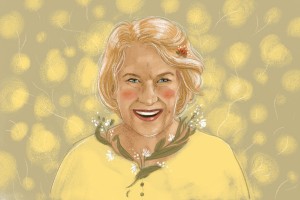
Illustration by Alissa Berkhan
There is no such thing as an artist: there is only the world, lit or unlit as the light allows. When the candle is burning, who looks at the wick? When the candle is out, who needs it? But the world without light is wasteland and chaos, and a life without sacrifice is abomination. What can any artist set on fire but his world?… What can he light but the short string of his gut, and when that’s burnt out, any muck ready to hand? His face is flame like a seraph’s, lighting the kingdom of God for the people to see; his life goes up in the works; his feet are waxen and salt. He is holy and he is firm, spanning all the long gap with the length of his love, in flawed imitation of Christ on the cross stretched both ways unbroken and thorned. So must the work be also, in touch with, in touch with, in touch with; spanning the gap from here to eternity, home.
—Annie Dillard
Few books to come across my desk lately have stirred so many emotions as The Abundance: Narrative Essays Old and New by Annie Dillard. In the Atlantic, the critic William Deresiewicz says that the book “might just as easily be called The Absence,” because the author has published nothing new for years. It’s a clever lead-in, but devoid of substance. Our online culture, with its constant demand for hitting the feeds at peak times every day, may dictate constant publication unto death as a requirement for any self-respecting author, but thank God Annie Dillard grew up before the advent of the internet. I prefer to look on her body of work and celebrate the abundance.
There is no doubt, however, that The Abundance has the feel of a valedictory, which is certainly one reason it kicks up emotions. Her impact on me would be hard to overstate. For me, reading Annie Dillard has often conjured up the sort of epiphany that she famously described in Pilgrim at Tinker Creek when she encounters “the tree with the lights in it.” “It was less like seeing than like being for the first time seen, knocked breathless by a powerful glance. The lights of the fire abated, but I’m still spending the power.”
Much has been said about Dillard’s writing: her fabulous verbs, the muscular Anglo-Saxon diction, which does wonders with a concrete, monosyllabic word, the lyricism of her prose. Much less has been noted or understood about the density and depth of her thought.
For example, while it has been observed that Pilgrim at Tinker Creek is modeled on Walden, few have understood it as a rebuttal to the transcendentalism of Thoreau and Emerson from a traditional theological, incarnational perspective. Flannery O’Connor once said: “When Emerson decided in 1832 that he could no longer celebrate the Lord’s Supper unless the bread and wine were removed…an important step in the vaporization of religion in America [took] place.” Pilgrim, along with For the Time Being and others of Dillard’s books, constitutes a profound reversal of that step.
In Holy the Firm she writes about carrying a bottle of wine to a small communion service: “Here is a bottle of wine with a label; Christ with a cork. I bear holiness splintered into a vessel, very God of very God, the sempiternal silence personal and brooding, bright on the back of my ribs.”
It may be that the richness of Dillard’s thought has been overlooked because she wears her learning so lightly, or perhaps because it is out of touch with the tenor of the times. We live, after all, in the culture that Thoreau and Emerson shaped, with its belief in the solitary individual who constructs the world in the sovereignty of her own mind. But the pilgrim at Tinker Creek is always struck, to use Marilynne Robinson’s phrase, by “the givenness of things.” The pilgrim makes her way to holy ground, to a cosmos that exists before and beyond us, and which we as creatures may share, transcending the limitations of individual consciousness and thus inhabiting a common world.
Since there is no way in the short space here to do justice to the abundance that is Annie Dillard’s achievement, I will content myself with recounting the one great literary anecdote that I have been vouchsafed. Some are graced with many hilarious or dramatic encounters with authors, but I am content that I have this one.
To be continued tomorrow.
Gregory Wolfe is the founder of Image and serves as Writer in Residence and Director of the MFA in Creative Writing program at Seattle Pacific University. His books includeThe Operation of Grace: Further Essays on Art, Faith, and Mystery, Beauty Will Save the World and Intruding Upon the Timeless. Follow him on Twitter: @Gregory_Wolfe.

Previous Post

April 25, 2016
The Cave of My Imagination
Next Post
April 27, 2016 Annie Spans the Gap, Part 2
Browse Our Archives
Select a Category A. G. Harmon Alissa Wilkinson Allison Backous Art Authors Brad Fruhauff Bradford Winters Bryan Bliss Caroline Langston Chad Thomas Johnston Chris Hoke Christiana N. Peterson Culture D.G. Myers D.L. Mayfield Daniel Bowman Jr. David Griffith Elizabeth Duffy Faith Film Greg Wolfe Guest Contributor Interview Jan Vallone Jeffrey Overstreet Jessica Eddings-Roeser Jessica Mesman Griffith Kelly Foster Lindsey Crittenden Morgan Meis music Natalie Vestin Nick Olson Peggy Rosenthal Personal Reflection Poetry Friday Reflection Relationships Review Richard Chess Richard Cole Sara Zarr Shannon Huffman Polson Sonya Bilocerkowycz Tania Runyan Tony Woodlief Topical Categories Uncategorized Vic Sizemore Writing
Select a Month October 2018 September 2018 August 2018 July 2018 June 2018 May 2018 April 2018 March 2018 February 2018 January 2018 December 2017 November 2017 October 2017 September 2017 August 2017 July 2017 June 2017 May 2017 April 2017 March 2017 February 2017 January 2017 December 2016 November 2016 October 2016 September 2016 August 2016 July 2016 June 2016 May 2016 April 2016 March 2016 February 2016 January 2016 December 2015 November 2015 October 2015 September 2015 August 2015 July 2015 June 2015 May 2015 April 2015 March 2015 February 2015 January 2015 December 2014 November 2014 October 2014 September 2014 August 2014 July 2014 June 2014 May 2014 April 2014 March 2014 February 2014 January 2014 December 2013 November 2013 October 2013 September 2013 August 2013 July 2013 June 2013 May 2013 April 2013 March 2013 February 2013 January 2013 December 2012 November 2012 October 2012 September 2012 August 2012 July 2012 June 2012 May 2012 February 2008
Follow Us!
TAKE THE
Religious Wisdom Quiz
We made a deceptive treaty with Israel by pretending to come from a distant land with moldy bread and worn-out wineskins. Who are we?
Select your answer to see how you score.
The Amorites The Canaanites The Gibeonites The Hivites
Related posts from Good Letters


Morning in a Forgotten Neighborhood


TRENDING AT PATHEOS Catholic

Rejecting Doom: Christian Hope And Human Action
Christianity is a religion of hope. We are to have hope and...

It’s What Comes From Within Which Matters
One of the most difficult things for us to understand is why...

Why I Choose the Eucharist Over the Sermon
Choose the Eucharist, Not the Sermon What are we supposed to get...

5 Design Elements Found in Spiritually Rooted Homes
Putting Spirituality Into Home Decor Our homes are more than our living...

Credo: A Story of God Told with the...
About 10 years ago, I began to imagine a personal "Credo" that...

The Anatomy of Divine Revelation in Catholic Thought
The claim that God has made Himself known to human beings is...
view all Catholic blogs
Ad-Free & Subscriber Log-In Subscription Support
- About Us
- 2026 Calendar
- Videos
- Podcasts
- Library of World Religions
- Faith In Media Tracker
- Advertise With Us
- Write for Us
- Privacy Policy
- Terms of Service
- Do Not Sell My Data
- Contact Us
- Radiant Digital
- Manage Newsletter Subscriptions
- Unsubscribe From Notifications
- Sitemap
Copyright 2008-2026, Patheos. All rights reserved.
Subscription Support Ad-Free & Subscriber Log-In
Follow Patheos