
BuddhistCatholicContemplativeEvangelicalGeneral ChristianHinduJewishLatter-day SaintMuslimNew VisionsProgressive Christian
Beliefs
- Buddhist
- Catholic
- Contemplative
- Evangelical
- General Christian
- Hindu
- Jewish
- Latter-day Saint
- More Voices
- Muslim
- New Visions
- Pagan
- Progressive Christian
Topics
- Religion News
- Food and Religion
- Sports and Religion
- Religious Art
- Religious Music and Entertainment
- Religious Events
- History and Religion
- Style and Religion
- Politics and Religion
- Women in Religion
- Recreation Outdoors and Religion
- Business Finance and Religion
- Careers Workplace and Religion
- Education and Religion
- Family Parenting and Religion
- Health Fitness and Religion
- Home and Religion
- Relationships and Religion
- Technology and Religion
- Travel and Religion
Columnists
- Buddhist Columnists
- Business Finance and Religion Columnists
- Careers Workplace and Religion Columnists
- Catholic Columnists
- Contemplative Columnists
- Education and Religion Columnists
- Evangelists Columnists
- Family Parenting and Religion Columnists
- General Christian Columnists
- Health Fitness and Religion Columnists
- Hindu Columnists
- History and Religion Columnists
- Home and Religion Columnists
- Jewish Columnists
- More Voices Columnists
- Latter Day Columnists
- Muslim Columnists
- New Visions Columnists
- Nonreligious Columnists
- Pagan Columnists
- Politics and Religion Columnists
- Progressive Columnists
- Recreation Outdoors and Religion Columnists
- Relationships and Religion Columnists
- Religion News Columnists
- Religious Art Columnists
- Religious Events Columnists
- Religious Music and Entertainment Columnists
- Sports and Religion Columnists
- Style and Religion Columnists
- Technology and Religion Columnists
- Travel and Religion Columnists
- Women in Religion Columnists
Resource Library
- 2026 Calendar
- Library of World Religions
- The 100 Most Holy Places on Earth
- Patheos Answers
- Podcasts
- Videos
- Faith Leaders Database
- Anglican Episcopalian
- Bahai
- Baptist
- Buddhism
- Christianity
- Confucianism
- Eastern Orthodoxy
- Hinduism
- Holiness and Pentecostal
- ISKCON
- Islam
- Judaism
- Lutheran
- Methodist
- The Church of Jesus Christ of Latter-day Saints
- New Age
- Paganism
- Presbytarian and Reformed
- Protestantism
- Religion Behind the Scenes
- Roman Catholic
- Scientology
- Shia Islam
- Sikhism
- Sufism
- Sunni Islam
- Taoism
- Zen
- See all religions
Research Tools
 Ad-Free & Subscriber Log-In Subscription Support
Ad-Free & Subscriber Log-In Subscription Support
Follow Patheos 

- Trending:
- Forgiveness
- |
- Marriage
- |
- Consciousness
- |
- Death Penalty
- |
- Election
- |
- Halloween
 Good Letters
-
Contributors
- Home
- Catholic
- The Living Among the Dead
The Living Among the Dead
Last updated on: March 14, 2016 at 1:00 am by Natalie Vestin
The Living Among the Dead 2016-03-08T12:05:38-07:00 Natalie Vestin
Patheos Explore the world's faith through different perspectives on religion and spirituality! Patheos has the views of the prevalent religions and spiritualities of the world.
 Thanksgiving Day after I turned four: high fever at dinner, a drive through a blizzard, then a spinal tap. Meningitis. The nurse promised me angels, and they floated from the bright examination light to the floor, and this is all I remember: paper angels filling the emergency room, snow falling outside, my mother crying.
For two weeks while my brain boiled, I was in the hospital bed and outside in the falling snow, both at once. My parents made me testify about the angels (but not about the snow) to our church, and later, I teased my father about this, about people who wanted a miracle so badly that they confused miracle with inflamed brain. He shrugged and said maybe they’re not so different.
I have been putting things side-by-side, trying to make sense of images that occur and reoccur and tie themselves to other things, snow and angel, miracle and spinal cord smolder. The signs of crisis averted, barely. Bear with me. I’ve been walking in circles, encountering the same signposts, over and over since my grandma died this summer. I’m looking for what I’ve lost, the signs for loss that only seem to point back toward themselves, building a constellation of images around the shape of something I can barely see.
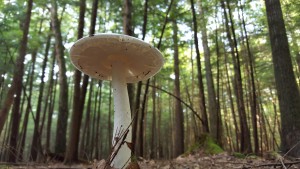
This summer, on the day my grandma stopped eating—after she asked my aunt to take her to emergency room so they could end her life, after my aunt explained that you can’t go in and ask doctors to kill you—my father taught me which of the Northwoods mushrooms I should never eat. False morel and Amanita bisporigera, the latter so deadly and beautiful it’s known as “destroying angel.” Unlike other Amanita species, it doesn’t have psychotropic effects when eaten or smoked, and it doesn’t send one into a killing trance the way that Amanita muscaria, the fly agaric, was reported to do for the Viking berserkers.
My dad didn’t know about my grandma starving herself; no one did at that point. We were talking of windstorm and downed trees and the consequent growth of the delicious orange fungus known as chicken of the woods. The overlap of events—destroying angel and the impotence of waiting for a loved one to die—was coincidence. But I’ve come to believe in the power of two things sitting side by side, coincidence as a thread that runs through every object and experience. Where you trip on it is up to you.
In the ten days it took my grandma to starve to death, I dreamed of mushrooms, and of snow, a dream that’s recurred since being in that hospital bed under a rain of paper angels. Wildfires in Canada sent down smoke that blotted out the sun and made runny yolk sunsets. I walked miles in the smoke even though everyone was supposed to stay inside. The air was white, opaque, a fine ash curtain. The air was a ghost of something burning away, haunting in pieces, until a storm scrubbed the air and moved it east.
I was worried I’d be frightened of the small box holding my grandma’s ashes at her burial. White ash, because our bones came from ocean and not the potassium-laden earth, because calcium and signs buried in code and a good shove of testosterone still say: Make this one a sea creature.
The ash felt perfect, as if it was not her and her, flung, and as though she could be in two or a million places at once. It felt luminous, like so much suffering banished or changed, as if we were all engaged in something lovely yet silly. Why were we seeking the living among the dead? And where should we seek instead?
Albert Einstein once wrote that physics, particularly the study of the atom and subatomic particles, was moving toward abstraction. The more abstract it became, he said, the less of a relationship the world around us would have to our senses, the more we would have to depend on signs, on coincidence and incomprehension and fog.
He was talking of particles that only exist when they interact with other particles, of things that lack stillness to the point where you can never say they’re truly anywhere. He was talking of seeking things that can only be found indirectly, through observation of effect on matter and collections of phenomena.
The church’s liturgical year from Advent to Ascension marks a journey of incarnation, movement from invisibility to visibility. Light and image and sign. The Eastern Orthodox icons know this in their radiance, the flame behind their oxide skin, lack of shading save for the bone-socket shadows under the eyes, for bone trumps flame.
I love Maundy Thursday when the lights go out, when the air takes on illusion of stillness and expectation. Then Easter—white, hopeful, and though I’m Christian with all it entails, still incomprehensible. And Pentecost, day close to my heart and burned brain—red banner and poured flame, ghost descending. Pentecost, potential for God or ghost one day hearing my prayer: Lord, make me coherent.
But I’m not. My faith is coincidence I try to tie together, objects sitting side by side, signs in smoke, more than a touch of paganism (it’s that bone-socket shadow, those sea creatures and forest angels), some affectionate blasphemy that usually goes unremarked upon because it lacks the threat of intelligibility.
The summer and fall were wet once the Canadian wildfires were extinguished. Mushrooms grew everywhere, huge patches of them, Chlorophyllum and destroying angel and, after a drenched couple of days, one unidentifiable one I mistook for a dog standing at the corner. Beautiful and sinister, easy to trample or ignore if you’ve nothing lost to seek. Their relentless resurrection after each storm seemed a sign against loss that was somehow at once empty and searching and perfect.
Natalie Vestin is a health scientist and writer from Saint Paul. Her essays have appeared in The Normal School, Iowa Review, Prairie Schooner, and elsewhere. Her chapbook Shine a Light, the Light Won’t Pass is forthcoming from Miel Books.

Previous Post

March 11, 2016
Poetry Friday: "Meditation on the Evangelista" by Karen An-Hwei Lee
Next Post
March 15, 2016 Diego Rivera’s Detroit Industry
Browse Our Archives
Select a Category A. G. Harmon Alissa Wilkinson Allison Backous Art Authors Brad Fruhauff Bradford Winters Bryan Bliss Caroline Langston Chad Thomas Johnston Chris Hoke Christiana N. Peterson Culture D.G. Myers D.L. Mayfield Daniel Bowman Jr. David Griffith Elizabeth Duffy Faith Film Greg Wolfe Guest Contributor Interview Jan Vallone Jeffrey Overstreet Jessica Eddings-Roeser Jessica Mesman Griffith Kelly Foster Lindsey Crittenden Morgan Meis music Natalie Vestin Nick Olson Peggy Rosenthal Personal Reflection Poetry Friday Reflection Relationships Review Richard Chess Richard Cole Sara Zarr Shannon Huffman Polson Sonya Bilocerkowycz Tania Runyan Tony Woodlief Topical Categories Uncategorized Vic Sizemore Writing
Select a Month October 2018 September 2018 August 2018 July 2018 June 2018 May 2018 April 2018 March 2018 February 2018 January 2018 December 2017 November 2017 October 2017 September 2017 August 2017 July 2017 June 2017 May 2017 April 2017 March 2017 February 2017 January 2017 December 2016 November 2016 October 2016 September 2016 August 2016 July 2016 June 2016 May 2016 April 2016 March 2016 February 2016 January 2016 December 2015 November 2015 October 2015 September 2015 August 2015 July 2015 June 2015 May 2015 April 2015 March 2015 February 2015 January 2015 December 2014 November 2014 October 2014 September 2014 August 2014 July 2014 June 2014 May 2014 April 2014 March 2014 February 2014 January 2014 December 2013 November 2013 October 2013 September 2013 August 2013 July 2013 June 2013 May 2013 April 2013 March 2013 February 2013 January 2013 December 2012 November 2012 October 2012 September 2012 August 2012 July 2012 June 2012 May 2012 February 2008
Follow Us!
TAKE THE
Religious Wisdom Quiz
Who was it that allowed the Israelites to return to Jerusalem from exile?
Select your answer to see how you score.
Artaxerxes Nebuchadnezzar Darius Cyrus the Great
Related posts from Good Letters


Morning in a Forgotten Neighborhood


TRENDING AT PATHEOS Catholic

Rejecting Doom: Christian Hope And Human Action
Christianity is a religion of hope. We are to have hope and...

It’s What Comes From Within Which Matters
One of the most difficult things for us to understand is why...

Why I Choose the Eucharist Over the Sermon
Choose the Eucharist, Not the Sermon What are we supposed to get...

5 Design Elements Found in Spiritually Rooted Homes
Putting Spirituality Into Home Decor Our homes are more than our living...

Credo: A Story of God Told with the...
About 10 years ago, I began to imagine a personal "Credo" that...

The Anatomy of Divine Revelation in Catholic Thought
The claim that God has made Himself known to human beings is...
view all Catholic blogs
Ad-Free & Subscriber Log-In Subscription Support
- About Us
- 2026 Calendar
- Videos
- Podcasts
- Library of World Religions
- Faith In Media Tracker
- Advertise With Us
- Write for Us
- Privacy Policy
- Terms of Service
- Do Not Sell My Data
- Contact Us
- Radiant Digital
- Manage Newsletter Subscriptions
- Unsubscribe From Notifications
- Sitemap
Copyright 2008-2026, Patheos. All rights reserved.
Subscription Support Ad-Free & Subscriber Log-In
Follow Patheos