
BuddhistCatholicContemplativeEvangelicalGeneral ChristianHinduJewishLatter-day SaintMuslimNew VisionsProgressive Christian
Beliefs
- Buddhist
- Catholic
- Contemplative
- Evangelical
- General Christian
- Hindu
- Jewish
- Latter-day Saint
- More Voices
- Muslim
- New Visions
- Pagan
- Progressive Christian
Topics
- Religion News
- Food and Religion
- Sports and Religion
- Religious Art
- Religious Music and Entertainment
- Religious Events
- History and Religion
- Style and Religion
- Politics and Religion
- Women in Religion
- Recreation Outdoors and Religion
- Business Finance and Religion
- Careers Workplace and Religion
- Education and Religion
- Family Parenting and Religion
- Health Fitness and Religion
- Home and Religion
- Relationships and Religion
- Technology and Religion
- Travel and Religion
Columnists
- Buddhist Columnists
- Business Finance and Religion Columnists
- Careers Workplace and Religion Columnists
- Catholic Columnists
- Contemplative Columnists
- Education and Religion Columnists
- Evangelists Columnists
- Family Parenting and Religion Columnists
- General Christian Columnists
- Health Fitness and Religion Columnists
- Hindu Columnists
- History and Religion Columnists
- Home and Religion Columnists
- Jewish Columnists
- More Voices Columnists
- Latter Day Columnists
- Muslim Columnists
- New Visions Columnists
- Nonreligious Columnists
- Pagan Columnists
- Politics and Religion Columnists
- Progressive Columnists
- Recreation Outdoors and Religion Columnists
- Relationships and Religion Columnists
- Religion News Columnists
- Religious Art Columnists
- Religious Events Columnists
- Religious Music and Entertainment Columnists
- Sports and Religion Columnists
- Style and Religion Columnists
- Technology and Religion Columnists
- Travel and Religion Columnists
- Women in Religion Columnists
Resource Library
- 2026 Calendar
- Library of World Religions
- The 100 Most Holy Places on Earth
- Patheos Answers
- Podcasts
- Videos
- Faith Leaders Database
- Anglican Episcopalian
- Bahai
- Baptist
- Buddhism
- Christianity
- Confucianism
- Eastern Orthodoxy
- Hinduism
- Holiness and Pentecostal
- ISKCON
- Islam
- Judaism
- Lutheran
- Methodist
- The Church of Jesus Christ of Latter-day Saints
- New Age
- Paganism
- Presbytarian and Reformed
- Protestantism
- Religion Behind the Scenes
- Roman Catholic
- Scientology
- Shia Islam
- Sikhism
- Sufism
- Sunni Islam
- Taoism
- Zen
- See all religions
Research Tools
 Ad-Free & Subscriber Log-In Subscription Support
Ad-Free & Subscriber Log-In Subscription Support
Follow Patheos 

- Trending:
- Forgiveness
- |
- Marriage
- |
- Consciousness
- |
- Death Penalty
- |
- Election
- |
- Halloween
 Good Letters
-
Contributors
- Home
- Catholic
- The Abandoned, Broken, and Burned
The Abandoned, Broken, and Burned
Last updated on: March 7, 2016 at 1:00 am by Caroline Langston
The Abandoned, Broken, and Burned 2016-03-02T15:33:05-07:00 Caroline Langston
Patheos Explore the world's faith through different perspectives on religion and spirituality! Patheos has the views of the prevalent religions and spiritualities of the world.
 By the time you read this, inshallah, we will have the new dishwasher purchased and installed in our kitchen.
I’m not holding my breath. It’s been this long, so it is easy to envision a horizon of expectations that continues to recede into the distance a few more weeks or months.
“Oh, come on,” my brother said to me a while back, “what is a dishwasher? $500? $1000? Just buy the thing.” It’s not that we didn’t have $500 lying around to spend—it’s just that there are so many other expenses— private school tuition, church donations, the remainder of our 2014 taxes—to cover, and it is always well to have a little cushion lying around in case of emergencies. (Our cushion is pretty little.)
We are well-paid, middle-class professionals (upper middle class if you look at the average household income for most Americans, though we actually feel pretty working class in our expensive coastal metropolitan area where two twenty-seven-year-old lawyers can easily clear $450,000 a year—First World, problems etc., etc).
So $500-1,000, in our house, is kind of a big deal.
I can’t bring myself to say that the dishwasher is actually broken. It is not broken! I promise you! Even though the last time I used it, back in December, it gave off a sad groan and a metallic scent of an Industrial Revolution era machine dying on a factory floor. But it didn’t actually stop.
If I admitted that the dishwasher was broken, and had, in fact, been broken for a couple of months now, I would have to end up ruminating on the Platonic dishwasher of my memory, the turquoise and brown-fake-wood-paneled-metal Kenmore model that was in my mother’s Mississippi kitchen.
That dishwasher, instead of an upper rack, had a funky round carousel for my mother’s Noritake Up-Sa-Daisy cups and saucers, that you could spin around and around with your finger. This is something I could do endlessly as a child, which goes to show you that random time-wasting is not the sole province of the digital generation.
At some point in my growing up, the dishwasher broke down. It never worked again, and it was never replaced. After awhile, even discussion about a new dishwasher seemed to cease as a possibility, as my mother hand-washed the dishes herself –Lemon Joy scent in the air—and let them air dry in the rack.
Eventually, somebody bound the front of the dishwasher with a swath of gray gaffe tape, because the door kept falling open. To peer inside its airless, long-dried up interior, which I did on occasion, was like peering into a little tomb: I laugh about it now, and think about that line from Allen Tate’s “Ode to the Confederate Dead”: “Shall we, more hopeful / Set up the grave in the house?”
Because one thing that was a constant of growing up in Mississippi was the presence of the abandoned, broken, and burned. The highways to Greenwood and Jackson were noted for the landmarks, here and there, of brick chimneys, the lone sentinel survivors of farmhouses that had burned down—from kerosene lanterns, or space heaters, or (I wouldn’t know this until I was older), firebombs.
Another conceit from the era: If the big Zenith cabinet TV set breaks, then get a portable Sony Trinitron and stick it up on top. (My brother would suggest that folks get a third, miniature set to complete the look.)
There, the broken stuff always remains. I live now in a place where the broken stuff gets immediately swept away and turned into loft-style condominiums with stainless steel appliances and granite countertops.
I laugh at myself, but there are benefits in patience and tolerance that accrue to the ability to abide the broken. For years, the Magnavox stereo in the living room dragged a bit when playing LP albums, but over time I learned you could spin it with your finger a bit, and it would ramp up to a perfect 331/3 RPM.
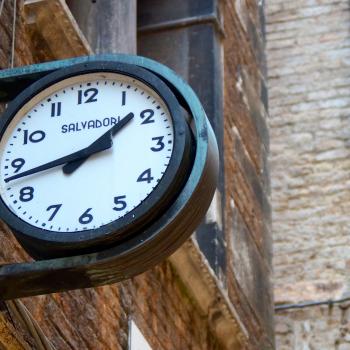
Even now, the timer on my dryer in the basement is broken, and for some reason it has not occurred to me to try to get it fixed—assuming that dryers can even be fixed, these days—instead, I am constantly checking clocks, clocks whose time might not even be correct, reckoning my own internal accounting, because didn’t Dilsey know to read the clocks that for all the rest of the Compsons were broken in Faulkner’s The Sound and the Fury?
I am a Fool for Christ regarding household fittings, I guess. Even in my middle-class neighborhood, the sale of a home to new owners seems to mark the requisite arrival of a contractor’s dumpster in the driveway, the violent ripping out of cabinets and the repainting of breakfast rooms so that the chosen wall accessories “pop”—and sometimes even the brand-new appliances that the former owners bought to sell the damned house in the first place.
This ripping and vacuuming and clearing makes me think of nothing less than abortion, for God’s sake—so completely must the traces be removed, the existing fixtures not be borne. (It’s an analogy, though a pointed and intentional one. Chill out.)
When the new dishwasher finally arrives, with its “free haul-away guarantee,” I will pat and bless the old one before they cart it out, the way that monks on Mt. Athos kiss the spoons with which they stir their soup. I will dispatch it and thank it for its grace, on its journey to refurbishment and resale, in the vast secondhand appliance markets that are on the side streets and back streets of my very own city. For, as much as my own city doesn’t admit it, we have our own abandoned, broken and burned right here.
A native of Yazoo City, Mississippi, Caroline Langston is a convert to the Eastern Orthodox Church. She is a widely published writer and essayist, a winner of the Pushcart Prize, and a commentator for NPR’s All Things Considered.

Previous Post

March 4, 2016
Learning Poetry, Unlearning God
Next Post
March 8, 2016 Thawing at the Edges
Browse Our Archives
Select a Category A. G. Harmon Alissa Wilkinson Allison Backous Art Authors Brad Fruhauff Bradford Winters Bryan Bliss Caroline Langston Chad Thomas Johnston Chris Hoke Christiana N. Peterson Culture D.G. Myers D.L. Mayfield Daniel Bowman Jr. David Griffith Elizabeth Duffy Faith Film Greg Wolfe Guest Contributor Interview Jan Vallone Jeffrey Overstreet Jessica Eddings-Roeser Jessica Mesman Griffith Kelly Foster Lindsey Crittenden Morgan Meis music Natalie Vestin Nick Olson Peggy Rosenthal Personal Reflection Poetry Friday Reflection Relationships Review Richard Chess Richard Cole Sara Zarr Shannon Huffman Polson Sonya Bilocerkowycz Tania Runyan Tony Woodlief Topical Categories Uncategorized Vic Sizemore Writing
Select a Month October 2018 September 2018 August 2018 July 2018 June 2018 May 2018 April 2018 March 2018 February 2018 January 2018 December 2017 November 2017 October 2017 September 2017 August 2017 July 2017 June 2017 May 2017 April 2017 March 2017 February 2017 January 2017 December 2016 November 2016 October 2016 September 2016 August 2016 July 2016 June 2016 May 2016 April 2016 March 2016 February 2016 January 2016 December 2015 November 2015 October 2015 September 2015 August 2015 July 2015 June 2015 May 2015 April 2015 March 2015 February 2015 January 2015 December 2014 November 2014 October 2014 September 2014 August 2014 July 2014 June 2014 May 2014 April 2014 March 2014 February 2014 January 2014 December 2013 November 2013 October 2013 September 2013 August 2013 July 2013 June 2013 May 2013 April 2013 March 2013 February 2013 January 2013 December 2012 November 2012 October 2012 September 2012 August 2012 July 2012 June 2012 May 2012 February 2008
Follow Us!
TAKE THE
Religious Wisdom Quiz
A righteous man loses everything—ten children, vast wealth, and his health—yet refuses to curse God. Who endured this test?
Select your answer to see how you score.
Joseph Job Solomon Jonah
Related posts from Good Letters



TRENDING AT PATHEOS Catholic

Rejecting Doom: Christian Hope And Human Action
Christianity is a religion of hope. We are to have hope and...

It’s What Comes From Within Which Matters
One of the most difficult things for us to understand is why...

Why I Choose the Eucharist Over the Sermon
Choose the Eucharist, Not the Sermon What are we supposed to get...

5 Design Elements Found in Spiritually Rooted Homes
Putting Spirituality Into Home Decor Our homes are more than our living...

Credo: A Story of God Told with the...
About 10 years ago, I began to imagine a personal "Credo" that...

The Anatomy of Divine Revelation in Catholic Thought
The claim that God has made Himself known to human beings is...
view all Catholic blogs
Ad-Free & Subscriber Log-In Subscription Support
- About Us
- 2026 Calendar
- Videos
- Podcasts
- Library of World Religions
- Faith In Media Tracker
- Advertise With Us
- Write for Us
- Privacy Policy
- Terms of Service
- Do Not Sell My Data
- Contact Us
- Radiant Digital
- Manage Newsletter Subscriptions
- Unsubscribe From Notifications
- Sitemap
Copyright 2008-2026, Patheos. All rights reserved.
Subscription Support Ad-Free & Subscriber Log-In
Follow Patheos