
BuddhistCatholicContemplativeEvangelicalGeneral ChristianHinduJewishLatter-day SaintMuslimNew VisionsProgressive Christian
Beliefs
- Buddhist
- Catholic
- Contemplative
- Evangelical
- General Christian
- Hindu
- Jewish
- Latter-day Saint
- More Voices
- Muslim
- New Visions
- Pagan
- Progressive Christian
Topics
- Religion News
- Food and Religion
- Sports and Religion
- Religious Art
- Religious Music and Entertainment
- Religious Events
- History and Religion
- Style and Religion
- Politics and Religion
- Women in Religion
- Recreation Outdoors and Religion
- Business Finance and Religion
- Careers Workplace and Religion
- Education and Religion
- Family Parenting and Religion
- Health Fitness and Religion
- Home and Religion
- Relationships and Religion
- Technology and Religion
- Travel and Religion
Columnists
- Buddhist Columnists
- Business Finance and Religion Columnists
- Careers Workplace and Religion Columnists
- Catholic Columnists
- Contemplative Columnists
- Education and Religion Columnists
- Evangelists Columnists
- Family Parenting and Religion Columnists
- General Christian Columnists
- Health Fitness and Religion Columnists
- Hindu Columnists
- History and Religion Columnists
- Home and Religion Columnists
- Jewish Columnists
- More Voices Columnists
- Latter Day Columnists
- Muslim Columnists
- New Visions Columnists
- Nonreligious Columnists
- Pagan Columnists
- Politics and Religion Columnists
- Progressive Columnists
- Recreation Outdoors and Religion Columnists
- Relationships and Religion Columnists
- Religion News Columnists
- Religious Art Columnists
- Religious Events Columnists
- Religious Music and Entertainment Columnists
- Sports and Religion Columnists
- Style and Religion Columnists
- Technology and Religion Columnists
- Travel and Religion Columnists
- Women in Religion Columnists
Resource Library
- 2026 Calendar
- Library of World Religions
- The 100 Most Holy Places on Earth
- Patheos Answers
- Podcasts
- Videos
- Faith Leaders Database
- Anglican Episcopalian
- Bahai
- Baptist
- Buddhism
- Christianity
- Confucianism
- Eastern Orthodoxy
- Hinduism
- Holiness and Pentecostal
- ISKCON
- Islam
- Judaism
- Lutheran
- Methodist
- The Church of Jesus Christ of Latter-day Saints
- New Age
- Paganism
- Presbytarian and Reformed
- Protestantism
- Religion Behind the Scenes
- Roman Catholic
- Scientology
- Shia Islam
- Sikhism
- Sufism
- Sunni Islam
- Taoism
- Zen
- See all religions
Research Tools
 Ad-Free & Subscriber Log-In Subscription Support
Ad-Free & Subscriber Log-In Subscription Support
Follow Patheos 

- Trending:
- Forgiveness
- |
- Marriage
- |
- Consciousness
- |
- Death Penalty
- |
- Election
- |
- Halloween
 Good Letters
-
Contributors
- Home
- Catholic
- Thawing at the Edges
Thawing at the Edges
Last updated on: March 8, 2016 at 1:00 am by Christiana N. Peterson
Thawing at the Edges 2016-03-02T15:54:14-07:00 Christiana N. Peterson
Patheos Explore the world's faith through different perspectives on religion and spirituality! Patheos has the views of the prevalent religions and spiritualities of the world.
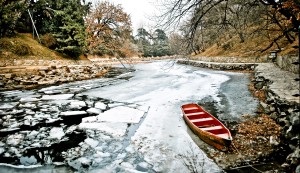 When the spring teases me one day, outplaying the winter dullness for just an afternoon, I go for a solitary walk. In my seven years in the Midwest, I’ve come to dread this part of the year. It’s not the liturgical season of Lent or the lament that comes along with it that I dread (lament is something I seem to be doing anyway these days). What I dread is the last months of winter when the novelty of snow and cold has worn off and we are left with the prediction of a rodent’s shadow.
My Texas constitution was built for sticky leather seats in summer, not the muted grays of a winter when everything left outside cracks, breaks, and busts. Ash Wednesday is a straightforward service to perform because ashes are everywhere; so much is burning, trying to keep all of us warm.
As I step out onto the bridge over our creek during my walk, the ice below begins to break apart. Some say it sounds like a gunshot when ice cracks. Perhaps it’s because a shallow creek is coming undone, and not a large lake, that I think not of guns but of a tree falling.
It’s funny that the rending of one thing should be reminiscent of the other.
I stop at the bridge’s edge and lean over, straining to see where the ice is breaking away. There’s a large hole, like a wound, in the middle of the creek. Water flows freely through it. I am transfixed by tracks on the ice around the hole. They look like chicken scratchings, as if some fowl creature has been tapping at the ice. The etchings are beautiful the way brutal natural things can be.
“I need you to think about what you will do if your grandmother doesn’t make it.” My mom tells me over the phone from Texas the day before.
My grandmother has been declining for years; dementia, falls, weakening back. She’s in her nineties, so we don’t expect her to live much longer. There is grief for the loss but the idea of her passing unearths this deeper grief about the possibility of losing my father, who is ill with cancer.
When I speak to my mother, the grief warms me, like it has been thawing and waiting for such a moment.
When my father first gave us the diagnosis, it seemed clinical in the telling, much like Joan Didion’s A Year of Magical Thinking, itself a chill, beautiful, and clinical articulation of grief. When I first read Didion’s book, I didn’t like her lack of feeling, her coldness. But now I think I understand better.
We gathered around the room the night that my dad told us he had cancer. My little sister Elena, the most outwardly tender of us all, sat at his feet, asking gently probing questions. For a moment, I was reminded of the scene from The Sound of Music when the oldest von Trapp daughter, Liesl, sits at the Captain’s feet, looking at him adoringly and singing harmony to “Edelweiss” with him. Elena looked at our father so warmly, her emotion raw and open, but there were no sweet songs sung that night.
Afterwards, as I went back to my room, I felt clinical too, cold to the shock.
Winter and coldness have become cliché metaphors for death. There is indeed some measure of coldness in grief. But grief has its own images apart from winter. Maybe the best metaphor for grief isn’t the dead of winter but in the months afterwards, when the thaw starts and everything underneath begins to wake up, alive to the sensations, feeling the bitter flowing underneath the hole in the middle.
The wind is hard against my face as I stare at the ice; the walk has been my only chance for sun all day, and I am a little dizzy. Maybe it’s because I’m unsteady from the wind, the sun, and the exercise, but the hole in the ice seems to swirl. I keep watching the middle, expecting to see the water trickle through, to see it crack out from the edges of the center.
I wonder if the land at the margins of the frozen water, or perhaps the creek itself is weary in the way of Psalm 63 (on the lectionary this Sunday in Lent): “O God, you are my God, I seek you, my soul thirsts for you; my flesh faints for you, as in a dry and weary land where there is no water.”
Does it take effort for the frozen creek to hold itself together? Is it painful when the warmth begins to spread, like fingers and toes tingling back to life?
Eventually, I see where the sound originates: at the sides of the creek, near the bank, shards of ice breaking away. The frozen creek and the water underneath are shifting at the edges. During winter, the water stays warmer underneath, but as spring comes, the warmth must flow upwards, melting the surface so that the entire creek runs like the water that flows through the middle. When the creek thaws, the chicken scratchings will crack, the hole will widen, the edges will break apart until the whole creek is alive, warmed by the painful awakening.
Christiana N. Peterson grew up in Texas and received a PhD in Creative Writing from St. Andrews University in Scotland. She has published pieces on death, fairytales and farm life at Art House America, her.meneutics, and cordella. She lives with her family in the rural Midwest where she is learning the joys and challenges of church and farm life. You can find more of Christiana’s writing on her blog at christiananpeterson.com and follow her on twitter.

Previous Post

March 7, 2016
The Abandoned, Broken, and Burned
Next Post
March 9, 2016 Finding My Inner Calamity Jane
Browse Our Archives
Select a Category A. G. Harmon Alissa Wilkinson Allison Backous Art Authors Brad Fruhauff Bradford Winters Bryan Bliss Caroline Langston Chad Thomas Johnston Chris Hoke Christiana N. Peterson Culture D.G. Myers D.L. Mayfield Daniel Bowman Jr. David Griffith Elizabeth Duffy Faith Film Greg Wolfe Guest Contributor Interview Jan Vallone Jeffrey Overstreet Jessica Eddings-Roeser Jessica Mesman Griffith Kelly Foster Lindsey Crittenden Morgan Meis music Natalie Vestin Nick Olson Peggy Rosenthal Personal Reflection Poetry Friday Reflection Relationships Review Richard Chess Richard Cole Sara Zarr Shannon Huffman Polson Sonya Bilocerkowycz Tania Runyan Tony Woodlief Topical Categories Uncategorized Vic Sizemore Writing
Select a Month October 2018 September 2018 August 2018 July 2018 June 2018 May 2018 April 2018 March 2018 February 2018 January 2018 December 2017 November 2017 October 2017 September 2017 August 2017 July 2017 June 2017 May 2017 April 2017 March 2017 February 2017 January 2017 December 2016 November 2016 October 2016 September 2016 August 2016 July 2016 June 2016 May 2016 April 2016 March 2016 February 2016 January 2016 December 2015 November 2015 October 2015 September 2015 August 2015 July 2015 June 2015 May 2015 April 2015 March 2015 February 2015 January 2015 December 2014 November 2014 October 2014 September 2014 August 2014 July 2014 June 2014 May 2014 April 2014 March 2014 February 2014 January 2014 December 2013 November 2013 October 2013 September 2013 August 2013 July 2013 June 2013 May 2013 April 2013 March 2013 February 2013 January 2013 December 2012 November 2012 October 2012 September 2012 August 2012 July 2012 June 2012 May 2012 February 2008
Follow Us!
TAKE THE
Religious Wisdom Quiz
What physical affliction did Job suffer?
Select your answer to see how you score.
Painful boils Leprosy Blindness Broken bones
Related posts from Good Letters


The Stars of the Earth Cry Out


TRENDING AT PATHEOS Catholic

Rejecting Doom: Christian Hope And Human Action
Christianity is a religion of hope. We are to have hope and...

It’s What Comes From Within Which Matters
One of the most difficult things for us to understand is why...

Why I Choose the Eucharist Over the Sermon
Choose the Eucharist, Not the Sermon What are we supposed to get...

5 Design Elements Found in Spiritually Rooted Homes
Putting Spirituality Into Home Decor Our homes are more than our living...

Credo: A Story of God Told with the...
About 10 years ago, I began to imagine a personal "Credo" that...

The Anatomy of Divine Revelation in Catholic Thought
The claim that God has made Himself known to human beings is...
view all Catholic blogs
Ad-Free & Subscriber Log-In Subscription Support
- About Us
- 2026 Calendar
- Videos
- Podcasts
- Library of World Religions
- Faith In Media Tracker
- Advertise With Us
- Write for Us
- Privacy Policy
- Terms of Service
- Do Not Sell My Data
- Contact Us
- Radiant Digital
- Manage Newsletter Subscriptions
- Unsubscribe From Notifications
- Sitemap
Copyright 2008-2026, Patheos. All rights reserved.
Subscription Support Ad-Free & Subscriber Log-In
Follow Patheos