
BuddhistCatholicContemplativeEvangelicalGeneral ChristianHinduJewishLatter-day SaintMuslimNew VisionsProgressive Christian
Beliefs
- Buddhist
- Catholic
- Contemplative
- Evangelical
- General Christian
- Hindu
- Jewish
- Latter-day Saint
- More Voices
- Muslim
- New Visions
- Pagan
- Progressive Christian
Topics
- Religion News
- Food and Religion
- Sports and Religion
- Religious Art
- Religious Music and Entertainment
- Religious Events
- History and Religion
- Style and Religion
- Politics and Religion
- Women in Religion
- Recreation Outdoors and Religion
- Business Finance and Religion
- Careers Workplace and Religion
- Education and Religion
- Family Parenting and Religion
- Health Fitness and Religion
- Home and Religion
- Relationships and Religion
- Technology and Religion
- Travel and Religion
Columnists
- Buddhist Columnists
- Business Finance and Religion Columnists
- Careers Workplace and Religion Columnists
- Catholic Columnists
- Contemplative Columnists
- Education and Religion Columnists
- Evangelists Columnists
- Family Parenting and Religion Columnists
- General Christian Columnists
- Health Fitness and Religion Columnists
- Hindu Columnists
- History and Religion Columnists
- Home and Religion Columnists
- Jewish Columnists
- More Voices Columnists
- Latter Day Columnists
- Muslim Columnists
- New Visions Columnists
- Nonreligious Columnists
- Pagan Columnists
- Politics and Religion Columnists
- Progressive Columnists
- Recreation Outdoors and Religion Columnists
- Relationships and Religion Columnists
- Religion News Columnists
- Religious Art Columnists
- Religious Events Columnists
- Religious Music and Entertainment Columnists
- Sports and Religion Columnists
- Style and Religion Columnists
- Technology and Religion Columnists
- Travel and Religion Columnists
- Women in Religion Columnists
Resource Library
- 2026 Calendar
- Library of World Religions
- The 100 Most Holy Places on Earth
- Patheos Answers
- Podcasts
- Videos
- Faith Leaders Database
- Anglican Episcopalian
- Bahai
- Baptist
- Buddhism
- Christianity
- Confucianism
- Eastern Orthodoxy
- Hinduism
- Holiness and Pentecostal
- ISKCON
- Islam
- Judaism
- Lutheran
- Methodist
- The Church of Jesus Christ of Latter-day Saints
- New Age
- Paganism
- Presbytarian and Reformed
- Protestantism
- Religion Behind the Scenes
- Roman Catholic
- Scientology
- Shia Islam
- Sikhism
- Sufism
- Sunni Islam
- Taoism
- Zen
- See all religions
Research Tools
 Ad-Free & Subscriber Log-In Subscription Support
Ad-Free & Subscriber Log-In Subscription Support
Follow Patheos 

- Trending:
- Forgiveness
- |
- Marriage
- |
- Consciousness
- |
- Death Penalty
- |
- Election
- |
- Halloween
 Good Letters
-
Contributors
- Home
- Catholic
- Refugees Are People, Not a Crisis
Refugees Are People, Not a Crisis
Last updated on: March 22, 2016 at 10:46 am by Peggy Rosenthal
Refugees Are People, Not a Crisis 2016-03-21T10:50:24-07:00 Peggy Rosenthal
Patheos Explore the world's faith through different perspectives on religion and spirituality! Patheos has the views of the prevalent religions and spiritualities of the world.
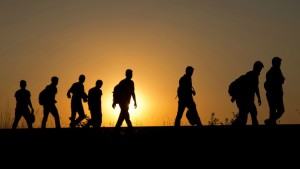 Sometimes the horrors in the news are so overwhelming that I’m left speechless. This is how I feel now—have been feeling for months—about what is being called Europe’s “refugee crisis.”
Refugee crisis. Encapsulating massive human suffering in those two simple words strikes me as demeaning: a slap in the face of every refugee from the endless wars in Syria, Afghanistan, Libya….
I imagine a woman who was evicted from the French refugee camp at Calais, sleepless with worry over the sick toddler she holds in her arms. I imagine her staring at me in numb despair when I read her a news story about “the refugee crisis.” I hear her scream back, “I’m not your crisis; I’m a person, a person who is pouring all my energy and money into trying to save my family from the brutalities of war and the indignities of being classified as a low-class refugee.”
I have no answer for her. I share her pain—to the extent that it’s possible for a comfortable U.S. citizen to share the pain of a despairing country-less person. But I don’t have the words to express my sharing.
When this happens—when I’m speechless at the world’s relentless cruelties—I turn to poetry.
In this particular case, I turn to Naomi Shihab Nye’s poem “Business,” with its epigraph (apparently the caption for a photo in a news story):
“Syrian refugees go about their business in a refugee camp in Mafraq, Jordan…”
The poem then purports simply to describe the refugees’ daily business:
Ropes on poles, jeans & shirts flapping in wind.
He sits on a giant bag of rice, head in hands.
Too much or too little, rips & bursts & furrows.
Something seared in a pan.
If you knew a mother, any mother, you would care
for mothers, yes? No.
What it is to be lonesome for stacked papers
on a desk, under glass globe,
brass vase with standing pencils,
new orders.
How quickly urgencies of doing disappear.
And where is the child from the next apartment,
whose crying kept him awake
these last terrible months?
Where do you file this unknowing?
This is the entire poem. “Business.” The poem’s opening line simply images the daily business of laundry. Line 2 is simply descriptive as well, though its final three words—“head in hands”—describe a gesture of pain, so they bring us inside the man’s being.
And then all at once, in line 3, we’re deep inside the experience of being a refugee:
“Too much or too little, rips & bursts & furrows.” We’re experiencing something like an earthquake of sensibility. No stable objects. Instead, the torn-apart sense of things not right, not in proportion. If I let myself get too far into the words of this line, I begin to feel nausea.
Then, just as suddenly, an external reality is sensed: “Something seared in a pan.”
Suddenly, again, the point of view shifts—to us, the readers of this poem, of this news story. First the assumption that knowledge of the refugees’ situation will move us: “If you knew a mother, any mother, you would care / for mothers, yes?” Then in a single harsh negative, we turn our backs: “No.”
Then the poem returns us to the refugee’s viewpoint, incisively contrasted with the stuff of our own daily business. Refugees are “lonesome” for the ordinary things that we take for granted: stacked papers, a desk, brass vase, pencils. These are the stuff of our “urgencies of doing.” Can I imagine my daily life without my desk, my pencils, my papers, my computer? Of course not. Yet for the refugee, “How quickly urgencies of doing disappear.”
And right in this stanza, something—someone—even more urgent has disappeared:
How quickly urgencies of doing disappear.
And where is the child from the next apartment,
whose crying kept him awake
these last terrible months?
It’s the refugee’s sudden realization that, in the midst of all these losses (of things, of comfort, of dignity), there is the terrible loss of a child’s crying. This crying that had been simply annoying, keeping the refugee awake, becomes precious through loss.
To the refugee’s mind, the lost child stands in for all the human relationships lost in the dreadful flight from home, and the continual tearing apart of new relationships formed through the terrifying journey that has not ended, that seems to have no end.
Then comes the poem’s devastating final line:
Where do you file this unknowing?
Silently, the “you” merges us readers (us outsiders) with the refugee’s inner self. Silently, “file” conflates the stuff of our own ordinary life (those papers to file) with the refugee’s lonesomeness for it. Silently, “this” unknowing swells to include the infinite unknowings of a refugee’s life: the all-encompassing unknowing, uncertainty, helplessness. No wonder the unnamed “he” of the opening stanza sits “head in hands.”
The end of a poem usually returns me to its title. “Business.” Isn’t this—everything that the poem so painfully depicts—our business? All of us?
Peggy Rosenthal is director of Poetry Retreats and writes widely on poetry as a spiritual resource. Her books include Praying through Poetry: Hope for Violent Times (Franciscan Media), and The Poets’ Jesus (Oxford). See Amazon for a full list. She also teaches an online course, “Poetry as a Spiritual Practice,” through Image’s Glen Online program.

Previous Post

March 21, 2016
A Space Program
Next Post
March 23, 2016 Better Call Saul
Browse Our Archives
Select a Category A. G. Harmon Alissa Wilkinson Allison Backous Art Authors Brad Fruhauff Bradford Winters Bryan Bliss Caroline Langston Chad Thomas Johnston Chris Hoke Christiana N. Peterson Culture D.G. Myers D.L. Mayfield Daniel Bowman Jr. David Griffith Elizabeth Duffy Faith Film Greg Wolfe Guest Contributor Interview Jan Vallone Jeffrey Overstreet Jessica Eddings-Roeser Jessica Mesman Griffith Kelly Foster Lindsey Crittenden Morgan Meis music Natalie Vestin Nick Olson Peggy Rosenthal Personal Reflection Poetry Friday Reflection Relationships Review Richard Chess Richard Cole Sara Zarr Shannon Huffman Polson Sonya Bilocerkowycz Tania Runyan Tony Woodlief Topical Categories Uncategorized Vic Sizemore Writing
Select a Month October 2018 September 2018 August 2018 July 2018 June 2018 May 2018 April 2018 March 2018 February 2018 January 2018 December 2017 November 2017 October 2017 September 2017 August 2017 July 2017 June 2017 May 2017 April 2017 March 2017 February 2017 January 2017 December 2016 November 2016 October 2016 September 2016 August 2016 July 2016 June 2016 May 2016 April 2016 March 2016 February 2016 January 2016 December 2015 November 2015 October 2015 September 2015 August 2015 July 2015 June 2015 May 2015 April 2015 March 2015 February 2015 January 2015 December 2014 November 2014 October 2014 September 2014 August 2014 July 2014 June 2014 May 2014 April 2014 March 2014 February 2014 January 2014 December 2013 November 2013 October 2013 September 2013 August 2013 July 2013 June 2013 May 2013 April 2013 March 2013 February 2013 January 2013 December 2012 November 2012 October 2012 September 2012 August 2012 July 2012 June 2012 May 2012 February 2008
Follow Us!
TAKE THE
Religious Wisdom Quiz
What did King Nebuchadnezzar order everyone to worship?
Select your answer to see how you score.
His crown A golden statue The sun A lion
Related posts from Good Letters


Morning in a Forgotten Neighborhood


TRENDING AT PATHEOS Catholic

Rejecting Doom: Christian Hope And Human Action
Christianity is a religion of hope. We are to have hope and...

It’s What Comes From Within Which Matters
One of the most difficult things for us to understand is why...

Why I Choose the Eucharist Over the Sermon
Choose the Eucharist, Not the Sermon What are we supposed to get...

5 Design Elements Found in Spiritually Rooted Homes
Putting Spirituality Into Home Decor Our homes are more than our living...

Credo: A Story of God Told with the...
About 10 years ago, I began to imagine a personal "Credo" that...

The Anatomy of Divine Revelation in Catholic Thought
The claim that God has made Himself known to human beings is...
view all Catholic blogs
Ad-Free & Subscriber Log-In Subscription Support
- About Us
- 2026 Calendar
- Videos
- Podcasts
- Library of World Religions
- Faith In Media Tracker
- Advertise With Us
- Write for Us
- Privacy Policy
- Terms of Service
- Do Not Sell My Data
- Contact Us
- Radiant Digital
- Manage Newsletter Subscriptions
- Unsubscribe From Notifications
- Sitemap
Copyright 2008-2026, Patheos. All rights reserved.
Subscription Support Ad-Free & Subscriber Log-In
Follow Patheos