
BuddhistCatholicContemplativeEvangelicalGeneral ChristianHinduJewishLatter-day SaintMuslimNew VisionsProgressive Christian
Beliefs
- Buddhist
- Catholic
- Contemplative
- Evangelical
- General Christian
- Hindu
- Jewish
- Latter-day Saint
- More Voices
- Muslim
- New Visions
- Pagan
- Progressive Christian
Topics
- Religion News
- Food and Religion
- Sports and Religion
- Religious Art
- Religious Music and Entertainment
- Religious Events
- History and Religion
- Style and Religion
- Politics and Religion
- Women in Religion
- Recreation Outdoors and Religion
- Business Finance and Religion
- Careers Workplace and Religion
- Education and Religion
- Family Parenting and Religion
- Health Fitness and Religion
- Home and Religion
- Relationships and Religion
- Technology and Religion
- Travel and Religion
Columnists
- Buddhist Columnists
- Business Finance and Religion Columnists
- Careers Workplace and Religion Columnists
- Catholic Columnists
- Contemplative Columnists
- Education and Religion Columnists
- Evangelists Columnists
- Family Parenting and Religion Columnists
- General Christian Columnists
- Health Fitness and Religion Columnists
- Hindu Columnists
- History and Religion Columnists
- Home and Religion Columnists
- Jewish Columnists
- More Voices Columnists
- Latter Day Columnists
- Muslim Columnists
- New Visions Columnists
- Nonreligious Columnists
- Pagan Columnists
- Politics and Religion Columnists
- Progressive Columnists
- Recreation Outdoors and Religion Columnists
- Relationships and Religion Columnists
- Religion News Columnists
- Religious Art Columnists
- Religious Events Columnists
- Religious Music and Entertainment Columnists
- Sports and Religion Columnists
- Style and Religion Columnists
- Technology and Religion Columnists
- Travel and Religion Columnists
- Women in Religion Columnists
Resource Library
- 2026 Calendar
- Library of World Religions
- The 100 Most Holy Places on Earth
- Patheos Answers
- Podcasts
- Videos
- Faith Leaders Database
- Anglican Episcopalian
- Bahai
- Baptist
- Buddhism
- Christianity
- Confucianism
- Eastern Orthodoxy
- Hinduism
- Holiness and Pentecostal
- ISKCON
- Islam
- Judaism
- Lutheran
- Methodist
- The Church of Jesus Christ of Latter-day Saints
- New Age
- Paganism
- Presbytarian and Reformed
- Protestantism
- Religion Behind the Scenes
- Roman Catholic
- Scientology
- Shia Islam
- Sikhism
- Sufism
- Sunni Islam
- Taoism
- Zen
- See all religions
Research Tools
 Ad-Free & Subscriber Log-In Subscription Support
Ad-Free & Subscriber Log-In Subscription Support
Follow Patheos 

- Trending:
- Forgiveness
- |
- Marriage
- |
- Consciousness
- |
- Death Penalty
- |
- Election
- |
- Halloween
 Good Letters
-
Contributors
- Home
- Catholic
- My Sh’ma
My Sh’ma
Last updated on: May 12, 2016 at 12:58 pm by Guest Contributor
My Sh’ma 2016-05-12T12:58:29-07:00 Guest Contributor
Patheos Explore the world's faith through different perspectives on religion and spirituality! Patheos has the views of the prevalent religions and spiritualities of the world.
By Judy Bolton-Fasman
 Sh’ma yisrael Adonai Elohanu Adonai echad—Hear O’ Israel the Lord is God, the Lord is one. Even an assimilated, lip-synching Jew like my father knew those six words of Judaism’s signature prayer—a prayer tucked into Jewish liturgy morning, noon, and night.
When I was little, my faith was confined to saying the Sh’ma. For as long as I can remember, I knew the Sh’ma was the prayer of prayers—the one that asked me to stop and listen. It was the prayer I said before I went to sleep—the prayer my devout mother punctuated with a vigorous “amen.” At Jewish day school, I learned that as Rabbi Akiva, one of Judaism’s foremost scholars who lived in the first century, was flayed alive in the hippodrome of Caesarea, he left this world with the words of the Sh’ma on his lips.
Jesus of Nazareth considered the Sh’ma to be one of his two greatest commandments. In the Gospel of Mark, Jesus says, “The first of all the commandments is: Hear, O Israel; The Lord our God is one Lord; thou shalt love the Lord thy God with all thy heart, and with all thy soul, and with all thy mind, and with all thy strength.” (Jesus’ other commandment was to love your neighbor as yourself).
The words of the Sh’ma are also written down on a piece of parchment that is enclosed in a mezuzah, a decorative case affixed to the doorposts of a Jewish house. But the mezuzah guarding our back door had disappeared under thick white paint, probably wiping out the blessed efficacy of the whole enterprise.
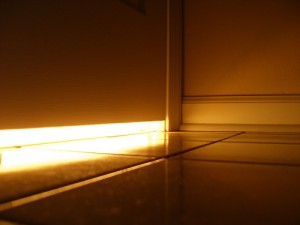
The Sh’ma said in the plain light of day lands on the ear as a cry, a plea. Listen. To me. The clarion call of the Sh’ma clears space and reins in time. But spying the sliver of night-light that slipped under my childhood bedroom door—illumination that represented silence itself—I implored with all my heart and all my soul for anyone to listen.
To drive home my desperation, I also bargained with God. If I promised to stop throwing away my vitamins, stealing things from kids at school, or hitting my sister in the middle of the night because she could sleep and I could not, would God send peace and its silent partner quiet to me?
As a child, I came to understand that the roles we played in life were most defined at night. I was the older, dowdy sister. My sister was the pretty one, the one with jet black eyes that sparkled—the one my father woke up to show off at the parties my parents threw in our living room.
I knew early on that, like the biblical Leah, I was the less desired sister. Forced by her father, Laban, to switch places with her sister, Rachel, on Rachel’s wedding night with Jacob, Leah was never loved the way she should have been. In the broad sweep of daylight, coming to terms with Laban’s ploy for this woman “of the weak eyes” broke my heart.
But I also learned that sometimes life could be rearranged for the better at night. My father was not the strict father with the McArthur sunglasses making me wear a seatbelt before its safety was universally appreciated, or clapping his hands to summon me to dinner when there was no soda, no candy, and no singing at the table.
Deep at night I liked my father much better than during the day. I presume it was the same for him with me as he looked out my bedroom window and narrated the weather or described the constellations. He hummed Viennese waltzes and Gilbert and Sullivan operettas. Music was his prayer, the music of a silent movie he saw beyond my window. Or maybe he was counting the stars because he couldn’t sleep either.
When I was a teenager I was sure I had outgrown saying the Sh’ma; I substituted for prayer the Top Forty crackling from the transistor radio I hid under my pillow. I read bad poetry and I wrote bad poetry. I was sure that I was the unhappiest, unluckiest fourteen-year-old on earth because God had not listened to me, the Leah of my family.
But now I know that, lurking in the shadows, God had always been with me. I just had to listen for God in the weather, in the dark, in music, in my dreams.
When I had my own children I took out the Sh’ma like a dress that had come back in style. The “sh” in Sh’ma soothed me into believing that God was listening. He heard my words. My children were proof of that.
God had discerned, and was still discerning, my intentions as a tongue distinguishes taste. The Sh’ma is a cry around which every other prayer and wish rallies, a prayer beyond words.
Sh’ma yisrael Adonai Elohanu Adonai echad. Hear me pray O’ Israel to listen to the silence of God’s looming absence.
Judy Bolton-Fasman is an award-winning writer and essayist. She is a weekly columnist on family and parenting for the Boston Jewish Advocate. Her popular column also frequently appears on the Christian Science Monitor’s Modern Parenthood blog, the Sisterhood blog of the Forward and the Huffington Post. She is also a contributor to Motherlode — the New York Times’ parenting blog. A long time book critic, she has written book reviews, interviews and essays for newspapers and magazines, including O Magazine, the New York Times, Boston Globe, Washington Post and Christian Science Monitor. She has been invited to speak about her popular weekly parenting column The Judy Chronicles and her memoir-in-progress on National Public Radio and Huffington Post Live as well as to universities, synagogues and women’s groups.

Previous Post

March 2, 2016
Good Enough to Tweet
Next Post
March 4, 2016 Learning Poetry, Unlearning God
Browse Our Archives
Select a Category A. G. Harmon Alissa Wilkinson Allison Backous Art Authors Brad Fruhauff Bradford Winters Bryan Bliss Caroline Langston Chad Thomas Johnston Chris Hoke Christiana N. Peterson Culture D.G. Myers D.L. Mayfield Daniel Bowman Jr. David Griffith Elizabeth Duffy Faith Film Greg Wolfe Guest Contributor Interview Jan Vallone Jeffrey Overstreet Jessica Eddings-Roeser Jessica Mesman Griffith Kelly Foster Lindsey Crittenden Morgan Meis music Natalie Vestin Nick Olson Peggy Rosenthal Personal Reflection Poetry Friday Reflection Relationships Review Richard Chess Richard Cole Sara Zarr Shannon Huffman Polson Sonya Bilocerkowycz Tania Runyan Tony Woodlief Topical Categories Uncategorized Vic Sizemore Writing
Select a Month October 2018 September 2018 August 2018 July 2018 June 2018 May 2018 April 2018 March 2018 February 2018 January 2018 December 2017 November 2017 October 2017 September 2017 August 2017 July 2017 June 2017 May 2017 April 2017 March 2017 February 2017 January 2017 December 2016 November 2016 October 2016 September 2016 August 2016 July 2016 June 2016 May 2016 April 2016 March 2016 February 2016 January 2016 December 2015 November 2015 October 2015 September 2015 August 2015 July 2015 June 2015 May 2015 April 2015 March 2015 February 2015 January 2015 December 2014 November 2014 October 2014 September 2014 August 2014 July 2014 June 2014 May 2014 April 2014 March 2014 February 2014 January 2014 December 2013 November 2013 October 2013 September 2013 August 2013 July 2013 June 2013 May 2013 April 2013 March 2013 February 2013 January 2013 December 2012 November 2012 October 2012 September 2012 August 2012 July 2012 June 2012 May 2012 February 2008
Follow Us!
TAKE THE
Religious Wisdom Quiz
What does "Nain" mean in Hebrew?
Select your answer to see how you score.
Holy place City of refuge Land of God Pleasant
Related posts from Good Letters

Poetry Friday: "The Burned Butterfly"


A Conversation with Alicia Ostriker: Part 1

The Stars of the Earth Cry Out
TRENDING AT PATHEOS Catholic

Rejecting Doom: Christian Hope And Human Action
Christianity is a religion of hope. We are to have hope and...

It’s What Comes From Within Which Matters
One of the most difficult things for us to understand is why...

Why I Choose the Eucharist Over the Sermon
Choose the Eucharist, Not the Sermon What are we supposed to get...

5 Design Elements Found in Spiritually Rooted Homes
Putting Spirituality Into Home Decor Our homes are more than our living...

Credo: A Story of God Told with the...
About 10 years ago, I began to imagine a personal "Credo" that...

The Anatomy of Divine Revelation in Catholic Thought
The claim that God has made Himself known to human beings is...
view all Catholic blogs
Ad-Free & Subscriber Log-In Subscription Support
- About Us
- 2026 Calendar
- Videos
- Podcasts
- Library of World Religions
- Faith In Media Tracker
- Advertise With Us
- Write for Us
- Privacy Policy
- Terms of Service
- Do Not Sell My Data
- Contact Us
- Radiant Digital
- Manage Newsletter Subscriptions
- Unsubscribe From Notifications
- Sitemap
Copyright 2008-2026, Patheos. All rights reserved.
Subscription Support Ad-Free & Subscriber Log-In
Follow Patheos