
BuddhistCatholicContemplativeEvangelicalGeneral ChristianHinduJewishLatter-day SaintMuslimNew VisionsProgressive Christian
Beliefs
- Buddhist
- Catholic
- Contemplative
- Evangelical
- General Christian
- Hindu
- Jewish
- Latter-day Saint
- More Voices
- Muslim
- New Visions
- Pagan
- Progressive Christian
Topics
- Religion News
- Food and Religion
- Sports and Religion
- Religious Art
- Religious Music and Entertainment
- Religious Events
- History and Religion
- Style and Religion
- Politics and Religion
- Women in Religion
- Recreation Outdoors and Religion
- Business Finance and Religion
- Careers Workplace and Religion
- Education and Religion
- Family Parenting and Religion
- Health Fitness and Religion
- Home and Religion
- Relationships and Religion
- Technology and Religion
- Travel and Religion
Columnists
- Buddhist Columnists
- Business Finance and Religion Columnists
- Careers Workplace and Religion Columnists
- Catholic Columnists
- Contemplative Columnists
- Education and Religion Columnists
- Evangelists Columnists
- Family Parenting and Religion Columnists
- General Christian Columnists
- Health Fitness and Religion Columnists
- Hindu Columnists
- History and Religion Columnists
- Home and Religion Columnists
- Jewish Columnists
- More Voices Columnists
- Latter Day Columnists
- Muslim Columnists
- New Visions Columnists
- Nonreligious Columnists
- Pagan Columnists
- Politics and Religion Columnists
- Progressive Columnists
- Recreation Outdoors and Religion Columnists
- Relationships and Religion Columnists
- Religion News Columnists
- Religious Art Columnists
- Religious Events Columnists
- Religious Music and Entertainment Columnists
- Sports and Religion Columnists
- Style and Religion Columnists
- Technology and Religion Columnists
- Travel and Religion Columnists
- Women in Religion Columnists
Resource Library
- 2026 Calendar
- Library of World Religions
- The 100 Most Holy Places on Earth
- Patheos Answers
- Podcasts
- Videos
- Faith Leaders Database
- Anglican Episcopalian
- Bahai
- Baptist
- Buddhism
- Christianity
- Confucianism
- Eastern Orthodoxy
- Hinduism
- Holiness and Pentecostal
- ISKCON
- Islam
- Judaism
- Lutheran
- Methodist
- The Church of Jesus Christ of Latter-day Saints
- New Age
- Paganism
- Presbytarian and Reformed
- Protestantism
- Religion Behind the Scenes
- Roman Catholic
- Scientology
- Shia Islam
- Sikhism
- Sufism
- Sunni Islam
- Taoism
- Zen
- See all religions
Research Tools
 Ad-Free & Subscriber Log-In Subscription Support
Ad-Free & Subscriber Log-In Subscription Support
Follow Patheos 

- Trending:
- Forgiveness
- |
- Marriage
- |
- Consciousness
- |
- Death Penalty
- |
- Election
- |
- Halloween
 Good Letters
-
Contributors
- Home
- Catholic
- Diego Rivera’s Detroit Industry
Diego Rivera’s Detroit Industry
Last updated on: March 15, 2016 at 1:00 am by Morgan Meis
Diego Rivera’s Detroit Industry 2016-03-08T12:43:08-07:00 Morgan Meis
Patheos Explore the world's faith through different perspectives on religion and spirituality! Patheos has the views of the prevalent religions and spiritualities of the world.
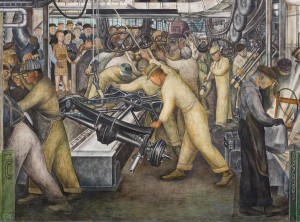
Detroit Industry. South Wall Detail.
The Detroit Institute of Art (DIA) is obviously not a religious institution. But damn if its Rivera Court doesn’t feel like sacred space.
The Rivera Court consists of wall murals, floor to ceiling, around an indoor courtyard. The murals were painted by Diego Rivera (1886-1957), the famous Mexican muralist. Rivera himself was not an especially religious man, to put it mildly. He was pretty clear about this fact. “I am an atheist,” he once said, “and I consider religions to be a form of collective neurosis.”
The content of the murals is as secular as the man. Rivera began painting them in 1932 (finishing in 1933), an era when the auto industry in Detroit was pumping out product full throttle. The murals portray, for the most part, working people hard at work. That’s probably why they are known as the Detroit Industry murals.
Why was a Mexican muralist—known at the time mostly for works portraying the history and everyday lives of people in his home country—commissioned to make art about Detroit’s manufacturing economy? A couple of sentences on the DIA website do a succinct job of explaining the project.
In Mexico, Rivera’s murals tied modern Mexican culture to its indigenous roots, revealing the ancient Indian cultures as Mexico’s true heritage. Similarly, Rivera’s Detroit Industry murals depict industry and technology as the indigenous culture of Detroit.
You can understand, then, why the industrialists of Detroit would pay good money for a mural by Rivera. They, too, saw “industry and technology as the indigenous culture of Detroit.” But this does not explain why the murals create—perhaps despite themselves—a sacred feeling.
In 1986, the art critic Robert Hughes reviewed a retrospective of Rivera’s work on display at DIA. In his review, Hughes tackled the question of why Rivera chose murals as his primary medium.
“Mexico,” Hughes explained, “had a huge illiterate population, used to learning Church doctrine by looking at images. Painting had little or no competition from other media. It could be as direct a form of social speech as it had once been in the city-states of the Renaissance.”
So, part of the reason that it feels, when standing in the middle of the Rivera Court, like standing in the middle of a cathedral, is that there is a direct lineage between the two. Rivera was recreating, for secular space, what the stained glass, mosaics, and murals had done in churches for hundreds of years. Instead of telling religious stories, Rivera was telling social, historical, and political stories.
The largest Detroit Industry panels focus on what is happening within factories (Rivera made many studies of the Ford River Rouge plant as the basis for these images). Workers pull and push and tug and bang. Blast furnaces pour out molten metals. Machines whir and clang. In these panels, Rivera shows us, literally, the cogs of the capitalist production process.
It has often been pointed out that Rivera was at pains, in his mural, to place his quasi-communist and pro-worker politics center stage (Rivera had officially broken with the Communist party by 1932, but was sympathetic with the politics of the far Left). Another mural by Rivera, Man at Crossroads (1933), was destroyed at the Rockefeller Center in New York because he famously refused to remove the portrait of Lenin he’d included in the work.
There’s no question that Detroit Industry contains a statement of leftwing, pro-worker politics. But what is often less noticed is the degree to which the specific politics of Detroit Industry are embedded in a greater cosmic narrative that is importantly pre-political. Put another way, Rivera embedded his pro-worker politics in the framework of a universal mythology.
For Rivera, the social, historical, and political story of human industry is related to a deeper, more fundamental story. Rivera portrays human industry as but an extension of a vast organic process that is cosmic in scope. The blast furnace on a lower panel, for instance, is connected to the natural forces of a volcano on the panel just above it.
Rivera intended that viewers of Detroit Industry should start reading the “narrative” on the eastern wall. At the center of that wall is a panel showing an infant child curled up in what looks like a womb, though it is also the root system of a giant tree. The rest of the mural unfolds from this “seed.”
Detroit Industry makes it very clear that human industry is an extension of more primal productive forces. There is a greater power at play, and that greater power manifests itself as the cycle of birth and death, creation and destruction. At its core is an idea of the cosmos as fundamentally creative. Individuals (human or otherwise) who are closer to this production process are also therefore more valuable, more vital. They are, in the Judeo-Christian sense of the term, more sacred.
Rivera borrowed much of his imagery—the fecund females at the top of the eastern wall panels; the reclining figures symbolic of the four races at the tops of the central panels, etc.—from Aztec mythology and the sacred art of other pre-Columbian peoples. He fused this imagery with storytelling techniques taken from Christian churches and from his deep knowledge of Renaissance art. The end result is a work of art deeply infused with spiritual form and content.
The only question is (and this question has dogged Western art since the early Renaissance): How does one use this new kind of sacred art? There is no specific form of worship or manner of ritual to be performed at the Rivera Court. No method for getting in touch with the deeper forces on display.
A troubling vagueness, therefore, hovers silently in the courtyard at the Detroit Institute of Arts. We’re not crazy to stand in the middle of that room and feel the aura of the sacred. But, what, exactly, are we supposed to do here?
Morgan Meis is the critic-at-large for The Smart Set (thesmartset.com). He has a PhD in Philosophy and has written for n+1, The Believer, Harper’s Magazine, and The Virginia Quarterly Review. He won the Whiting Award in 2013. Morgan is also an editor at 3 Quarks Daily, and a winner of a Creative Capital | Warhol Foundation Arts Writers grant. A book of Morgan’s selected essays can be found here. He can be reached at [email protected].

Previous Post

March 14, 2016
The Living Among the Dead
Next Post
March 16, 2016 What Happened to Fun?
Browse Our Archives
Select a Category A. G. Harmon Alissa Wilkinson Allison Backous Art Authors Brad Fruhauff Bradford Winters Bryan Bliss Caroline Langston Chad Thomas Johnston Chris Hoke Christiana N. Peterson Culture D.G. Myers D.L. Mayfield Daniel Bowman Jr. David Griffith Elizabeth Duffy Faith Film Greg Wolfe Guest Contributor Interview Jan Vallone Jeffrey Overstreet Jessica Eddings-Roeser Jessica Mesman Griffith Kelly Foster Lindsey Crittenden Morgan Meis music Natalie Vestin Nick Olson Peggy Rosenthal Personal Reflection Poetry Friday Reflection Relationships Review Richard Chess Richard Cole Sara Zarr Shannon Huffman Polson Sonya Bilocerkowycz Tania Runyan Tony Woodlief Topical Categories Uncategorized Vic Sizemore Writing
Select a Month October 2018 September 2018 August 2018 July 2018 June 2018 May 2018 April 2018 March 2018 February 2018 January 2018 December 2017 November 2017 October 2017 September 2017 August 2017 July 2017 June 2017 May 2017 April 2017 March 2017 February 2017 January 2017 December 2016 November 2016 October 2016 September 2016 August 2016 July 2016 June 2016 May 2016 April 2016 March 2016 February 2016 January 2016 December 2015 November 2015 October 2015 September 2015 August 2015 July 2015 June 2015 May 2015 April 2015 March 2015 February 2015 January 2015 December 2014 November 2014 October 2014 September 2014 August 2014 July 2014 June 2014 May 2014 April 2014 March 2014 February 2014 January 2014 December 2013 November 2013 October 2013 September 2013 August 2013 July 2013 June 2013 May 2013 April 2013 March 2013 February 2013 January 2013 December 2012 November 2012 October 2012 September 2012 August 2012 July 2012 June 2012 May 2012 February 2008
Follow Us!
TAKE THE
Religious Wisdom Quiz
What does "Amen" originally mean?
Select your answer to see how you score.
Let it happen Praise God Be true So be it
Related posts from Good Letters


Morning in a Forgotten Neighborhood


TRENDING AT PATHEOS Catholic

Rejecting Doom: Christian Hope And Human Action
Christianity is a religion of hope. We are to have hope and...

It’s What Comes From Within Which Matters
One of the most difficult things for us to understand is why...

Why I Choose the Eucharist Over the Sermon
Choose the Eucharist, Not the Sermon What are we supposed to get...

5 Design Elements Found in Spiritually Rooted Homes
Putting Spirituality Into Home Decor Our homes are more than our living...

Credo: A Story of God Told with the...
About 10 years ago, I began to imagine a personal "Credo" that...

The Anatomy of Divine Revelation in Catholic Thought
The claim that God has made Himself known to human beings is...
view all Catholic blogs
Ad-Free & Subscriber Log-In Subscription Support
- About Us
- 2026 Calendar
- Videos
- Podcasts
- Library of World Religions
- Faith In Media Tracker
- Advertise With Us
- Write for Us
- Privacy Policy
- Terms of Service
- Do Not Sell My Data
- Contact Us
- Radiant Digital
- Manage Newsletter Subscriptions
- Unsubscribe From Notifications
- Sitemap
Copyright 2008-2026, Patheos. All rights reserved.
Subscription Support Ad-Free & Subscriber Log-In
Follow Patheos