
BuddhistCatholicContemplativeEvangelicalGeneral ChristianHinduJewishLatter-day SaintMuslimNew VisionsProgressive Christian
Beliefs
- Buddhist
- Catholic
- Contemplative
- Evangelical
- General Christian
- Hindu
- Jewish
- Latter-day Saint
- More Voices
- Muslim
- New Visions
- Pagan
- Progressive Christian
Topics
- Religion News
- Food and Religion
- Sports and Religion
- Religious Art
- Religious Music and Entertainment
- Religious Events
- History and Religion
- Style and Religion
- Politics and Religion
- Women in Religion
- Recreation Outdoors and Religion
- Business Finance and Religion
- Careers Workplace and Religion
- Education and Religion
- Family Parenting and Religion
- Health Fitness and Religion
- Home and Religion
- Relationships and Religion
- Technology and Religion
- Travel and Religion
Columnists
- Buddhist Columnists
- Business Finance and Religion Columnists
- Careers Workplace and Religion Columnists
- Catholic Columnists
- Contemplative Columnists
- Education and Religion Columnists
- Evangelists Columnists
- Family Parenting and Religion Columnists
- General Christian Columnists
- Health Fitness and Religion Columnists
- Hindu Columnists
- History and Religion Columnists
- Home and Religion Columnists
- Jewish Columnists
- More Voices Columnists
- Latter Day Columnists
- Muslim Columnists
- New Visions Columnists
- Nonreligious Columnists
- Pagan Columnists
- Politics and Religion Columnists
- Progressive Columnists
- Recreation Outdoors and Religion Columnists
- Relationships and Religion Columnists
- Religion News Columnists
- Religious Art Columnists
- Religious Events Columnists
- Religious Music and Entertainment Columnists
- Sports and Religion Columnists
- Style and Religion Columnists
- Technology and Religion Columnists
- Travel and Religion Columnists
- Women in Religion Columnists
Resource Library
- 2026 Calendar
- Library of World Religions
- The 100 Most Holy Places on Earth
- Patheos Answers
- Podcasts
- Videos
- Faith Leaders Database
- Anglican Episcopalian
- Bahai
- Baptist
- Buddhism
- Christianity
- Confucianism
- Eastern Orthodoxy
- Hinduism
- Holiness and Pentecostal
- ISKCON
- Islam
- Judaism
- Lutheran
- Methodist
- The Church of Jesus Christ of Latter-day Saints
- New Age
- Paganism
- Presbytarian and Reformed
- Protestantism
- Religion Behind the Scenes
- Roman Catholic
- Scientology
- Shia Islam
- Sikhism
- Sufism
- Sunni Islam
- Taoism
- Zen
- See all religions
Research Tools
 Ad-Free & Subscriber Log-In Subscription Support
Ad-Free & Subscriber Log-In Subscription Support
Follow Patheos 

- Trending:
- Forgiveness
- |
- Marriage
- |
- Consciousness
- |
- Death Penalty
- |
- Election
- |
- Halloween
 Good Letters
-
Contributors
- Home
- Catholic
- A Space Program
A Space Program
Last updated on: March 21, 2016 at 1:00 am by Alissa Wilkinson
A Space Program 2016-03-20T21:39:43-07:00 Alissa Wilkinson
Patheos Explore the world's faith through different perspectives on religion and spirituality! Patheos has the views of the prevalent religions and spiritualities of the world.
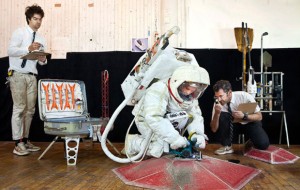 The tenth item on a list entitled “How to Watch This Film,” which accompanies Tom Sachs’ A Space Program, says that the film is “a love letter to the analog era.”
That obsession with all things handmade and non-digital was obvious as I watched the film—even though I was sitting on my couch, streaming a digital screener on my iPhone and beaming it over WiFi to my Apple TV, which is about the least analog thing a person can do.
But Sachs loves this stuff. He’s a sculptor, sort of—playing with all kinds of things from the natural and human-made world to form whimsical new objects, like boomboxes and in this case, fake planets and massive mission control centers and even the credits roll for the film, which looks like it’s rolling by on taped-together black construction paper.
The movie (“NOT A DOCUMENTARY,” the instructions insist, “it’s an INDUSTRIAL film like the safety videos they make you watch in high school shop class so you don’t cut your fingers off”) is a window onto a large-scale art installation Sachs and his studio team mounted in 2012 at New York City’s Park Avenue Armory. Five years earlier, a smaller version of the project had been mounted at the Gagosian Gallery, in which the team “went to the moon”—so this expedition was titled Space Program 2.0: MARS.
The installation took over the Armory’s 55,000 square foot Wade Thompson Drill Hall and ran for four weeks, and in an eleven-hour production, the team mounted a journey to and from Mars, while a crowd of observers watched. It’s a ton of fun to watch, recalling the hours and hours you spent as a kid in the backyard with your friends, using all the leftover paper towel tubes and cardboard boxes and craft supplies you could muster in service of imagination.
The only difference here is that the participants are grownups, with a budget and the ability to use a circular saw. The “journey” was documented by director Van Neistat (who has previously worked with Sachs on several shorts) and makes for a strange, experimental, enjoyable homage to both those instructional videos and to the ways that science, art, and religion all occupy a similar space.
The twelfth and final item on the “How to Watch This Film” list somewhat ominously suggests that “If you believe in God, you need to watch this movie.” I scratched my head a bit when I read that, but the first line of the film is a quotation from the visionary inventor Buckminster Fuller: “Science and religion are on a parallel course to answer one question: are we alone?”
In an interview after the film played at SXSW last year, Sachs elaborated a bit:
I did a residency at Jet Propulsion Laboratory in Pasadena, so a lot of the technical stuff I got to work on with the guys there… I thought I would get all this engineering information, but really, what I got was all the spiritual stuff, because these scientists are these deeply spiritual individuals. They’re answering the same questions that religion answers—are we alone? Where do we come from? They are very into the big questions and the difference between a rocket scientist and a rocket engineer is that scientists use these machines to answer the questions and the engineers are into the nuts and bolts of how to get it done, and they work together. I’m a little in between because there’s a real blue collar side to making sculpture. You get to weld and do carpentry or handle clay or whatever it is, but then if it’s going to have any resonance, you’ve got to be interested at least in the big questions. That’s why when you find artists who are involved in religious dogma in the modern age, their art is never good. Back in the time of Michelangelo is different, but even then, I think he sucked up to the church just to get the bills paid.
Those big questions haunt Space Program 2.0: MARS, which features, among other things, a mounting stress level between the two astronauts that breaks into a full-scale fight and necessitates an explanatory video about how explosions can be modulated by their reactions. The film makes a strong case that we’re not alone in the universe precisely because we have one another, and though it evokes a state of wonder at what might be out there, it keeps turning the focus back on the wonder of humans: “We go to Mars not to exploit the resources of a new planet but to better understand our resources here on Earth.”
Those resources are the building blocks of science, to be sure—and also of art, which characterizes Sachs’s own art. That he sees such a strong link between them is no wonder. The team calls themselves “bricoleurs,” people who engage in bricolage, the act of repairing or creating with available resources. Which is certainly what astronauts end up doing (as another movie about a trip to Mars taught us last year), and what artists do, too.
And in some sense, bricolage is the work of religion. Those religious questions—who are we? where did we come from? where are we going? what do we do while we’re here?—are answered with reference to our unique situations. Christianity takes as its authority the Bible, but recognizes that the text is also a bit of a work of bricolage, seeking to repair the broken places in human societies and human hearts with the metaphors and images available to those who penned it. So Christian worship has taken different forms and changed shape a bit depending on what broken place needed healing around the worshippers.
Near the end of the film, after the fight breaks out, the astronauts engage in a tea ceremony. Tea ceremonies have long been ways of extending hospitality and peace to another party. It’s a way of combatting narcissism, of sharing time and space and contemplation.
In the same interview, Sachs explains: “That’s the other great thing that the planet Earth has. If I could bring art to another planet, I wouldn’t bring a Barnett Newman painting. I would bring a tea ceremony because it’s so complex and encompasses all the stuff about religion that I like, as well as all the philosophy and hospitality and generosity and appreciation for Earth.” Not a bad discovery, for a handmade trip to outer space.
A Space Program opened at Metrograph in New York City on March 18 before expanding to a limited number of engagements around the United States*.*
Alissa Wilkinson is Christianity Today’s chief film critic and an assistant professor of English and humanities at The King’s College in New York City. She taught the “Spirituality and Food” seminar at the Glen Workshop in 2015 and tweets at @alissamarie.

Previous Post

March 18, 2016
Dancing on the Way to Prison
Next Post
March 22, 2016 Refugees Are People, Not a Crisis
Browse Our Archives
Select a Category A. G. Harmon Alissa Wilkinson Allison Backous Art Authors Brad Fruhauff Bradford Winters Bryan Bliss Caroline Langston Chad Thomas Johnston Chris Hoke Christiana N. Peterson Culture D.G. Myers D.L. Mayfield Daniel Bowman Jr. David Griffith Elizabeth Duffy Faith Film Greg Wolfe Guest Contributor Interview Jan Vallone Jeffrey Overstreet Jessica Eddings-Roeser Jessica Mesman Griffith Kelly Foster Lindsey Crittenden Morgan Meis music Natalie Vestin Nick Olson Peggy Rosenthal Personal Reflection Poetry Friday Reflection Relationships Review Richard Chess Richard Cole Sara Zarr Shannon Huffman Polson Sonya Bilocerkowycz Tania Runyan Tony Woodlief Topical Categories Uncategorized Vic Sizemore Writing
Select a Month October 2018 September 2018 August 2018 July 2018 June 2018 May 2018 April 2018 March 2018 February 2018 January 2018 December 2017 November 2017 October 2017 September 2017 August 2017 July 2017 June 2017 May 2017 April 2017 March 2017 February 2017 January 2017 December 2016 November 2016 October 2016 September 2016 August 2016 July 2016 June 2016 May 2016 April 2016 March 2016 February 2016 January 2016 December 2015 November 2015 October 2015 September 2015 August 2015 July 2015 June 2015 May 2015 April 2015 March 2015 February 2015 January 2015 December 2014 November 2014 October 2014 September 2014 August 2014 July 2014 June 2014 May 2014 April 2014 March 2014 February 2014 January 2014 December 2013 November 2013 October 2013 September 2013 August 2013 July 2013 June 2013 May 2013 April 2013 March 2013 February 2013 January 2013 December 2012 November 2012 October 2012 September 2012 August 2012 July 2012 June 2012 May 2012 February 2008
Follow Us!
TAKE THE
Religious Wisdom Quiz
What did Nehemiah rebuild in Jerusalem amid much opposition?
Select your answer to see how you score.
The Temple The tower of Siloam The city wall The palace
Related posts from Good Letters



Leonard Cohen’s Holy and Broken Hallelujah

Ready or Not for the Days of Awe
TRENDING AT PATHEOS Catholic

Rejecting Doom: Christian Hope And Human Action
Christianity is a religion of hope. We are to have hope and...

It’s What Comes From Within Which Matters
One of the most difficult things for us to understand is why...

Why I Choose the Eucharist Over the Sermon
Choose the Eucharist, Not the Sermon What are we supposed to get...

5 Design Elements Found in Spiritually Rooted Homes
Putting Spirituality Into Home Decor Our homes are more than our living...

Credo: A Story of God Told with the...
About 10 years ago, I began to imagine a personal "Credo" that...

The Anatomy of Divine Revelation in Catholic Thought
The claim that God has made Himself known to human beings is...
view all Catholic blogs
Ad-Free & Subscriber Log-In Subscription Support
- About Us
- 2026 Calendar
- Videos
- Podcasts
- Library of World Religions
- Faith In Media Tracker
- Advertise With Us
- Write for Us
- Privacy Policy
- Terms of Service
- Do Not Sell My Data
- Contact Us
- Radiant Digital
- Manage Newsletter Subscriptions
- Unsubscribe From Notifications
- Sitemap
Copyright 2008-2026, Patheos. All rights reserved.
Subscription Support Ad-Free & Subscriber Log-In
Follow Patheos