
BuddhistCatholicContemplativeEvangelicalGeneral ChristianHinduJewishLatter-day SaintMuslimNew VisionsProgressive Christian
Beliefs
- Buddhist
- Catholic
- Contemplative
- Evangelical
- General Christian
- Hindu
- Jewish
- Latter-day Saint
- More Voices
- Muslim
- New Visions
- Pagan
- Progressive Christian
Topics
- Religion News
- Food and Religion
- Sports and Religion
- Religious Art
- Religious Music and Entertainment
- Religious Events
- History and Religion
- Style and Religion
- Politics and Religion
- Women in Religion
- Recreation Outdoors and Religion
- Business Finance and Religion
- Careers Workplace and Religion
- Education and Religion
- Family Parenting and Religion
- Health Fitness and Religion
- Home and Religion
- Relationships and Religion
- Technology and Religion
- Travel and Religion
Columnists
- Buddhist Columnists
- Business Finance and Religion Columnists
- Careers Workplace and Religion Columnists
- Catholic Columnists
- Contemplative Columnists
- Education and Religion Columnists
- Evangelists Columnists
- Family Parenting and Religion Columnists
- General Christian Columnists
- Health Fitness and Religion Columnists
- Hindu Columnists
- History and Religion Columnists
- Home and Religion Columnists
- Jewish Columnists
- More Voices Columnists
- Latter Day Columnists
- Muslim Columnists
- New Visions Columnists
- Nonreligious Columnists
- Pagan Columnists
- Politics and Religion Columnists
- Progressive Columnists
- Recreation Outdoors and Religion Columnists
- Relationships and Religion Columnists
- Religion News Columnists
- Religious Art Columnists
- Religious Events Columnists
- Religious Music and Entertainment Columnists
- Sports and Religion Columnists
- Style and Religion Columnists
- Technology and Religion Columnists
- Travel and Religion Columnists
- Women in Religion Columnists
Resource Library
- 2026 Calendar
- Library of World Religions
- The 100 Most Holy Places on Earth
- Patheos Answers
- Podcasts
- Videos
- Faith Leaders Database
- Anglican Episcopalian
- Bahai
- Baptist
- Buddhism
- Christianity
- Confucianism
- Eastern Orthodoxy
- Hinduism
- Holiness and Pentecostal
- ISKCON
- Islam
- Judaism
- Lutheran
- Methodist
- The Church of Jesus Christ of Latter-day Saints
- New Age
- Paganism
- Presbytarian and Reformed
- Protestantism
- Religion Behind the Scenes
- Roman Catholic
- Scientology
- Shia Islam
- Sikhism
- Sufism
- Sunni Islam
- Taoism
- Zen
- See all religions
Research Tools
 Ad-Free & Subscriber Log-In Subscription Support
Ad-Free & Subscriber Log-In Subscription Support
Follow Patheos 

- Trending:
- Forgiveness
- |
- Marriage
- |
- Consciousness
- |
- Death Penalty
- |
- Election
- |
- Halloween
 Good Letters
-
Contributors
- Home
- Catholic
- A Rabbi, a Priest, and a Wedding: Part 1
A Rabbi, a Priest, and a Wedding: Part 1
Last updated on: March 30, 2016 at 1:00 am by Guest Contributor
A Rabbi, a Priest, and a Wedding: Part 1 2016-03-29T11:16:51-07:00 Guest Contributor
Patheos Explore the world's faith through different perspectives on religion and spirituality! Patheos has the views of the prevalent religions and spiritualities of the world.
By Danielle Leshaw
 Father Bill offered a set of instructions. “Walk beside me, never on my left, but always on my right.”
I nodded.
“And we’re walking towards Jesus.” He pointed across the church. “Shall we practice?”
“Yes, please,” I answered.
We processed up the aisle, an elderly priest and a young, female rabbi. I matched his steps. His brown frock went swish-swish while the long, braided belt knocked against his knees. It was a long path, from the entrance doors of the church up the aisle to the ornate dais. This gave me time to look around. The Stations of the Cross were divided up around the big room, white pedestals with hammered copper sculptures of Jesus during his final moments. It was a sunny morning. The skylights streamed light beams. Every Jesus, big or small, hanging or standing or crouching or sitting, was illuminated. And as if by divine command, there were little specs of glitter dust in each ray of light.
We were alone in the big sanctuary. I wondered if this was what it felt like to be a nun. Quiet, walking towards God, light beams and priests all around. I assumed that my place on Father Bill’s right indicated obedience of some kind.
“We’ll stop here and kneel,” he instructed, “I’ll say a few prayers, and then we’ll get up and walk to the other side of the room. Remember,” he cautioned, his voice soft, “stay on my right.”
I was confused by all the choreography. And nervous. We had a bride and groom to greet at any moment, and I needed to appear composed and confident. But I was worried that during the wedding ceremony I would find myself on Father Bill’s left. And then what? Would I have taken the spiritual place of one of the members of the holy trinity? Would my presence indicate a desire to usurp their authority? Would the Christian marriage rituals be ruined?
The Catholic bride had found me through a friend, who told her I was great at weddings. “That’s nice,” I said, when we were on the phone, “but I’m great at Jewish weddings.” The kind of wedding where we stand in the same place, almost the entire time, with little choreography and not many rights or lefts.
She laughed. “I want this for my fiancé. He’s Jewish, and I know it will mean so much to him and his family if you’re there.”
I paused. I told her I’d need a few days to think about it. We’re not allowed to stand beside priests and marry people. We risk expulsion from our rabbinical associations. We risk being shunned by our rabbinic colleagues. We risk getting fired from our jobs that we mostly love. But we also risk confusing the assembled community of witnesses, who, because of our presence, might have the impression that we condone interfaith marriage, or believe that two religions can be successfully blended in one home.
We are ordained as keepers of the faith. It is assumed we will guard ritual and practice and provide entryways and opportunity. Standing beside priests and blessing a couple in a multitude of religions doesn’t exactly honor that guardianship. As a result, co-officiation is a major taboo, and for twelve years—to avoid social and professional ostracism, and because I too had been opposed to co-officiation for many of the obvious reasons—I adhered to the expectations of the rabbinate.
But I was pulled by the bride’s voice and her desire to create something Jewish for her Jewish groom. I wanted to be part of her plan to ensure that Judaism was represented during their marriage rites, even if I had no idea if they would bring Judaism into their home.
She didn’t have to say it, but I also knew she was worried that the groom’s family would be uncomfortable in the church pews, sad perhaps, even if they loved the bride. They’d feel out of place. My job would be to help them feel more comfortable. I wanted to nurture and soothe. I wanted them to know that a leader in the Jewish community cared about them.
Clergy get into trouble when we feel this pull—we have a natural instinct to care for others, and so our governing bodies have ethical guidelines in place so that we don’t overstep boundaries and compromise Judaism, our careers, and our relationships. And yet I found myself calling the bride a few days later to say yes, and to explain the situation and a few rules: I couldn’t have any videography in the church. No tagging me in Facebook photos. I would arrive, perform the ceremony alongside the priest, and then take leave.
“You won’t join us at the reception?” she asked.
“No,” I responded. “Not even the first glass of wine.”
“Who will help us do the Jewish dance?” she asked.
“His family will know what to do, I’m certain of it.”
If I said no, and the next rabbi said no, and all the rabbis after me said no to this young couple, all those no’s would translate to un-love and un-faith and un-God and un-everything. And I’d hate to think I chose to be a rabbi only to say no to people who come and ask me to perform rituals that I might be disinclined to perform, but that if I just stretched a little bit, maybe the way Jesus got stretched on that cross, then we could make Judaism a little bit more available to those in need. Catholics included.
To be continued tomorrow.
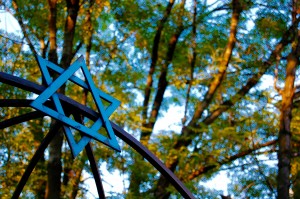
Image above is by Jamie Mitchell and licensed by Creative Commons.
Danielle Leshaw is the Rabbi and Executive Director of Hillel at Ohio University in Athens, Ohio. She’s been published in The New York Times, Tablet Magazine, The Jewish Daily Forward, Mutha, Moment Magazine, is a Puschart Prize nominee, and is a two-time recipient of the Ohio Arts Council prize, the leading state grant for writers and artists. To see more of her writing, visit www. DanielleLeshaw.com. She’s also on twitter (far too frequently) at @RabbiDanielle.

Previous Post

March 29, 2016
Believing in the Beach Boys
Next Post
March 31, 2016 A Rabbi, a Priest, and a Wedding: Part 2
Browse Our Archives
Select a Category A. G. Harmon Alissa Wilkinson Allison Backous Art Authors Brad Fruhauff Bradford Winters Bryan Bliss Caroline Langston Chad Thomas Johnston Chris Hoke Christiana N. Peterson Culture D.G. Myers D.L. Mayfield Daniel Bowman Jr. David Griffith Elizabeth Duffy Faith Film Greg Wolfe Guest Contributor Interview Jan Vallone Jeffrey Overstreet Jessica Eddings-Roeser Jessica Mesman Griffith Kelly Foster Lindsey Crittenden Morgan Meis music Natalie Vestin Nick Olson Peggy Rosenthal Personal Reflection Poetry Friday Reflection Relationships Review Richard Chess Richard Cole Sara Zarr Shannon Huffman Polson Sonya Bilocerkowycz Tania Runyan Tony Woodlief Topical Categories Uncategorized Vic Sizemore Writing
Select a Month October 2018 September 2018 August 2018 July 2018 June 2018 May 2018 April 2018 March 2018 February 2018 January 2018 December 2017 November 2017 October 2017 September 2017 August 2017 July 2017 June 2017 May 2017 April 2017 March 2017 February 2017 January 2017 December 2016 November 2016 October 2016 September 2016 August 2016 July 2016 June 2016 May 2016 April 2016 March 2016 February 2016 January 2016 December 2015 November 2015 October 2015 September 2015 August 2015 July 2015 June 2015 May 2015 April 2015 March 2015 February 2015 January 2015 December 2014 November 2014 October 2014 September 2014 August 2014 July 2014 June 2014 May 2014 April 2014 March 2014 February 2014 January 2014 December 2013 November 2013 October 2013 September 2013 August 2013 July 2013 June 2013 May 2013 April 2013 March 2013 February 2013 January 2013 December 2012 November 2012 October 2012 September 2012 August 2012 July 2012 June 2012 May 2012 February 2008
Follow Us!
TAKE THE
Religious Wisdom Quiz
I was lifted up on a pole that healed those who looked at me. What am I?
Select your answer to see how you score.
The bronze serpent A healing statue The Golden Calf The Stone Tablets
Related posts from Good Letters


Morning in a Forgotten Neighborhood


TRENDING AT PATHEOS Catholic

Rejecting Doom: Christian Hope And Human Action
Christianity is a religion of hope. We are to have hope and...

It’s What Comes From Within Which Matters
One of the most difficult things for us to understand is why...

Why I Choose the Eucharist Over the Sermon
Choose the Eucharist, Not the Sermon What are we supposed to get...

5 Design Elements Found in Spiritually Rooted Homes
Putting Spirituality Into Home Decor Our homes are more than our living...

Credo: A Story of God Told with the...
About 10 years ago, I began to imagine a personal "Credo" that...

The Anatomy of Divine Revelation in Catholic Thought
The claim that God has made Himself known to human beings is...
view all Catholic blogs
Ad-Free & Subscriber Log-In Subscription Support
- About Us
- 2026 Calendar
- Videos
- Podcasts
- Library of World Religions
- Faith In Media Tracker
- Advertise With Us
- Write for Us
- Privacy Policy
- Terms of Service
- Do Not Sell My Data
- Contact Us
- Radiant Digital
- Manage Newsletter Subscriptions
- Unsubscribe From Notifications
- Sitemap
Copyright 2008-2026, Patheos. All rights reserved.
Subscription Support Ad-Free & Subscriber Log-In
Follow Patheos