
BuddhistCatholicContemplativeEvangelicalGeneral ChristianHinduJewishLatter-day SaintMuslimNew VisionsProgressive Christian
Beliefs
- Buddhist
- Catholic
- Contemplative
- Evangelical
- General Christian
- Hindu
- Jewish
- Latter-day Saint
- More Voices
- Muslim
- New Visions
- Pagan
- Progressive Christian
Topics
- Religion News
- Food and Religion
- Sports and Religion
- Religious Art
- Religious Music and Entertainment
- Religious Events
- History and Religion
- Style and Religion
- Politics and Religion
- Women in Religion
- Recreation Outdoors and Religion
- Business Finance and Religion
- Careers Workplace and Religion
- Education and Religion
- Family Parenting and Religion
- Health Fitness and Religion
- Home and Religion
- Relationships and Religion
- Technology and Religion
- Travel and Religion
Columnists
- Buddhist Columnists
- Business Finance and Religion Columnists
- Careers Workplace and Religion Columnists
- Catholic Columnists
- Contemplative Columnists
- Education and Religion Columnists
- Evangelists Columnists
- Family Parenting and Religion Columnists
- General Christian Columnists
- Health Fitness and Religion Columnists
- Hindu Columnists
- History and Religion Columnists
- Home and Religion Columnists
- Jewish Columnists
- More Voices Columnists
- Latter Day Columnists
- Muslim Columnists
- New Visions Columnists
- Nonreligious Columnists
- Pagan Columnists
- Politics and Religion Columnists
- Progressive Columnists
- Recreation Outdoors and Religion Columnists
- Relationships and Religion Columnists
- Religion News Columnists
- Religious Art Columnists
- Religious Events Columnists
- Religious Music and Entertainment Columnists
- Sports and Religion Columnists
- Style and Religion Columnists
- Technology and Religion Columnists
- Travel and Religion Columnists
- Women in Religion Columnists
Resource Library
- 2026 Calendar
- Library of World Religions
- The 100 Most Holy Places on Earth
- Patheos Answers
- Podcasts
- Videos
- Faith Leaders Database
- Anglican Episcopalian
- Bahai
- Baptist
- Buddhism
- Christianity
- Confucianism
- Eastern Orthodoxy
- Hinduism
- Holiness and Pentecostal
- ISKCON
- Islam
- Judaism
- Lutheran
- Methodist
- The Church of Jesus Christ of Latter-day Saints
- New Age
- Paganism
- Presbytarian and Reformed
- Protestantism
- Religion Behind the Scenes
- Roman Catholic
- Scientology
- Shia Islam
- Sikhism
- Sufism
- Sunni Islam
- Taoism
- Zen
- See all religions
Research Tools
 Ad-Free & Subscriber Log-In Subscription Support
Ad-Free & Subscriber Log-In Subscription Support
Follow Patheos 

- Trending:
- Forgiveness
- |
- Marriage
- |
- Consciousness
- |
- Death Penalty
- |
- Election
- |
- Halloween
 Good Letters
-
Contributors
- Home
- Catholic
- Kolam: The Beauty of Uselessness
Kolam: The Beauty of Uselessness
Last updated on: February 4, 2016 at 1:00 am by Caroline Langston
Kolam: The Beauty of Uselessness 2016-02-01T12:25:16-07:00 Caroline Langston
Patheos Explore the world's faith through different perspectives on religion and spirituality! Patheos has the views of the prevalent religions and spiritualities of the world.
 This one’s for Carin Ruff, and by way of answering my niece Kate’s question.
A little more than twenty years ago, I spent a summer traveling around India under the auspices of the Fulbright-Hays program, a summer fellowship grant program for teachers. Over the course of about six weeks, we traveled to some twelve cities, from the very feet of the Himalayas to the Bay of Bengal.
India seems far nearer now than it was then; when our group visited, the country was in the final days of an old-style Socialist economy, and it was before the boom in the country’s tech sector—which had already started—had achieved a generalized reputation abroad.
It was before India became the home of the world’s customer service call centers, and before the ubiquity of the “mobile phone” revolution: I recall a hot afternoon in Chennai (which was then still called Madras) when I had to walk three blocks to a telephone office and pay in cash to wait for an operator to connect me to an international trunk line.
On that trip, I saw the Taj Mahal, the Red Fort, and the erotic temples of Khajuraho—the whole UNESCO package. But what I remember more vividly, and fondly, are the little things: the reusable cups given out by the “air hostesses” on Indian Airlines and the dogs that waited in front of sidewalk shrines where shirtless Brahmin priests performed puja— acts of reverence to the divine—as though they, the dogs, were praying.
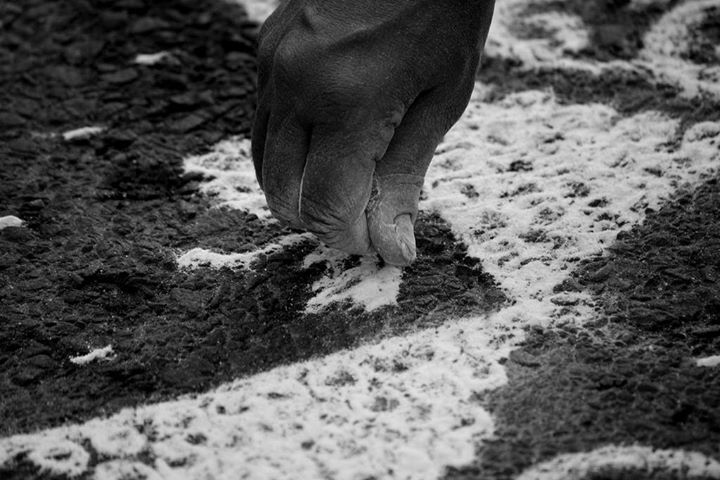
Hinduism was the gateway to the notion of mystical Christianity for me—but, more than the grandeur of the Shore Temple of Mahabalipuram, what sticks out in my memory are the kolam designs in front of the houses of the peasant women living nearby: Every morning before dawn, these women use rice flour or chalk dust to trace elaborate, interlocking, sometimes multicolored designs in their thresholds and courtyards.
Kolam designs are gestures of hospitality and welcome, and according to Wikipedia, are believed to bring good luck via the goddess Laxshmi. Every single day, the combination of foot traffic and rain scatters them away. So every morning, they must be drawn anew—and not just any way, either, but according to the conventions of “interlocking lines and dots” (again, Wikipedia) that govern kolam creation.
It’s that commitment to beautiful uselessness that struck me—we all know mandalas, of course, constructed by what we think of as grave and silent Buddhist monks—but here is the same gesture embedded, daily, in the quotidian mysteries of home and the workaday world. Rather than a gesture of refusal, this one is an embrace.
It is a gesture that is not instrumental, or transactional in nature—although I suppose on some level, petitioning the divine could count as such. But it is certainly not one that is guaranteed. The accounting calculus is elsewhere.
How much of what we do is transactional, it seems—even we “grace alone” folks who do not esteem Jamesian work-efforts: We go to the funeral because we knew the person who died, but also because we want to be seen by the relatives of the person, and ultimately, because we want people to come to our funeral, too.
But what of the gestures that secure nothing for us? I would like to share an example.
A couple of years ago, a young couple at my church and I decided to make a hospital visit to an infirm parishioner who lived in a down-at-the-heels suburb that was far from the church, but closer to where we lived than anyone else in the parish. Neither of us really knew this older man, who had lived for decades alone in this place, without wife or children, and who had come faithfully across town for the Divine Liturgy at the parish, where he had been one of the founders.
He had spent a lifetime working in construction, if I have this correctly, and his family were all back in the Midwest. And now he was apparently dying alone, at Southern Maryland Hospital Center.
The young couple picked me up at my house on a May weeknight just as a giant line of gray thunderclouds crossed over the Capital Beltway and dumped a thunder of drops on the windshield. They had been married barely a year, and they giggled and held hands intermittently as we moved, inchworm-like, through the evening rush hour traffic, as I sat in the backseat wondering what the hell I was doing—a working mother, on a weeknight, driving an hour or more.
Then when we got to the hospital, we found that there was still an hour before the Intensive Care Unit had visiting hours.
No matter—the young couple was game for anything, and we didn’t even think about leaving, but settled in to wait. What for?, I found myself wondering, as we ventured into the basement of a hospital so relatively impoverished that it did not even have much of a cafeteria still open at night beyond a couple of vending machines and Formica tables in a break room.
We talked. I love this couple. But still the hour passed oh so slowly, and I thought of everything else I could be doing—things for my children or husband, the laundry, other forms of self-development and productivity. At last the hour was up and they let us into the locked ward of the ICU.
The man was in his room, his skin olive against the whiteness of the sheets, his mouth open, and his breathing heavy, loud, and labored, rasping. He was in a medically induced coma, the nurse said to us.
The young husband and wife and I all glanced at each other. Then we prayed, nothing spontaneous or timely, but the Trisagion cycle of prayers most foundational to our tradition. We sang the Paschal Hymn—Christ is risen from the dead, trampling down Death by Death—and then we ended, glanced at each other once again, and left, to the sunset and the renewed rain.
This may appear to have been a useless gesture, but to me it feels like the most important thing I did in 2014.
But that’s the thing: These acts are like kolam. And they are meant to be done every day.
A native of Yazoo City, Mississippi, Caroline Langston is a convert to the Eastern Orthodox Church. She is a widely published writer and essayist, a winner of the Pushcart Prize, and a commentator for NPR’s All Things Considered.

Previous Post

February 3, 2016
Creating Sacred Literature
Next Post
February 5, 2016 Brooklyn: A Drama of Discernment
Browse Our Archives
Select a Category A. G. Harmon Alissa Wilkinson Allison Backous Art Authors Brad Fruhauff Bradford Winters Bryan Bliss Caroline Langston Chad Thomas Johnston Chris Hoke Christiana N. Peterson Culture D.G. Myers D.L. Mayfield Daniel Bowman Jr. David Griffith Elizabeth Duffy Faith Film Greg Wolfe Guest Contributor Interview Jan Vallone Jeffrey Overstreet Jessica Eddings-Roeser Jessica Mesman Griffith Kelly Foster Lindsey Crittenden Morgan Meis music Natalie Vestin Nick Olson Peggy Rosenthal Personal Reflection Poetry Friday Reflection Relationships Review Richard Chess Richard Cole Sara Zarr Shannon Huffman Polson Sonya Bilocerkowycz Tania Runyan Tony Woodlief Topical Categories Uncategorized Vic Sizemore Writing
Select a Month October 2018 September 2018 August 2018 July 2018 June 2018 May 2018 April 2018 March 2018 February 2018 January 2018 December 2017 November 2017 October 2017 September 2017 August 2017 July 2017 June 2017 May 2017 April 2017 March 2017 February 2017 January 2017 December 2016 November 2016 October 2016 September 2016 August 2016 July 2016 June 2016 May 2016 April 2016 March 2016 February 2016 January 2016 December 2015 November 2015 October 2015 September 2015 August 2015 July 2015 June 2015 May 2015 April 2015 March 2015 February 2015 January 2015 December 2014 November 2014 October 2014 September 2014 August 2014 July 2014 June 2014 May 2014 April 2014 March 2014 February 2014 January 2014 December 2013 November 2013 October 2013 September 2013 August 2013 July 2013 June 2013 May 2013 April 2013 March 2013 February 2013 January 2013 December 2012 November 2012 October 2012 September 2012 August 2012 July 2012 June 2012 May 2012 February 2008
Follow Us!
TAKE THE
Religious Wisdom Quiz
What does the Shield of Faith protect believers from?
Select your answer to see how you score.
The need for armor Earthly wealth Physical attacks The fiery darts of the enemy
Related posts from Good Letters


Morning in a Forgotten Neighborhood


TRENDING AT PATHEOS Catholic

Creation, Preservation, and Teleology in Catholic Theology
As I write this, it is very early Monday morning. Like millions...

The Parable Of The Sower And The Word...
One of Christ’s most famous parables is that of the sower who...

Rejecting Doom: Christian Hope And Human Action
Christianity is a religion of hope. We are to have hope and...

Why I Choose the Eucharist Over the Sermon
Choose the Eucharist, Not the Sermon What are we supposed to get...

5 Design Elements Found in Spiritually Rooted Homes
Putting Spirituality Into Home Decor Our homes are more than our living...

Credo: A Story of God Told with the...
About 10 years ago, I began to imagine a personal "Credo" that...
view all Catholic blogs
Ad-Free & Subscriber Log-In Subscription Support
- About Us
- 2026 Calendar
- Videos
- Podcasts
- Library of World Religions
- Faith In Media Tracker
- Advertise With Us
- Write for Us
- Privacy Policy
- Terms of Service
- Do Not Sell My Data
- Contact Us
- Radiant Digital
- Manage Newsletter Subscriptions
- Unsubscribe From Notifications
- Sitemap
Copyright 2008-2026, Patheos. All rights reserved.
Subscription Support Ad-Free & Subscriber Log-In
Follow Patheos