
BuddhistCatholicContemplativeEvangelicalGeneral ChristianHinduJewishLatter-day SaintMuslimNew VisionsProgressive Christian
Beliefs
- Buddhist
- Catholic
- Contemplative
- Evangelical
- General Christian
- Hindu
- Jewish
- Latter-day Saint
- More Voices
- Muslim
- New Visions
- Pagan
- Progressive Christian
Topics
- Religion News
- Food and Religion
- Sports and Religion
- Religious Art
- Religious Music and Entertainment
- Religious Events
- History and Religion
- Style and Religion
- Politics and Religion
- Women in Religion
- Recreation Outdoors and Religion
- Business Finance and Religion
- Careers Workplace and Religion
- Education and Religion
- Family Parenting and Religion
- Health Fitness and Religion
- Home and Religion
- Relationships and Religion
- Technology and Religion
- Travel and Religion
Columnists
- Buddhist Columnists
- Business Finance and Religion Columnists
- Careers Workplace and Religion Columnists
- Catholic Columnists
- Contemplative Columnists
- Education and Religion Columnists
- Evangelists Columnists
- Family Parenting and Religion Columnists
- General Christian Columnists
- Health Fitness and Religion Columnists
- Hindu Columnists
- History and Religion Columnists
- Home and Religion Columnists
- Jewish Columnists
- More Voices Columnists
- Latter Day Columnists
- Muslim Columnists
- New Visions Columnists
- Nonreligious Columnists
- Pagan Columnists
- Politics and Religion Columnists
- Progressive Columnists
- Recreation Outdoors and Religion Columnists
- Relationships and Religion Columnists
- Religion News Columnists
- Religious Art Columnists
- Religious Events Columnists
- Religious Music and Entertainment Columnists
- Sports and Religion Columnists
- Style and Religion Columnists
- Technology and Religion Columnists
- Travel and Religion Columnists
- Women in Religion Columnists
Resource Library
- 2026 Calendar
- Library of World Religions
- The 100 Most Holy Places on Earth
- Patheos Answers
- Podcasts
- Videos
- Faith Leaders Database
- Anglican Episcopalian
- Bahai
- Baptist
- Buddhism
- Christianity
- Confucianism
- Eastern Orthodoxy
- Hinduism
- Holiness and Pentecostal
- ISKCON
- Islam
- Judaism
- Lutheran
- Methodist
- The Church of Jesus Christ of Latter-day Saints
- New Age
- Paganism
- Presbytarian and Reformed
- Protestantism
- Religion Behind the Scenes
- Roman Catholic
- Scientology
- Shia Islam
- Sikhism
- Sufism
- Sunni Islam
- Taoism
- Zen
- See all religions
Research Tools
 Ad-Free & Subscriber Log-In Subscription Support
Ad-Free & Subscriber Log-In Subscription Support
Follow Patheos 

- Trending:
- Forgiveness
- |
- Marriage
- |
- Consciousness
- |
- Death Penalty
- |
- Election
- |
- Halloween
 Good Letters
-
Contributors
- Home
- Catholic
- Honey, Let’s Get Tattoos: Tattoos and Embodiment
Honey, Let’s Get Tattoos: Tattoos and Embodiment
Last updated on: February 9, 2016 at 1:00 am by Brad Fruhauff
Honey, Let’s Get Tattoos: Tattoos and Embodiment 2016-02-05T12:00:20-07:00 Brad Fruhauff
Patheos Explore the world's faith through different perspectives on religion and spirituality! Patheos has the views of the prevalent religions and spiritualities of the world.
Continued from a previous post. Read part 1 here.
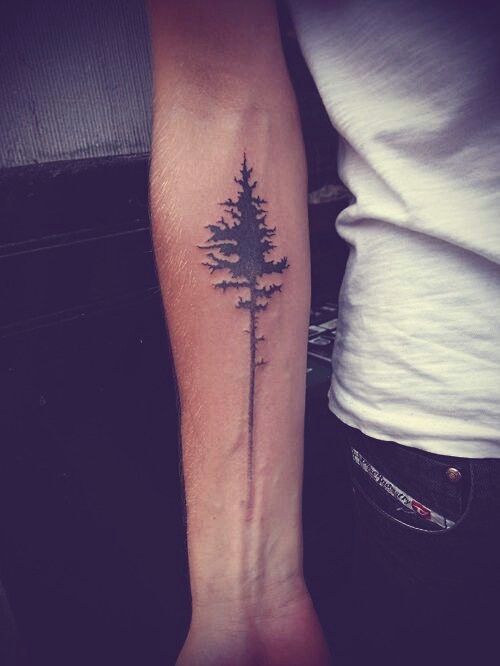 After my wife Katie and I decided to get matching tattoos, we spent months pinning designs and discussing placement, and—let’s be honest—fighting over pretty much every detail. It probably had been easier to choose our children’s names. We’re a stubborn and volatile couple, so there was no chance this would be a sweet story; it could only be a struggle of wills. We arrived, exhausted, at a conclusion, but somehow still grateful for one another, and when we finally got to the tattoo parlor, it could only have been anticlimactic.
Our artist, a large bald man named Bear with tattoos all over his arms, neck, and head, told us to walk around for twenty minutes or so while he made the stencils, giving us the opportunity to argue one last time about where to get marked. We had agreed on tree of life designs—mine more Celtic and hers more organic.
The tree invokes diverse mythologies, not least that of Genesis where it represents the source of eternal life in Christ. It also hearkens to an image of growing together from the sermon Katie’s grandfather gave at our wedding. We’d get the design on our inner forearms—my left, her right—so that they’d sort of knot up whenever we held hands, ‘cause we’re sweet like that.
Agreeing to get a tattoo in the first place had been something of a process for me, and it brought me in touch with the conflictual relationship between my theology of the body and my actual emotions about my body and my wife’s. When we actually pulled the trigger, we both learned something about ourselves. She learned she was not nearly so casual as she had thought herself: She reneged on the forearm placement and opted for her back. I learned, to my own surprise, that I existed in space and time.
Maybe that’s dramatic, but that’s how it felt. When I woke up the next morning with a large, black, knotted tree on my arm, I felt a different relationship to the world than I had the previous day, what I knew was embodiment.
David Bentley Hart describes existence in grand terms as “a pure gift…wavering from nothingness into the openness of God’s self-outpouring infinity, persisting in a condition of absolute fragility and fortuity, impossible in itself, and so actual beyond itself.”
It’s important to Hart that Christian theology affirms the fundamental goodness of creation against most other worldviews that believe life is vexed with doing violence in word and deed. Living, for such belief, becomes a self-aggrandizing heroism rather than a humble celebration of and living for the good Creator. The religious legalism I imbibed as a child committed the same error and gave me psychological blocks to certain forms of body modification.
Legalism also combined with my reserved temperament to create a distance between me and my own life that I’ve often blamed when I’ve felt the paucity of my imagination. As a child I imagined my life in my thirties as some idyll involving a blond wife and sun shining on a breakfast nook. Now that I’m in my thirties I realize most people imagine their futures married to a brunette and renting a nook-less apartment. Yet, I’m still imagining that same nowhere-future I did as a child—not as something I desire so much as what part of me believes I’d have if I’d done life “right.”
It’s silly, really, and perhaps a bit sad. I’ve known enough of the sorts of things that ought to connect me to finitude. We’ve had two kids, I’ve had chronic back pain for years, we’ve tasted stunning wines and melt-in-your-mouth fish and chips, and I’ve mourned at two funerals in the last four months. Yet, none of these things has broken me from that age-old sense of being some kind of space holder for some other existence.
If Hart provides a better theology of life, Gerard Manley Hopkins demonstrates the Christian discipline of attention to the world. His love of particularity helps me feel something of what it must be like to be attuned to the world. When he declares:
Each mortal thing does one thing and the same:
Deals out that being indoors each one dwells;
Selves – goes itself, myself it speaks and spells,
Crying What I do is me: for that I came*.”*
It’s a reminder to me to listen to the world—not to some moral I try to wrest from it but to the way it selves, resonates in its being in harmony with a divine music. The harmony plays in the chaos and the chaos does not overcome it.
Getting the tattoo, allowing my body to be so pierced and stained helped me hear that harmony by making me feel time and fragility as a function of will and bodily permanence. And in this sense of my embodied self I felt, too, more compassion for others, a general feeling of common humanity. Maybe it made me more sensitive to my wife and children; maybe it made it easier to cry at movies; I’m not entirely sure.
Strangely, too, the effect has already begun to fade, despite the ever-present reminder on my arm, such that I’m torn between the surprising feelings of wanting, on the one hand, to maybe get another one to feel it again, and on the other hand, to re-experience some of the very same anxieties from the first time around.
But seeking such stimulation is not really the trick. The trick, as Hopkins shows us, is to learn to see how “Christ plays in ten thousand places,” how the grace of being shines in every moment and wraps us in the presence of God in the present, in the world. In the flesh.
Brad Fruhauff is a film buff, comics nerd, literature scholar, editor, and writer living in Evanston, Illinois. He is Senior Editor at Relief: A Christian Literary Review and a Writing and Communications Specialist at Trinity International University where he also serves as Contributing Editor for Sapientia. He has published poems, essays, and reviews in Books & Culture, catapult, Christianity and Literature, Englewood Review of Books, Every Day Poems, Not Yet Christmas: An Advent Reader, Rock & Sling, and in the newly released How to Write a Poem.

Previous Post

February 8, 2016
Why Art?
Next Post
February 10, 2016 The Beautiful Miracle of Our Fragility
Browse Our Archives
Select a Category A. G. Harmon Alissa Wilkinson Allison Backous Art Authors Brad Fruhauff Bradford Winters Bryan Bliss Caroline Langston Chad Thomas Johnston Chris Hoke Christiana N. Peterson Culture D.G. Myers D.L. Mayfield Daniel Bowman Jr. David Griffith Elizabeth Duffy Faith Film Greg Wolfe Guest Contributor Interview Jan Vallone Jeffrey Overstreet Jessica Eddings-Roeser Jessica Mesman Griffith Kelly Foster Lindsey Crittenden Morgan Meis music Natalie Vestin Nick Olson Peggy Rosenthal Personal Reflection Poetry Friday Reflection Relationships Review Richard Chess Richard Cole Sara Zarr Shannon Huffman Polson Sonya Bilocerkowycz Tania Runyan Tony Woodlief Topical Categories Uncategorized Vic Sizemore Writing
Select a Month October 2018 September 2018 August 2018 July 2018 June 2018 May 2018 April 2018 March 2018 February 2018 January 2018 December 2017 November 2017 October 2017 September 2017 August 2017 July 2017 June 2017 May 2017 April 2017 March 2017 February 2017 January 2017 December 2016 November 2016 October 2016 September 2016 August 2016 July 2016 June 2016 May 2016 April 2016 March 2016 February 2016 January 2016 December 2015 November 2015 October 2015 September 2015 August 2015 July 2015 June 2015 May 2015 April 2015 March 2015 February 2015 January 2015 December 2014 November 2014 October 2014 September 2014 August 2014 July 2014 June 2014 May 2014 April 2014 March 2014 February 2014 January 2014 December 2013 November 2013 October 2013 September 2013 August 2013 July 2013 June 2013 May 2013 April 2013 March 2013 February 2013 January 2013 December 2012 November 2012 October 2012 September 2012 August 2012 July 2012 June 2012 May 2012 February 2008
Follow Us!
TAKE THE
Religious Wisdom Quiz
How many days was Jesus tempted in the wilderness?
Select your answer to see how you score.
40 days 50 days 60 days 30 days
Related posts from Good Letters


Morning in a Forgotten Neighborhood


TRENDING AT PATHEOS Catholic

Rejecting Doom: Christian Hope And Human Action
Christianity is a religion of hope. We are to have hope and...

It’s What Comes From Within Which Matters
One of the most difficult things for us to understand is why...

Why I Choose the Eucharist Over the Sermon
Choose the Eucharist, Not the Sermon What are we supposed to get...

5 Design Elements Found in Spiritually Rooted Homes
Putting Spirituality Into Home Decor Our homes are more than our living...

Credo: A Story of God Told with the...
About 10 years ago, I began to imagine a personal "Credo" that...

The Anatomy of Divine Revelation in Catholic Thought
The claim that God has made Himself known to human beings is...
view all Catholic blogs
Ad-Free & Subscriber Log-In Subscription Support
- About Us
- 2026 Calendar
- Videos
- Podcasts
- Library of World Religions
- Faith In Media Tracker
- Advertise With Us
- Write for Us
- Privacy Policy
- Terms of Service
- Do Not Sell My Data
- Contact Us
- Radiant Digital
- Manage Newsletter Subscriptions
- Unsubscribe From Notifications
- Sitemap
Copyright 2008-2026, Patheos. All rights reserved.
Subscription Support Ad-Free & Subscriber Log-In
Follow Patheos