
BuddhistCatholicContemplativeEvangelicalGeneral ChristianHinduJewishLatter-day SaintMuslimNew VisionsProgressive Christian
Beliefs
- Buddhist
- Catholic
- Contemplative
- Evangelical
- General Christian
- Hindu
- Jewish
- Latter-day Saint
- More Voices
- Muslim
- New Visions
- Pagan
- Progressive Christian
Topics
- Religion News
- Food and Religion
- Sports and Religion
- Religious Art
- Religious Music and Entertainment
- Religious Events
- History and Religion
- Style and Religion
- Politics and Religion
- Women in Religion
- Recreation Outdoors and Religion
- Business Finance and Religion
- Careers Workplace and Religion
- Education and Religion
- Family Parenting and Religion
- Health Fitness and Religion
- Home and Religion
- Relationships and Religion
- Technology and Religion
- Travel and Religion
Columnists
- Buddhist Columnists
- Business Finance and Religion Columnists
- Careers Workplace and Religion Columnists
- Catholic Columnists
- Contemplative Columnists
- Education and Religion Columnists
- Evangelists Columnists
- Family Parenting and Religion Columnists
- General Christian Columnists
- Health Fitness and Religion Columnists
- Hindu Columnists
- History and Religion Columnists
- Home and Religion Columnists
- Jewish Columnists
- More Voices Columnists
- Latter Day Columnists
- Muslim Columnists
- New Visions Columnists
- Nonreligious Columnists
- Pagan Columnists
- Politics and Religion Columnists
- Progressive Columnists
- Recreation Outdoors and Religion Columnists
- Relationships and Religion Columnists
- Religion News Columnists
- Religious Art Columnists
- Religious Events Columnists
- Religious Music and Entertainment Columnists
- Sports and Religion Columnists
- Style and Religion Columnists
- Technology and Religion Columnists
- Travel and Religion Columnists
- Women in Religion Columnists
Resource Library
- 2026 Calendar
- Library of World Religions
- The 100 Most Holy Places on Earth
- Patheos Answers
- Podcasts
- Videos
- Faith Leaders Database
- Anglican Episcopalian
- Bahai
- Baptist
- Buddhism
- Christianity
- Confucianism
- Eastern Orthodoxy
- Hinduism
- Holiness and Pentecostal
- ISKCON
- Islam
- Judaism
- Lutheran
- Methodist
- The Church of Jesus Christ of Latter-day Saints
- New Age
- Paganism
- Presbytarian and Reformed
- Protestantism
- Religion Behind the Scenes
- Roman Catholic
- Scientology
- Shia Islam
- Sikhism
- Sufism
- Sunni Islam
- Taoism
- Zen
- See all religions
Research Tools
 Ad-Free & Subscriber Log-In Subscription Support
Ad-Free & Subscriber Log-In Subscription Support
Follow Patheos 

- Trending:
- Forgiveness
- |
- Marriage
- |
- Consciousness
- |
- Death Penalty
- |
- Election
- |
- Halloween
 Good Letters
-
Contributors
- Home
- Catholic
- Fiat Lux: Cathedral of the Pines
Fiat Lux: Cathedral of the Pines
Last updated on: February 19, 2016 at 1:00 am by Alissa Wilkinson
Fiat Lux: Cathedral of the Pines 2016-02-17T10:40:45-07:00 Alissa Wilkinson
Patheos Explore the world's faith through different perspectives on religion and spirituality! Patheos has the views of the prevalent religions and spiritualities of the world.
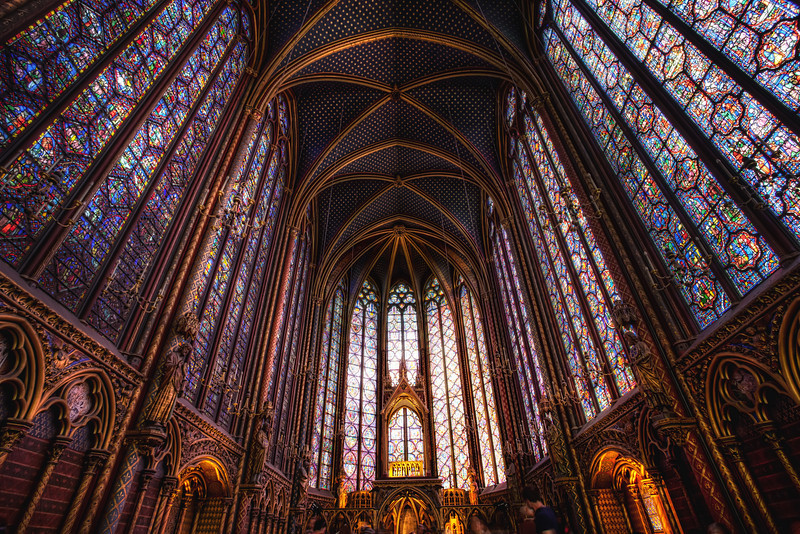 This summer in Paris, on the morning before we flew home, I took my husband to Sainte-Chapelle, the medieval Gothic chapel on the Île de la Cité, right in the heart of Paris, a few streets over from the Notre Dame.
A friend had brought me to Sainte-Chappelle years before. In the few free hours we had following a conference, it was the only thing I saw in the city on that trip. I climbed the stairs from the lower chapel wearily, still jetlagged. But though half the famous windows were covered for construction, the light exploded across my field of vision with a shock I can still feel in my bones when I remember it.
Fifteen stained glass windows from the thirteenth century ring the room, stretching almost from floor to ceiling—not set into the walls so much as forming them. You can taste the rose light, feel it press your skin. It is glossy, thick with history and memory and the breath of millions of visitors.
With my husband in tow on the last day of our trip, I padded up those stairs again, this time wide awake and ready for the light. In the years since I’d been there, the covered half of the room had been restored and the scaffolding removed, revealing the other half. Now I could see all fifteen windows, and I stood in the middle of the room, transfixed.
Fiat lux. Let there be light: The organizing principle of the Gothic cathedral, nowhere more evident than Sainte-Chapelle.
The world is larger inside that cathedral, and I am lit from every side with every color. Creation is reborn, warmed with the light that seems close to the first sunrise. Every sunrise and glowing wintry pink sunset brings me back to that room.
Our winter in New York City has been mostly dry and cold, and so we’ve seen our share of pink sunsets. After one of those a few weeks ago, my husband brought me to the Gagosian Gallery in Chelsea to see the latest collection of photographs from acclaimed artist Gregory Crewdson, who creates staged scenes with figures and a sense of the uncanny.
The exhibit is called Cathedral of the Pines, for a trail in Becket, Massachusetts, on which Crewdson actually shot some of the images in 2013 and 2014. There are thirty-one images, nearly evenly split between indoor and outdoor scenes. They are shot and developed in a way that self-consciously evokes paintings more than photographs, with figures and colors that feel fixed upon the canvas as if laid there carefully with a brush.
In all of them, human figures appear that recall Edward Hopper’s lonely, empty-eyed subjects—along with houses and structures that also recall Hopper, all located in towering forests or near bridges. We’ve caught these figures in a moment in their story that’s so ambiguous we’re not sure what’s going on. Many are in states of undress. And even when they’re in a room together, they are alone.
“It was deep in the forests of Becket, Massachusetts, that I finally felt darkness lift, experienced a reconnection with my artistic process, and moved into a period of renewal and intense creative productivity,” Crewdson writes about creating the series.
Cathedral of the Pines. With Sainte-Chappelle still humming in my mind, the exhibit’s name and images turned me on to the possibilities of light and space—and it’s hard to imagine that they weren’t somewhere in the artist’s mind.
In the interior shots, the lonely figures are placed in domestic spaces with banal and sometimes ugly fixtures, wood-paneled walls with holes cut in them, worn carpets, mismatched furniture. They don’t look happy—they’ve been caught in moments of melancholy reflection, realization, or despair, but with expressions so muted that we fill in the blanks.
Slowly, though, we begin to see that there is something missing in the images. In several, footprints in the snow spotted outside the house lead away. In “Father and Son,” a man lies in bed, and we can see a son reflected in the mirror on the wall, but only in the mirror: Is he there at all?
Sometimes what’s missing is less obvious—a fishing rod, a heavy piece of furniture that left a dent in the shag carpet. In a number of the photographs both indoors and outdoors, people stand nude, often with their clothing piled visibly in the image. What happened here? What or who led them to a state of exposure? It’s not so much Adam and Eve in a state of nature as figures obviously and intentionally disrobed, as if trying to get closer to something in the air.
What hangs about all the figures is a light that doesn’t match the environment. This is especially clear in the interior images, where women and men stand at sinks and sit at tables and sink into easy chairs, smoking, with the lightest hint of a halo, as if the glow is coming from somewhere else, contrasting sharply with their expressions of weariness.
It’s hard not to think of religious iconography, faces lit from within and serious with holiness. But these are lit from beyond—from, presumably, the pines; even in the indoor scenes, small pictures on the walls of the home depict the trees and mountains outside, tiny ironic reflections of the grandeur visible just outside of the windows.
That Crewdson “felt darkness lift” in these forests isn’t obvious from the images—if anything, you can feel the darkness descending on these lonely subjects.
But the light around them recalls the cathedrals—which are, after all, altars at which worshippers remember an absent person they expect to return. The light all around the worshipper in the cathedral, the figure in the midst of the pines, and even the gawking tourist in Sainte-Chapelle—each is a palpable attempt to evoke the warmth of a divine presence, a reality to hope for, a desperate and grasping belief in an end where all will be set right.
Alissa Wilkinson is Christianity Today’s chief film critic and an assistant professor of English and humanities at The King’s College in New York City. She taught the “Spirituality and Food” seminar at the Glen Workshop in 2015 and tweets at @alissamarie.

Previous Post

February 18, 2016
Everyone’s Waiting for the Victory Song
Next Post
February 22, 2016 Poetry in a Season of Lament, Part 1
Browse Our Archives
Select a Category A. G. Harmon Alissa Wilkinson Allison Backous Art Authors Brad Fruhauff Bradford Winters Bryan Bliss Caroline Langston Chad Thomas Johnston Chris Hoke Christiana N. Peterson Culture D.G. Myers D.L. Mayfield Daniel Bowman Jr. David Griffith Elizabeth Duffy Faith Film Greg Wolfe Guest Contributor Interview Jan Vallone Jeffrey Overstreet Jessica Eddings-Roeser Jessica Mesman Griffith Kelly Foster Lindsey Crittenden Morgan Meis music Natalie Vestin Nick Olson Peggy Rosenthal Personal Reflection Poetry Friday Reflection Relationships Review Richard Chess Richard Cole Sara Zarr Shannon Huffman Polson Sonya Bilocerkowycz Tania Runyan Tony Woodlief Topical Categories Uncategorized Vic Sizemore Writing
Select a Month October 2018 September 2018 August 2018 July 2018 June 2018 May 2018 April 2018 March 2018 February 2018 January 2018 December 2017 November 2017 October 2017 September 2017 August 2017 July 2017 June 2017 May 2017 April 2017 March 2017 February 2017 January 2017 December 2016 November 2016 October 2016 September 2016 August 2016 July 2016 June 2016 May 2016 April 2016 March 2016 February 2016 January 2016 December 2015 November 2015 October 2015 September 2015 August 2015 July 2015 June 2015 May 2015 April 2015 March 2015 February 2015 January 2015 December 2014 November 2014 October 2014 September 2014 August 2014 July 2014 June 2014 May 2014 April 2014 March 2014 February 2014 January 2014 December 2013 November 2013 October 2013 September 2013 August 2013 July 2013 June 2013 May 2013 April 2013 March 2013 February 2013 January 2013 December 2012 November 2012 October 2012 September 2012 August 2012 July 2012 June 2012 May 2012 February 2008
Follow Us!
TAKE THE
Religious Wisdom Quiz
In the Parable of the Good Samaritan, who is the true neighbor?
Select your answer to see how you score.
The Levite The Samaritan The priest The robber
Related posts from Good Letters


Morning in a Forgotten Neighborhood


TRENDING AT PATHEOS Catholic

Rejecting Doom: Christian Hope And Human Action
Christianity is a religion of hope. We are to have hope and...

It’s What Comes From Within Which Matters
One of the most difficult things for us to understand is why...

Why I Choose the Eucharist Over the Sermon
Choose the Eucharist, Not the Sermon What are we supposed to get...

5 Design Elements Found in Spiritually Rooted Homes
Putting Spirituality Into Home Decor Our homes are more than our living...

Credo: A Story of God Told with the...
About 10 years ago, I began to imagine a personal "Credo" that...

The Anatomy of Divine Revelation in Catholic Thought
The claim that God has made Himself known to human beings is...
view all Catholic blogs
Ad-Free & Subscriber Log-In Subscription Support
- About Us
- 2026 Calendar
- Videos
- Podcasts
- Library of World Religions
- Faith In Media Tracker
- Advertise With Us
- Write for Us
- Privacy Policy
- Terms of Service
- Do Not Sell My Data
- Contact Us
- Radiant Digital
- Manage Newsletter Subscriptions
- Unsubscribe From Notifications
- Sitemap
Copyright 2008-2026, Patheos. All rights reserved.
Subscription Support Ad-Free & Subscriber Log-In
Follow Patheos