
BuddhistCatholicContemplativeEvangelicalGeneral ChristianHinduJewishLatter-day SaintMuslimNew VisionsProgressive Christian
Beliefs
- Buddhist
- Catholic
- Contemplative
- Evangelical
- General Christian
- Hindu
- Jewish
- Latter-day Saint
- More Voices
- Muslim
- New Visions
- Pagan
- Progressive Christian
Topics
- Religion News
- Food and Religion
- Sports and Religion
- Religious Art
- Religious Music and Entertainment
- Religious Events
- History and Religion
- Style and Religion
- Politics and Religion
- Women in Religion
- Recreation Outdoors and Religion
- Business Finance and Religion
- Careers Workplace and Religion
- Education and Religion
- Family Parenting and Religion
- Health Fitness and Religion
- Home and Religion
- Relationships and Religion
- Technology and Religion
- Travel and Religion
Columnists
- Buddhist Columnists
- Business Finance and Religion Columnists
- Careers Workplace and Religion Columnists
- Catholic Columnists
- Contemplative Columnists
- Education and Religion Columnists
- Evangelists Columnists
- Family Parenting and Religion Columnists
- General Christian Columnists
- Health Fitness and Religion Columnists
- Hindu Columnists
- History and Religion Columnists
- Home and Religion Columnists
- Jewish Columnists
- More Voices Columnists
- Latter Day Columnists
- Muslim Columnists
- New Visions Columnists
- Nonreligious Columnists
- Pagan Columnists
- Politics and Religion Columnists
- Progressive Columnists
- Recreation Outdoors and Religion Columnists
- Relationships and Religion Columnists
- Religion News Columnists
- Religious Art Columnists
- Religious Events Columnists
- Religious Music and Entertainment Columnists
- Sports and Religion Columnists
- Style and Religion Columnists
- Technology and Religion Columnists
- Travel and Religion Columnists
- Women in Religion Columnists
Resource Library
- 2026 Calendar
- Library of World Religions
- The 100 Most Holy Places on Earth
- Patheos Answers
- Podcasts
- Videos
- Faith Leaders Database
- Anglican Episcopalian
- Bahai
- Baptist
- Buddhism
- Christianity
- Confucianism
- Eastern Orthodoxy
- Hinduism
- Holiness and Pentecostal
- ISKCON
- Islam
- Judaism
- Lutheran
- Methodist
- The Church of Jesus Christ of Latter-day Saints
- New Age
- Paganism
- Presbytarian and Reformed
- Protestantism
- Religion Behind the Scenes
- Roman Catholic
- Scientology
- Shia Islam
- Sikhism
- Sufism
- Sunni Islam
- Taoism
- Zen
- See all religions
Research Tools
 Ad-Free & Subscriber Log-In Subscription Support
Ad-Free & Subscriber Log-In Subscription Support
Follow Patheos 

- Trending:
- Forgiveness
- |
- Marriage
- |
- Consciousness
- |
- Death Penalty
- |
- Election
- |
- Halloween
 Good Letters
-
Contributors
- Home
- Catholic
- Brooklyn: A Drama of Discernment
Brooklyn: A Drama of Discernment
Last updated on: February 5, 2016 at 1:00 am by A. G. Harmon
Brooklyn: A Drama of Discernment 2016-02-01T12:50:01-07:00 A. G. Harmon
Patheos Explore the world's faith through different perspectives on religion and spirituality! Patheos has the views of the prevalent religions and spiritualities of the world.
 One of the hardest things in life is having two good choices that are completely exclusive of each other. It’s not a matter of picking a major in college, regretting it, and changing to another track; not a matter of taking a job at the wrong place and eventually finding your way to another one. Many choices—perhaps most choices—can be undone, however long and laborious the undoing.
But those decisions that are irreversible, unalterable, and unavoidable are the ones that cause the most anguish, especially when there’s much to recommend both of the alternatives (of course, at times we’re cursed with an array of good options, but for simplicity’s sake, we’ll keep it to two). In these dilemmas, we have an embarrassment of riches. The stakes are high: Pick one and lose the other forever.
Arguably, in this day and age, such dire consequences are less often the case than they used to be. What were historically lifelong commitments are now temporary engagements; wherever you are, you can get out pretty quickly. Affiliations, careers, and faiths are imminently interchangeable now.
Even marriage, which was once a permanent choice, has hardly the strength of a hair anymore, let alone a chain. You can divorce several times without stigma, though with somewhat more financial burden. And to our eternal shame, even children can be opted out of now, with the backing of a vast secular orthodoxy and the many huge industries that make a profit from it.
But that was not always so. There was a time when choosing meant you made a promise that honor and decency demanded you keep. In one of the loveliest movies to come along in a while, one of the loveliest characters to come along in an equally long while has to make such a choice—between two good things that she could never have predicted would present themselves.
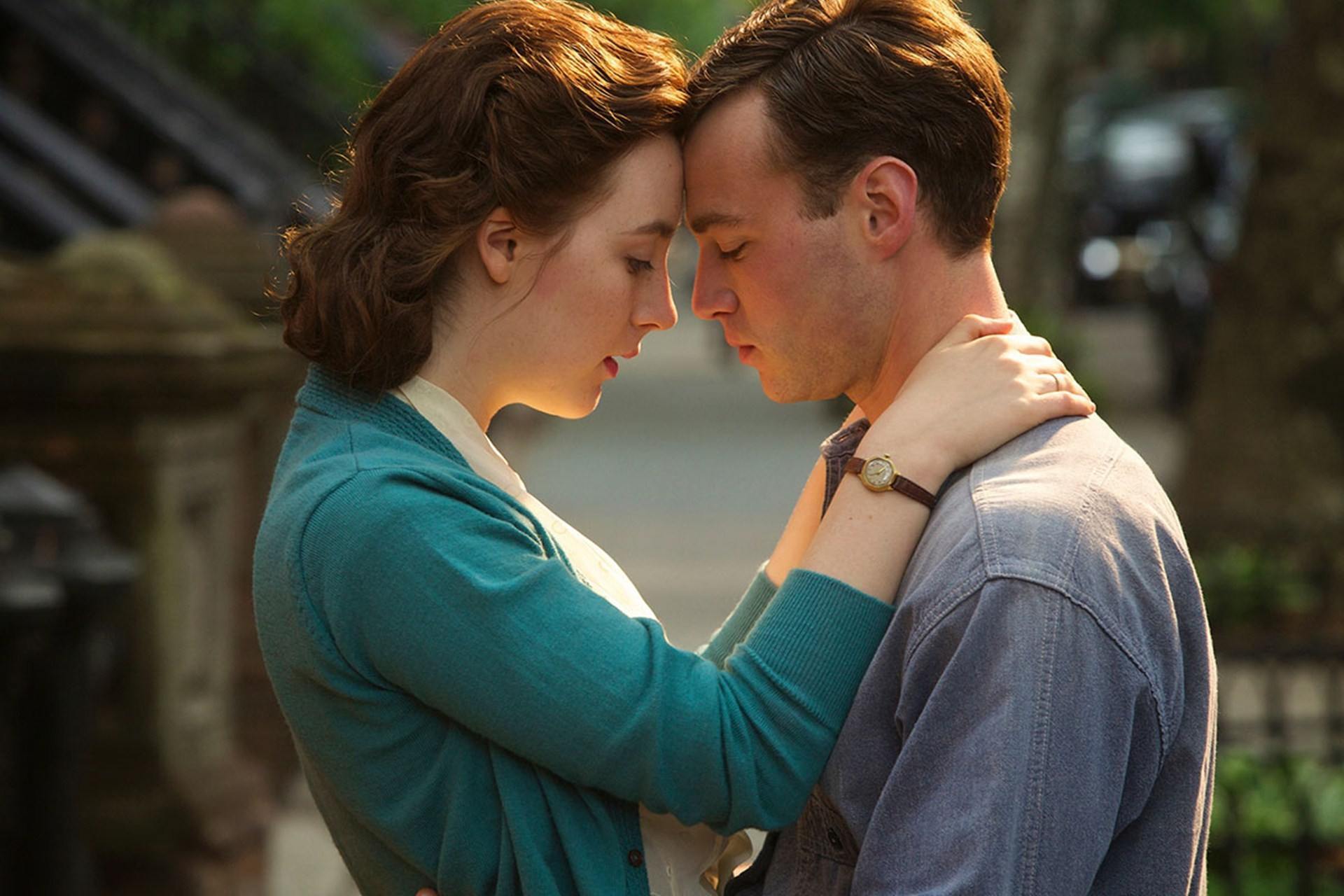
In the film version of Colm Tóibín’s novel Brooklyn, screenwriter (and great novelist) Nick Hornby dramatizes the choices facing Eilis Lacey, an Irish immigrant to 1950s New York City. Eilis (portrayed with remarkable sensitivity by Saoirse Ronan) begins her journey to America because she in fact has so few alternatives in her village. Although she loves the place dearly, and is intensely close to her devoted sister and her widowed mother, there is no job for her and no prospect of marriage.
Through the arrangements made by a kindly Irish priest now in New York, Eilis is promised a position in a department store. So she sets out across the ocean in hopes of making a life for herself, just as so many immigrants have always done.
The film could have followed the cliché of that journey, but though there are things familiar to all such tales—the alienation of the newly arrived, the nearly unendurable homesickness, the regrets of having committed what seems from all indications to be a terrible mistake, all balanced against the small joys and slowly-won triumphs of good-hearted helpers—the movie is about much more than that.
For Eilis is not a sad case who finds her way to prosperity, learning that what seemed an error was in fact a triumph—but a case who, because of unforeseen circumstances, finds herself with the option of two lives, each as wonderful and appealing as the other.
One alternative is the new life she’s found, the one that began with the future secured for her by the old village priest (who thankfully never becomes a villain in the film). After she withstands her initial trials, Eilis finds her feet through the encouragement of the priest, letters from home, and the kindness of her new acquaintances. She is heart sore, but slowly acclimates to her environs, even attending a bookkeeping class that the priest has steered her toward.
Then she meets a young Italian-American man at a dance. In time, the depth of his devotion to her becomes a thing of wonder, so much so that it takes her words away. The embrace of his love is overwhelming, and the humble but bright future he wants to provide for her is more than she dreamed possible. Everything is working out.
Then she gets news from home; monumental news. A turn of events requires Eilis her to leave the place she has come to love, and a man who loves her, and temporarily return to the place that she first loved, and to those who first taught her just what that word means. What develops back in Ireland is something that, had the timing been different—had the new events transpired before she set out for America—most certainly would have kept her from ever leaving.
All that she’d worked to place in a safe, cordoned-off spot in her heart comes rushing back. Both sides of the Atlantic pull at her with equal force.
When you have allegiances and loyalties and duties on both sides of a question, what do you do? And when the only downside to both choices is that one of them must be surrendered forever, how do you decide?
The need for the power of discernment in such situations is most keenly felt. Highlighting that moral impasse is a unique and beautifully rendered complication in Brooklyn. And when Eilis makes her choice, it is supremely satisfying to reflect upon the basis of that choice, and at what exact point it became clear to her that she had to make it.
A.G. Harmon teaches Shakespeare, Law and Literature, Jurisprudence, and Writing at The Catholic University of America in Washington, D.C. His novel, A House All Stilled, won the 2001 Peter Taylor Prize for the Novel.

Previous Post

February 4, 2016
Kolam: The Beauty of Uselessness
Next Post
February 8, 2016 Why Art?
Browse Our Archives
Select a Category A. G. Harmon Alissa Wilkinson Allison Backous Art Authors Brad Fruhauff Bradford Winters Bryan Bliss Caroline Langston Chad Thomas Johnston Chris Hoke Christiana N. Peterson Culture D.G. Myers D.L. Mayfield Daniel Bowman Jr. David Griffith Elizabeth Duffy Faith Film Greg Wolfe Guest Contributor Interview Jan Vallone Jeffrey Overstreet Jessica Eddings-Roeser Jessica Mesman Griffith Kelly Foster Lindsey Crittenden Morgan Meis music Natalie Vestin Nick Olson Peggy Rosenthal Personal Reflection Poetry Friday Reflection Relationships Review Richard Chess Richard Cole Sara Zarr Shannon Huffman Polson Sonya Bilocerkowycz Tania Runyan Tony Woodlief Topical Categories Uncategorized Vic Sizemore Writing
Select a Month October 2018 September 2018 August 2018 July 2018 June 2018 May 2018 April 2018 March 2018 February 2018 January 2018 December 2017 November 2017 October 2017 September 2017 August 2017 July 2017 June 2017 May 2017 April 2017 March 2017 February 2017 January 2017 December 2016 November 2016 October 2016 September 2016 August 2016 July 2016 June 2016 May 2016 April 2016 March 2016 February 2016 January 2016 December 2015 November 2015 October 2015 September 2015 August 2015 July 2015 June 2015 May 2015 April 2015 March 2015 February 2015 January 2015 December 2014 November 2014 October 2014 September 2014 August 2014 July 2014 June 2014 May 2014 April 2014 March 2014 February 2014 January 2014 December 2013 November 2013 October 2013 September 2013 August 2013 July 2013 June 2013 May 2013 April 2013 March 2013 February 2013 January 2013 December 2012 November 2012 October 2012 September 2012 August 2012 July 2012 June 2012 May 2012 February 2008
Follow Us!
TAKE THE
Religious Wisdom Quiz
What city did Jesus grow up in?
Select your answer to see how you score.
Jericho Nazareth Bethlehem Capernaum
Related posts from Good Letters


Morning in a Forgotten Neighborhood


TRENDING AT PATHEOS Catholic

The Parable Of The Sower And The Word...
One of Christ’s most famous parables is that of the sower who...

Rejecting Doom: Christian Hope And Human Action
Christianity is a religion of hope. We are to have hope and...

Why I Choose the Eucharist Over the Sermon
Choose the Eucharist, Not the Sermon What are we supposed to get...

5 Design Elements Found in Spiritually Rooted Homes
Putting Spirituality Into Home Decor Our homes are more than our living...

Credo: A Story of God Told with the...
About 10 years ago, I began to imagine a personal "Credo" that...

The Anatomy of Divine Revelation in Catholic Thought
The claim that God has made Himself known to human beings is...
view all Catholic blogs
Ad-Free & Subscriber Log-In Subscription Support
- About Us
- 2026 Calendar
- Videos
- Podcasts
- Library of World Religions
- Faith In Media Tracker
- Advertise With Us
- Write for Us
- Privacy Policy
- Terms of Service
- Do Not Sell My Data
- Contact Us
- Radiant Digital
- Manage Newsletter Subscriptions
- Unsubscribe From Notifications
- Sitemap
Copyright 2008-2026, Patheos. All rights reserved.
Subscription Support Ad-Free & Subscriber Log-In
Follow Patheos