
BuddhistCatholicContemplativeEvangelicalGeneral ChristianHinduJewishLatter-day SaintMuslimNew VisionsProgressive Christian
Beliefs
- Buddhist
- Catholic
- Contemplative
- Evangelical
- General Christian
- Hindu
- Jewish
- Latter-day Saint
- More Voices
- Muslim
- New Visions
- Pagan
- Progressive Christian
Topics
- Religion News
- Food and Religion
- Sports and Religion
- Religious Art
- Religious Music and Entertainment
- Religious Events
- History and Religion
- Style and Religion
- Politics and Religion
- Women in Religion
- Recreation Outdoors and Religion
- Business Finance and Religion
- Careers Workplace and Religion
- Education and Religion
- Family Parenting and Religion
- Health Fitness and Religion
- Home and Religion
- Relationships and Religion
- Technology and Religion
- Travel and Religion
Columnists
- Buddhist Columnists
- Business Finance and Religion Columnists
- Careers Workplace and Religion Columnists
- Catholic Columnists
- Contemplative Columnists
- Education and Religion Columnists
- Evangelists Columnists
- Family Parenting and Religion Columnists
- General Christian Columnists
- Health Fitness and Religion Columnists
- Hindu Columnists
- History and Religion Columnists
- Home and Religion Columnists
- Jewish Columnists
- More Voices Columnists
- Latter Day Columnists
- Muslim Columnists
- New Visions Columnists
- Nonreligious Columnists
- Pagan Columnists
- Politics and Religion Columnists
- Progressive Columnists
- Recreation Outdoors and Religion Columnists
- Relationships and Religion Columnists
- Religion News Columnists
- Religious Art Columnists
- Religious Events Columnists
- Religious Music and Entertainment Columnists
- Sports and Religion Columnists
- Style and Religion Columnists
- Technology and Religion Columnists
- Travel and Religion Columnists
- Women in Religion Columnists
Resource Library
- 2026 Calendar
- Library of World Religions
- The 100 Most Holy Places on Earth
- Patheos Answers
- Podcasts
- Videos
- Faith Leaders Database
- Anglican Episcopalian
- Bahai
- Baptist
- Buddhism
- Christianity
- Confucianism
- Eastern Orthodoxy
- Hinduism
- Holiness and Pentecostal
- ISKCON
- Islam
- Judaism
- Lutheran
- Methodist
- The Church of Jesus Christ of Latter-day Saints
- New Age
- Paganism
- Presbytarian and Reformed
- Protestantism
- Religion Behind the Scenes
- Roman Catholic
- Scientology
- Shia Islam
- Sikhism
- Sufism
- Sunni Islam
- Taoism
- Zen
- See all religions
Research Tools
 Ad-Free & Subscriber Log-In Subscription Support
Ad-Free & Subscriber Log-In Subscription Support
Follow Patheos 

- Trending:
- Forgiveness
- |
- Marriage
- |
- Consciousness
- |
- Death Penalty
- |
- Election
- |
- Halloween
 Good Letters
-
Contributors
- Home
- Catholic
- The Confessions of X: An Interview with Suzanne M. Wolfe, Part 1
The Confessions of X: An Interview with Suzanne M. Wolfe, Part 1
Last updated on: January 28, 2016 at 1:00 am by Gregory Wolfe
The Confessions of X: An Interview with Suzanne M. Wolfe, Part 1 2016-01-26T13:01:00-07:00 Gregory Wolfe
Patheos Explore the world's faith through different perspectives on religion and spirituality! Patheos has the views of the prevalent religions and spiritualities of the world.
By Gregory Wolfe and Suzanne M. Wolfe
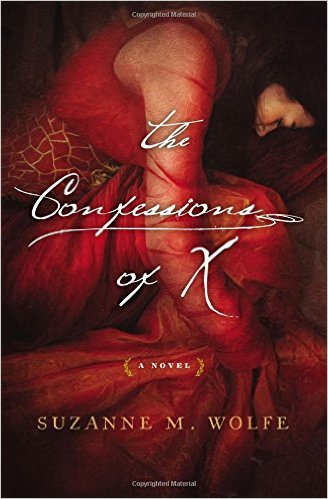 Earlier this week, HarperCollins/Nelson released The Confessions of X, Suzanne M. Wolfe’s second novel. Image editor Gregory Wolfe interviewed her about the book.
GW: So I guess doing this interview with you is a case of raw nepotism. You OK with that?
SMW: I prefer my nepotism medium rare.
GW: Your second novel, The Confessions of X, has just been published. What is it about?
SMW: It’s the story of St. Augustine’s concubine told in her own voice—her “Confessions,” if you will. She is a shadowy figure in Augustine’s Confessions. He simply refers to her as “Una”—the One. The first chapter begins with her as an old woman waiting in the courtyard outside the room in which Augustine is dying in the city of Hippo Regius. As she waits for night to fall, she recounts the story of her life and how she came to meet Augustine in Carthage, became his concubine, and bore him a son. And what happens to her after he famously casts her off.
GW: Why did you decide to write her story?
SMW: In religion class at my convent school when I was twelve, I raised my hand and asked who this mysterious woman was in Augustine’s Confessions. Sister Bernadette replied: “No one knows. She is lost to history.” That phrase “lost to history” stayed with me. I thought of all the great women in history whose lives have been eclipsed by the men they loved. Forty years later, I decided to go looking for the concubine so she could tell her story.
GW: We use the term “concubine” rather loosely, I believe. You’ve said that “common law wife” would be a more accurate term. Could you explain a bit about that, since it affects how people understand this story?
SMW: To our contemporary ears “concubine” sounds synonymous with “mistress” or even “prostitute.” In the ancient world this wasn’t the case. The reason I liken a concubine to a common-law wife is that concubinage involved a monogamous sexual relationship when the man and woman were not, or could not be, married for societal reasons.
This was almost always due to a man of higher social status falling in love with a woman of low social status. One of the most famous examples is Caelis, the freedwoman and concubine of the Emperor Vespasian. Frequently, concubinage was voluntary on the part of the woman and her family as it involved a means by which she could attain economic security. To be labeled a concubine was not a derogatory term in the ancient world and was often inscribed on tombstones to denote the status of the deceased.
GW: Augustine has the reputation of being sexually promiscuous—in part, because of his own language condemning his sins—but he was faithful to the concubine, wasn’t he?
SMW: Yes, he was faithful to the concubine all the years they were together. After she was sent away, he had a brief fling with his housekeeper. I think that he was so ashamed about this “affair” that he castigates himself too harshly about it in the Confessions, hence the lasting impression in history that he was promiscuous. By today’s standards, and perhaps any age’s, he was a model of chastity.
GW: Augustine never names her in his own Confessions, even though he names all the other principals in his life. So she remains nameless, and you’ve stayed true to that by never giving her name in the book (hence “X”)…
SMW: At first, I was mad at Augustine for not naming her. I thought that it suggested that he was ashamed of his relationship with her. But the great biographer, Peter Brown, believes that she may have been living at the time the Confessions was published and Augustine was trying to preserve her anonymity. I agree.
It is clear that Augustine loved her passionately. In the Confessions he says: “The woman with whom I had been living was torn from my side as an obstacle to my marriage and this blow crushed my heart to bleeding because I loved her dearly.”
In the earlier drafts of the novel, I named her at the very end. But then it occurred to me that the voice that emerges in the novel is so singular, so vibrantly alive, that it is this that gives her a more lasting and unique identity and that her name was no longer so important.
GW: In the novel, X is the daughter of a mosaicist or a mosaic artist—or whatever the term is. Why did that appeal to you?
SMW: At some point in the narrative, X’s father describes his craft as “the art of broken things.” The creation of a mosaic from tesserae is a wonderful metaphor for the memoir—the careful selection of particular memories to make a retrospective narrative of X’s life from childhood to old age. She is, in so many ways, her father’s daughter—she builds up a compelling picture of her life and the ancient world of Carthage, Rome, and Milan for the reader. And her life is tragic but she takes these broken pieces and makes a beautiful whole out of them.
GW: Augustine and X were very young when they entered into their relationship. I suppose part of the poignancy of the story for both of them is that they couldn’t foresee what was to come, right?
SMW: Absolutely. We know Augustine was seventeen when he met X in Carthage. She was probably younger by a year or two. So they were both only teenagers, for heaven’s sake. And we know how reckless and passionate teenagers are [here Suzanne and Greg, parents of four adult children, exchange small, slightly weary smiles].
In addition, Augustine belonged to a Gnostic sect, the Manichees, so nothing indicated that he would one day convert to Catholicism, that he would become a priest and bishop. The sad thing is that, even if he had not converted, Augustine would not have been able to rise in his profession as rhetor and, later, as orator to the imperial court in Milan, unless he made an advantageous marriage to a woman of his own social rank. In hindsight, one could perhaps predict that they would have been parted by events, but what young love can look that far into the future?
To be continued tomorrow.
Gregory Wolfe is the founder of Image and serves as Writer in Residence and Director of the MFA in Creative Writing program at Seattle Pacific University. His books includeThe Operation of Grace: Further Essays on Art, Faith, and Mystery, Beauty Will Save the World and Intruding Upon the Timeless. Follow him on Twitter: @Gregory_Wolfe.
Suzanne M. Wolfe grew up in Manchester, England, and read English Literature at Oxford University, where she co-founded the Oxford C.S. Lewis Society. She is Writer in Residence at Seattle Pacific University and has taught literature and creative writing there since 2000. Wolfe is the author of Unveiling: A Novel (Paraclete Press, 2004) and co-founder, along with her husband, of Image, a journal of the arts and faith. Suzanne and Greg have also co-authored many books on literature and prayer and are the parents of four grown children. They live outside of Seattle.

Previous Post

January 27, 2016
Where to Hang Your Grief
Next Post
January 29, 2016 The Confessions of X: An Interview with Suzanne M. Wolfe, Part 2
Browse Our Archives
Select a Category A. G. Harmon Alissa Wilkinson Allison Backous Art Authors Brad Fruhauff Bradford Winters Bryan Bliss Caroline Langston Chad Thomas Johnston Chris Hoke Christiana N. Peterson Culture D.G. Myers D.L. Mayfield Daniel Bowman Jr. David Griffith Elizabeth Duffy Faith Film Greg Wolfe Guest Contributor Interview Jan Vallone Jeffrey Overstreet Jessica Eddings-Roeser Jessica Mesman Griffith Kelly Foster Lindsey Crittenden Morgan Meis music Natalie Vestin Nick Olson Peggy Rosenthal Personal Reflection Poetry Friday Reflection Relationships Review Richard Chess Richard Cole Sara Zarr Shannon Huffman Polson Sonya Bilocerkowycz Tania Runyan Tony Woodlief Topical Categories Uncategorized Vic Sizemore Writing
Select a Month October 2018 September 2018 August 2018 July 2018 June 2018 May 2018 April 2018 March 2018 February 2018 January 2018 December 2017 November 2017 October 2017 September 2017 August 2017 July 2017 June 2017 May 2017 April 2017 March 2017 February 2017 January 2017 December 2016 November 2016 October 2016 September 2016 August 2016 July 2016 June 2016 May 2016 April 2016 March 2016 February 2016 January 2016 December 2015 November 2015 October 2015 September 2015 August 2015 July 2015 June 2015 May 2015 April 2015 March 2015 February 2015 January 2015 December 2014 November 2014 October 2014 September 2014 August 2014 July 2014 June 2014 May 2014 April 2014 March 2014 February 2014 January 2014 December 2013 November 2013 October 2013 September 2013 August 2013 July 2013 June 2013 May 2013 April 2013 March 2013 February 2013 January 2013 December 2012 November 2012 October 2012 September 2012 August 2012 July 2012 June 2012 May 2012 February 2008
Follow Us!
TAKE THE
Religious Wisdom Quiz
What prominent city did Paul visit, known for its altar to "an unknown god"?
Select your answer to see how you score.
Ephesus Athens Corinth Rome
Related posts from Good Letters

A Conversation with Alicia Ostriker: Part 1

A Conversation with Alicia Ostriker: Part 2

The Stars of the Earth Cry Out

TRENDING AT PATHEOS Catholic

Rejecting Doom: Christian Hope And Human Action
Christianity is a religion of hope. We are to have hope and...

It’s What Comes From Within Which Matters
One of the most difficult things for us to understand is why...

Why I Choose the Eucharist Over the Sermon
Choose the Eucharist, Not the Sermon What are we supposed to get...

5 Design Elements Found in Spiritually Rooted Homes
Putting Spirituality Into Home Decor Our homes are more than our living...

Credo: A Story of God Told with the...
About 10 years ago, I began to imagine a personal "Credo" that...

The Anatomy of Divine Revelation in Catholic Thought
The claim that God has made Himself known to human beings is...
view all Catholic blogs
Ad-Free & Subscriber Log-In Subscription Support
- About Us
- 2026 Calendar
- Videos
- Podcasts
- Library of World Religions
- Faith In Media Tracker
- Advertise With Us
- Write for Us
- Privacy Policy
- Terms of Service
- Do Not Sell My Data
- Contact Us
- Radiant Digital
- Manage Newsletter Subscriptions
- Unsubscribe From Notifications
- Sitemap
Copyright 2008-2026, Patheos. All rights reserved.
Subscription Support Ad-Free & Subscriber Log-In
Follow Patheos