
BuddhistCatholicContemplativeEvangelicalGeneral ChristianHinduJewishLatter-day SaintMuslimNew VisionsProgressive Christian
Beliefs
- Buddhist
- Catholic
- Contemplative
- Evangelical
- General Christian
- Hindu
- Jewish
- Latter-day Saint
- More Voices
- Muslim
- New Visions
- Pagan
- Progressive Christian
Topics
- Religion News
- Food and Religion
- Sports and Religion
- Religious Art
- Religious Music and Entertainment
- Religious Events
- History and Religion
- Style and Religion
- Politics and Religion
- Women in Religion
- Recreation Outdoors and Religion
- Business Finance and Religion
- Careers Workplace and Religion
- Education and Religion
- Family Parenting and Religion
- Health Fitness and Religion
- Home and Religion
- Relationships and Religion
- Technology and Religion
- Travel and Religion
Columnists
- Buddhist Columnists
- Business Finance and Religion Columnists
- Careers Workplace and Religion Columnists
- Catholic Columnists
- Contemplative Columnists
- Education and Religion Columnists
- Evangelists Columnists
- Family Parenting and Religion Columnists
- General Christian Columnists
- Health Fitness and Religion Columnists
- Hindu Columnists
- History and Religion Columnists
- Home and Religion Columnists
- Jewish Columnists
- More Voices Columnists
- Latter Day Columnists
- Muslim Columnists
- New Visions Columnists
- Nonreligious Columnists
- Pagan Columnists
- Politics and Religion Columnists
- Progressive Columnists
- Recreation Outdoors and Religion Columnists
- Relationships and Religion Columnists
- Religion News Columnists
- Religious Art Columnists
- Religious Events Columnists
- Religious Music and Entertainment Columnists
- Sports and Religion Columnists
- Style and Religion Columnists
- Technology and Religion Columnists
- Travel and Religion Columnists
- Women in Religion Columnists
Resource Library
- 2026 Calendar
- Library of World Religions
- The 100 Most Holy Places on Earth
- Patheos Answers
- Podcasts
- Videos
- Faith Leaders Database
- Anglican Episcopalian
- Bahai
- Baptist
- Buddhism
- Christianity
- Confucianism
- Eastern Orthodoxy
- Hinduism
- Holiness and Pentecostal
- ISKCON
- Islam
- Judaism
- Lutheran
- Methodist
- The Church of Jesus Christ of Latter-day Saints
- New Age
- Paganism
- Presbytarian and Reformed
- Protestantism
- Religion Behind the Scenes
- Roman Catholic
- Scientology
- Shia Islam
- Sikhism
- Sufism
- Sunni Islam
- Taoism
- Zen
- See all religions
Research Tools
 Ad-Free & Subscriber Log-In Subscription Support
Ad-Free & Subscriber Log-In Subscription Support
Follow Patheos 

- Trending:
- Forgiveness
- |
- Marriage
- |
- Consciousness
- |
- Death Penalty
- |
- Election
- |
- Halloween
 Good Letters
-
Contributors
- Home
- Catholic
- Learning Detachment in the Attic
Learning Detachment in the Attic
Last updated on: January 14, 2016 at 1:00 am by Guest Contributor
Learning Detachment in the Attic 2016-01-13T16:44:04-07:00 Guest Contributor
Patheos Explore the world's faith through different perspectives on religion and spirituality! Patheos has the views of the prevalent religions and spiritualities of the world.
By Elizabeth Duffy
 When my cousin became a Dominican sister, she gave away all of her belongings. My sister and I were invited to come and shop in her closet and salvage any clothes we wanted before they went to charity. More valuable items she bequeathed to family members, and I was the lucky recipient of a pretty pair of lapis lazuli earrings, as well as a Honda Civic, which I, in turn, drove to Rhode Island to discern my own calling to join a religious community there.
Ultimately, I didn’t stay, but I met my husband’s sister there, and she set me up with the man I would marry less than a year after my return.
I never had it in me to give away all that I own, such a sad and rich young woman was I.
So little has changed.
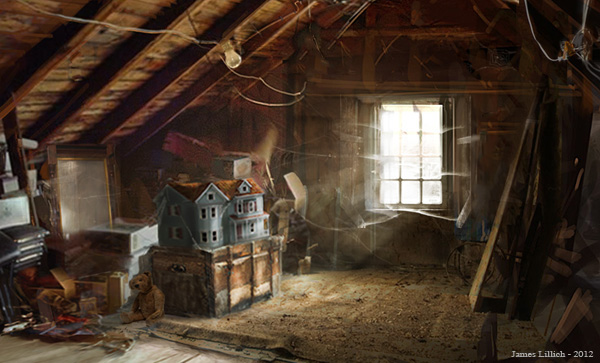
My husband and I have just cleaned out our attic. Everything that was in there is now gone, so that we might begin the process of converting it into another bedroom for the kids, who now sleep stacked like sardines in the two bedrooms upstairs.
What became clear as we went through the piles is that, contrary to all my big talk about detachment and anti-materialism, I’m the packrat in the family. I’m the one with fourteen Sterilite bins in the attic.
Among the items I threw away:
- A fourth grade research paper on the Internal Combustion Engine.
- A bag of plaques connoting high performance in brain game, journalism, cross- country, honor roll, and presidential fitness.
- A box of cassette tapes, including The Smiths, The Cure, The Sugarcubes, and a variety of disintegrating mix tapes from old boyfriends.
- A short story titled “Best Friends” by a nine-year-old author and illustrator who used orange magic marker for skin color.
I was in the process of reading through a box of folded notes passed to me from classmates in middle school when my husband made a move to carry all remaining items out to the burn pit.
“Do you understand that you are asking me to part with my identity? This is going to take some time,” I said to his back as he left the room with another bag of recently coined garbage.
He barely had a yearbook to show for the years of his life before I knew him. Early on when we were dating, I was annoyed that he didn’t have more baby pictures because I wanted to see what kind of babies we might make. Now that that mystery is solved, it’s true, I’ve had little interest in his artifacts.
When I was young, I believed that these objects made me worthy of love. They were the sacraments of secular childhood, the outward sign of my interior life, my interests, my identity, my victories. I lived from ritual to ritual, from the slow build of studying for a final to the release of passing it, from anticipation of a phone call or a school dance to the moment of glorious fulfillment when there would be communion with my fellow supplicants.
I believed that some day, the important people of my future life would be glad to receive all of this testimony, that they would follow the glistening trail from this box to that, this notebook to that one, and the objects would witness on my behalf, ensuring that I would never be reduced to a subjective memory in someone else’s mind.
Here in the Sterilite bins was my eternal life.
Of course, I knew nothing about love when I was a child, having only been the recipient of it. Offering real sacrificial love to others requires so much more than I was prepared to give, and I knew this innately the first time I held a crying newborn in my arms—that the priests of my childhood hadn’t actually supplied me with meaningful tools.
I had to go deeper and lean more heavily into the sacraments I received at Mass, sacraments with more valuable and lasting effect, though the evidence of their existence is less specific—oil, wine, water, bread, a priest making a cross over my head.
Rather than store them for another day when they will testify in my absence, I carry their grace with me, testifying, I hope, not to my own merit, but to the source of my love, which I believe to be God.
I still have affection for the secular rites of life in a small community as I continue to live them with my own burgeoning family—the dark pilgrimage each morning to school and work, and the glad return home, duty done, in the evening. When I’m in the right frame of mind, they can be just as nurturing to me as any heartfelt prayer. The catechism of my faith notes, “God has bound salvation to the sacrament of Baptism, but he himself is not bound by his sacraments.”
In other words, the sacraments of our faith are real, and God has made promises regarding them, but he can still make himself known or not-known however he chooses, and if he wants the Friday night football game to be a source of grace for all who have gathered in the stadium, so be it.
I believe he’s made known to me, specifically, that there is no eternal life in my old Sterilite bins, that they contain, rather, a shrine to a rather average person, and testify to what is least remarkable in my life—minor accomplishments at the threshold of grace.
There’s an old adage that married people end up where religious sisters and priests begin their vocations, with complete detachment from worldly things. Perhaps it is sacramental grace that allows us to do voluntarily what death does for everyone involuntarily, to not just put childish things in the attic for another day, but to really dispense with them and be free.
Elizabeth Duffy writes at Patheos: Elizabeth Duffy: Perspectives on Catholic Life, Family, and Culture and at bettyduffy.blogspot.com. She is a contributor to Living Faith/ Daily Catholic Devotions, and has work published or forthcoming from OSV, On Faith, The Catholic Educator, and Image.

Previous Post

January 13, 2016
Winners: Arts & Faith Ecumenical Jury Awards for 2015, Part 2
Next Post
January 15, 2016 Honey, I Want a Tattoo
Browse Our Archives
Select a Category A. G. Harmon Alissa Wilkinson Allison Backous Art Authors Brad Fruhauff Bradford Winters Bryan Bliss Caroline Langston Chad Thomas Johnston Chris Hoke Christiana N. Peterson Culture D.G. Myers D.L. Mayfield Daniel Bowman Jr. David Griffith Elizabeth Duffy Faith Film Greg Wolfe Guest Contributor Interview Jan Vallone Jeffrey Overstreet Jessica Eddings-Roeser Jessica Mesman Griffith Kelly Foster Lindsey Crittenden Morgan Meis music Natalie Vestin Nick Olson Peggy Rosenthal Personal Reflection Poetry Friday Reflection Relationships Review Richard Chess Richard Cole Sara Zarr Shannon Huffman Polson Sonya Bilocerkowycz Tania Runyan Tony Woodlief Topical Categories Uncategorized Vic Sizemore Writing
Select a Month October 2018 September 2018 August 2018 July 2018 June 2018 May 2018 April 2018 March 2018 February 2018 January 2018 December 2017 November 2017 October 2017 September 2017 August 2017 July 2017 June 2017 May 2017 April 2017 March 2017 February 2017 January 2017 December 2016 November 2016 October 2016 September 2016 August 2016 July 2016 June 2016 May 2016 April 2016 March 2016 February 2016 January 2016 December 2015 November 2015 October 2015 September 2015 August 2015 July 2015 June 2015 May 2015 April 2015 March 2015 February 2015 January 2015 December 2014 November 2014 October 2014 September 2014 August 2014 July 2014 June 2014 May 2014 April 2014 March 2014 February 2014 January 2014 December 2013 November 2013 October 2013 September 2013 August 2013 July 2013 June 2013 May 2013 April 2013 March 2013 February 2013 January 2013 December 2012 November 2012 October 2012 September 2012 August 2012 July 2012 June 2012 May 2012 February 2008
Follow Us!
TAKE THE
Religious Wisdom Quiz
Where did Philip meet the Ethiopian eunuch?
Select your answer to see how you score.
Samaria road Jericho road Desert road Jerusalem road
Related posts from Good Letters


Morning in a Forgotten Neighborhood


TRENDING AT PATHEOS Catholic

Rejecting Doom: Christian Hope And Human Action
Christianity is a religion of hope. We are to have hope and...

It’s What Comes From Within Which Matters
One of the most difficult things for us to understand is why...

Why I Choose the Eucharist Over the Sermon
Choose the Eucharist, Not the Sermon What are we supposed to get...

5 Design Elements Found in Spiritually Rooted Homes
Putting Spirituality Into Home Decor Our homes are more than our living...

Credo: A Story of God Told with the...
About 10 years ago, I began to imagine a personal "Credo" that...

The Anatomy of Divine Revelation in Catholic Thought
The claim that God has made Himself known to human beings is...
view all Catholic blogs
Ad-Free & Subscriber Log-In Subscription Support
- About Us
- 2026 Calendar
- Videos
- Podcasts
- Library of World Religions
- Faith In Media Tracker
- Advertise With Us
- Write for Us
- Privacy Policy
- Terms of Service
- Do Not Sell My Data
- Contact Us
- Radiant Digital
- Manage Newsletter Subscriptions
- Unsubscribe From Notifications
- Sitemap
Copyright 2008-2026, Patheos. All rights reserved.
Subscription Support Ad-Free & Subscriber Log-In
Follow Patheos