
BuddhistCatholicContemplativeEvangelicalGeneral ChristianHinduJewishLatter-day SaintMuslimNew VisionsProgressive Christian
Beliefs
- Buddhist
- Catholic
- Contemplative
- Evangelical
- General Christian
- Hindu
- Jewish
- Latter-day Saint
- More Voices
- Muslim
- New Visions
- Pagan
- Progressive Christian
Topics
- Religion News
- Food and Religion
- Sports and Religion
- Religious Art
- Religious Music and Entertainment
- Religious Events
- History and Religion
- Style and Religion
- Politics and Religion
- Women in Religion
- Recreation Outdoors and Religion
- Business Finance and Religion
- Careers Workplace and Religion
- Education and Religion
- Family Parenting and Religion
- Health Fitness and Religion
- Home and Religion
- Relationships and Religion
- Technology and Religion
- Travel and Religion
Columnists
- Buddhist Columnists
- Business Finance and Religion Columnists
- Careers Workplace and Religion Columnists
- Catholic Columnists
- Contemplative Columnists
- Education and Religion Columnists
- Evangelists Columnists
- Family Parenting and Religion Columnists
- General Christian Columnists
- Health Fitness and Religion Columnists
- Hindu Columnists
- History and Religion Columnists
- Home and Religion Columnists
- Jewish Columnists
- More Voices Columnists
- Latter Day Columnists
- Muslim Columnists
- New Visions Columnists
- Nonreligious Columnists
- Pagan Columnists
- Politics and Religion Columnists
- Progressive Columnists
- Recreation Outdoors and Religion Columnists
- Relationships and Religion Columnists
- Religion News Columnists
- Religious Art Columnists
- Religious Events Columnists
- Religious Music and Entertainment Columnists
- Sports and Religion Columnists
- Style and Religion Columnists
- Technology and Religion Columnists
- Travel and Religion Columnists
- Women in Religion Columnists
Resource Library
- 2026 Calendar
- Library of World Religions
- The 100 Most Holy Places on Earth
- Patheos Answers
- Podcasts
- Videos
- Faith Leaders Database
- Anglican Episcopalian
- Bahai
- Baptist
- Buddhism
- Christianity
- Confucianism
- Eastern Orthodoxy
- Hinduism
- Holiness and Pentecostal
- ISKCON
- Islam
- Judaism
- Lutheran
- Methodist
- The Church of Jesus Christ of Latter-day Saints
- New Age
- Paganism
- Presbytarian and Reformed
- Protestantism
- Religion Behind the Scenes
- Roman Catholic
- Scientology
- Shia Islam
- Sikhism
- Sufism
- Sunni Islam
- Taoism
- Zen
- See all religions
Research Tools
 Ad-Free & Subscriber Log-In Subscription Support
Ad-Free & Subscriber Log-In Subscription Support
Follow Patheos 

- Trending:
- Forgiveness
- |
- Marriage
- |
- Consciousness
- |
- Death Penalty
- |
- Election
- |
- Halloween
 Good Letters
-
Contributors
- Home
- Catholic
- A Metaphorical God, Part 2
A Metaphorical God, Part 2
Last updated on: January 6, 2016 at 5:43 pm by Gregory Wolfe
A Metaphorical God, Part 2 2016-01-06T17:43:05-07:00 Gregory Wolfe
Patheos Explore the world's faith through different perspectives on religion and spirituality! Patheos has the views of the prevalent religions and spiritualities of the world.
Continued from yesterday.
 In some ways, “mystery” is perhaps the boldest term we chose as a subtitle for Image, the one most out of touch with our times. It is true that secular artists and writers regularly speak of navigating uncertainties and ambiguities. But in their embrace of post-Enlightenment thought, they tacitly accept various determinisms that attempt to explain reality with reference to biology, psychology, sociology, or any of the modernist replacements for ultimate reality. Most secular writers and artists simply live with the contradiction. Though there occasionally arise writers like David Foster Wallace who are more open and anguished about these conflicts, evasion and complacency remain the norm.
At the same time, it is no exaggeration to say that much of the contemporary hostility toward mystery comes from those who enthusiastically embrace religion. The relentless literalism and pragmatism of the fundamentalist stem from a fear of mystery, of the ambiguity of Holy Saturday. In the decades since Image was founded, many believers have awakened to the limitations of politics and polemics and embraced the need to make culture, not war. But there is still a long way to go.
In the preface to Intruding Upon the Timeless, my first collection of Image essays, I focused largely on one aspect of the journal’s mission: the ambition to prove that the encounter between art and faith was far from over, that it continued in our own time and all over the globe. That desire to find a place at the table in the larger cultural conversation was, indeed, central to the founding of the journal. The goal was not to engage secularism and fundamentalism in a new culture war, but to demonstrate that an ancient and still vital alternative tradition remains worthy of engagement.
More than a quarter century into the experiment, I think it’s fair to say that we’re only just beginning that conversation.
But those of us who started the journal also sensed in a dim and inchoate way that we were after something larger than a place at the table. At some level we realized that placing art and faith in dialogue would produce meaningful resonances.
It’s turned out to be a powerful tuning fork. Each of those resonances is really an analogy—a comparison that, while acknowledging differences, still finds illuminating resemblances. For example, what might the literary device known as ambiguity have to say about the life of faith? Is tragedy compatible with the ways that western religions imagine the deity? How might reading scripture influence the way we read novels, or paintings for that matter?
Art and faith use narrative, language, image, and symbol like probes sent out to take readings and return with reports of meaning. They share a need to initiate acts of making and discovery that, far from knowing in advance what they will encounter, must proceed in fear and trembling.
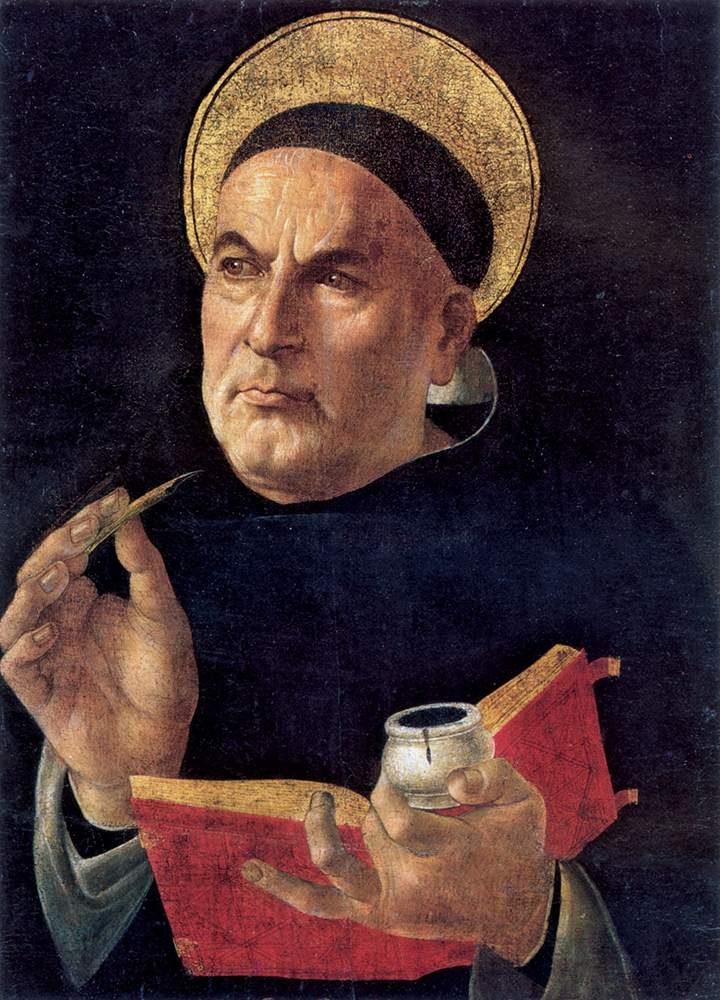
Analogy is a complex subject. In the Summa Theologica, Thomas Aquinas considers whether poetic analogy can tell us anything true about God, given the utter disparity between human and divine minds:
The science of poetry is about things which because of their deficiency of truth cannot be laid hold of by reason. Hence reason has to be drawn off to the side by means of certain similitudes. But then, theology is also about things which lie beyond reason. Thus the symbolic method is common to both, since neither is accommodated [to human reason].
The specific question that Aquinas grapples with is the way in which scripture employs metaphors—which are, after all, analogies. He concludes that:
The beam of divine revelation is not extinguished by the sense imagery that veils it; its truth does not flicker out; because the minds of those to whom the revelation is given are not allowed to remain arrested by the images but are lifted up to their meaning.
I take these quotations from Denis Donoghue’s dense but rewarding book Metaphor. There he considers the famous definition of metaphor by I.A. Richards as something divided into “tenor” and “vehicle.” For example, in Shakespeare’s phrase “all the world’s a stage” world is the tenor and stage is the vehicle. The best metaphors, Donoghue suggests, set up a tension of likeness and unlikeness between tenor and vehicle, which are held simultaneously in the mind.
Donoghue notes that in the Christian tradition some thinkers seemed to believe that the vehicle takes over and extinguishes the tenor, as in those theologians who argued that the New Testament made the Old Testament obsolete and irrelevant. But he goes on to show that the deepest and widest tradition in the church rejected this form of reductionism, cherishing both terms equally. He cites Erich Auerbach, who points out in Mimesis that Tertullian spoke for the majority of theologians:
[Tertullian] was definitely hostile to spiritualism and refused to consider the Old Testament as mere allegory; according to him, it had real, literal meaning throughout, and even where there was figural prophecy, the figure had just as much historical reality as what it prophesied.
For Auerbach, figurative language “establishes a connection between two events or persons, the first of which signifies not only itself but also the second, while the second encompasses or fulfills the first.” In the poet Dante, Auerbach found the literary culmination of this way of thinking:
It is precisely the figural interpretation of reality which, though in constant conflict with purely spiritualist and Neoplatonic tendencies, was the dominant view in the European Middle Ages: the idea that earthly life is thoroughly real, with the reality of the flesh into which the Logos entered, but that with all its reality it is only umbra and figura of the authentic, future, ultimate truth, the real reality that will unveil and preserve the figura.
It is in this spirit, if on a thoroughly pedestrian level, that I have attempted to pursue the analogies between art and faith in search of mystery.
Gregory Wolfe is the founder of Image and serves as Writer in Residence and Director of the MFA in Creative Writing program at Seattle Pacific University. His books include The Operation of Grace: Further Essays on Art, Faith, and Mystery, Beauty Will Save the World, and Intruding Upon the Timeless. Follow him on Twitter: @Gregory_Wolfe.

Previous Post

January 4, 2016
A Metaphorical God, Part 1
Next Post

January 6, 2016 Autistic Lives Matter
Browse Our Archives
Select a Category A. G. Harmon Alissa Wilkinson Allison Backous Art Authors Brad Fruhauff Bradford Winters Bryan Bliss Caroline Langston Chad Thomas Johnston Chris Hoke Christiana N. Peterson Culture D.G. Myers D.L. Mayfield Daniel Bowman Jr. David Griffith Elizabeth Duffy Faith Film Greg Wolfe Guest Contributor Interview Jan Vallone Jeffrey Overstreet Jessica Eddings-Roeser Jessica Mesman Griffith Kelly Foster Lindsey Crittenden Morgan Meis music Natalie Vestin Nick Olson Peggy Rosenthal Personal Reflection Poetry Friday Reflection Relationships Review Richard Chess Richard Cole Sara Zarr Shannon Huffman Polson Sonya Bilocerkowycz Tania Runyan Tony Woodlief Topical Categories Uncategorized Vic Sizemore Writing
Select a Month October 2018 September 2018 August 2018 July 2018 June 2018 May 2018 April 2018 March 2018 February 2018 January 2018 December 2017 November 2017 October 2017 September 2017 August 2017 July 2017 June 2017 May 2017 April 2017 March 2017 February 2017 January 2017 December 2016 November 2016 October 2016 September 2016 August 2016 July 2016 June 2016 May 2016 April 2016 March 2016 February 2016 January 2016 December 2015 November 2015 October 2015 September 2015 August 2015 July 2015 June 2015 May 2015 April 2015 March 2015 February 2015 January 2015 December 2014 November 2014 October 2014 September 2014 August 2014 July 2014 June 2014 May 2014 April 2014 March 2014 February 2014 January 2014 December 2013 November 2013 October 2013 September 2013 August 2013 July 2013 June 2013 May 2013 April 2013 March 2013 February 2013 January 2013 December 2012 November 2012 October 2012 September 2012 August 2012 July 2012 June 2012 May 2012 February 2008
Follow Us!
TAKE THE
Religious Wisdom Quiz
What does "Haggai" mean in Hebrew?
Select your answer to see how you score.
The Lord Saves Festive The Rock God's Messenger
Related posts from Good Letters

Halos and Other Important Things
The Liturgy of the Stars: Part 2
TRENDING AT PATHEOS Catholic

Rejecting Doom: Christian Hope And Human Action
Christianity is a religion of hope. We are to have hope and...

It’s What Comes From Within Which Matters
One of the most difficult things for us to understand is why...

Why I Choose the Eucharist Over the Sermon
Choose the Eucharist, Not the Sermon What are we supposed to get...

5 Design Elements Found in Spiritually Rooted Homes
Putting Spirituality Into Home Decor Our homes are more than our living...

Credo: A Story of God Told with the...
About 10 years ago, I began to imagine a personal "Credo" that...

The Anatomy of Divine Revelation in Catholic Thought
The claim that God has made Himself known to human beings is...
view all Catholic blogs
Ad-Free & Subscriber Log-In Subscription Support
- About Us
- 2026 Calendar
- Videos
- Podcasts
- Library of World Religions
- Faith In Media Tracker
- Advertise With Us
- Write for Us
- Privacy Policy
- Terms of Service
- Do Not Sell My Data
- Contact Us
- Radiant Digital
- Manage Newsletter Subscriptions
- Unsubscribe From Notifications
- Sitemap
Copyright 2008-2026, Patheos. All rights reserved.
Subscription Support Ad-Free & Subscriber Log-In
Follow Patheos