
BuddhistCatholicContemplativeEvangelicalGeneral ChristianHinduJewishLatter-day SaintMuslimNew VisionsProgressive Christian
Beliefs
- Buddhist
- Catholic
- Contemplative
- Evangelical
- General Christian
- Hindu
- Jewish
- Latter-day Saint
- More Voices
- Muslim
- New Visions
- Pagan
- Progressive Christian
Topics
- Religion News
- Food and Religion
- Sports and Religion
- Religious Art
- Religious Music and Entertainment
- Religious Events
- History and Religion
- Style and Religion
- Politics and Religion
- Women in Religion
- Recreation Outdoors and Religion
- Business Finance and Religion
- Careers Workplace and Religion
- Education and Religion
- Family Parenting and Religion
- Health Fitness and Religion
- Home and Religion
- Relationships and Religion
- Technology and Religion
- Travel and Religion
Columnists
- Buddhist Columnists
- Business Finance and Religion Columnists
- Careers Workplace and Religion Columnists
- Catholic Columnists
- Contemplative Columnists
- Education and Religion Columnists
- Evangelists Columnists
- Family Parenting and Religion Columnists
- General Christian Columnists
- Health Fitness and Religion Columnists
- Hindu Columnists
- History and Religion Columnists
- Home and Religion Columnists
- Jewish Columnists
- More Voices Columnists
- Latter Day Columnists
- Muslim Columnists
- New Visions Columnists
- Nonreligious Columnists
- Pagan Columnists
- Politics and Religion Columnists
- Progressive Columnists
- Recreation Outdoors and Religion Columnists
- Relationships and Religion Columnists
- Religion News Columnists
- Religious Art Columnists
- Religious Events Columnists
- Religious Music and Entertainment Columnists
- Sports and Religion Columnists
- Style and Religion Columnists
- Technology and Religion Columnists
- Travel and Religion Columnists
- Women in Religion Columnists
Resource Library
- 2026 Calendar
- Library of World Religions
- The 100 Most Holy Places on Earth
- Patheos Answers
- Podcasts
- Videos
- Faith Leaders Database
- Anglican Episcopalian
- Bahai
- Baptist
- Buddhism
- Christianity
- Confucianism
- Eastern Orthodoxy
- Hinduism
- Holiness and Pentecostal
- ISKCON
- Islam
- Judaism
- Lutheran
- Methodist
- The Church of Jesus Christ of Latter-day Saints
- New Age
- Paganism
- Presbytarian and Reformed
- Protestantism
- Religion Behind the Scenes
- Roman Catholic
- Scientology
- Shia Islam
- Sikhism
- Sufism
- Sunni Islam
- Taoism
- Zen
- See all religions
Research Tools
 Ad-Free & Subscriber Log-In Subscription Support
Ad-Free & Subscriber Log-In Subscription Support
Follow Patheos 

- Trending:
- Forgiveness
- |
- Marriage
- |
- Consciousness
- |
- Death Penalty
- |
- Election
- |
- Halloween
 Good Letters
-
Contributors
- Home
- Catholic
- God is Sacrificial Love
God is Sacrificial Love
Last updated on: December 29, 2015 at 2:07 am by A. G. Harmon
God is Sacrificial Love 2015-12-29T02:07:28-07:00 A. G. Harmon
Patheos Explore the world's faith through different perspectives on religion and spirituality! Patheos has the views of the prevalent religions and spiritualities of the world.
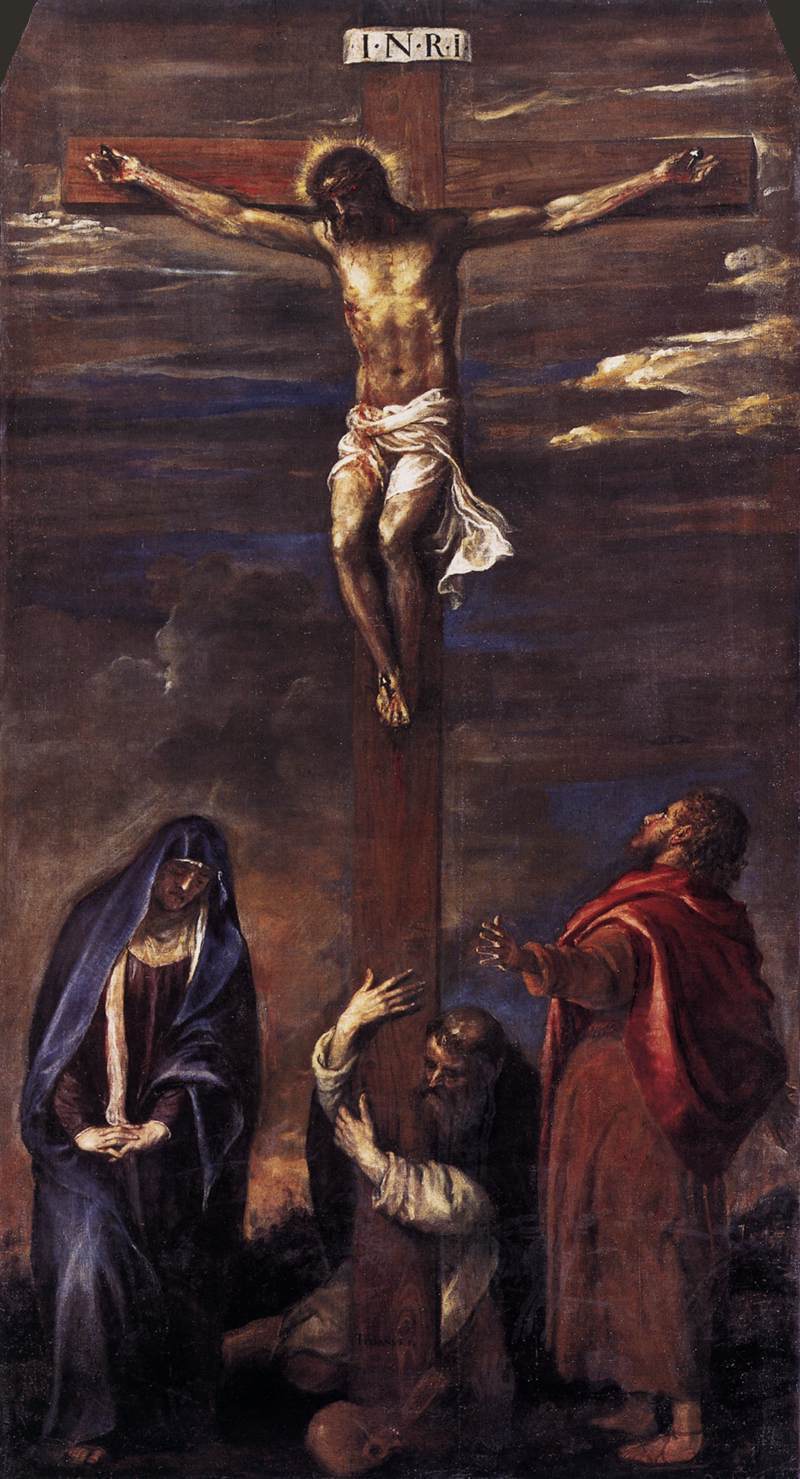 If God is love, as we’re told, then what kind of love is he? In the quest to know that which is beyond all knowing—another one of those oxymorons so characteristic of religion—we find a set of pictures that for any serious adult proves ultimately unsatisfying.
Brotherly love, fatherly love, even passionate love have all been employed to express God’s essence through platitudes and poetry, paintings and precepts. God with his hand on our shoulders; God carrying us in his arms; God pining away below our windows, vexing tarts that we are. Speaking for myself, these images long ago began to cloy. To the limited extent that they can voice the truth about the transcendent, any effect they take is all worn out. The fuzz is off the velvet.
And yet, there is one image that does not lose its appeal—that beckons the beholder further in rather than tires him with what only settles and sates. One image is always fresh, with the power of pulsing blood, of throbbing lesion; and therein seems to lie the answer to what kind of love God is.
The crucifix must surely be the strangest of all religious symbols. No matter how many cultural anthropologists strain to find parallels between Jesus and Apollo, or Dionysus, or Orpheus, or any of the other likely lads who “fade in the fall, rise in the spring,” the symbol of the tortured God—God stretched upon a rack, transfixed upon it, and left there to bleed his life out by the creatures he has made—is unique.
Even the closest myths are distanced by the teleological purpose of the crucifixion; after all, it’s not just crops that grow again in the wake of this deicide; it’s not just a matter of better grapes and a higher stand of corn. In the crucifix, the murderer is reborn in the act of a God who has deigned to die at his hands, and more importantly, in his place.
Sure, the Aztec gods wanted their sacrifices, and the faithful ripped the beating hearts out of captured prisoners as an offering of appeasement; the Celts slit the throats of an assorted lot and sank them in their bogs to get what they needed, and the Chinese were wont to entomb a goodly number of servants as part of a great man’s burial ceremony. Hardly a culture known to us, from pole to pole, is unblemished by this history.
Scapegoats are a part of even the crudest, most primitive forms of religion. The impulse is practically instinctual. Find someone willing or unwilling, saddle him up with your sins, and then send him over the precipice, burn him on a pyre, or gut him on a rock. It’s supposed to provide you with a clean slate.
But in all of those instances, the substitution is offered to the deity by the transgressor, and the roles are clear and distinct. In the crucifix, the deity takes two of the roles in the triad. In every other case, there is a difference between the payer and the payee; in the crucifix, God is both bank and borrower, lender and debtor.
This comports with what we know of love in its highest expression and purest form—sacrificial love. The love that wins the life of the beloved at the cost of the lover’s life is qualitatively different. It is the unparalleled example of what the word means. When we hear tales of it, rather than respond with hearts all aflutter and cheeks all aglow, we stand wide-eyed and sober, even somewhat frightened by the awesomeness of a soldier who throws himself on a grenade to save his fellows, of a mother who rushes into a burning house to save her child.
The more cynical like to say that such acts can be put down to some instinctive need to preserve one’s gene pool, but why do people do it to save those with whom they share no DNA? Why do strangers save strangers? Even more perverse, why would a victim volunteer himself for a martyrdom deserved by the very one who effectuates that martyrdom? Only love can explain it.
And to push the point as far as it can be pushed: If the ontology of love is sacrifice, and if God is love, then God is sacrificial love, and always has been. Not just at the point when the Second Person of the Trinity entered time and allowed the ransoming to occur on a craggy hill outside Jerusalem in the first century, but before there ever was a time. Beyond all beginning, there was a wound; beyond all endings to come, it will remain.
Further yet, if our being is contingent, in that we constantly receive our essence and existence from the source of being—and if that being is sacrificial love—then what enables us, what sustains us, is a stream of the archetypal selflessness depicted upon the crucifix. In seeking God’s face, we are shown his wounds, their cost and purpose.
Who is God? The one who has bled, is the answer; the one who bleeds now, and will forevermore.
A.G. Harmon teaches Shakespeare, Law and Literature, Jurisprudence, and Writing at The Catholic University of America in Washington, D.C. His novel, A House All Stilled, won the 2001 Peter Taylor Prize for the Novel.
Previous Post

December 28, 2015
Precious Things Come from Staying
Next Post

December 30, 2015 Scoliosis and the Statue of St. Francis
Browse Our Archives
Select a Category A. G. Harmon Alissa Wilkinson Allison Backous Art Authors Brad Fruhauff Bradford Winters Bryan Bliss Caroline Langston Chad Thomas Johnston Chris Hoke Christiana N. Peterson Culture D.G. Myers D.L. Mayfield Daniel Bowman Jr. David Griffith Elizabeth Duffy Faith Film Greg Wolfe Guest Contributor Interview Jan Vallone Jeffrey Overstreet Jessica Eddings-Roeser Jessica Mesman Griffith Kelly Foster Lindsey Crittenden Morgan Meis music Natalie Vestin Nick Olson Peggy Rosenthal Personal Reflection Poetry Friday Reflection Relationships Review Richard Chess Richard Cole Sara Zarr Shannon Huffman Polson Sonya Bilocerkowycz Tania Runyan Tony Woodlief Topical Categories Uncategorized Vic Sizemore Writing
Select a Month October 2018 September 2018 August 2018 July 2018 June 2018 May 2018 April 2018 March 2018 February 2018 January 2018 December 2017 November 2017 October 2017 September 2017 August 2017 July 2017 June 2017 May 2017 April 2017 March 2017 February 2017 January 2017 December 2016 November 2016 October 2016 September 2016 August 2016 July 2016 June 2016 May 2016 April 2016 March 2016 February 2016 January 2016 December 2015 November 2015 October 2015 September 2015 August 2015 July 2015 June 2015 May 2015 April 2015 March 2015 February 2015 January 2015 December 2014 November 2014 October 2014 September 2014 August 2014 July 2014 June 2014 May 2014 April 2014 March 2014 February 2014 January 2014 December 2013 November 2013 October 2013 September 2013 August 2013 July 2013 June 2013 May 2013 April 2013 March 2013 February 2013 January 2013 December 2012 November 2012 October 2012 September 2012 August 2012 July 2012 June 2012 May 2012 February 2008
Follow Us!
TAKE THE
Religious Wisdom Quiz
I asked for wisdom above all else, and God granted me riches and honor as well. Who am I?
Select your answer to see how you score.
Hezekiah David Solomon Josiah
Related posts from Good Letters

Leonard Cohen’s Holy and Broken Hallelujah

Ready or Not for the Days of Awe


TRENDING AT PATHEOS Catholic

Rejecting Doom: Christian Hope And Human Action
Christianity is a religion of hope. We are to have hope and...

It’s What Comes From Within Which Matters
One of the most difficult things for us to understand is why...

Why I Choose the Eucharist Over the Sermon
Choose the Eucharist, Not the Sermon What are we supposed to get...

5 Design Elements Found in Spiritually Rooted Homes
Putting Spirituality Into Home Decor Our homes are more than our living...

Credo: A Story of God Told with the...
About 10 years ago, I began to imagine a personal "Credo" that...

The Anatomy of Divine Revelation in Catholic Thought
The claim that God has made Himself known to human beings is...
view all Catholic blogs
Ad-Free & Subscriber Log-In Subscription Support
- About Us
- 2026 Calendar
- Videos
- Podcasts
- Library of World Religions
- Faith In Media Tracker
- Advertise With Us
- Write for Us
- Privacy Policy
- Terms of Service
- Do Not Sell My Data
- Contact Us
- Radiant Digital
- Manage Newsletter Subscriptions
- Unsubscribe From Notifications
- Sitemap
Copyright 2008-2026, Patheos. All rights reserved.
Subscription Support Ad-Free & Subscriber Log-In
Follow Patheos