
BuddhistCatholicContemplativeEvangelicalGeneral ChristianHinduJewishLatter-day SaintMuslimNew VisionsProgressive Christian
Beliefs
- Buddhist
- Catholic
- Contemplative
- Evangelical
- General Christian
- Hindu
- Jewish
- Latter-day Saint
- More Voices
- Muslim
- New Visions
- Pagan
- Progressive Christian
Topics
- Religion News
- Food and Religion
- Sports and Religion
- Religious Art
- Religious Music and Entertainment
- Religious Events
- History and Religion
- Style and Religion
- Politics and Religion
- Women in Religion
- Recreation Outdoors and Religion
- Business Finance and Religion
- Careers Workplace and Religion
- Education and Religion
- Family Parenting and Religion
- Health Fitness and Religion
- Home and Religion
- Relationships and Religion
- Technology and Religion
- Travel and Religion
Columnists
- Buddhist Columnists
- Business Finance and Religion Columnists
- Careers Workplace and Religion Columnists
- Catholic Columnists
- Contemplative Columnists
- Education and Religion Columnists
- Evangelists Columnists
- Family Parenting and Religion Columnists
- General Christian Columnists
- Health Fitness and Religion Columnists
- Hindu Columnists
- History and Religion Columnists
- Home and Religion Columnists
- Jewish Columnists
- More Voices Columnists
- Latter Day Columnists
- Muslim Columnists
- New Visions Columnists
- Nonreligious Columnists
- Pagan Columnists
- Politics and Religion Columnists
- Progressive Columnists
- Recreation Outdoors and Religion Columnists
- Relationships and Religion Columnists
- Religion News Columnists
- Religious Art Columnists
- Religious Events Columnists
- Religious Music and Entertainment Columnists
- Sports and Religion Columnists
- Style and Religion Columnists
- Technology and Religion Columnists
- Travel and Religion Columnists
- Women in Religion Columnists
Resource Library
- 2026 Calendar
- Library of World Religions
- The 100 Most Holy Places on Earth
- Patheos Answers
- Podcasts
- Videos
- Faith Leaders Database
- Anglican Episcopalian
- Bahai
- Baptist
- Buddhism
- Christianity
- Confucianism
- Eastern Orthodoxy
- Hinduism
- Holiness and Pentecostal
- ISKCON
- Islam
- Judaism
- Lutheran
- Methodist
- The Church of Jesus Christ of Latter-day Saints
- New Age
- Paganism
- Presbytarian and Reformed
- Protestantism
- Religion Behind the Scenes
- Roman Catholic
- Scientology
- Shia Islam
- Sikhism
- Sufism
- Sunni Islam
- Taoism
- Zen
- See all religions
Research Tools
 Ad-Free & Subscriber Log-In Subscription Support
Ad-Free & Subscriber Log-In Subscription Support
Follow Patheos 

- Trending:
- Forgiveness
- |
- Marriage
- |
- Consciousness
- |
- Death Penalty
- |
- Election
- |
- Halloween
 Good Letters
-
Contributors
- Home
- Catholic
- The Odyssey: Homer’s Retort to Current U.S. Policy
The Odyssey: Homer’s Retort to Current U.S. Policy
Last updated on: November 5, 2015 at 1:00 am by Peggy Rosenthal
The Odyssey: Homer’s Retort to Current U.S. Policy 2015-11-04T14:41:23-07:00 Peggy Rosenthal
Patheos Explore the world's faith through different perspectives on religion and spirituality! Patheos has the views of the prevalent religions and spiritualities of the world.
 Are you as numb to news of war as I am?
We the American public are so used to hearing that our country is acting militarily in yet another place on the globe that we don’t even question whether we should be arming the Saudi Arabian forces in Yemen or “supporting” Syrian so-called moderate rebels.
We’re still fighting (and killing civilians in wedding parties and now even a hospital) in Afghanistan. And, incredibly, we’re back in Iraq: “training” (yet again) government forces. Aren’t they trained by now?
At least there’s a bit of public outrage over the recent disclosures about our drone “kill lists” in Yemen, Somalia, Afghanistan…
I’ve heard that the U.S. military is involved right now in from seventy-five to a hundred thirty wars, depending on how you define “involved” and “war.” This was the context for my recent re-reading of Virgil’s Aeneid, in Robert Fitzgerald’s fine translation. As I read, I couldn’t help but be struck by the similarity of my country’s militaristic sense of mission to that of Augustan Rome. “Headlong we rush to bite the desert dust” is how Fitzgerald’s iambic pentameter puts it.
Fitzgerald’s Iliad and Odyssey are also on my shelf. With warring so much the rage these days, you’d think I’d turn next to The Iliad. But instead it’s The Odyssey that I reached for—since it’s about how we should live instead of how we do.
Restoration is The Odyssey‘s theme. Though the title word has come to mean adventurous wandering, the poem’s whole thrust is really toward restoring Odysseus to his rightful place at home.
In Book Six of The Odyssey, Odysseus is shipwrecked on the coast of the island of Scheria. Nausikaa and her handmaidens go to the seashore to wash clothes. Awakened by their games, Odysseus emerges from the forest naked and begs Nausikaa for help. He articulates what “home” means in a famous speech.
I actually cried when I read that speech. Odysseus does his share of crying in the poem, so I was in noble company. He’s weeping with longing for home when we first see him; he weeps later with grief when the minstrel sings of the Trojan War. My tears at his words to Nausikaa, though, were of gratitude—for the human fulfillment they picture:
And may the gods accomplish your desire:
a home, a husband, and harmonious
converse with him—the best thing in the world
being a strong house held in serenity
where man and wife agree.
“The best thing in the world” isn’t in the Greek, which literally says “there’s nothing more excellent or better than.” But Fitzgerald was brilliant to bring the world in via the English idiom. Because the Homeric household is very much in the world. The domestic concord for which Odysseus claims prime value isn’t a private peace cut off from the cruel world. Quite the opposite: The harmonious households visited throughout The Odyssey make the world a better place by spreading their blessings.
They do this mainly by extending hospitality. Strangers wandering in receive a welcome fit for the gods. The creed of good homes is the line graciously used to welcome Odysseus at two different times when he shows up looking particularly bedraggled: “Strangers and beggars come from Zeus.”
Nausikaa is the first to welcome Odysseus with these words. She does so, in fact, in response to her guest’s assertion of the value of domestic concord. From her parents’ supremely peaceful household, she has learned the right order of things: that hospitality is the natural extension of the harmonious home.
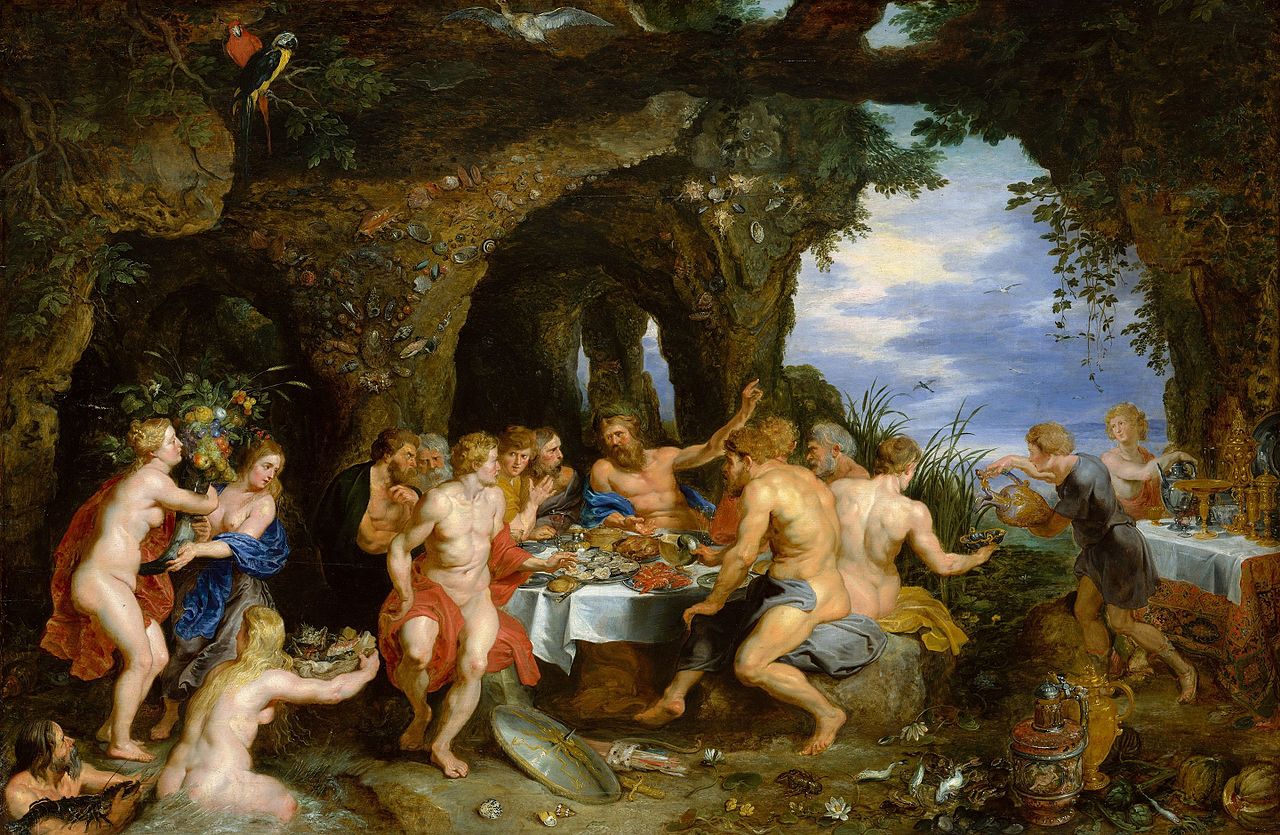
What all the harmonious households in the poem are doing when either Telemachus or Odysseus drop in is feasting. The amount of food consumed in the poem could feed an army—though the whole point is that peace, not war, is now being nurtured.
My husband and I were recently musing about this. He commented that The Iliad and The Odyssey together are Homer’s War and Peace. I see them also as Homer’s tragedy and comedy: comedy in its largest sense, as the celebration of life. While the defining activity of The Iliad‘s tragic vision is fighting (from the battlefield slaughter to the squabbling among the gods), the defining activity of The Odyssey‘s comic vision is feasting.
A feast, especially for a marriage, has always been the symbol for comedy’s celebration of human concord and continuity. All the singing, dancing, and athletic games that go on at The Odyssey‘s feasts are collective body language expressing exuberant harmony. And the remarkable amount of joking among characters—the fun we commonly think of as comic—is a manifestation writ small of the larger vision of joy.
Comic and tragic visions are essentially inseparable, though. Just as at the instant a warrior in The Iliad bites the dust in gory death, a brief glimpse is often given of the peaceful world being lost, so does The Odyssey repeatedly recall the terrible waste of the Trojan War, giving a sense of precious value to the time of joy. Homer couldn’t bear the thought of war without the possibility of people living in harmony, and we can’t either.
At least I can’t. That’s why, while our political world is behaving tragically, I need the balance and restorative hope that comedy brings.
Peggy Rosenthal is director of Poetry Retreats and writes widely on poetry as a spiritual resource. Her books include Praying through Poetry: Hope for Violent Times (Franciscan Media), and The Poets’ Jesus (Oxford). See Amazon for a full list. She also teaches an online course, “Poetry as a Spiritual Practice,” through Image’s Glen Online program.

Previous Post

November 4, 2015
Listening to a Stranger’s Story
Next Post

November 6, 2015 Poetry Friday: "Canticle of Want" by Marjorie Stelmach
Browse Our Archives
Select a Category A. G. Harmon Alissa Wilkinson Allison Backous Art Authors Brad Fruhauff Bradford Winters Bryan Bliss Caroline Langston Chad Thomas Johnston Chris Hoke Christiana N. Peterson Culture D.G. Myers D.L. Mayfield Daniel Bowman Jr. David Griffith Elizabeth Duffy Faith Film Greg Wolfe Guest Contributor Interview Jan Vallone Jeffrey Overstreet Jessica Eddings-Roeser Jessica Mesman Griffith Kelly Foster Lindsey Crittenden Morgan Meis music Natalie Vestin Nick Olson Peggy Rosenthal Personal Reflection Poetry Friday Reflection Relationships Review Richard Chess Richard Cole Sara Zarr Shannon Huffman Polson Sonya Bilocerkowycz Tania Runyan Tony Woodlief Topical Categories Uncategorized Vic Sizemore Writing
Select a Month October 2018 September 2018 August 2018 July 2018 June 2018 May 2018 April 2018 March 2018 February 2018 January 2018 December 2017 November 2017 October 2017 September 2017 August 2017 July 2017 June 2017 May 2017 April 2017 March 2017 February 2017 January 2017 December 2016 November 2016 October 2016 September 2016 August 2016 July 2016 June 2016 May 2016 April 2016 March 2016 February 2016 January 2016 December 2015 November 2015 October 2015 September 2015 August 2015 July 2015 June 2015 May 2015 April 2015 March 2015 February 2015 January 2015 December 2014 November 2014 October 2014 September 2014 August 2014 July 2014 June 2014 May 2014 April 2014 March 2014 February 2014 January 2014 December 2013 November 2013 October 2013 September 2013 August 2013 July 2013 June 2013 May 2013 April 2013 March 2013 February 2013 January 2013 December 2012 November 2012 October 2012 September 2012 August 2012 July 2012 June 2012 May 2012 February 2008
Follow Us!
TAKE THE
Religious Wisdom Quiz
A woman who had suffered bleeding for twelve years was healed by touching Jesus' what?
Select your answer to see how you score.
His feet His hand His cloak The hairs of his head
Related posts from Good Letters


Morning in a Forgotten Neighborhood


TRENDING AT PATHEOS Catholic

The Parable Of The Sower And The Word...
One of Christ’s most famous parables is that of the sower who...

Rejecting Doom: Christian Hope And Human Action
Christianity is a religion of hope. We are to have hope and...

Why I Choose the Eucharist Over the Sermon
Choose the Eucharist, Not the Sermon What are we supposed to get...

5 Design Elements Found in Spiritually Rooted Homes
Putting Spirituality Into Home Decor Our homes are more than our living...

Credo: A Story of God Told with the...
About 10 years ago, I began to imagine a personal "Credo" that...

The Anatomy of Divine Revelation in Catholic Thought
The claim that God has made Himself known to human beings is...
view all Catholic blogs
Ad-Free & Subscriber Log-In Subscription Support
- About Us
- 2026 Calendar
- Videos
- Podcasts
- Library of World Religions
- Faith In Media Tracker
- Advertise With Us
- Write for Us
- Privacy Policy
- Terms of Service
- Do Not Sell My Data
- Contact Us
- Radiant Digital
- Manage Newsletter Subscriptions
- Unsubscribe From Notifications
- Sitemap
Copyright 2008-2026, Patheos. All rights reserved.
Subscription Support Ad-Free & Subscriber Log-In
Follow Patheos