
BuddhistCatholicContemplativeEvangelicalGeneral ChristianHinduJewishLatter-day SaintMuslimNew VisionsProgressive Christian
Beliefs
- Buddhist
- Catholic
- Contemplative
- Evangelical
- General Christian
- Hindu
- Jewish
- Latter-day Saint
- More Voices
- Muslim
- New Visions
- Pagan
- Progressive Christian
Topics
- Religion News
- Food and Religion
- Sports and Religion
- Religious Art
- Religious Music and Entertainment
- Religious Events
- History and Religion
- Style and Religion
- Politics and Religion
- Women in Religion
- Recreation Outdoors and Religion
- Business Finance and Religion
- Careers Workplace and Religion
- Education and Religion
- Family Parenting and Religion
- Health Fitness and Religion
- Home and Religion
- Relationships and Religion
- Technology and Religion
- Travel and Religion
Columnists
- Buddhist Columnists
- Business Finance and Religion Columnists
- Careers Workplace and Religion Columnists
- Catholic Columnists
- Contemplative Columnists
- Education and Religion Columnists
- Evangelists Columnists
- Family Parenting and Religion Columnists
- General Christian Columnists
- Health Fitness and Religion Columnists
- Hindu Columnists
- History and Religion Columnists
- Home and Religion Columnists
- Jewish Columnists
- More Voices Columnists
- Latter Day Columnists
- Muslim Columnists
- New Visions Columnists
- Nonreligious Columnists
- Pagan Columnists
- Politics and Religion Columnists
- Progressive Columnists
- Recreation Outdoors and Religion Columnists
- Relationships and Religion Columnists
- Religion News Columnists
- Religious Art Columnists
- Religious Events Columnists
- Religious Music and Entertainment Columnists
- Sports and Religion Columnists
- Style and Religion Columnists
- Technology and Religion Columnists
- Travel and Religion Columnists
- Women in Religion Columnists
Resource Library
- 2026 Calendar
- Library of World Religions
- The 100 Most Holy Places on Earth
- Patheos Answers
- Podcasts
- Videos
- Faith Leaders Database
- Anglican Episcopalian
- Bahai
- Baptist
- Buddhism
- Christianity
- Confucianism
- Eastern Orthodoxy
- Hinduism
- Holiness and Pentecostal
- ISKCON
- Islam
- Judaism
- Lutheran
- Methodist
- The Church of Jesus Christ of Latter-day Saints
- New Age
- Paganism
- Presbytarian and Reformed
- Protestantism
- Religion Behind the Scenes
- Roman Catholic
- Scientology
- Shia Islam
- Sikhism
- Sufism
- Sunni Islam
- Taoism
- Zen
- See all religions
Research Tools
 Ad-Free & Subscriber Log-In Subscription Support
Ad-Free & Subscriber Log-In Subscription Support
Follow Patheos 

- Trending:
- Forgiveness
- |
- Marriage
- |
- Consciousness
- |
- Death Penalty
- |
- Election
- |
- Halloween
 Good Letters
-
Contributors
- Home
- Catholic
- The Man Living Under the Overpass
The Man Living Under the Overpass
Last updated on: November 11, 2015 at 1:00 am by Peggy Rosenthal
The Man Living Under the Overpass 2015-11-10T14:20:54-07:00 Peggy Rosenthal
Patheos Explore the world's faith through different perspectives on religion and spirituality! Patheos has the views of the prevalent religions and spiritualities of the world.
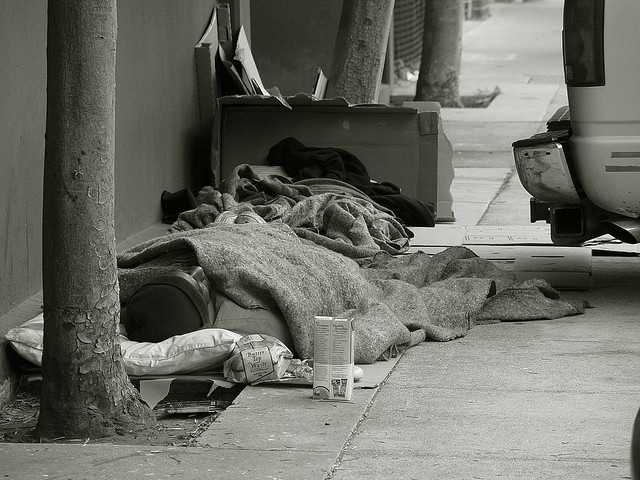 My daily bike-ride near downtown Tucson is not picturesque. It’s along a bike trail that’s squeezed between a highway and a tattered string of small factories and beaten down neighborhoods.
The bike trail is usually fairly abandoned when I ride it. Occasionally I’ll pass another biker or someone walking.
But I can always count on passing the man who lives under the overpass that’s an exit ramp from the highway.
It’s dark under that overpass. And he is dark: African American, wearing a dark-colored dirty jacket. He’s usually sitting in the least visible place possible: on the concrete, leaning against a post, his back to the bike trail. Sometimes he’s talking to himself, but usually he’s silent…just sitting or lying down. Near him is a shopping cart stuffed with what I assume are all his possessions. I can see a dusty gray wool blanket at the top; nothing else is clearly visible as I bike by.
He doesn’t seem dangerous, to himself or others. He is hiding…from others and from himself? Where does he get food, I always wonder. And what damage has been done to his psyche that he has chosen this life of self-imposed solitary confinement?
He seems so locked in with his solitude that I don’t dare stop to offer help; my guess is that this would frighten him.
But my husband and I have been concerned about him. Is there any agency looking after him? So my husband went to the folks at our neighborhood association, which the police use as an informal sub-station. Yes, they knew of him. One of the policemen said, “It’s because of the cutbacks to services; people that should be in institutionalized care are left to themselves.” “He’s crazy,” said another, but with compassion in his voice. “We’ll check in on him,” another said.
I shake my head in dismay. What kind of society have we created that people so hurt are not cared for? Are left on the sidewalk like the trash that has heaped to overflowing in the trashcan next to this man’s “home”?
But another part of me senses, whenever my bike approaches his home, that I’m passing through sacred ground. “You live here, Lord,” I’ve come to say to myself. And I always pray as I bike past him: “Lord, let him know that you are alive in him, in whatever way that he can recognize you.”
But I feel inarticulate in the face of the mystery of this man’s life. And when I feel inarticulate, I turn to poetry.
Eileen Myles expresses an appropriate sense of outrage in these lines from her “An American Poem”:
The homeless are wandering
the streets of our nation’s
greatest city. Homeless
men with AIDS are among
them. Is that right?
That there are no homes
for the homeless, that
there is no free medical
help for these men. And women.
That they get the message
—as they are dying—
that this is not their home?
I share these sentiments, but to my ear these lines belong more in a political protest speech than in a poem. Poetry, I feel, should be more nuanced, should have at least some element of reflectiveness. So I find the following poem by Ruth Stone speaking more profoundly of my relation to the man who lives under the overpass. The poem is called “Shapes.”
In the longer view it doesn’t matter.
However, it’s that having lived, it matters.
So that every death breaks you apart.
You find yourself weeping at the door
of your own kitchen, overwhelmed
by loss. And you find yourself weeping
as you pass the homeless person
head in hands resigned on a cement
step, the wire basket on wheels right there.
Like stopped film, or a line of Vallejo,
or a sketch of the mechanics of a wing
by Leonardo. All pauses in space,
a violent compression of meaning
in an instant within the meaningless.
Even staring into the dim shapes
at the farthest edge; accepting that blur.
I like this poem’s images for that “violent compression of meaning / in an instant within the meaningless.”
Yet maybe the poetry that most powerfully articulates what I imagine as the cry of the man under the overpass himself is biblical. Living like a slave who longs for the shadow—as someone who truly lives in the shadow—this man might utter Job’s plaint in 7:1-6:
Do not human beings have a hard service on earth,
and are not their days like the days of a laborer?
Like a slave who longs for the shadow,
and like laborers who look for their wages,
so I am allotted months of emptiness,
and nights of misery are apportioned to me.
When I lie down I say, ‘When shall I rise?’
But the night is long,
and I am full of tossing until dawn.
My flesh is clothed with worms and dirt;
my skin hardens, then breaks out again.
My days are swifter than a weaver’s shuttle,
and come to their end without hope.
While for me it does help to hear what I imagine as this man’s spirit articulated in Job’s magnificent poetry, I don’t see, alas, how it can help him. All I see is his days “coming to their end without hope.”
Originally published in Good Letters on May 4, 2012.
Peggy Rosenthal is director of Poetry Retreats and writes widely on poetry as a spiritual resource. Her books include Praying through Poetry: Hope for Violent Times (Franciscan Media), and The Poets’ Jesus (Oxford). See Amazon for a full list. She also teaches an online course, “Poetry as a Spiritual Practice,” through Image’s Glen Online program.

Previous Post

November 10, 2015
The Evidence of Things Not Seen
Next Post
November 12, 2015 Sleeping in Slave Quarters at Sweet Briar College
Browse Our Archives
Select a Category A. G. Harmon Alissa Wilkinson Allison Backous Art Authors Brad Fruhauff Bradford Winters Bryan Bliss Caroline Langston Chad Thomas Johnston Chris Hoke Christiana N. Peterson Culture D.G. Myers D.L. Mayfield Daniel Bowman Jr. David Griffith Elizabeth Duffy Faith Film Greg Wolfe Guest Contributor Interview Jan Vallone Jeffrey Overstreet Jessica Eddings-Roeser Jessica Mesman Griffith Kelly Foster Lindsey Crittenden Morgan Meis music Natalie Vestin Nick Olson Peggy Rosenthal Personal Reflection Poetry Friday Reflection Relationships Review Richard Chess Richard Cole Sara Zarr Shannon Huffman Polson Sonya Bilocerkowycz Tania Runyan Tony Woodlief Topical Categories Uncategorized Vic Sizemore Writing
Select a Month October 2018 September 2018 August 2018 July 2018 June 2018 May 2018 April 2018 March 2018 February 2018 January 2018 December 2017 November 2017 October 2017 September 2017 August 2017 July 2017 June 2017 May 2017 April 2017 March 2017 February 2017 January 2017 December 2016 November 2016 October 2016 September 2016 August 2016 July 2016 June 2016 May 2016 April 2016 March 2016 February 2016 January 2016 December 2015 November 2015 October 2015 September 2015 August 2015 July 2015 June 2015 May 2015 April 2015 March 2015 February 2015 January 2015 December 2014 November 2014 October 2014 September 2014 August 2014 July 2014 June 2014 May 2014 April 2014 March 2014 February 2014 January 2014 December 2013 November 2013 October 2013 September 2013 August 2013 July 2013 June 2013 May 2013 April 2013 March 2013 February 2013 January 2013 December 2012 November 2012 October 2012 September 2012 August 2012 July 2012 June 2012 May 2012 February 2008
Follow Us!
TAKE THE
Religious Wisdom Quiz
Who was it that allowed the Israelites to return to Jerusalem from exile?
Select your answer to see how you score.
Artaxerxes Nebuchadnezzar Darius Cyrus the Great
Related posts from Good Letters


Morning in a Forgotten Neighborhood


TRENDING AT PATHEOS Catholic

Rejecting Doom: Christian Hope And Human Action
Christianity is a religion of hope. We are to have hope and...

It’s What Comes From Within Which Matters
One of the most difficult things for us to understand is why...

Why I Choose the Eucharist Over the Sermon
Choose the Eucharist, Not the Sermon What are we supposed to get...

5 Design Elements Found in Spiritually Rooted Homes
Putting Spirituality Into Home Decor Our homes are more than our living...

Credo: A Story of God Told with the...
About 10 years ago, I began to imagine a personal "Credo" that...

The Anatomy of Divine Revelation in Catholic Thought
The claim that God has made Himself known to human beings is...
view all Catholic blogs
Ad-Free & Subscriber Log-In Subscription Support
- About Us
- 2026 Calendar
- Videos
- Podcasts
- Library of World Religions
- Faith In Media Tracker
- Advertise With Us
- Write for Us
- Privacy Policy
- Terms of Service
- Do Not Sell My Data
- Contact Us
- Radiant Digital
- Manage Newsletter Subscriptions
- Unsubscribe From Notifications
- Sitemap
Copyright 2008-2026, Patheos. All rights reserved.
Subscription Support Ad-Free & Subscriber Log-In
Follow Patheos