
BuddhistCatholicContemplativeEvangelicalGeneral ChristianHinduJewishLatter-day SaintMuslimNew VisionsProgressive Christian
Beliefs
- Buddhist
- Catholic
- Contemplative
- Evangelical
- General Christian
- Hindu
- Jewish
- Latter-day Saint
- More Voices
- Muslim
- New Visions
- Pagan
- Progressive Christian
Topics
- Religion News
- Food and Religion
- Sports and Religion
- Religious Art
- Religious Music and Entertainment
- Religious Events
- History and Religion
- Style and Religion
- Politics and Religion
- Women in Religion
- Recreation Outdoors and Religion
- Business Finance and Religion
- Careers Workplace and Religion
- Education and Religion
- Family Parenting and Religion
- Health Fitness and Religion
- Home and Religion
- Relationships and Religion
- Technology and Religion
- Travel and Religion
Columnists
- Buddhist Columnists
- Business Finance and Religion Columnists
- Careers Workplace and Religion Columnists
- Catholic Columnists
- Contemplative Columnists
- Education and Religion Columnists
- Evangelists Columnists
- Family Parenting and Religion Columnists
- General Christian Columnists
- Health Fitness and Religion Columnists
- Hindu Columnists
- History and Religion Columnists
- Home and Religion Columnists
- Jewish Columnists
- More Voices Columnists
- Latter Day Columnists
- Muslim Columnists
- New Visions Columnists
- Nonreligious Columnists
- Pagan Columnists
- Politics and Religion Columnists
- Progressive Columnists
- Recreation Outdoors and Religion Columnists
- Relationships and Religion Columnists
- Religion News Columnists
- Religious Art Columnists
- Religious Events Columnists
- Religious Music and Entertainment Columnists
- Sports and Religion Columnists
- Style and Religion Columnists
- Technology and Religion Columnists
- Travel and Religion Columnists
- Women in Religion Columnists
Resource Library
- 2026 Calendar
- Library of World Religions
- The 100 Most Holy Places on Earth
- Patheos Answers
- Podcasts
- Videos
- Faith Leaders Database
- Anglican Episcopalian
- Bahai
- Baptist
- Buddhism
- Christianity
- Confucianism
- Eastern Orthodoxy
- Hinduism
- Holiness and Pentecostal
- ISKCON
- Islam
- Judaism
- Lutheran
- Methodist
- The Church of Jesus Christ of Latter-day Saints
- New Age
- Paganism
- Presbytarian and Reformed
- Protestantism
- Religion Behind the Scenes
- Roman Catholic
- Scientology
- Shia Islam
- Sikhism
- Sufism
- Sunni Islam
- Taoism
- Zen
- See all religions
Research Tools
 Ad-Free & Subscriber Log-In Subscription Support
Ad-Free & Subscriber Log-In Subscription Support
Follow Patheos 

- Trending:
- Forgiveness
- |
- Marriage
- |
- Consciousness
- |
- Death Penalty
- |
- Election
- |
- Halloween
 Good Letters
-
Contributors
- Home
- Catholic
- The Evidence of Things Not Seen
The Evidence of Things Not Seen
Last updated on: November 10, 2015 at 1:00 am by Vic Sizemore
The Evidence of Things Not Seen 2015-11-09T20:11:35-07:00 Vic Sizemore
Patheos Explore the world's faith through different perspectives on religion and spirituality! Patheos has the views of the prevalent religions and spiritualities of the world.
 Since I’ve been blogging here at Good Letters I have been contacted by several friends who knew me back when I was a Baptist. My friend Heidi asked, “Are you a universalist now?” Cliff wondered if I was, “denying or seriously doubting Jesus’ claim to be God.” Another asked if I was “still a believer,” and yet another frankly labeled me agnostic.
These friends are seeing my musings after many years away—thanks to social media. Their own journeys seem to be keeping closer to their original faith, and mine not so much. There’s no doubt that it’s been a long road from my strict fundamentalist childhood to where I am now.
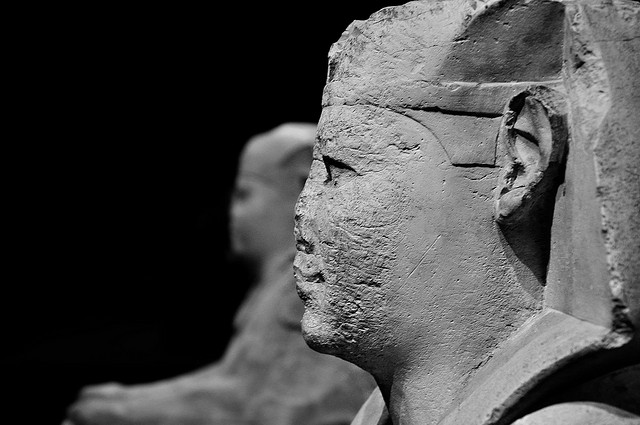
In preparation for one of my classes this semester I read Joseph Campbell’s The Hero With A Thousand Faces. I read of Osiris, the dying and resurrecting god who was the hope of eternal life for Egyptians, how sarcophagi have his face on them because people wanted to literally put off themselves and put on Osiris—the god-man who beat death—in order to get safely through the land of the dead.
Then there was Isis, who was impregnated miraculously and gave birth to a god. I first read of Isis and Osiris in a college apartment that reeked of dirty dishes and my roommate’s neglected pit bull, in Huntington, West Virginia. We huddled around a gas wall heater while snowflakes blew through gaps between the windowpanes. I was reading Areopagitica for my Milton class.
I still have the Complete Poems and Major Prose from that 1988 class. I had highlighted and underlined the passage in which the sad friends of Truth, “imitating the careful search that Isis made for the mangled body of Osiris,” cast about looking for the Truth that had been “hewed…into a thousand pieces, and scattered…to the four winds.”
And there’s the Epic of Gilgamesh with its flood story that predates Moses by something like eight hundred years, and contains the story of Utnapishtim, an earlier Noah. It also has a serpent—the common enemy and bringer of death in ancient Mesopotamian literature—who steals Gilgamesh’s one shot at evading death.
On and on it goes. The world of ancient mythology is chockfull of uncanny parallels with stories that I grew up hearing were literal, authoritative versions of history.
The parallels are not the problem. Modern science has chucked these competing truth claims into the same bin labeled the best they could do before they knew better. It’s no wonder the tale of the bumpkin going off to college and losing his faith is a cliché. No wonder either that so many declare themselves agnostic and choose to think no more about it, but rather turn their attention to actually living in this world.
- H. Huxley coined the word agnostic. He explained it this way: “It is wrong for a man to say he is certain of the objective truth of a proposition unless he can produce evidence which logically justifies that certainty.”
To Huxley, metaphysical, religious, spiritual claims are of no use. You are talking about things that can only ever be a matter of conjecture and opinion. People I know who call themselves agnostic say basically, “No one knows for certain, so why waste any more time and energy on it?”
For some reason putting an unknown-and-unknowable label on the debate and then checking out has never been a living option for me. I’ve always loved Fyodor Dostoyevsky: I recognize the feeling when his doubt rises and rises and rises. I also recognize the way, who knows how or why, faith always rises to meet it.
But in the rising, faith changes, takes on different shape.
This is also why I love reading Thomas Merton in dialogue with Buddhism, how he accepts ambiguity about ultimate things into his faith, and how by some means that makes his faith deeper, richer.
In Don DeLillo’s Falling Man, one of the characters, in the wake of the attacks of 9/11, thinks about all the variations of belief and decides she is “free to think and doubt and believe simultaneously.” This sounds fair and honest to me.
Hebrews 11:1 says, “faith is the substance of things hoped for, the evidence of things not seen.” The evidence of things not seen is faith in those unseen things. This appears to be some very clumsy circular reasoning, and that can be a little frustrating.
I think of Miguel de Unamuno’s claim that the longing for immortality in the human soul is enough to justify belief in immortality. Einstein writes, “Seeds of doubt are seeds of contemplation. Acknowledgement of our own ignorance before the vast mystery we face is the beginning of faith.”
Again, acknowledgement of our own ignorance before the vast mystery we face is the beginning of faith. Faith itself is evidence that the vast mystery is substantial.
Is that all we get? Would it be enough?
When asked where I stand vis-à-vis the old-time religion, I have to honestly say, I don’t know. However, that is hardly the same as calling myself agnostic. My head spins in disbelief, but unbelief is no more a living option to me than turning away from the question. I cannot shrug my shoulders and turn to more practically useful things. I sometimes wish I could; it would make for a happier life.
So, instead of agnostic I thought maybe I would call myself proelpizognostic or elpisgnostic, elpizo being the Greek word for hope. I asked my friend Amy, who is a professor of classics, what she thought. She said one of those two words would work but elpizo doesn’t usually compound that way. She suggested proupomenognostic, explaining that upomeno means await, endure, abide. That’s perfect.
So proupomenognostic it is. I await a time when I will know. I still believe knowing is possible, even if it is always a knowing that thrives somehow, paradoxically, in the midst of doubt, hunger, longing.
Originally published in Good Letters on October 3, 2103.
Vic Sizemore earned his MFA in fiction from Seattle Pacific University in 2009. His short stories are published or forthcoming in StoryQuarterly, Southern Humanities Review, Connecticut Review, Portland Review, Blue Mesa Review, Sou’wester, Silk Road Review, Atticus Review, PANK Magazine Fiction Fix, Vol.1 Brooklyn, Conclave, and elsewhere. Excerpts from his novel The Calling are published in Connecticut Review, Portland Review, Prick of the Spindle, Burrow Press Review, Rock & Sling, and Relief. His fiction has won the New Millennium Writings Award for Fiction, and been nominated for Best American Nonrequired Reading and a Pushcart Prize. You can find Vic at http://vicsizemore.wordpress.com/.

Previous Post

November 9, 2015
The Curse of a Good Memory
Next Post
November 11, 2015 The Man Living Under the Overpass
Browse Our Archives
Select a Category A. G. Harmon Alissa Wilkinson Allison Backous Art Authors Brad Fruhauff Bradford Winters Bryan Bliss Caroline Langston Chad Thomas Johnston Chris Hoke Christiana N. Peterson Culture D.G. Myers D.L. Mayfield Daniel Bowman Jr. David Griffith Elizabeth Duffy Faith Film Greg Wolfe Guest Contributor Interview Jan Vallone Jeffrey Overstreet Jessica Eddings-Roeser Jessica Mesman Griffith Kelly Foster Lindsey Crittenden Morgan Meis music Natalie Vestin Nick Olson Peggy Rosenthal Personal Reflection Poetry Friday Reflection Relationships Review Richard Chess Richard Cole Sara Zarr Shannon Huffman Polson Sonya Bilocerkowycz Tania Runyan Tony Woodlief Topical Categories Uncategorized Vic Sizemore Writing
Select a Month October 2018 September 2018 August 2018 July 2018 June 2018 May 2018 April 2018 March 2018 February 2018 January 2018 December 2017 November 2017 October 2017 September 2017 August 2017 July 2017 June 2017 May 2017 April 2017 March 2017 February 2017 January 2017 December 2016 November 2016 October 2016 September 2016 August 2016 July 2016 June 2016 May 2016 April 2016 March 2016 February 2016 January 2016 December 2015 November 2015 October 2015 September 2015 August 2015 July 2015 June 2015 May 2015 April 2015 March 2015 February 2015 January 2015 December 2014 November 2014 October 2014 September 2014 August 2014 July 2014 June 2014 May 2014 April 2014 March 2014 February 2014 January 2014 December 2013 November 2013 October 2013 September 2013 August 2013 July 2013 June 2013 May 2013 April 2013 March 2013 February 2013 January 2013 December 2012 November 2012 October 2012 September 2012 August 2012 July 2012 June 2012 May 2012 February 2008
Follow Us!
TAKE THE
Religious Wisdom Quiz
How long did Israel wander in the wilderness after leaving Egypt?
Select your answer to see how you score.
Forty years Ten years Seventy years Five years
Related posts from Good Letters


Morning in a Forgotten Neighborhood


TRENDING AT PATHEOS Catholic

Rejecting Doom: Christian Hope And Human Action
Christianity is a religion of hope. We are to have hope and...

It’s What Comes From Within Which Matters
One of the most difficult things for us to understand is why...

Why I Choose the Eucharist Over the Sermon
Choose the Eucharist, Not the Sermon What are we supposed to get...

5 Design Elements Found in Spiritually Rooted Homes
Putting Spirituality Into Home Decor Our homes are more than our living...

Credo: A Story of God Told with the...
About 10 years ago, I began to imagine a personal "Credo" that...

The Anatomy of Divine Revelation in Catholic Thought
The claim that God has made Himself known to human beings is...
view all Catholic blogs
Ad-Free & Subscriber Log-In Subscription Support
- About Us
- 2026 Calendar
- Videos
- Podcasts
- Library of World Religions
- Faith In Media Tracker
- Advertise With Us
- Write for Us
- Privacy Policy
- Terms of Service
- Do Not Sell My Data
- Contact Us
- Radiant Digital
- Manage Newsletter Subscriptions
- Unsubscribe From Notifications
- Sitemap
Copyright 2008-2026, Patheos. All rights reserved.
Subscription Support Ad-Free & Subscriber Log-In
Follow Patheos