
BuddhistCatholicContemplativeEvangelicalGeneral ChristianHinduJewishLatter-day SaintMuslimNew VisionsProgressive Christian
Beliefs
- Buddhist
- Catholic
- Contemplative
- Evangelical
- General Christian
- Hindu
- Jewish
- Latter-day Saint
- More Voices
- Muslim
- New Visions
- Pagan
- Progressive Christian
Topics
- Religion News
- Food and Religion
- Sports and Religion
- Religious Art
- Religious Music and Entertainment
- Religious Events
- History and Religion
- Style and Religion
- Politics and Religion
- Women in Religion
- Recreation Outdoors and Religion
- Business Finance and Religion
- Careers Workplace and Religion
- Education and Religion
- Family Parenting and Religion
- Health Fitness and Religion
- Home and Religion
- Relationships and Religion
- Technology and Religion
- Travel and Religion
Columnists
- Buddhist Columnists
- Business Finance and Religion Columnists
- Careers Workplace and Religion Columnists
- Catholic Columnists
- Contemplative Columnists
- Education and Religion Columnists
- Evangelists Columnists
- Family Parenting and Religion Columnists
- General Christian Columnists
- Health Fitness and Religion Columnists
- Hindu Columnists
- History and Religion Columnists
- Home and Religion Columnists
- Jewish Columnists
- More Voices Columnists
- Latter Day Columnists
- Muslim Columnists
- New Visions Columnists
- Nonreligious Columnists
- Pagan Columnists
- Politics and Religion Columnists
- Progressive Columnists
- Recreation Outdoors and Religion Columnists
- Relationships and Religion Columnists
- Religion News Columnists
- Religious Art Columnists
- Religious Events Columnists
- Religious Music and Entertainment Columnists
- Sports and Religion Columnists
- Style and Religion Columnists
- Technology and Religion Columnists
- Travel and Religion Columnists
- Women in Religion Columnists
Resource Library
- 2026 Calendar
- Library of World Religions
- The 100 Most Holy Places on Earth
- Patheos Answers
- Podcasts
- Videos
- Faith Leaders Database
- Anglican Episcopalian
- Bahai
- Baptist
- Buddhism
- Christianity
- Confucianism
- Eastern Orthodoxy
- Hinduism
- Holiness and Pentecostal
- ISKCON
- Islam
- Judaism
- Lutheran
- Methodist
- The Church of Jesus Christ of Latter-day Saints
- New Age
- Paganism
- Presbytarian and Reformed
- Protestantism
- Religion Behind the Scenes
- Roman Catholic
- Scientology
- Shia Islam
- Sikhism
- Sufism
- Sunni Islam
- Taoism
- Zen
- See all religions
Research Tools
 Ad-Free & Subscriber Log-In Subscription Support
Ad-Free & Subscriber Log-In Subscription Support
Follow Patheos 

- Trending:
- Forgiveness
- |
- Marriage
- |
- Consciousness
- |
- Death Penalty
- |
- Election
- |
- Halloween
 Good Letters
-
Contributors
- Home
- Catholic
- Cry Melodies
Cry Melodies
Last updated on: November 16, 2015 at 1:00 am by A. G. Harmon
Cry Melodies 2015-11-13T13:19:35-07:00 A. G. Harmon
Patheos Explore the world's faith through different perspectives on religion and spirituality! Patheos has the views of the prevalent religions and spiritualities of the world.
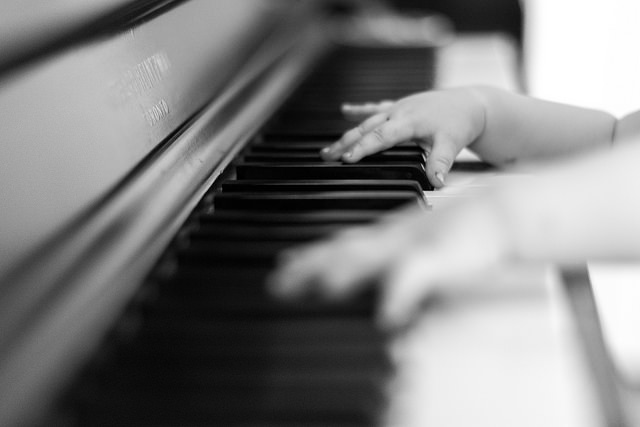 This post was made possible through the support of a grant from The BioLogos Foundation’s Evolution and Christian Faith program. The opinions expressed are those of the author and do not necessarily reflect the views of BioLogos.
Before I formed you in the womb I knew you, and before you were born I consecrated you. — Jeremiah 1:5
The role of music in life is so great that to make a point about it is to risk staleness. In fact, it’s one of the best indicators of a priori awareness. “We all know that,” silently remarks the hearer, when some correlation between melody and mind, song and soul, is pointed out.
But most of the things we know about music tend to be related to the reactions it elicits. Music enlivens us, calms us, inspires us, undoes us—we react to it; it sets our feet going. Our lives are set to a metronome. Marches, waltzes, head thrashes, mosh pit jumps, whatever its mode, music plays us as much as we play it. Physically, we become the wind chime, the Aeolian harp, as the notes blow past and cascade through the pipes and strings of our bodies.
Further, music is said to both sustain and substantiate us. It is the “food of love,” said the man of Stratford (Twelfth Night), and fit for “treasons, stratagems, and spoils” are those who have no music within themselves (The Merchant of Venice).
Few would quarrel with these things; they are the time-tested effects of melody. As Kant said, music is the “quickening art,” and it takes very little to spark the fire.
But these observations all deal with the present, with the consequences of a particular iPod track being played or a particular XM radio station blasting forth. We know best what music can do to the here and now. Suspected, but not as well understood, is the connection between music and the past—music’s role in memory-making and memory-retention, and even more remarkable, its connection with the future, in language acquisition.
Scientists have been looking into these things over the past few years. And it seems that the brain’s medial pre-frontal cortex, located just behind the forehead, is the center for the music-memory interchange.
According to Petr Janata, a cognitive neuroscientist at UC-Davis, “a piece of familiar music serves as a soundtrack for a mental movie that starts playing in our head. It calls back memories of a particular person or place, and you might all of a sudden see that person’s face in your mind’s eye.”
Of course, this too we know on a subconscious level. Some songs we have to crank up because of what they put us in mind of, bouncing around the car as we blast our way to work. Conversely, some we have to turn off—again, because of what they put us in mind of, remembrances too bittersweet to stand at a given moment.
Still, the role of music as catalytic converter is deepened by this observation. Music sparks memory, and memory—being the storehouse of the self that it is—reminds us of who we are. We recapture ourselves through recollection—i.e., collecting, again—the things that make us up. And what makes us up is not simply a matter of chemical compounds, a spreadsheet of elements in proportionate measures, but a constitution of experiences, of formative moments, of choices, for good and ill.
What we are is the scars of a lifetime and the stories that explain them—those won in glory, those won in infamy. Music brings it all back.
The re-constitutional power of music is attested to by the effect it has on those for whom the paths of memory have become choked. Alzheimer’s and dementia patients “brighten” when they hear music with which they’re familiar. Patients that have been incommunicable are able to sing along with the tunes of their past and even to converse about them.
That’s because the prefrontal cortex, the location of the music-memory complex, is among the last to atrophy. Neurologists at the Boston University Alzheimer’s Disease Center explain that emotional memories are the strongest and best-retained. Music acts as their summoner, ironically, because it’s associated with “procedural” memories—those that have to do with repetition—not with “episodic” memories, which help us place events within time. The diseases that attack memory mostly go after the parts of the brain that store episodes, not procedures.
And the stock-taking of who and what we are—a process itself as crucial to existence as any other, if we admit that a “person” is more than a carbon structure—is a process that reaches far, far back. It transcends even the womb, with music playing a role in the foundation of selfhood.
At The University of Würzburg in Germany, scientist Kathleen Wermke has found that early as the third trimester, fetuses can remember sounds they hear from the external world. They have “a particular sensitivity to melody contour in both music and language.
Newborns prefer their mother’s voice over other voices and perceive the emotional content of messages conveyed via intonation contours in maternal speech (a.k.a. “motherese”). Their perceptual preference for the surrounding language and their ability to distinguish between different languages and pitch changes are based primarily on melody.”
The neonates produce different “cry melodies” based upon the patterns typical of the ambient language. Patricia Kuhl, Co-Director of the University of Washington’s Institute for Learning and Brain Sciences, says the finding shows that infants begin learning well before they are born.
So it is melody that teaches us both what our first cry will sound like, and then how to go about making that cry; melody by which we score and memorialize our lives, and melody by which we recall them, even when time and age have clouded our way. Music at the first, music at the last.
My what intricate and marvelous things we are, formed long before we’ve felt the warmth of sun or touch, long before air has broken through the border of our beings.
While we yet swim within the reaches of our mother’s blood, the grand symphony of our souls is atuning. And all the while it hearkens to the notes and cadences, the bass and treble of the world within which we will soon play our song, before whom we will nigh burst forth in a great masterpiece of life.
For you formed my inward parts; you knitted me together in my mother’s womb. I praise you, for I am fearfully and wonderfully made.—Psalm 139:13-14
Join in the conversation about evolution and Christian faith by visiting the BioLogos symposium at Patheos. Click here for more on Image’s BioLogos colloquy.
A.G. Harmon teaches Shakespeare, Law and Literature, Jurisprudence, and Writing at The Catholic University of America in Washington, D.C. His novel, A House All Stilled, won the 2001 Peter Taylor Prize for the Novel.

Previous Post

November 13, 2015
Poetry Friday: "Mixed Company" by Brett Foster
Next Post
November 17, 2015 Joining in Life and in Death
Browse Our Archives
Select a Category A. G. Harmon Alissa Wilkinson Allison Backous Art Authors Brad Fruhauff Bradford Winters Bryan Bliss Caroline Langston Chad Thomas Johnston Chris Hoke Christiana N. Peterson Culture D.G. Myers D.L. Mayfield Daniel Bowman Jr. David Griffith Elizabeth Duffy Faith Film Greg Wolfe Guest Contributor Interview Jan Vallone Jeffrey Overstreet Jessica Eddings-Roeser Jessica Mesman Griffith Kelly Foster Lindsey Crittenden Morgan Meis music Natalie Vestin Nick Olson Peggy Rosenthal Personal Reflection Poetry Friday Reflection Relationships Review Richard Chess Richard Cole Sara Zarr Shannon Huffman Polson Sonya Bilocerkowycz Tania Runyan Tony Woodlief Topical Categories Uncategorized Vic Sizemore Writing
Select a Month October 2018 September 2018 August 2018 July 2018 June 2018 May 2018 April 2018 March 2018 February 2018 January 2018 December 2017 November 2017 October 2017 September 2017 August 2017 July 2017 June 2017 May 2017 April 2017 March 2017 February 2017 January 2017 December 2016 November 2016 October 2016 September 2016 August 2016 July 2016 June 2016 May 2016 April 2016 March 2016 February 2016 January 2016 December 2015 November 2015 October 2015 September 2015 August 2015 July 2015 June 2015 May 2015 April 2015 March 2015 February 2015 January 2015 December 2014 November 2014 October 2014 September 2014 August 2014 July 2014 June 2014 May 2014 April 2014 March 2014 February 2014 January 2014 December 2013 November 2013 October 2013 September 2013 August 2013 July 2013 June 2013 May 2013 April 2013 March 2013 February 2013 January 2013 December 2012 November 2012 October 2012 September 2012 August 2012 July 2012 June 2012 May 2012 February 2008
Follow Us!
TAKE THE
Religious Wisdom Quiz
True or False: Paul shook a viper off his hand into the fire on the island of Cyprus.
Select your answer to see how you score.
TRUE FALSE
Related posts from Good Letters

On Writing Odes: Taking Time to Celebrate
The Crown and Victoria: Tales of Two Queens
Listening to My Life: 17 Listens for 2017
TRENDING AT PATHEOS Catholic

Creation, Preservation, and Teleology in Catholic Theology
As I write this, it is very early Monday morning. Like millions...

The Parable Of The Sower And The Word...
One of Christ’s most famous parables is that of the sower who...

Rejecting Doom: Christian Hope And Human Action
Christianity is a religion of hope. We are to have hope and...

Why I Choose the Eucharist Over the Sermon
Choose the Eucharist, Not the Sermon What are we supposed to get...

5 Design Elements Found in Spiritually Rooted Homes
Putting Spirituality Into Home Decor Our homes are more than our living...

Credo: A Story of God Told with the...
About 10 years ago, I began to imagine a personal "Credo" that...
view all Catholic blogs
Ad-Free & Subscriber Log-In Subscription Support
- About Us
- 2026 Calendar
- Videos
- Podcasts
- Library of World Religions
- Faith In Media Tracker
- Advertise With Us
- Write for Us
- Privacy Policy
- Terms of Service
- Do Not Sell My Data
- Contact Us
- Radiant Digital
- Manage Newsletter Subscriptions
- Unsubscribe From Notifications
- Sitemap
Copyright 2008-2026, Patheos. All rights reserved.
Subscription Support Ad-Free & Subscriber Log-In
Follow Patheos