
BuddhistCatholicContemplativeEvangelicalGeneral ChristianHinduJewishLatter-day SaintMuslimNew VisionsProgressive Christian
Beliefs
- Buddhist
- Catholic
- Contemplative
- Evangelical
- General Christian
- Hindu
- Jewish
- Latter-day Saint
- More Voices
- Muslim
- New Visions
- Pagan
- Progressive Christian
Topics
- Religion News
- Food and Religion
- Sports and Religion
- Religious Art
- Religious Music and Entertainment
- Religious Events
- History and Religion
- Style and Religion
- Politics and Religion
- Women in Religion
- Recreation Outdoors and Religion
- Business Finance and Religion
- Careers Workplace and Religion
- Education and Religion
- Family Parenting and Religion
- Health Fitness and Religion
- Home and Religion
- Relationships and Religion
- Technology and Religion
- Travel and Religion
Columnists
- Buddhist Columnists
- Business Finance and Religion Columnists
- Careers Workplace and Religion Columnists
- Catholic Columnists
- Contemplative Columnists
- Education and Religion Columnists
- Evangelists Columnists
- Family Parenting and Religion Columnists
- General Christian Columnists
- Health Fitness and Religion Columnists
- Hindu Columnists
- History and Religion Columnists
- Home and Religion Columnists
- Jewish Columnists
- More Voices Columnists
- Latter Day Columnists
- Muslim Columnists
- New Visions Columnists
- Nonreligious Columnists
- Pagan Columnists
- Politics and Religion Columnists
- Progressive Columnists
- Recreation Outdoors and Religion Columnists
- Relationships and Religion Columnists
- Religion News Columnists
- Religious Art Columnists
- Religious Events Columnists
- Religious Music and Entertainment Columnists
- Sports and Religion Columnists
- Style and Religion Columnists
- Technology and Religion Columnists
- Travel and Religion Columnists
- Women in Religion Columnists
Resource Library
- 2026 Calendar
- Library of World Religions
- The 100 Most Holy Places on Earth
- Patheos Answers
- Podcasts
- Videos
- Faith Leaders Database
- Anglican Episcopalian
- Bahai
- Baptist
- Buddhism
- Christianity
- Confucianism
- Eastern Orthodoxy
- Hinduism
- Holiness and Pentecostal
- ISKCON
- Islam
- Judaism
- Lutheran
- Methodist
- The Church of Jesus Christ of Latter-day Saints
- New Age
- Paganism
- Presbytarian and Reformed
- Protestantism
- Religion Behind the Scenes
- Roman Catholic
- Scientology
- Shia Islam
- Sikhism
- Sufism
- Sunni Islam
- Taoism
- Zen
- See all religions
Research Tools
 Ad-Free & Subscriber Log-In Subscription Support
Ad-Free & Subscriber Log-In Subscription Support
Follow Patheos 

- Trending:
- Forgiveness
- |
- Marriage
- |
- Consciousness
- |
- Death Penalty
- |
- Election
- |
- Halloween
 Good Letters
-
Contributors
- Home
- Catholic
- Wonder Woman, Flying, Part 2: Beauty and Sacrament
Wonder Woman, Flying, Part 2: Beauty and Sacrament
Last updated on: May 12, 2016 at 1:37 pm by Brad Fruhauff
Wonder Woman, Flying, Part 2: Beauty and Sacrament 2016-05-12T13:37:25-07:00 Brad Fruhauff
Patheos Explore the world's faith through different perspectives on religion and spirituality! Patheos has the views of the prevalent religions and spiritualities of the world.
Continued from yesterday.
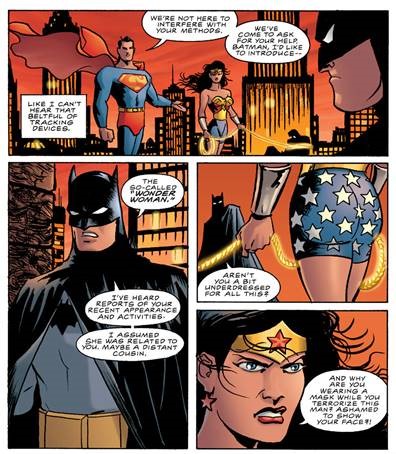 In this scene from Batman’s first meeting with Wonder Woman in Trinity, you can feel the writer Matt Wagner’s personality trumping the artist; though it doesn’t really add much to the narrative, Wagner can’t help but let Bats make a crack about her costume.
Superheroines’ costumes are perpetually controversial, it seems (perhaps because few artists have done much to better protect their heroines), and I sympathize with those who critique the way women are often overly sexualized in ways men are not. I don’t agree that the antidote is more sexualized male bodies. That strikes me as the kind of capitalistic, individualistic, hedonistic thinking that led to the hypersexualization of all bodies at the magazine racks. But at the same time, I also don’t believe we need more realistic bodies or body armor in all cases.
Take Wonder Woman flying, for instance. Yes, it stretches the suspension of disbelief to breaking to put her in a strapless one-piece “armor” (and yes, it is frequently referred to as armor; if you look, you’ll see the chest-piece and waistband are, in fact, metal). Some newer series and geek blogs have tried to re-imagine her costume in more realistic terms with some success, but increased realism comes at the cost of bringing Diana closer down to earth.
Now, while in my previous post I called Wonder Woman an icon of transcendent hope, I wouldn’t want to suggest her iconicity matters more than her humanity. It is important to me that Diana is a person with an inner life and a personal history, but it is important to the character of Wonder Woman that she remain just this side of totally individual, because it is part of her mythological function to receive our hopes and desires for goodness onto herself.
Pérez’s drawing captures the individual/icon dynamic in the way he shows us a young woman enjoying the power and beauty of her own body. Her eyes are closed and she’s smiling, taking a moment to herself after an unimaginably stressful day of trying to convince patriarchy’s children of a better way.
She abandons herself in a field of play where her powers are not called upon for any purpose other than the joy of having them. Her body is lean and agile and she loves how the wind curves across it. Her posture signifies not power but moral innocence. In this picture she is the opposite of Batman and purer than Superman.
Granted, she still wears the implausible unitard that shows a lot of skin, and even as self-aware as Pérez is, there’s no escaping the pervasive comics interest in the hero’s idealized, often exaggerated body. I have my list of characters whose costumes or features exceed good taste (Ms. Marvel and Black Cat pretty well take the cake on this; next to them, Diana’s costume is as scandalous as a swimsuit), but in this case I don’t think it is an intrinsically sexual image, and I read her idealization as serving a legitimately transcendent purpose.
Make no mistake, even Pérez has other female characters become body-conscious around Diana, but Diana herself never looks at other women as anything other than sisters. Pérez, at least, never presents her as eye candy for a male readership; and this is important because Wonder Woman has always had a female empowerment dimension to her (which I never realized until learning about her creator).
Beauty for superheroines generally alternates between the Greek ideals of symmetry and proportion and straight-up male fantasy. Certainly either can serve the shame-based body-ideals of our consumer age, but I can’t help reading Pérez’s work against that tradition.
I don’t think it’s going too far to say that in his hands (and some others’), Wonder Woman’s beauty is sacramental. Physically, she represents the goodness of the body—that movement is itself a kind of freedom, that sensation underlies much of our joy and pleasure, that a body is a fearful and wonderful thing in itself. We see hints of this in how her arms are lengthened beyond proportion but her face expresses a private experience; she is both impossible ideal and her own person.
In our age of internet porn and sexting, when the most recent controversy about Wonder Woman was whether Gal Gadot, who will play the role in Superman vs. Batman, is muscular enough or has large enough breasts (conversations that don’t merit links), I think it’s worth reminding ourselves over and over that beauty is not always reducible to the sexual nor only merely a tool for a powerful group such as white men.
Superheroes—male and female—have come to constitute part of the American psyche for more reasons than nostalgia or escapist fantasy. They are the closest thing we have to a national pantheon (as distinct from our hall of heroes), and their popularity does not preclude their spiritual significance.
Wonder Woman can be both an individual beckoning the same moral response we give other fictional characters and a sacramental image of incarnate being; she’s most fascinating when she can transform this tension into a harmony.
Wonder Woman flying reminds us that playing basketball, running, dancing, even just stretching in the morning, all uses of our bodies, whatever our limitations, express their created goodness. The little skip over a puddle, the victorious fist pump, even a comically raised eyebrow, it turns out, are all forms of flying.
Brad Fruhauff is a film buff, comics nerd, literature scholar, editor, and writer living in Evanston, IL. He is Senior Editor at Relief: A Christian Literary Review and a Writing and Communications Specialist at Trinity International University where he also serves as Contributing Editor for Sapientia. He has published poems, essays, and reviews in Books & Culture, catapult, Christianity and Literature, Englewood Review of Books, Every Day Poems, Not Yet Christmas: An Advent Reader, Rock & Sling, and in the newly released How to Write a Poem.

Previous Post

October 1, 2015
Wonder Woman, Flying, Part 1: Transcendent Hope
Next Post
October 5, 2015 Dr. Seuss and Dietrich Bonhoeffer
Browse Our Archives
Select a Category A. G. Harmon Alissa Wilkinson Allison Backous Art Authors Brad Fruhauff Bradford Winters Bryan Bliss Caroline Langston Chad Thomas Johnston Chris Hoke Christiana N. Peterson Culture D.G. Myers D.L. Mayfield Daniel Bowman Jr. David Griffith Elizabeth Duffy Faith Film Greg Wolfe Guest Contributor Interview Jan Vallone Jeffrey Overstreet Jessica Eddings-Roeser Jessica Mesman Griffith Kelly Foster Lindsey Crittenden Morgan Meis music Natalie Vestin Nick Olson Peggy Rosenthal Personal Reflection Poetry Friday Reflection Relationships Review Richard Chess Richard Cole Sara Zarr Shannon Huffman Polson Sonya Bilocerkowycz Tania Runyan Tony Woodlief Topical Categories Uncategorized Vic Sizemore Writing
Select a Month October 2018 September 2018 August 2018 July 2018 June 2018 May 2018 April 2018 March 2018 February 2018 January 2018 December 2017 November 2017 October 2017 September 2017 August 2017 July 2017 June 2017 May 2017 April 2017 March 2017 February 2017 January 2017 December 2016 November 2016 October 2016 September 2016 August 2016 July 2016 June 2016 May 2016 April 2016 March 2016 February 2016 January 2016 December 2015 November 2015 October 2015 September 2015 August 2015 July 2015 June 2015 May 2015 April 2015 March 2015 February 2015 January 2015 December 2014 November 2014 October 2014 September 2014 August 2014 July 2014 June 2014 May 2014 April 2014 March 2014 February 2014 January 2014 December 2013 November 2013 October 2013 September 2013 August 2013 July 2013 June 2013 May 2013 April 2013 March 2013 February 2013 January 2013 December 2012 November 2012 October 2012 September 2012 August 2012 July 2012 June 2012 May 2012 February 2008
Follow Us!
TAKE THE
Religious Wisdom Quiz
What did Pharaoh’s daughter find floating in the river?
Select your answer to see how you score.
Baby Moses A golden idol A scroll A fish
Related posts from Good Letters




Can a Racist Drive a Prius? Stereotypes and...
TRENDING AT PATHEOS Catholic

Creation, Preservation, and Teleology in Catholic Theology
As I write this, it is very early Monday morning. Like millions...

The Parable Of The Sower And The Word...
One of Christ’s most famous parables is that of the sower who...

Rejecting Doom: Christian Hope And Human Action
Christianity is a religion of hope. We are to have hope and...

Why I Choose the Eucharist Over the Sermon
Choose the Eucharist, Not the Sermon What are we supposed to get...

5 Design Elements Found in Spiritually Rooted Homes
Putting Spirituality Into Home Decor Our homes are more than our living...

Credo: A Story of God Told with the...
About 10 years ago, I began to imagine a personal "Credo" that...
view all Catholic blogs
Ad-Free & Subscriber Log-In Subscription Support
- About Us
- 2026 Calendar
- Videos
- Podcasts
- Library of World Religions
- Faith In Media Tracker
- Advertise With Us
- Write for Us
- Privacy Policy
- Terms of Service
- Do Not Sell My Data
- Contact Us
- Radiant Digital
- Manage Newsletter Subscriptions
- Unsubscribe From Notifications
- Sitemap
Copyright 2008-2026, Patheos. All rights reserved.
Subscription Support Ad-Free & Subscriber Log-In
Follow Patheos