
BuddhistCatholicContemplativeEvangelicalGeneral ChristianHinduJewishLatter-day SaintMuslimNew VisionsProgressive Christian
Beliefs
- Buddhist
- Catholic
- Contemplative
- Evangelical
- General Christian
- Hindu
- Jewish
- Latter-day Saint
- More Voices
- Muslim
- New Visions
- Pagan
- Progressive Christian
Topics
- Religion News
- Food and Religion
- Sports and Religion
- Religious Art
- Religious Music and Entertainment
- Religious Events
- History and Religion
- Style and Religion
- Politics and Religion
- Women in Religion
- Recreation Outdoors and Religion
- Business Finance and Religion
- Careers Workplace and Religion
- Education and Religion
- Family Parenting and Religion
- Health Fitness and Religion
- Home and Religion
- Relationships and Religion
- Technology and Religion
- Travel and Religion
Columnists
- Buddhist Columnists
- Business Finance and Religion Columnists
- Careers Workplace and Religion Columnists
- Catholic Columnists
- Contemplative Columnists
- Education and Religion Columnists
- Evangelists Columnists
- Family Parenting and Religion Columnists
- General Christian Columnists
- Health Fitness and Religion Columnists
- Hindu Columnists
- History and Religion Columnists
- Home and Religion Columnists
- Jewish Columnists
- More Voices Columnists
- Latter Day Columnists
- Muslim Columnists
- New Visions Columnists
- Nonreligious Columnists
- Pagan Columnists
- Politics and Religion Columnists
- Progressive Columnists
- Recreation Outdoors and Religion Columnists
- Relationships and Religion Columnists
- Religion News Columnists
- Religious Art Columnists
- Religious Events Columnists
- Religious Music and Entertainment Columnists
- Sports and Religion Columnists
- Style and Religion Columnists
- Technology and Religion Columnists
- Travel and Religion Columnists
- Women in Religion Columnists
Resource Library
- 2026 Calendar
- Library of World Religions
- The 100 Most Holy Places on Earth
- Patheos Answers
- Podcasts
- Videos
- Faith Leaders Database
- Anglican Episcopalian
- Bahai
- Baptist
- Buddhism
- Christianity
- Confucianism
- Eastern Orthodoxy
- Hinduism
- Holiness and Pentecostal
- ISKCON
- Islam
- Judaism
- Lutheran
- Methodist
- The Church of Jesus Christ of Latter-day Saints
- New Age
- Paganism
- Presbytarian and Reformed
- Protestantism
- Religion Behind the Scenes
- Roman Catholic
- Scientology
- Shia Islam
- Sikhism
- Sufism
- Sunni Islam
- Taoism
- Zen
- See all religions
Research Tools
 Ad-Free & Subscriber Log-In Subscription Support
Ad-Free & Subscriber Log-In Subscription Support
Follow Patheos 

- Trending:
- Forgiveness
- |
- Marriage
- |
- Consciousness
- |
- Death Penalty
- |
- Election
- |
- Halloween
 Good Letters
-
Contributors
- Home
- Catholic
- Wonder Woman, Flying, Part 1: Transcendent Hope
Wonder Woman, Flying, Part 1: Transcendent Hope
Last updated on: May 12, 2016 at 1:37 pm by Brad Fruhauff
Wonder Woman, Flying, Part 1: Transcendent Hope 2016-05-12T13:37:53-07:00 Brad Fruhauff
Patheos Explore the world's faith through different perspectives on religion and spirituality! Patheos has the views of the prevalent religions and spiritualities of the world.
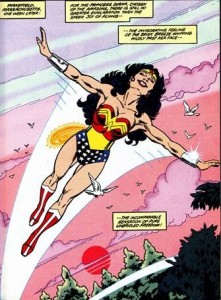 It’s one of my favorite images of Diana of Themyscira, a.k.a. Wonder Woman: her proud, bold body fills the page as she soars across a pink sunset, arms spread wide like a diver, her legs not straight but slightly askew as if skipping on the air.

As someone who never had much use for comics, I’m still a little surprised that I even have a favorite image of Wonder Woman, or that I prefer to call her Diana. Now she intrigues me for many reasons, but it was this image that helped me to “get” her and, indeed, to fall in love with her character.
I’ve read probably a hundred comic book titles in the six years since I really started to get into them—and I mean full-on novels running several hundred pages as well as the volumes that collect five to eight issues of a series—but I still tend to think of them as lighter fare, the medium I looked to for mental stimulation those early nights of parenthood when my newborn needed rocking, the medium I still prefer when my children, now six and three, are playing by themselves but I’m not confident I’ll be able to focus for long.
Yet for all their blatant dialogue and over-the-top action, I find that the good comics really do reach beyond entertainment status to become serious, thoughtful stories about morality, justice, and even the violence so central to many of them. And like any good story, the best comics develop these themes through the tools of their medium and not merely through a few key lines of dialogue. That’s what this image from George Pérez’s 1980s reboot of Wonder Woman does for me.
In this full-page panel, I see more than just an idealization; I see a character both human and icon—and certainly not, by the way, just a “female Superman” (best not to make that mistake).
She stands out against the world in all her glory: lean, strong, dynamic, her absurdly American costume toned-down by her wide golden belt and the hip white stripes on her go-go boots. Her power bands catch the setting sun and make her sparkle even as her golden lasso burns with Hephaestus’s fire. She is the powerful, perfect woman come to save us from our monsters.
This is Diana as symbol of hope.
But we see her otherness, too—a young woman whose powers set her apart and remind us that she comes from a different world. On her home island of Themyscira they have incredible technologies, but they practice ancient virtues—imagine a cross between an idealized ancient Greece and a 1950s sci-fi B-movie utopia (it’s also called, more blatantly, Paradise Island).
It’s an attractive home, where training as a warrior means expressing the virtues of the body in subjection to the will rather than becoming a weapon that needs to be used. Peace consists in cooperation in the name of mutual good rather than the anxious protection and expansion of power. She represents a world both nostalgic and aspirational.
In Pérez’s series, Diana leaves Themyscira for “Man’s (or Patriarch’s) World” as an ambassador of the feminine virtues of cooperation, compassion, and unity (represented by the Greek goddesses—plus Hermes and sometimes Apollo) over and against the masculine virtues of aggression and power (Ares, Hades, Zeus, or demigods like the Gorgons, Phobos and Deimos).
A kind of “anthropologist on Mars” character, she is often confused or surprised by how suspicious, vicious, and petty people can be in Man’s World. The violence women do to one another particularly baffles her; she calls them all sisters and does not understand why they do not band together with her to resist their true foe: the logic and structures of patriarchy.
If Pérez’s politics sometimes become blatant, he gives the values themselves enough room that they overflow the particular historical moment. He allegorizes the Cold War as the machinations of Ares on both sidesof the conflict, conflict itself serving to empower him above the other gods regardless of the victor.
Pérez reframes the geopolitical ideological conflict as a global question of values and commitments: will we bow to the forces of strife or stand for the forces of peace? Superhero comics often present a cynical view of the world and tread a fine line between a redemptive hope and a Manichaean fatalism; by explicitly invoking the gods and a domain beyond the everyday, Pérez comes as close as I’ve seen to recognizing our fundamental orientation to worship and thus to raising the question of which god(s) we will serve.
This is Diana as otherworldly messenger, as angel, a reminder of a higher order of reality.
The simplicity of the allegory doesn’t really bother me; sometimes claiming complexity masks self-serving purposes, and if the greatest truths belong to everyone, they cannot be esoteric but must be simple enough for everyone to grasp on at least some level. For the same reason I believe in Diana’s naïveté; she stands for and behind a worldview that lacks the sexiness of an elaborate system.
Visually, Pérez presents this moral and diplomatic purpose in the freedom of flight. In context of the narrative, it is a breath, a respite before more speeches and more battles. To witness her flying is to recall that she is still a human being, the bearer of our transcendent hope but not identical to it. She has her own journey of facing down evil and becoming good.
In this picture, at least, she’s winning; her goodness shines in her smile and her wide, vulnerable pose. It’s a private moment, but our presence is not lurid because her confidence and trust are like an invitation.
It’s as if her virtue lifts her into the air, beckoning us to become good, too.
To be continued tomorrow.
Brad Fruhauff is a film buff, comics nerd, literature scholar, editor, and writer living in Evanston, IL. He is Senior Editor at Relief: A Christian Literary Review and a Writing and Communications Specialist at Trinity International University where he also serves as Contributing Editor for Sapientia. He has published poems, essays, and reviews in Books & Culture, catapult, Christianity and Literature, Englewood Review of Books, Every Day Poems, Not Yet Christmas: An Advent Reader, Rock & Sling, and in the newly released How to Write a Poem.

Previous Post

September 30, 2015
Beauty Will Save the Seventh Grade
Next Post
October 2, 2015 Wonder Woman, Flying, Part 2: Beauty and Sacrament
Browse Our Archives
Select a Category A. G. Harmon Alissa Wilkinson Allison Backous Art Authors Brad Fruhauff Bradford Winters Bryan Bliss Caroline Langston Chad Thomas Johnston Chris Hoke Christiana N. Peterson Culture D.G. Myers D.L. Mayfield Daniel Bowman Jr. David Griffith Elizabeth Duffy Faith Film Greg Wolfe Guest Contributor Interview Jan Vallone Jeffrey Overstreet Jessica Eddings-Roeser Jessica Mesman Griffith Kelly Foster Lindsey Crittenden Morgan Meis music Natalie Vestin Nick Olson Peggy Rosenthal Personal Reflection Poetry Friday Reflection Relationships Review Richard Chess Richard Cole Sara Zarr Shannon Huffman Polson Sonya Bilocerkowycz Tania Runyan Tony Woodlief Topical Categories Uncategorized Vic Sizemore Writing
Select a Month October 2018 September 2018 August 2018 July 2018 June 2018 May 2018 April 2018 March 2018 February 2018 January 2018 December 2017 November 2017 October 2017 September 2017 August 2017 July 2017 June 2017 May 2017 April 2017 March 2017 February 2017 January 2017 December 2016 November 2016 October 2016 September 2016 August 2016 July 2016 June 2016 May 2016 April 2016 March 2016 February 2016 January 2016 December 2015 November 2015 October 2015 September 2015 August 2015 July 2015 June 2015 May 2015 April 2015 March 2015 February 2015 January 2015 December 2014 November 2014 October 2014 September 2014 August 2014 July 2014 June 2014 May 2014 April 2014 March 2014 February 2014 January 2014 December 2013 November 2013 October 2013 September 2013 August 2013 July 2013 June 2013 May 2013 April 2013 March 2013 February 2013 January 2013 December 2012 November 2012 October 2012 September 2012 August 2012 July 2012 June 2012 May 2012 February 2008
Follow Us!
TAKE THE
Religious Wisdom Quiz
What does "Selah" (found in Psalms) most likely mean?
Select your answer to see how you score.
Amen Sing Pause/Reflect Hallelujah
Related posts from Good Letters


Poetry Friday: "The Burned Butterfly"

TRENDING AT PATHEOS Catholic

Rejecting Doom: Christian Hope And Human Action
Christianity is a religion of hope. We are to have hope and...

It’s What Comes From Within Which Matters
One of the most difficult things for us to understand is why...

Why I Choose the Eucharist Over the Sermon
Choose the Eucharist, Not the Sermon What are we supposed to get...

5 Design Elements Found in Spiritually Rooted Homes
Putting Spirituality Into Home Decor Our homes are more than our living...

Credo: A Story of God Told with the...
About 10 years ago, I began to imagine a personal "Credo" that...

The Anatomy of Divine Revelation in Catholic Thought
The claim that God has made Himself known to human beings is...
view all Catholic blogs
Ad-Free & Subscriber Log-In Subscription Support
- About Us
- 2026 Calendar
- Videos
- Podcasts
- Library of World Religions
- Faith In Media Tracker
- Advertise With Us
- Write for Us
- Privacy Policy
- Terms of Service
- Do Not Sell My Data
- Contact Us
- Radiant Digital
- Manage Newsletter Subscriptions
- Unsubscribe From Notifications
- Sitemap
Copyright 2008-2026, Patheos. All rights reserved.
Subscription Support Ad-Free & Subscriber Log-In
Follow Patheos