
BuddhistCatholicContemplativeEvangelicalGeneral ChristianHinduJewishLatter-day SaintMuslimNew VisionsProgressive Christian
Beliefs
- Buddhist
- Catholic
- Contemplative
- Evangelical
- General Christian
- Hindu
- Jewish
- Latter-day Saint
- More Voices
- Muslim
- New Visions
- Pagan
- Progressive Christian
Topics
- Religion News
- Food and Religion
- Sports and Religion
- Religious Art
- Religious Music and Entertainment
- Religious Events
- History and Religion
- Style and Religion
- Politics and Religion
- Women in Religion
- Recreation Outdoors and Religion
- Business Finance and Religion
- Careers Workplace and Religion
- Education and Religion
- Family Parenting and Religion
- Health Fitness and Religion
- Home and Religion
- Relationships and Religion
- Technology and Religion
- Travel and Religion
Columnists
- Buddhist Columnists
- Business Finance and Religion Columnists
- Careers Workplace and Religion Columnists
- Catholic Columnists
- Contemplative Columnists
- Education and Religion Columnists
- Evangelists Columnists
- Family Parenting and Religion Columnists
- General Christian Columnists
- Health Fitness and Religion Columnists
- Hindu Columnists
- History and Religion Columnists
- Home and Religion Columnists
- Jewish Columnists
- More Voices Columnists
- Latter Day Columnists
- Muslim Columnists
- New Visions Columnists
- Nonreligious Columnists
- Pagan Columnists
- Politics and Religion Columnists
- Progressive Columnists
- Recreation Outdoors and Religion Columnists
- Relationships and Religion Columnists
- Religion News Columnists
- Religious Art Columnists
- Religious Events Columnists
- Religious Music and Entertainment Columnists
- Sports and Religion Columnists
- Style and Religion Columnists
- Technology and Religion Columnists
- Travel and Religion Columnists
- Women in Religion Columnists
Resource Library
- 2026 Calendar
- Library of World Religions
- The 100 Most Holy Places on Earth
- Patheos Answers
- Podcasts
- Videos
- Faith Leaders Database
- Anglican Episcopalian
- Bahai
- Baptist
- Buddhism
- Christianity
- Confucianism
- Eastern Orthodoxy
- Hinduism
- Holiness and Pentecostal
- ISKCON
- Islam
- Judaism
- Lutheran
- Methodist
- The Church of Jesus Christ of Latter-day Saints
- New Age
- Paganism
- Presbytarian and Reformed
- Protestantism
- Religion Behind the Scenes
- Roman Catholic
- Scientology
- Shia Islam
- Sikhism
- Sufism
- Sunni Islam
- Taoism
- Zen
- See all religions
Research Tools
 Ad-Free & Subscriber Log-In Subscription Support
Ad-Free & Subscriber Log-In Subscription Support
Follow Patheos 

- Trending:
- Forgiveness
- |
- Marriage
- |
- Consciousness
- |
- Death Penalty
- |
- Election
- |
- Halloween
 Good Letters
-
Contributors
- Home
- Catholic
- Dr. Seuss and Dietrich Bonhoeffer
Dr. Seuss and Dietrich Bonhoeffer
Last updated on: October 5, 2015 at 3:02 pm by Guest Contributor
Dr. Seuss and Dietrich Bonhoeffer 2015-10-05T15:02:11-07:00 Guest Contributor
Patheos Explore the world's faith through different perspectives on religion and spirituality! Patheos has the views of the prevalent religions and spiritualities of the world.
By Kathleen L. Housley
 I am reading a biography of the theologian Dietrich Bonhoeffer, who was hanged in 1945 for his role in the plot to kill Hitler.
Suddenly the door opens and my two-year-old grandson, Alex, bounces in. Seeing the book, he attempts to climb into my lap so I can read to him as well. I put down the biography, pick him up, and select Mr. Brown Can Moo! Can You?, which is in the pile of books beside my chair along with Bonhoeffer’s Ethics and Letters and Papers from Prison, shifting instantly from the lead-weight of Nazism to the whimsy of Dr. Seuss.
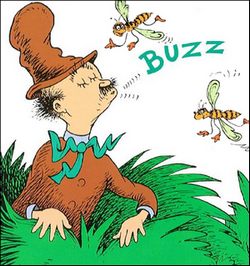
Mr. Brown is an imitator extraordinaire of sounds. He can moo so well that a wide-eyed cow with blue horns looks on in stunned amazement. He can make the tick-tock sounds of a clock so convincingly that the clock changes its angle of repose out of respect. He is adept at the buzz of bees who, like the cow, look happily surprised by hearing their own sound emerge from a human mouth.
However, Mr. Brown’s most impressive imitation is thunder and lightning about which he gets so excited that he jumps up and down as yellow bolts zigzag around him. On the opposite end of the decibel scale is the silent kiss of two goldfish.
Theodor Seuss Geisel (Dr. Seuss) had a superb way of pulling listening children into his books. In Mr. Brown Can Moo! Can You?, which is subtitled Dr. Seuss’s Book of Wonderful Noises, he encourages them to make the sounds along with Mr. Brown. “I think you ought to try,” he writes. And my grandson does just that, hooting like the owl and popping like a cork.
There is one odd thing about Mr. Brown that most adults probably haven’t noticed. Never once in the book does he open his eyes. Like an opera singer with hands reverently clasped and head slightly tipped back, Mr. Brown has abandoned sight for sound. Even when standing on the back of a purple horse, his eyes are shut tight, and he is totally engrossed in klopp klopp klopp.
Mr. Brown lives fully in the present, or more accurately, the auditory moment he himself produces. About such strange goings-on, the horse looks blissfully happy. So does Alex.
I am not annoyed about having my concentration broken and my solitude taken away. In fact, even if my research demands both, there is something fundamentally right about it.
Bonhoeffer would have understood. He was interrupted numerous times during the writing of the Cost of Discipleship (which he composed in the late 1930s while running a seminary that the Nazis had declared illegal) and Ethics (which he wrote while deeply involved in the resistance).
Following his arrest in 1943*,* he read and wrote as much as possible in the enforced solitude of his cell. But he was often interrupted by guards, inmates, bombing raids, and work in the prison infirmary, taking the time to listen and to offer what help he could right up until the day he was hanged.
For example, on February 1, 1944, he wrote to his friend Eberhard Bethge about a terrible bombing raid on Berlin that had blown out the prison windows the night before. In the morning, some prisoners and guards had sought out Bonhoeffer for comforting. He wrote in his letter:
But I’m afraid I’m bad at comforting. I can listen all right, but I can hardly ever find anything to say. But perhaps the way one asks about some things and not about others helps to suggest what really matters; and it seems to me more important actually to share someone’s distress than to use smooth words about it.
Occasionally, Bonhoeffer broke off mid-sentence, writing “Enough of this; I’ve just been disturbed again” (May 29, 1944). But later he picked up his chain of thought as imperturbably as if nothing had occurred.
Similarly, the life of Jesus can be seen as perpetual interruption. I have often thought the disciples must have fumed at his inability to stay on schedule and get things done. Jesus would never have adhered to a prioritized things-to-do list. There was always one more child to hold, one more sick person to be healed, one more anxious person asking a hard question. Never impatient or self-absorbed, Jesus knew, as Bonhoeffer put it, “what really matters.”
And so my grandson and I finish Mr. Brown Can Moo! Can You? The last sound he makes is the soft whisper of a butterfly, very soft and very high.
“Maybe YOU can, too, I think you ought to try.”
Kathleen L. Housley writes on the interconnection of the sciences and religion. She is the author of nine books, most recently the poetry collection Epiphanies (Wising Up) and the novel The Sage of Time and Chance (Wipf & Stock), based on Ecclesiastes.

Previous Post

October 2, 2015
Wonder Woman, Flying, Part 2: Beauty and Sacrament
Next Post
October 6, 2015 Tale of the Lucky and the Star-Crossed
Browse Our Archives
Select a Category A. G. Harmon Alissa Wilkinson Allison Backous Art Authors Brad Fruhauff Bradford Winters Bryan Bliss Caroline Langston Chad Thomas Johnston Chris Hoke Christiana N. Peterson Culture D.G. Myers D.L. Mayfield Daniel Bowman Jr. David Griffith Elizabeth Duffy Faith Film Greg Wolfe Guest Contributor Interview Jan Vallone Jeffrey Overstreet Jessica Eddings-Roeser Jessica Mesman Griffith Kelly Foster Lindsey Crittenden Morgan Meis music Natalie Vestin Nick Olson Peggy Rosenthal Personal Reflection Poetry Friday Reflection Relationships Review Richard Chess Richard Cole Sara Zarr Shannon Huffman Polson Sonya Bilocerkowycz Tania Runyan Tony Woodlief Topical Categories Uncategorized Vic Sizemore Writing
Select a Month October 2018 September 2018 August 2018 July 2018 June 2018 May 2018 April 2018 March 2018 February 2018 January 2018 December 2017 November 2017 October 2017 September 2017 August 2017 July 2017 June 2017 May 2017 April 2017 March 2017 February 2017 January 2017 December 2016 November 2016 October 2016 September 2016 August 2016 July 2016 June 2016 May 2016 April 2016 March 2016 February 2016 January 2016 December 2015 November 2015 October 2015 September 2015 August 2015 July 2015 June 2015 May 2015 April 2015 March 2015 February 2015 January 2015 December 2014 November 2014 October 2014 September 2014 August 2014 July 2014 June 2014 May 2014 April 2014 March 2014 February 2014 January 2014 December 2013 November 2013 October 2013 September 2013 August 2013 July 2013 June 2013 May 2013 April 2013 March 2013 February 2013 January 2013 December 2012 November 2012 October 2012 September 2012 August 2012 July 2012 June 2012 May 2012 February 2008
Follow Us!
TAKE THE
Religious Wisdom Quiz
What does Paul say is the greatest of faith, hope, and love?
Select your answer to see how you score.
Love Faith Hope Strength
Related posts from Good Letters


Morning in a Forgotten Neighborhood


TRENDING AT PATHEOS Catholic

Rejecting Doom: Christian Hope And Human Action
Christianity is a religion of hope. We are to have hope and...

It’s What Comes From Within Which Matters
One of the most difficult things for us to understand is why...

Why I Choose the Eucharist Over the Sermon
Choose the Eucharist, Not the Sermon What are we supposed to get...

5 Design Elements Found in Spiritually Rooted Homes
Putting Spirituality Into Home Decor Our homes are more than our living...

Credo: A Story of God Told with the...
About 10 years ago, I began to imagine a personal "Credo" that...

The Anatomy of Divine Revelation in Catholic Thought
The claim that God has made Himself known to human beings is...
view all Catholic blogs
Ad-Free & Subscriber Log-In Subscription Support
- About Us
- 2026 Calendar
- Videos
- Podcasts
- Library of World Religions
- Faith In Media Tracker
- Advertise With Us
- Write for Us
- Privacy Policy
- Terms of Service
- Do Not Sell My Data
- Contact Us
- Radiant Digital
- Manage Newsletter Subscriptions
- Unsubscribe From Notifications
- Sitemap
Copyright 2008-2026, Patheos. All rights reserved.
Subscription Support Ad-Free & Subscriber Log-In
Follow Patheos