
BuddhistCatholicContemplativeEvangelicalGeneral ChristianHinduJewishLatter-day SaintMuslimNew VisionsProgressive Christian
Beliefs
- Buddhist
- Catholic
- Contemplative
- Evangelical
- General Christian
- Hindu
- Jewish
- Latter-day Saint
- More Voices
- Muslim
- New Visions
- Pagan
- Progressive Christian
Topics
- Religion News
- Food and Religion
- Sports and Religion
- Religious Art
- Religious Music and Entertainment
- Religious Events
- History and Religion
- Style and Religion
- Politics and Religion
- Women in Religion
- Recreation Outdoors and Religion
- Business Finance and Religion
- Careers Workplace and Religion
- Education and Religion
- Family Parenting and Religion
- Health Fitness and Religion
- Home and Religion
- Relationships and Religion
- Technology and Religion
- Travel and Religion
Columnists
- Buddhist Columnists
- Business Finance and Religion Columnists
- Careers Workplace and Religion Columnists
- Catholic Columnists
- Contemplative Columnists
- Education and Religion Columnists
- Evangelists Columnists
- Family Parenting and Religion Columnists
- General Christian Columnists
- Health Fitness and Religion Columnists
- Hindu Columnists
- History and Religion Columnists
- Home and Religion Columnists
- Jewish Columnists
- More Voices Columnists
- Latter Day Columnists
- Muslim Columnists
- New Visions Columnists
- Nonreligious Columnists
- Pagan Columnists
- Politics and Religion Columnists
- Progressive Columnists
- Recreation Outdoors and Religion Columnists
- Relationships and Religion Columnists
- Religion News Columnists
- Religious Art Columnists
- Religious Events Columnists
- Religious Music and Entertainment Columnists
- Sports and Religion Columnists
- Style and Religion Columnists
- Technology and Religion Columnists
- Travel and Religion Columnists
- Women in Religion Columnists
Resource Library
- 2026 Calendar
- Library of World Religions
- The 100 Most Holy Places on Earth
- Patheos Answers
- Podcasts
- Videos
- Faith Leaders Database
- Anglican Episcopalian
- Bahai
- Baptist
- Buddhism
- Christianity
- Confucianism
- Eastern Orthodoxy
- Hinduism
- Holiness and Pentecostal
- ISKCON
- Islam
- Judaism
- Lutheran
- Methodist
- The Church of Jesus Christ of Latter-day Saints
- New Age
- Paganism
- Presbytarian and Reformed
- Protestantism
- Religion Behind the Scenes
- Roman Catholic
- Scientology
- Shia Islam
- Sikhism
- Sufism
- Sunni Islam
- Taoism
- Zen
- See all religions
Research Tools
 Ad-Free & Subscriber Log-In Subscription Support
Ad-Free & Subscriber Log-In Subscription Support
Follow Patheos 

- Trending:
- Forgiveness
- |
- Marriage
- |
- Consciousness
- |
- Death Penalty
- |
- Election
- |
- Halloween
 Good Letters
-
Contributors
- Home
- Catholic
- The Holy Wafer on the Floor
The Holy Wafer on the Floor
Last updated on: November 13, 2015 at 11:53 am by Morgan Meis
The Holy Wafer on the Floor 2015-11-13T11:53:28-07:00 Morgan Meis
Patheos Explore the world's faith through different perspectives on religion and spirituality! Patheos has the views of the prevalent religions and spiritualities of the world.
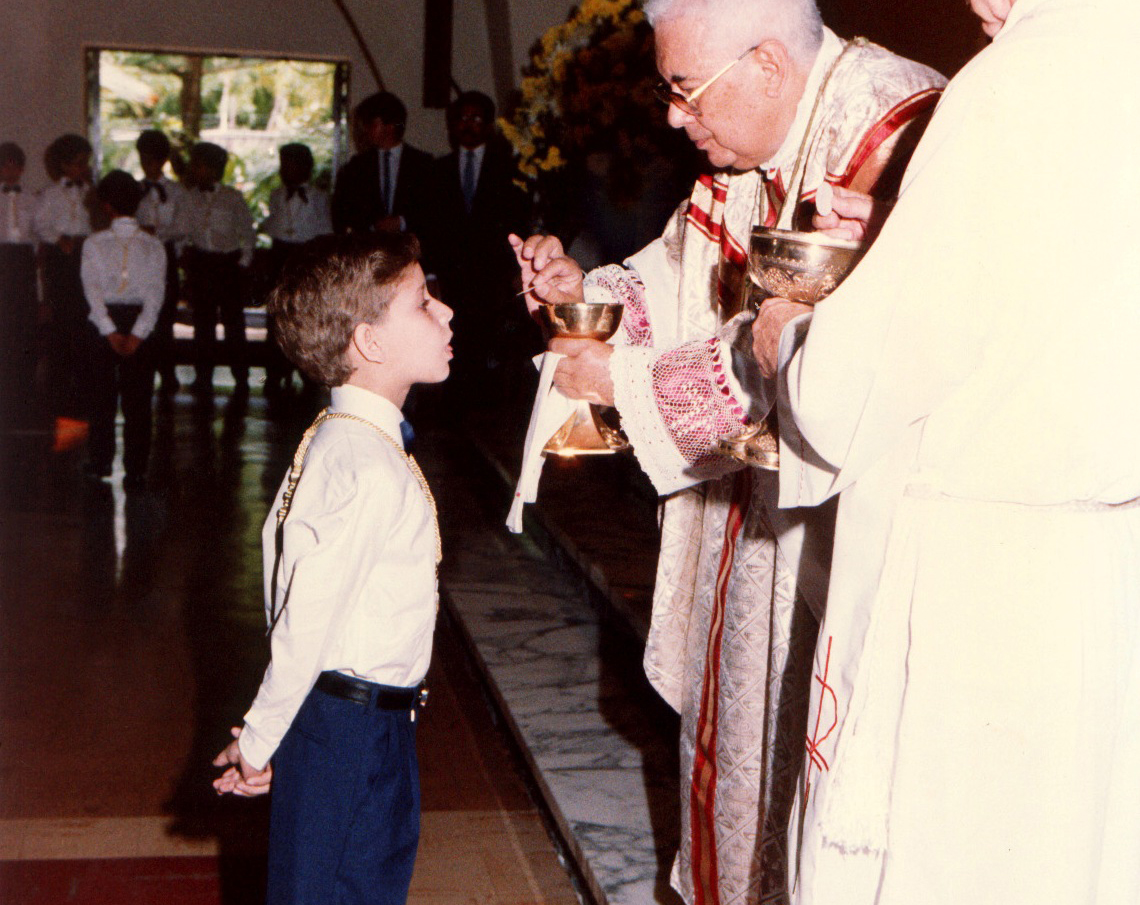 Sometimes I take the Host in the mouth, other times I take it in the hand. Mostly I take it in the mouth. That’s because of the strangeness of it, the good strangeness. I don’t generally let other people feed me, let alone grown men. Let alone priests.
So, this meal is not like other meals. It is a meal that challenges my desire to have control of what goes into me and how. In this meal, I like to feel I’ve surrendered something, that I’ve become vulnerable standing there at the foot of the altar with my mouth open, giving someone else the power to do what they will.
The other day, the younger priest at my church misfired in his attempt to give me communion. He’s not like the older priest, who sticks the wafer right in there, saliva be damned, germs be damned, all of it be damned.
The younger priest, who is a good man all told, worries about viruses and colds and the transmission of disease. And his hand wavers. He doesn’t want to get too close, the younger priest. Because of that, and surely without ever intending any harm, he has become a Host-chucker.
The other morning at Mass, he chucked it a little too hard. The Host bounced off of my outstretched tongue and went sailing. For a moment, the young priest’s physical instincts kicked in. He almost made a grab for the falling Host, trying to catch it before it fell.
Something held him at the last minute and he let it fall. There it was on the ground. “Oops,” he said, smiling weakly. Then he bent down, and picked it up, and tucked it into his robe somewhere. I never saw it again.
I wanted to go back into the sacristy after Mass and ask him about it. I wanted to discuss this episode of the fallen Host. I was curious about what happens to a consecrated but spoiled Host. It had been in my mouth, after all, for a fraction of a second.
The Host was mine. And then, it wasn’t. Just after it bounced out of my mouth, I looked at it there on the floor of the church. A panicky sort of thought invaded my mind: “What is that thing? What is it really? What do I believe that it is?”
That’s what I wanted to ask the young priest. “What happened to us out there?” I wanted to ask. “Has everything gone funny? Did we just prove, accidentally, that we have no idea what we are doing here, taking and giving communion?”
Instead, when mass was over, I walked back outside to the parking lot and got in my car. I drove the few minutes back home as I do every morning. I tried to forget.
A few days later, a book happened to fall into my hands. “Oh, did it,” you say to yourself knowingly, “did the book just fall into your hands, or were higher forces at play?” Well, I don’t know the answer to that. The book, you see, is by a Buddhist monk.
Why would God send me messages about the true nature of the Holy Wafer through the writings of a Zen Buddhist monk? I don’t know. I do know that this monk, Thich Nhat Hanh, seems to have a special relationship with Christ, strange as that may sound. He wrote a book called Living Buddha, Living Christ.
In that book, you will find the following words:
It is ironic that when mass is said today, many congregants are not called to mindfulness at all. They have heard the words so many times that they just feel a little distracted. This is exactly what Jesus was trying to overcome when he said, This is My body. This is My blood. When we are truly there, dwelling deeply in the present moment, we can see that the bread and the wine are really the Body and Blood of Christ and the priest’s words are truly the words of the Lord. The body of Christ is the body of God, the body of ultimate reality, the ground of all existence. We do not have to look anywhere else for it. It resides deep in our own being. The Eucharistic rite encourages us to be fully aware so that we can touch the body of reality in us. Bread and wine are not symbols. They contain the reality, just as we do.
Was that what lay helpless on the floor that day in church? Was it the “ultimate reality,” the “ground of all existence” lying on the ground?
I think that’s exactly what it was, and what it always is. “This is Holy Communion,” writes Thich Nhat Hanh, “to live in faith. When we practice this way, every meal is the Last Supper. In fact, we could call it the First Supper, because everything will be fresh and new.”
Sometimes it takes a mistake, a kink in the normal workings of the world, a Host dropped ingloriously on the floor, to draw attention to what is true.
Morgan Meis is a contributor to Page Turner at The New Yorker. He has a PhD in Philosophy and has written for The Smart Set, n+1, The Believer, Harper’s Magazine, and The Virginia Quarterly Review. He won the Whiting Award in 2013. Morgan is also an editor at 3 Quarks Daily, and a winner of a Creative Capital | Warhol Foundation Arts Writers grant. A book of Morgan’s selected essays can be found here. He can be reached at [email protected].

Previous Post

September 22, 2015
Canticle of Creation
Next Post
September 24, 2015 The Harboring Silence, Part 1
Browse Our Archives
Select a Category A. G. Harmon Alissa Wilkinson Allison Backous Art Authors Brad Fruhauff Bradford Winters Bryan Bliss Caroline Langston Chad Thomas Johnston Chris Hoke Christiana N. Peterson Culture D.G. Myers D.L. Mayfield Daniel Bowman Jr. David Griffith Elizabeth Duffy Faith Film Greg Wolfe Guest Contributor Interview Jan Vallone Jeffrey Overstreet Jessica Eddings-Roeser Jessica Mesman Griffith Kelly Foster Lindsey Crittenden Morgan Meis music Natalie Vestin Nick Olson Peggy Rosenthal Personal Reflection Poetry Friday Reflection Relationships Review Richard Chess Richard Cole Sara Zarr Shannon Huffman Polson Sonya Bilocerkowycz Tania Runyan Tony Woodlief Topical Categories Uncategorized Vic Sizemore Writing
Select a Month October 2018 September 2018 August 2018 July 2018 June 2018 May 2018 April 2018 March 2018 February 2018 January 2018 December 2017 November 2017 October 2017 September 2017 August 2017 July 2017 June 2017 May 2017 April 2017 March 2017 February 2017 January 2017 December 2016 November 2016 October 2016 September 2016 August 2016 July 2016 June 2016 May 2016 April 2016 March 2016 February 2016 January 2016 December 2015 November 2015 October 2015 September 2015 August 2015 July 2015 June 2015 May 2015 April 2015 March 2015 February 2015 January 2015 December 2014 November 2014 October 2014 September 2014 August 2014 July 2014 June 2014 May 2014 April 2014 March 2014 February 2014 January 2014 December 2013 November 2013 October 2013 September 2013 August 2013 July 2013 June 2013 May 2013 April 2013 March 2013 February 2013 January 2013 December 2012 November 2012 October 2012 September 2012 August 2012 July 2012 June 2012 May 2012 February 2008
Follow Us!
TAKE THE
Religious Wisdom Quiz
Proverbs warns against what kind of woman as a symbol of temptation?
Select your answer to see how you score.
Widow Queen Adulterous woman Mother-in-law
Related posts from Good Letters

Morning in a Forgotten Neighborhood

Leonard Cohen’s Holy and Broken Hallelujah

Ready or Not for the Days of Awe

TRENDING AT PATHEOS Catholic

Rejecting Doom: Christian Hope And Human Action
Christianity is a religion of hope. We are to have hope and...

It’s What Comes From Within Which Matters
One of the most difficult things for us to understand is why...

Why I Choose the Eucharist Over the Sermon
Choose the Eucharist, Not the Sermon What are we supposed to get...

5 Design Elements Found in Spiritually Rooted Homes
Putting Spirituality Into Home Decor Our homes are more than our living...

Credo: A Story of God Told with the...
About 10 years ago, I began to imagine a personal "Credo" that...

The Anatomy of Divine Revelation in Catholic Thought
The claim that God has made Himself known to human beings is...
view all Catholic blogs
Ad-Free & Subscriber Log-In Subscription Support
- About Us
- 2026 Calendar
- Videos
- Podcasts
- Library of World Religions
- Faith In Media Tracker
- Advertise With Us
- Write for Us
- Privacy Policy
- Terms of Service
- Do Not Sell My Data
- Contact Us
- Radiant Digital
- Manage Newsletter Subscriptions
- Unsubscribe From Notifications
- Sitemap
Copyright 2008-2026, Patheos. All rights reserved.
Subscription Support Ad-Free & Subscriber Log-In
Follow Patheos