
BuddhistCatholicContemplativeEvangelicalGeneral ChristianHinduJewishLatter-day SaintMuslimNew VisionsProgressive Christian
Beliefs
- Buddhist
- Catholic
- Contemplative
- Evangelical
- General Christian
- Hindu
- Jewish
- Latter-day Saint
- More Voices
- Muslim
- New Visions
- Pagan
- Progressive Christian
Topics
- Religion News
- Food and Religion
- Sports and Religion
- Religious Art
- Religious Music and Entertainment
- Religious Events
- History and Religion
- Style and Religion
- Politics and Religion
- Women in Religion
- Recreation Outdoors and Religion
- Business Finance and Religion
- Careers Workplace and Religion
- Education and Religion
- Family Parenting and Religion
- Health Fitness and Religion
- Home and Religion
- Relationships and Religion
- Technology and Religion
- Travel and Religion
Columnists
- Buddhist Columnists
- Business Finance and Religion Columnists
- Careers Workplace and Religion Columnists
- Catholic Columnists
- Contemplative Columnists
- Education and Religion Columnists
- Evangelists Columnists
- Family Parenting and Religion Columnists
- General Christian Columnists
- Health Fitness and Religion Columnists
- Hindu Columnists
- History and Religion Columnists
- Home and Religion Columnists
- Jewish Columnists
- More Voices Columnists
- Latter Day Columnists
- Muslim Columnists
- New Visions Columnists
- Nonreligious Columnists
- Pagan Columnists
- Politics and Religion Columnists
- Progressive Columnists
- Recreation Outdoors and Religion Columnists
- Relationships and Religion Columnists
- Religion News Columnists
- Religious Art Columnists
- Religious Events Columnists
- Religious Music and Entertainment Columnists
- Sports and Religion Columnists
- Style and Religion Columnists
- Technology and Religion Columnists
- Travel and Religion Columnists
- Women in Religion Columnists
Resource Library
- 2026 Calendar
- Library of World Religions
- The 100 Most Holy Places on Earth
- Patheos Answers
- Podcasts
- Videos
- Faith Leaders Database
- Anglican Episcopalian
- Bahai
- Baptist
- Buddhism
- Christianity
- Confucianism
- Eastern Orthodoxy
- Hinduism
- Holiness and Pentecostal
- ISKCON
- Islam
- Judaism
- Lutheran
- Methodist
- The Church of Jesus Christ of Latter-day Saints
- New Age
- Paganism
- Presbytarian and Reformed
- Protestantism
- Religion Behind the Scenes
- Roman Catholic
- Scientology
- Shia Islam
- Sikhism
- Sufism
- Sunni Islam
- Taoism
- Zen
- See all religions
Research Tools
 Ad-Free & Subscriber Log-In Subscription Support
Ad-Free & Subscriber Log-In Subscription Support
Follow Patheos 

- Trending:
- Forgiveness
- |
- Marriage
- |
- Consciousness
- |
- Death Penalty
- |
- Election
- |
- Halloween
 Good Letters
-
Contributors
- Home
- Catholic
- The Harboring Silence, Part 1
The Harboring Silence, Part 1
Last updated on: September 24, 2015 at 1:00 am by Gregory Wolfe
The Harboring Silence, Part 1 2015-09-23T20:55:18-07:00 Gregory Wolfe
Patheos Explore the world's faith through different perspectives on religion and spirituality! Patheos has the views of the prevalent religions and spiritualities of the world.
The following editorial statement from issue 86 of Image is adapted from a commencement address given at the Seattle Pacific University MFA in creative writing graduation in Santa Fe on August 8, 2015.
 “The great poet does not completely fill out the space of his theme with his words. He leaves a space clear, into which another and higher poet can speak.”
—Max Picard, The World of Silence
Graduation marks the moment when you leave the community that has surrounded you for two years for the solitude of your writing life. That community will continue to exist and even expand over the years, and will include many reunions and gatherings, but the level of intensity and support you’ve experience in the program may never be matched.
Which means that it’s now down to you and your laptop—the blank screen and the blinking cursor. Or, if you’re the old-fashioned sort, the empty page and the poised pen.
Perhaps you’re ready, willing, and able to fill the screen, but perhaps you’re nervous about all those white pixels. Will you have words to fill the emptiness? Will you be able to speak into the silence?
At this residency we’ve been reading two poets who struggled with the relationship between words and silence, T.S. Eliot and Denise Levertov. For these authors and for each of us, the problem of silence is both a theme and a vocational challenge to be faced each day.
Eliot and Levertov were not immune from the fear and dread—and sometimes anger and frustration—brought on by what can feel like the overwhelming power of silence. As poets, however, they came to believe that engaging with silence was their primary vocation and that this required them to know when to avoid the noise and distraction that most of us employ to banish silence.
Both poets were also acutely aware of the larger historical and intellectual issues that shape how we understand silence in the postmodern era. They understood that in our time we tend to think of silence as emptiness rather than fullness—absence rather than presence. But they also knew that at various times and places, certain artists, thinkers, and mystics have believed that the opposite might be true: that silence might betoken a superabundance of presence and meaning, even if it remains shrouded in mystery.
Eliot and Levertov knew that their work had to dramatize this tension between presence and absence, because they experienced that tension in their own lives.
For Eliot, the existence of death, of cosmic entropy, the fact that everything goes into the “dark,” is the ultimate challenge. And yet in the Four Quartets he also discovers that when words—or human souls, for that matter—are given form, are shaped into something beautiful—such forms resist death and make silence eloquent.
Words, after speech, reach
Into the silence. Only by the form, the pattern,
Can words or music reach
The stillness, as a Chinese jar still
Moves perpetually in its stillness.
Eliot believed that the best way to “reach into the silence” was the via negativa (or negative way), the path that tries to remove all the noise of the world and meet God in the pregnant darkness of silence. This path requires asceticism and self-denial.
Levertov, on the other hand, was a lifelong advocate of the affirmative way, which sees in the created world analogies that enable us to understand, however dimly, something of the nature of God. She once quoted with approval the words of Oscar Milosz: “To wait for faith in order to be able to pray is to put the cart before the horse. Our way leads from the physical to the spiritual.” Or as critic James Dougherty puts it: “It is through her profound love for the secular that now [Levertov] can aspire to faith in the spiritual.”
Whereas Eliot was preoccupied with form, Levertov focused on voice, on the primal act of the poetic utterance against the background of silence. To speak about the poet’s voice is to raise the familiar questions: is the glass empty or full? Is writing simply a monologue? Or does it somehow involve another, a hearer as well as a speaker, establishing a dialogue?
The literary critic Walter J. Ong once said that the solitary nature of the individual voice “reveals a rift, a limitation inside our own beings, but a rift which opens its own way to salvation—for it is a rift which comes from our bearing vicariously within ourselves the other with whom we must commune, and who must commune with us, too, and thereby compensate for the rift, the limitation, in our persons.”
Max Picard, in his classic work The World of Silence, argues that language is more deeply human than silence, but at the same time he holds that language which does not respect silence becomes little more than noise.
Not until one man speaks to another, does he learn that speech no longer belongs to silence but to man. He learns it through the Thou of the other person, for through the Thou the word first belongs to man and no longer to silence. When two people are conversing with one another, however, a third is always present: Silence is listening. That is what gives breadth to a conversation: when the words are not moving merely within the narrow space occupied by the two speakers, but come from afar, from the place where silence is listening.
To be continued tomorrow.
Gregory Wolfe is the founder of Image and serves as Writer in Residence and Director of the MFA in Creative Writing program at Seattle Pacific University. His books include Beauty Will Save the World and Intruding Upon the Timeless. Follow him on Twitter: @Gregory_Wolfe.
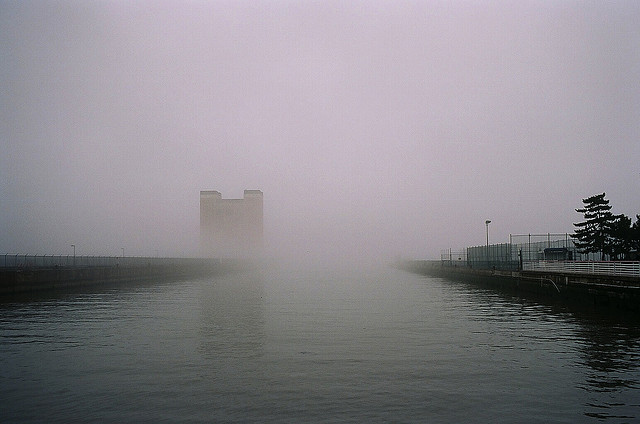
 The header image is used under a Creative Commons license and is attributed to Nesster on Flickr.
Previous Post

September 23, 2015
The Holy Wafer on the Floor
Next Post
September 25, 2015 The Harboring Silence, Part 2
Browse Our Archives
Select a Category A. G. Harmon Alissa Wilkinson Allison Backous Art Authors Brad Fruhauff Bradford Winters Bryan Bliss Caroline Langston Chad Thomas Johnston Chris Hoke Christiana N. Peterson Culture D.G. Myers D.L. Mayfield Daniel Bowman Jr. David Griffith Elizabeth Duffy Faith Film Greg Wolfe Guest Contributor Interview Jan Vallone Jeffrey Overstreet Jessica Eddings-Roeser Jessica Mesman Griffith Kelly Foster Lindsey Crittenden Morgan Meis music Natalie Vestin Nick Olson Peggy Rosenthal Personal Reflection Poetry Friday Reflection Relationships Review Richard Chess Richard Cole Sara Zarr Shannon Huffman Polson Sonya Bilocerkowycz Tania Runyan Tony Woodlief Topical Categories Uncategorized Vic Sizemore Writing
Select a Month October 2018 September 2018 August 2018 July 2018 June 2018 May 2018 April 2018 March 2018 February 2018 January 2018 December 2017 November 2017 October 2017 September 2017 August 2017 July 2017 June 2017 May 2017 April 2017 March 2017 February 2017 January 2017 December 2016 November 2016 October 2016 September 2016 August 2016 July 2016 June 2016 May 2016 April 2016 March 2016 February 2016 January 2016 December 2015 November 2015 October 2015 September 2015 August 2015 July 2015 June 2015 May 2015 April 2015 March 2015 February 2015 January 2015 December 2014 November 2014 October 2014 September 2014 August 2014 July 2014 June 2014 May 2014 April 2014 March 2014 February 2014 January 2014 December 2013 November 2013 October 2013 September 2013 August 2013 July 2013 June 2013 May 2013 April 2013 March 2013 February 2013 January 2013 December 2012 November 2012 October 2012 September 2012 August 2012 July 2012 June 2012 May 2012 February 2008
Follow Us!
TAKE THE
Religious Wisdom Quiz
In the Lord's Prayer, what do Christians ask for daily?
Select your answer to see how you score.
Fame Daily bread Riches Long life
Related posts from Good Letters


On Writing Odes: Taking Time to Celebrate

Poetry Friday: "The Burned Butterfly"

A Conversation with Alicia Ostriker: Part 1
TRENDING AT PATHEOS Catholic

Rejecting Doom: Christian Hope And Human Action
Christianity is a religion of hope. We are to have hope and...

It’s What Comes From Within Which Matters
One of the most difficult things for us to understand is why...

Why I Choose the Eucharist Over the Sermon
Choose the Eucharist, Not the Sermon What are we supposed to get...

5 Design Elements Found in Spiritually Rooted Homes
Putting Spirituality Into Home Decor Our homes are more than our living...

Credo: A Story of God Told with the...
About 10 years ago, I began to imagine a personal "Credo" that...

The Anatomy of Divine Revelation in Catholic Thought
The claim that God has made Himself known to human beings is...
view all Catholic blogs
Ad-Free & Subscriber Log-In Subscription Support
- About Us
- 2026 Calendar
- Videos
- Podcasts
- Library of World Religions
- Faith In Media Tracker
- Advertise With Us
- Write for Us
- Privacy Policy
- Terms of Service
- Do Not Sell My Data
- Contact Us
- Radiant Digital
- Manage Newsletter Subscriptions
- Unsubscribe From Notifications
- Sitemap
Copyright 2008-2026, Patheos. All rights reserved.
Subscription Support Ad-Free & Subscriber Log-In
Follow Patheos