
BuddhistCatholicContemplativeEvangelicalGeneral ChristianHinduJewishLatter-day SaintMuslimNew VisionsProgressive Christian
Beliefs
- Buddhist
- Catholic
- Contemplative
- Evangelical
- General Christian
- Hindu
- Jewish
- Latter-day Saint
- More Voices
- Muslim
- New Visions
- Pagan
- Progressive Christian
Topics
- Religion News
- Food and Religion
- Sports and Religion
- Religious Art
- Religious Music and Entertainment
- Religious Events
- History and Religion
- Style and Religion
- Politics and Religion
- Women in Religion
- Recreation Outdoors and Religion
- Business Finance and Religion
- Careers Workplace and Religion
- Education and Religion
- Family Parenting and Religion
- Health Fitness and Religion
- Home and Religion
- Relationships and Religion
- Technology and Religion
- Travel and Religion
Columnists
- Buddhist Columnists
- Business Finance and Religion Columnists
- Careers Workplace and Religion Columnists
- Catholic Columnists
- Contemplative Columnists
- Education and Religion Columnists
- Evangelists Columnists
- Family Parenting and Religion Columnists
- General Christian Columnists
- Health Fitness and Religion Columnists
- Hindu Columnists
- History and Religion Columnists
- Home and Religion Columnists
- Jewish Columnists
- More Voices Columnists
- Latter Day Columnists
- Muslim Columnists
- New Visions Columnists
- Nonreligious Columnists
- Pagan Columnists
- Politics and Religion Columnists
- Progressive Columnists
- Recreation Outdoors and Religion Columnists
- Relationships and Religion Columnists
- Religion News Columnists
- Religious Art Columnists
- Religious Events Columnists
- Religious Music and Entertainment Columnists
- Sports and Religion Columnists
- Style and Religion Columnists
- Technology and Religion Columnists
- Travel and Religion Columnists
- Women in Religion Columnists
Resource Library
- 2026 Calendar
- Library of World Religions
- The 100 Most Holy Places on Earth
- Patheos Answers
- Podcasts
- Videos
- Faith Leaders Database
- Anglican Episcopalian
- Bahai
- Baptist
- Buddhism
- Christianity
- Confucianism
- Eastern Orthodoxy
- Hinduism
- Holiness and Pentecostal
- ISKCON
- Islam
- Judaism
- Lutheran
- Methodist
- The Church of Jesus Christ of Latter-day Saints
- New Age
- Paganism
- Presbytarian and Reformed
- Protestantism
- Religion Behind the Scenes
- Roman Catholic
- Scientology
- Shia Islam
- Sikhism
- Sufism
- Sunni Islam
- Taoism
- Zen
- See all religions
Research Tools
 Ad-Free & Subscriber Log-In Subscription Support
Ad-Free & Subscriber Log-In Subscription Support
Follow Patheos 

- Trending:
- Forgiveness
- |
- Marriage
- |
- Consciousness
- |
- Death Penalty
- |
- Election
- |
- Halloween
 Good Letters
-
Contributors
- Home
- Catholic
- Canticle of Creation
Canticle of Creation
Last updated on: September 22, 2015 at 1:00 am by Guest Contributor
Canticle of Creation 2015-09-21T15:56:57-07:00 Guest Contributor
Patheos Explore the world's faith through different perspectives on religion and spirituality! Patheos has the views of the prevalent religions and spiritualities of the world.
By Brian Volck
This post was made possible through the support of a grant from The BioLogos Foundation’s Evolution and Christian Faith program. The opinions expressed are those of the author and do not necessarily reflect the views of BioLogos.
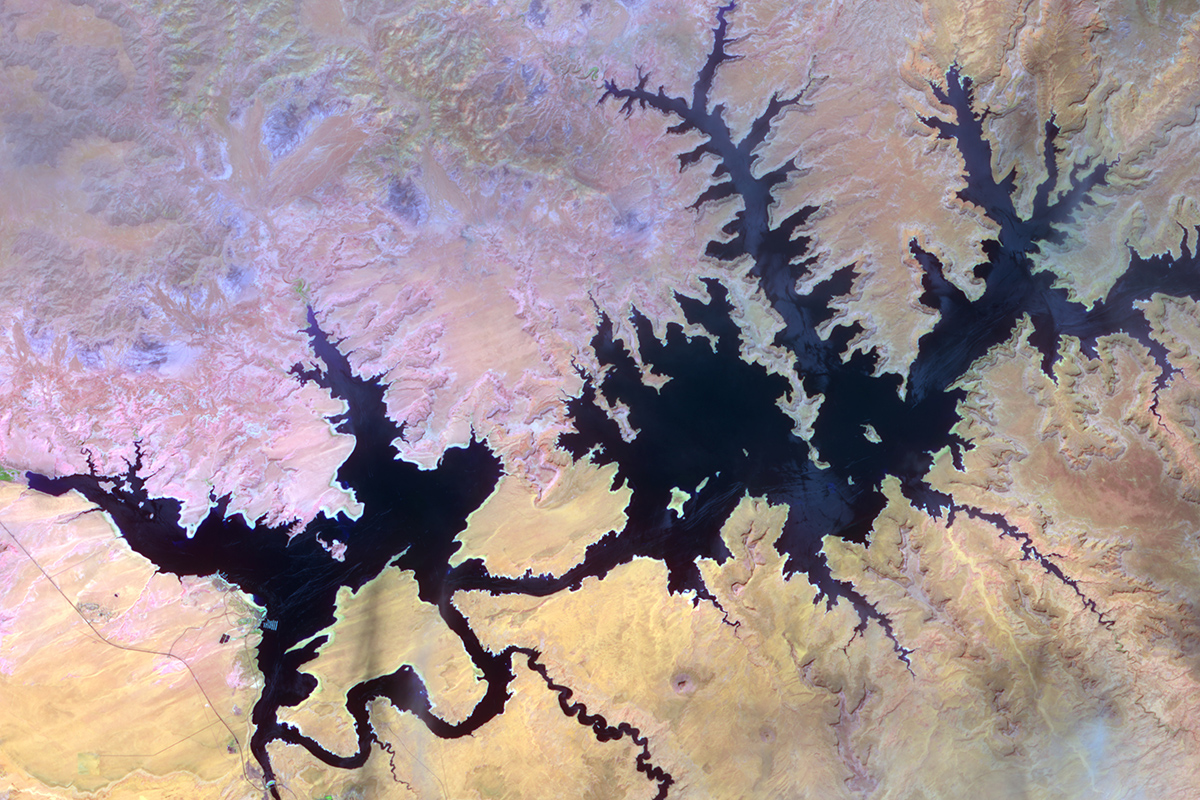 Though I’ve heard it said otherwise, the Great Wall of China is not the only evidence of human artifice visible to inhabitants of the International Space Station. Among the more prominent is Lake Powell, the now drought-shrunken reservoir behind the Glen Canyon Dam on the Colorado River. The dam—an impressive feat of engineering—required a tradeoff: electricity to chill and illuminate buildings in Phoenix and Las Vegas in exchange for flooding a beautiful landscape upstream and disturbing the ecosystem of the Grand Canyon downstream.
Parts of some national borders are visible from space, where one country—typically the poorer—has denuded its forests or otherwise severely degraded its land. The most obvious evidence of human activity, however, shines from earth’s nighttime hemisphere, where blobs of light radiate from cities like metastases from a tumor.
These are among the reasons some scientists now refer to the current epoch in the earth’s history as the Anthropocene, from two Greek roots meaning “human” and “new.” What’s new about it is the effect humans now have on the planet: an unprecedented and unhealthy pattern of change in biodiversity, regional chemistry, and global climate.
In 1967, decades before the word Anthropocene was first used in its current context, Lynn White, Jr., a historian, suggested that the real origin of the global ecological crisis was Christianity, which in its medieval form interpreted the injunction in Genesis 1:28, “fill the earth and subdue it” as divine authority to rape the planet.
For most historians and biblical scholars, White’s thesis has since died the death of a thousand qualifications, but some still find it attractive for its simplicity and clear assignment of blame.
For all the details and nuances White got wrong, his argument was subtler than even some supporters give him credit. He didn’t think ditching Christianity for “Science” was the answer. He argued instead for a transformed relationship between humans and nature, one that limited human power so that it was no longer exploitive. He even proposed St. Francis of Assisi as the model and patron of this new ecology.
How interesting, then, that the man who took St. Francis’s name when elected pope writes so forcefully on the urgent task of transforming humanity’s relationship with all creation. Like St. Francis, the pope links care of the nonhuman world with that of marginalized and impoverished humans. His insights draw from the deep Christian tradition, textured with knowledge from the sciences and hard-won wisdom from human experience.
The pope’s recent encyclical is titled Laudato Si’ (“Praised be”),words taken from St. Francis’s thirteenth-century hymn in praise of God through, for, and by the wonders of the created world: Sun, Moon, and Earth, those who forgive, those who make peace—even “sister bodily death.” It’s a large and generous vision.
St. Francis couldn’t have known about biological evolution. Pope Francis does, and presents the Christian doctrine of creation in harmony with evolutionary theory. Both Francises share an understanding, consonant with evolution, that for all the traits that make humans special, they are nevertheless part of—and in no way separate from—the totality of creation.
Indeed, calling Laudato Si’ a document on the environment misses the point, since the environment is easily understood as something other than us. Pope Francis writes:
When we speak of the “environment,” what we really mean is a relationship existing between nature and the society which lives in it. Nature cannot be regarded as something separate from ourselves or as a mere setting in which we live. We are part of nature, included in it and thus in constant interaction with it.
He later underscores this deep unity:
If the present ecological crisis is one small sign of the ethical, cultural, and spiritual crisis of modernity, we cannot presume to heal our relationship with nature and the environment without healing all fundamental relationships.
It seems that human intelligence, that inexplicable product of a brain that evolved over millennia, must relearn its small place in a large and populous creation.
It may help to remember that the words “ecology” and “ecumenical” share a Greek root, meaning “household.” Pope Francis’s ecology of creation emphasizes broad consultation and carefully limited human stewardship, not the modern ideology that science and technology give some—but rarely all—humans the power and right to direct the planetary future.
Rather than pontificating from the Vatican, the pope quotes the Orthodox Ecumenical Patriarch, regional bishop’s conferences, and Sufi mystics. He consults the ecological sciences. He repeatedly advocates an increased respect for and engagement with the earthy wisdom of indigenous peoples.
There are those who disagree with the pope’s message, dismissing him as a naive meddler in matters beyond his competence. Some of the better-reasoned counterarguments, such as those of David Brooks or Damon Linker, emphasize the benefits—especially to the poor—of modern technology and consumer capitalism. They advocate tweaking current systems rather than radically transforming relationships and limiting human power.
Linker, for example, says the control of nature envisioned by early modern giants like Machiavelli, Bacon, Hobbes, and Locke will resolve the current ecological crisis and that it’s precisely the pope’s “kind of well-meaning wishful thinking that provoked the modern project in the first place.”
I think Linker is wrong, though I hope he’s right, if only because a series of tweaks to the current system seems far more likely than the global transformation the pope calls for in Laudato Si’. Humans rarely change if they can avoid it, and change reluctantly even when there’s no other choice.
Yet humans are visibly changing the world, and not necessarily for the better. Perhaps the current way of doing things is both sustainable and sufficiently adaptable to grow despite unintended global damage. I doubt it. Adaptation and growth are key to evolution, but so are limits, interdependence, and bodily death.
I, for one, hope to embody the difficult and humbling transformation Pope Francis calls for. It’s still too beautiful a world not to try.
Brian Volck is a pediatrician who received his MFA in creative writing from Seattle Pacific University. His first collection of poetry, Flesh Becomes Word (Dos Madres), was released in 2013, and his memoir, Attending Others: A Doctor’s Education in Bodies and Words, will be published by Cascade in 2016. His essays, poetry, and reviews have appeared in America, The Christian Century, DoubleTake, and Health Affairs.

Previous Post

September 21, 2015
Let Me Die Like This
Next Post
September 23, 2015 The Holy Wafer on the Floor
Browse Our Archives
Select a Category A. G. Harmon Alissa Wilkinson Allison Backous Art Authors Brad Fruhauff Bradford Winters Bryan Bliss Caroline Langston Chad Thomas Johnston Chris Hoke Christiana N. Peterson Culture D.G. Myers D.L. Mayfield Daniel Bowman Jr. David Griffith Elizabeth Duffy Faith Film Greg Wolfe Guest Contributor Interview Jan Vallone Jeffrey Overstreet Jessica Eddings-Roeser Jessica Mesman Griffith Kelly Foster Lindsey Crittenden Morgan Meis music Natalie Vestin Nick Olson Peggy Rosenthal Personal Reflection Poetry Friday Reflection Relationships Review Richard Chess Richard Cole Sara Zarr Shannon Huffman Polson Sonya Bilocerkowycz Tania Runyan Tony Woodlief Topical Categories Uncategorized Vic Sizemore Writing
Select a Month October 2018 September 2018 August 2018 July 2018 June 2018 May 2018 April 2018 March 2018 February 2018 January 2018 December 2017 November 2017 October 2017 September 2017 August 2017 July 2017 June 2017 May 2017 April 2017 March 2017 February 2017 January 2017 December 2016 November 2016 October 2016 September 2016 August 2016 July 2016 June 2016 May 2016 April 2016 March 2016 February 2016 January 2016 December 2015 November 2015 October 2015 September 2015 August 2015 July 2015 June 2015 May 2015 April 2015 March 2015 February 2015 January 2015 December 2014 November 2014 October 2014 September 2014 August 2014 July 2014 June 2014 May 2014 April 2014 March 2014 February 2014 January 2014 December 2013 November 2013 October 2013 September 2013 August 2013 July 2013 June 2013 May 2013 April 2013 March 2013 February 2013 January 2013 December 2012 November 2012 October 2012 September 2012 August 2012 July 2012 June 2012 May 2012 February 2008
Follow Us!
TAKE THE
Religious Wisdom Quiz
What city did the walls fall down after the Israelites marched around it?
Select your answer to see how you score.
Nazareth Jerusalem Nineveh Jericho
Related posts from Good Letters



The Stars of the Earth Cry Out

TRENDING AT PATHEOS Catholic

The Parable Of The Sower And The Word...
One of Christ’s most famous parables is that of the sower who...

Rejecting Doom: Christian Hope And Human Action
Christianity is a religion of hope. We are to have hope and...

Why I Choose the Eucharist Over the Sermon
Choose the Eucharist, Not the Sermon What are we supposed to get...

5 Design Elements Found in Spiritually Rooted Homes
Putting Spirituality Into Home Decor Our homes are more than our living...

Credo: A Story of God Told with the...
About 10 years ago, I began to imagine a personal "Credo" that...

The Anatomy of Divine Revelation in Catholic Thought
The claim that God has made Himself known to human beings is...
view all Catholic blogs
Ad-Free & Subscriber Log-In Subscription Support
- About Us
- 2026 Calendar
- Videos
- Podcasts
- Library of World Religions
- Faith In Media Tracker
- Advertise With Us
- Write for Us
- Privacy Policy
- Terms of Service
- Do Not Sell My Data
- Contact Us
- Radiant Digital
- Manage Newsletter Subscriptions
- Unsubscribe From Notifications
- Sitemap
Copyright 2008-2026, Patheos. All rights reserved.
Subscription Support Ad-Free & Subscriber Log-In
Follow Patheos