
BuddhistCatholicContemplativeEvangelicalGeneral ChristianHinduJewishLatter-day SaintMuslimNew VisionsProgressive Christian
Beliefs
- Buddhist
- Catholic
- Contemplative
- Evangelical
- General Christian
- Hindu
- Jewish
- Latter-day Saint
- More Voices
- Muslim
- New Visions
- Pagan
- Progressive Christian
Topics
- Religion News
- Food and Religion
- Sports and Religion
- Religious Art
- Religious Music and Entertainment
- Religious Events
- History and Religion
- Style and Religion
- Politics and Religion
- Women in Religion
- Recreation Outdoors and Religion
- Business Finance and Religion
- Careers Workplace and Religion
- Education and Religion
- Family Parenting and Religion
- Health Fitness and Religion
- Home and Religion
- Relationships and Religion
- Technology and Religion
- Travel and Religion
Columnists
- Buddhist Columnists
- Business Finance and Religion Columnists
- Careers Workplace and Religion Columnists
- Catholic Columnists
- Contemplative Columnists
- Education and Religion Columnists
- Evangelists Columnists
- Family Parenting and Religion Columnists
- General Christian Columnists
- Health Fitness and Religion Columnists
- Hindu Columnists
- History and Religion Columnists
- Home and Religion Columnists
- Jewish Columnists
- More Voices Columnists
- Latter Day Columnists
- Muslim Columnists
- New Visions Columnists
- Nonreligious Columnists
- Pagan Columnists
- Politics and Religion Columnists
- Progressive Columnists
- Recreation Outdoors and Religion Columnists
- Relationships and Religion Columnists
- Religion News Columnists
- Religious Art Columnists
- Religious Events Columnists
- Religious Music and Entertainment Columnists
- Sports and Religion Columnists
- Style and Religion Columnists
- Technology and Religion Columnists
- Travel and Religion Columnists
- Women in Religion Columnists
Resource Library
- 2026 Calendar
- Library of World Religions
- The 100 Most Holy Places on Earth
- Patheos Answers
- Podcasts
- Videos
- Faith Leaders Database
- Anglican Episcopalian
- Bahai
- Baptist
- Buddhism
- Christianity
- Confucianism
- Eastern Orthodoxy
- Hinduism
- Holiness and Pentecostal
- ISKCON
- Islam
- Judaism
- Lutheran
- Methodist
- The Church of Jesus Christ of Latter-day Saints
- New Age
- Paganism
- Presbytarian and Reformed
- Protestantism
- Religion Behind the Scenes
- Roman Catholic
- Scientology
- Shia Islam
- Sikhism
- Sufism
- Sunni Islam
- Taoism
- Zen
- See all religions
Research Tools
 Ad-Free & Subscriber Log-In Subscription Support
Ad-Free & Subscriber Log-In Subscription Support
Follow Patheos 

- Trending:
- Forgiveness
- |
- Marriage
- |
- Consciousness
- |
- Death Penalty
- |
- Election
- |
- Halloween
 Good Letters
-
Contributors
- Home
- Catholic
- Blood and Silver
Blood and Silver
Last updated on: September 8, 2015 at 1:00 am by Caroline Langston
Blood and Silver 2015-09-01T11:34:19-07:00 Caroline Langston
Patheos Explore the world's faith through different perspectives on religion and spirituality! Patheos has the views of the prevalent religions and spiritualities of the world.
 By Caroline Langston
I stood in the security line at the Louis Armstrong International Airport in New Orleans wondering if I was going to be detained, and taken for dangerous. Hell, I didn’t know, was this something for which I could be arrested? Maybe I should’ve let my brother talk me into sending the glossy, fitted wood box on ahead via mail—though that would have been exorbitant. Plus, I didn’t want to let it out of my hands.
I couldn’t have packed it in checked luggage because it might have been stolen. And who knows? It might have been even more illegal to bundle it away in a packed bag. But I didn’t know about checked bags, since it’s a point of honor going back to boarding school days for me to never have more luggage than I can carry onto the plane, which had led to the spare travel wardrobe of a Greek widow, a succession of black dresses.
I could even feel myself sweating a bit, as I watched the box disappear into the X-ray and I walked barefoot through the scanner. I imagined how the bulky square edges of the box would appear on the monitor, the metal inside in skeletal form.
But not a word from security. There was a small problem with the necklace I was wearing, but that was solved by swinging it behind my neck. I slipped back on my pewter Cole Haan wedges, grabbed my bags, and felt protectively for the heavy tray of sterling silver flatware at the bottom of my suitcase.
The story had started a couple of weeks before, when out of the blue, my older brother texted me on a Saturday from Mississippi: What is Mom’s silver pattern?
Lunt, William and Mary, I wrote back.
Which, if you know it, is a genteel but unassuming pattern, produced 1921-2010, according to information found on Replacements.com. With its simple straight lines with a thin band of chasing (thank you Lesca Black, eighth grade home economics teacher, once again) along the delicate handles, William and Mary is appropriate for the kind of middleclass strivers that my people are—not the typical Mississippi Delta debutante-showoffs with repoussé designs like Francis I, or the Tiffany Chrysanthemum chosen by the Yankee daughters of the 1%.
After a while I heard back from him again: Do you need more? Set at an estate sale for $950.
A few minutes later: Down to $650 but all pieces monogrammed.
Me: A la carte possible? Could use 1 tsp and any/all serving pieces.
Him: No. Then a few minutes later, Looks like he would take $400.
Me: Well, I don’t have that to send right now but if you got it I could send you $100 a month.
Finally: too late it’s sold for $650.
And that was that, until a day or so later when my brother called to tell me that he was the one who had purchased the set—as a gift for me—but hadn’t wanted to write that in a text message.
I was unable to speak when he said this. I do not know how to describe how I felt, other than to say that it felt as though some precious, irreplaceable gift had been given back to me—something that felt close to salvation.
Unearned, unmerited, a gift so unexpected that it struck me, like Zechariah in the face of such news, dumb.
This passage from Jane Kenyon’s poem “Happiness” comes as close to how I felt as anything:
No, happiness is the uncle you never
knew about, who flies a single-engine plane
onto the grassy landing strip, hitchhikes
into town, and inquires at every door
until he finds you asleep midafternoon
as you so often are during the unmerciful
hours of your despair.
So many things, it seemed, were given in this offering: My mother, all the way back from the grave to me; she who could chop wood and wore jeans and loved football, but who had painstakingly identified for my five-year-old self the niceties of having long-handled sterling “iced tea spoons.”
And also my cultural heritage, that Southern thing, of being the kind of person who would actually care about sterling silver and even use it—in an age where people register for wedding presents at Target and Bed, Bath, and Beyond, and the big “gets” are small appliances and thousand-dollar cookware. (Unless they are planning to spam people via email to pay for their indulgent honeymoon.)
I have trod this ground before, I know, but I find that there’s the barest hint of misogyny in the reflexive dismissal of sterling silver by men and women in favor of the ubiquitous choices of giant pottery plates and wrought iron flatware that could be wielded by Fred Flintstone. As if our tableware must be tough and inviolable, and those that are fragile must be worthless.
Then, of course, there are the people who claim the wasteful extravagance of such purported luxuries—certain kinds of plain-type Christians worst of all, quick to cite Acts 7:48, that “the Most High does not dwell in houses made by human hands.”
But we love through our bodies, what we smell and touch, and I don’t see how that can’t be extended to the love manifested in the settings on a table.
There’s a famous story about Dorothy Day, possibly apocryphal, where she takes an expensive ring that has been given to her ministry and just goes and gives it to a homeless woman to do whatever she wanted with it—a gesture that gets her flack from her colleagues who accuse her of wasting it, and can only see the money that the sold ring would have brought.
You will recall the similarity to Judas’s comment about the jar of spikenard that Mary poured over the Lord’s feet (John 12:1-8).
Dorothy Day is said to have told her detractors, “Do you suppose that God created diamonds only for the rich?”
My table a temple; I lay it out in honor. I touch the soupspoons, the cake server, even the tiny, precious tongs for sugar cubes.
A native of Yazoo City, Mississippi, Caroline Langston is a convert to the Eastern Orthodox Church. She is a widely published writer and essayist, a winner of the Pushcart Prize, and a commentator for NPR’s All Things Considered.
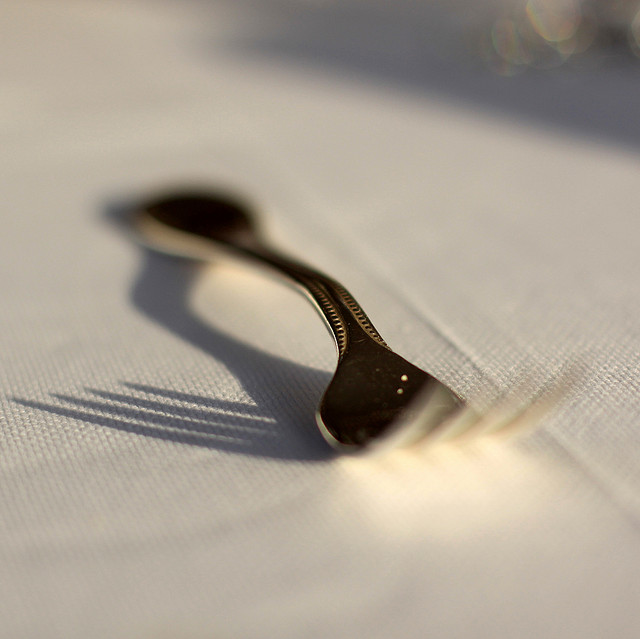
The above royalty free image is attributed to jenny downing on Flickr.
Previous Post

September 4, 2015
For the Newlyweds
Next Post

September 9, 2015 What's Wrong with this Picture?
Browse Our Archives
Select a Category A. G. Harmon Alissa Wilkinson Allison Backous Art Authors Brad Fruhauff Bradford Winters Bryan Bliss Caroline Langston Chad Thomas Johnston Chris Hoke Christiana N. Peterson Culture D.G. Myers D.L. Mayfield Daniel Bowman Jr. David Griffith Elizabeth Duffy Faith Film Greg Wolfe Guest Contributor Interview Jan Vallone Jeffrey Overstreet Jessica Eddings-Roeser Jessica Mesman Griffith Kelly Foster Lindsey Crittenden Morgan Meis music Natalie Vestin Nick Olson Peggy Rosenthal Personal Reflection Poetry Friday Reflection Relationships Review Richard Chess Richard Cole Sara Zarr Shannon Huffman Polson Sonya Bilocerkowycz Tania Runyan Tony Woodlief Topical Categories Uncategorized Vic Sizemore Writing
Select a Month October 2018 September 2018 August 2018 July 2018 June 2018 May 2018 April 2018 March 2018 February 2018 January 2018 December 2017 November 2017 October 2017 September 2017 August 2017 July 2017 June 2017 May 2017 April 2017 March 2017 February 2017 January 2017 December 2016 November 2016 October 2016 September 2016 August 2016 July 2016 June 2016 May 2016 April 2016 March 2016 February 2016 January 2016 December 2015 November 2015 October 2015 September 2015 August 2015 July 2015 June 2015 May 2015 April 2015 March 2015 February 2015 January 2015 December 2014 November 2014 October 2014 September 2014 August 2014 July 2014 June 2014 May 2014 April 2014 March 2014 February 2014 January 2014 December 2013 November 2013 October 2013 September 2013 August 2013 July 2013 June 2013 May 2013 April 2013 March 2013 February 2013 January 2013 December 2012 November 2012 October 2012 September 2012 August 2012 July 2012 June 2012 May 2012 February 2008
Follow Us!
TAKE THE
Religious Wisdom Quiz
Who was cast into a fiery furnace but was unharmed?
Select your answer to see how you score.
Moses, Aaron, and Joshua Daniel Shadrach, Meshach, and Abednego Elijah and Elisha
Related posts from Good Letters


Morning in a Forgotten Neighborhood


TRENDING AT PATHEOS Catholic

Rejecting Doom: Christian Hope And Human Action
Christianity is a religion of hope. We are to have hope and...

It’s What Comes From Within Which Matters
One of the most difficult things for us to understand is why...

Why I Choose the Eucharist Over the Sermon
Choose the Eucharist, Not the Sermon What are we supposed to get...

5 Design Elements Found in Spiritually Rooted Homes
Putting Spirituality Into Home Decor Our homes are more than our living...

Credo: A Story of God Told with the...
About 10 years ago, I began to imagine a personal "Credo" that...

The Anatomy of Divine Revelation in Catholic Thought
The claim that God has made Himself known to human beings is...
view all Catholic blogs
Ad-Free & Subscriber Log-In Subscription Support
- About Us
- 2026 Calendar
- Videos
- Podcasts
- Library of World Religions
- Faith In Media Tracker
- Advertise With Us
- Write for Us
- Privacy Policy
- Terms of Service
- Do Not Sell My Data
- Contact Us
- Radiant Digital
- Manage Newsletter Subscriptions
- Unsubscribe From Notifications
- Sitemap
Copyright 2008-2026, Patheos. All rights reserved.
Subscription Support Ad-Free & Subscriber Log-In
Follow Patheos