
BuddhistCatholicContemplativeEvangelicalGeneral ChristianHinduJewishLatter-day SaintMuslimNew VisionsProgressive Christian
Beliefs
- Buddhist
- Catholic
- Contemplative
- Evangelical
- General Christian
- Hindu
- Jewish
- Latter-day Saint
- More Voices
- Muslim
- New Visions
- Pagan
- Progressive Christian
Topics
- Religion News
- Food and Religion
- Sports and Religion
- Religious Art
- Religious Music and Entertainment
- Religious Events
- History and Religion
- Style and Religion
- Politics and Religion
- Women in Religion
- Recreation Outdoors and Religion
- Business Finance and Religion
- Careers Workplace and Religion
- Education and Religion
- Family Parenting and Religion
- Health Fitness and Religion
- Home and Religion
- Relationships and Religion
- Technology and Religion
- Travel and Religion
Columnists
- Buddhist Columnists
- Business Finance and Religion Columnists
- Careers Workplace and Religion Columnists
- Catholic Columnists
- Contemplative Columnists
- Education and Religion Columnists
- Evangelists Columnists
- Family Parenting and Religion Columnists
- General Christian Columnists
- Health Fitness and Religion Columnists
- Hindu Columnists
- History and Religion Columnists
- Home and Religion Columnists
- Jewish Columnists
- More Voices Columnists
- Latter Day Columnists
- Muslim Columnists
- New Visions Columnists
- Nonreligious Columnists
- Pagan Columnists
- Politics and Religion Columnists
- Progressive Columnists
- Recreation Outdoors and Religion Columnists
- Relationships and Religion Columnists
- Religion News Columnists
- Religious Art Columnists
- Religious Events Columnists
- Religious Music and Entertainment Columnists
- Sports and Religion Columnists
- Style and Religion Columnists
- Technology and Religion Columnists
- Travel and Religion Columnists
- Women in Religion Columnists
Resource Library
- 2026 Calendar
- Library of World Religions
- The 100 Most Holy Places on Earth
- Patheos Answers
- Podcasts
- Videos
- Faith Leaders Database
- Anglican Episcopalian
- Bahai
- Baptist
- Buddhism
- Christianity
- Confucianism
- Eastern Orthodoxy
- Hinduism
- Holiness and Pentecostal
- ISKCON
- Islam
- Judaism
- Lutheran
- Methodist
- The Church of Jesus Christ of Latter-day Saints
- New Age
- Paganism
- Presbytarian and Reformed
- Protestantism
- Religion Behind the Scenes
- Roman Catholic
- Scientology
- Shia Islam
- Sikhism
- Sufism
- Sunni Islam
- Taoism
- Zen
- See all religions
Research Tools
 Ad-Free & Subscriber Log-In Subscription Support
Ad-Free & Subscriber Log-In Subscription Support
Follow Patheos 

- Trending:
- Forgiveness
- |
- Marriage
- |
- Consciousness
- |
- Death Penalty
- |
- Election
- |
- Halloween
 Good Letters
-
Contributors
- Home
- Catholic
- The Day I Became Elijah
The Day I Became Elijah
Last updated on: August 7, 2015 at 1:00 am by Guest Contributor
The Day I Became Elijah 2015-07-28T15:35:38-07:00 Guest Contributor
Patheos Explore the world's faith through different perspectives on religion and spirituality! Patheos has the views of the prevalent religions and spiritualities of the world.
 By Martyn Wendell Jones
In his essay “The Wounded Word,” French philosopher-poet Jean-Louis Chrétien describes prayer as situated in “an act of presence to the invisible.” People who pray are disclosed to God and, secondarily, themselves, illuminated with a “light from elsewhere.” I was six when I first experienced this in its full measure.
“It troubles me,” our teacher said, “that lots of you said “ooh” and “wow” when the football players were getting tackled in the first part of the video, but no-one said anything when the football player told us about what Jesus had done for him during the second part of the video.”
We squirmed in the benches. The grass outside was positively shining; a second teacher blocked the door to keep us from running out to play in it. Fans spun overhead, not dissipating the heat so much as mixing us into it.
Finally we were released. My peers ran and played.
I, on the other hand, received a call from the Lord. It didn’t come down from the sky with thunder. Instead, I remember a quietly emerging sense of destiny. When our keepers called for us to reconvene in the classroom, I wandered towards a path my father had shown me earlier. It led into the woods.
“This act of presence,” Chrétien goes on, puts the praying person “thoroughly at stake, in all dimensions of his being. It exposes him in every sense of the word expose and with nothing held back.” As the ability to pray at all is a sheer gift from without, so the praying person is given in the act of prayer—both to the object of address, and to himself.
I walked into the woods, sure that I was about to meet the Lord. Clouds came and went overhead. A brilliant light came down in broken and shifting columns that irradiated plants and tree trunks.
Before reaching the beach, I stopped by a vacant pool and prayed. What did I ask of the Lord? That he would give me the gifts he had given the prophets of the Old Testament.
Fire did not descend, and I heard no still, small voice, but soon enough I perceived a calm over me and everything else on the earth. I had become hip to the world’s swaddling in divine love. Glory!
The gift I sought was given, I knew; I needed only to accept it.
To the beach, then. I wanted confirmation. In search of a tangible way to exercise the faith by which I would someday work miracles, I took off my sandals and walked onto the wet part of the shore.
The use of the voice in prayer involves the body, which makes possible the absolute gift: that “all can be sacrificed at once, without division or restriction.”
“Okay, now stop!” I thrust my hands over approaching waves. I varied the exercise in order to produce more satisfactory outcomes; I noted that four out of the previous seven waves had stopped their ascent towards my feet when I told them to, and felt as though I had achieved some facility with my God-given power. “I want to be like Moses,” I said to the sky, “I want to be like Elijah!”
Patience, patience, I counseled myself. I slowed my thoughts, began to consciously appreciate the splendors of creation: the gulls, the beached fish, the toddlers playing with their mom.
Could the Lord intend me to plant the seed of faith in these young minds? I observed their games on the beach with consummate magnanimity while making a slow, measured approach. Oh, you want to bury me in sand? Bury me. I delight in your burying.
Up to my neck, I deigned to remain interred while the children played. The waves broke gently in front of us; I felt the cool grit of my earthen body cast and smiled. God was with me. God was with us all. I noticed the sun was getting low.
Prayer, Chrétien says, is “real, like all that is implied in the encounter, only in the impossible. The agonic dimension is nothing other than the ordeal of transcendence.”
The struggle for truth and for God in prayer is an ordeal—a “theophany,” a passion for God. In this, prayer loses “any ability to measure itself and know itself completely.”
Instead of going back through the woods, I decided to take the road that led back to camp. On the road I met one of my teachers on her way home from dinner.
“Where have you been?”
“I was just praying.”
She walked with me back towards camp, listening as I related my experiences.
When he saw us, my father ran and took me in his arms.
“Where have you been?”
“I was talking with God, asking him to make me a prophet.”
We went to the cabin where my whole family was staying. My mother was crying. My father started crying. My sister and brother were crying. I had been missing for hours. Search parties had been formed.
My mother embraced me tightly; her face was wet and hot.
“Where have you been?”
Didn’t you know I would be in my father’s house? I wanted to say.
Prayer ultimately gathers the praying person into itself, appropriates him or her through words that originate elsewhere. In prayer as in all speech, a chorus of voices exists in each single voice: I speak with phrases of my father, inflections of my mother, the intonations of my siblings.
I did not know what my prayers meant back then; I don’t know what my prayers mean now. I speak anyway, leaping into the impossible possibility, and am revealed with that light from elsewhere.
Joining the silent chorus, I give voice to prayers of ecstasy and praise, prayers that contain the greatest hopes and questions and agonies of life—and also, perhaps, a prayer of thanks for a lost child found, safe, twenty years in the past.
He was unaware of his presumption. I wish I were still unaware.
Martyn Wendell Jones received his B.A. from Wheaton College and his M.A. from the Katholieke Universiteit Leuven. He lives with his wife in Toronto, Ontario.
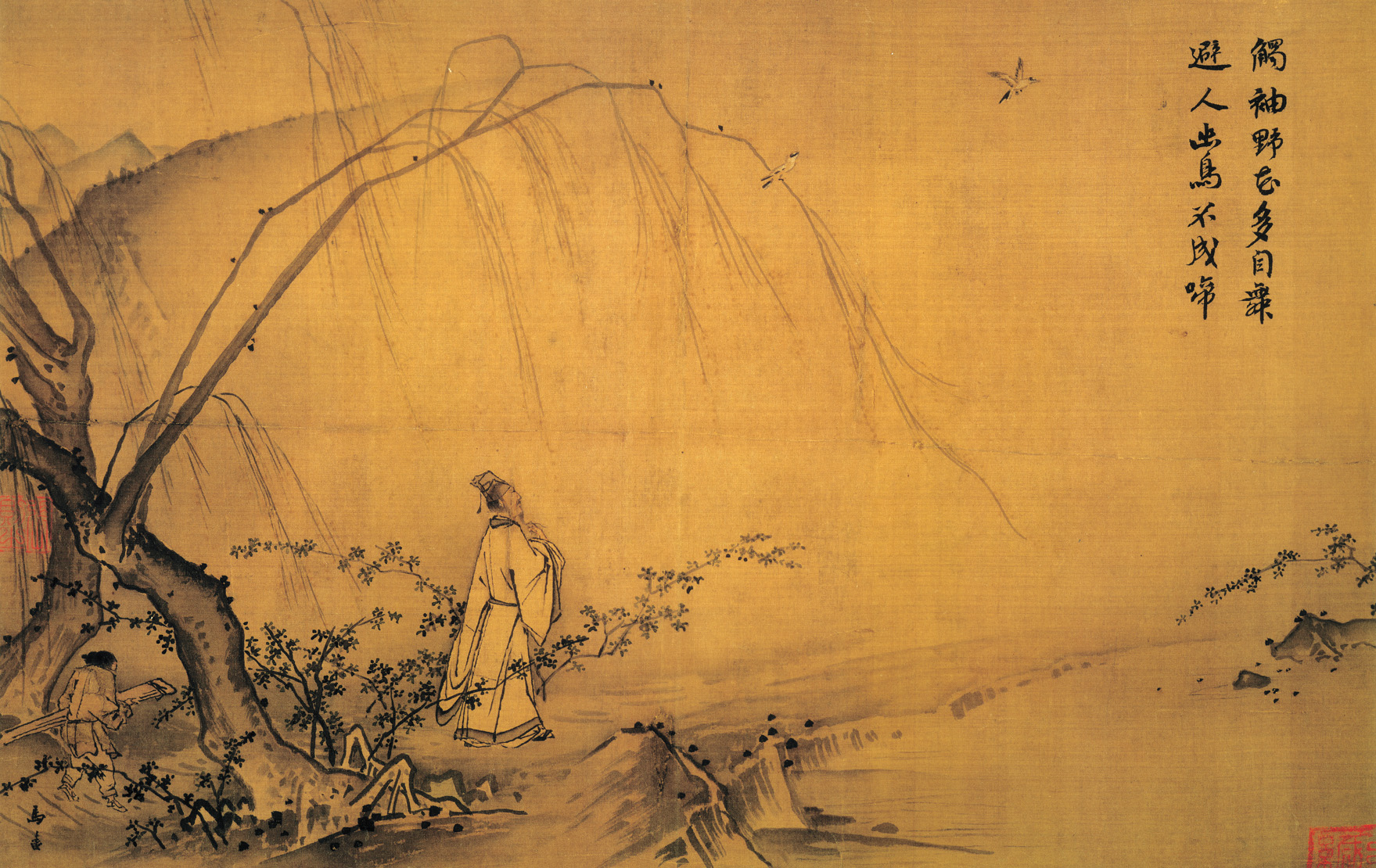
The above Creative Commons Image entitled “Walking on a Mountain Path in Spring” is attributed to Google Images.
Previous Post
August 6, 2015
Redrawing the Tree of Life in Yellowstone
Next Post

August 10, 2015 What Is the Future?
Browse Our Archives
Select a Category A. G. Harmon Alissa Wilkinson Allison Backous Art Authors Brad Fruhauff Bradford Winters Bryan Bliss Caroline Langston Chad Thomas Johnston Chris Hoke Christiana N. Peterson Culture D.G. Myers D.L. Mayfield Daniel Bowman Jr. David Griffith Elizabeth Duffy Faith Film Greg Wolfe Guest Contributor Interview Jan Vallone Jeffrey Overstreet Jessica Eddings-Roeser Jessica Mesman Griffith Kelly Foster Lindsey Crittenden Morgan Meis music Natalie Vestin Nick Olson Peggy Rosenthal Personal Reflection Poetry Friday Reflection Relationships Review Richard Chess Richard Cole Sara Zarr Shannon Huffman Polson Sonya Bilocerkowycz Tania Runyan Tony Woodlief Topical Categories Uncategorized Vic Sizemore Writing
Select a Month October 2018 September 2018 August 2018 July 2018 June 2018 May 2018 April 2018 March 2018 February 2018 January 2018 December 2017 November 2017 October 2017 September 2017 August 2017 July 2017 June 2017 May 2017 April 2017 March 2017 February 2017 January 2017 December 2016 November 2016 October 2016 September 2016 August 2016 July 2016 June 2016 May 2016 April 2016 March 2016 February 2016 January 2016 December 2015 November 2015 October 2015 September 2015 August 2015 July 2015 June 2015 May 2015 April 2015 March 2015 February 2015 January 2015 December 2014 November 2014 October 2014 September 2014 August 2014 July 2014 June 2014 May 2014 April 2014 March 2014 February 2014 January 2014 December 2013 November 2013 October 2013 September 2013 August 2013 July 2013 June 2013 May 2013 April 2013 March 2013 February 2013 January 2013 December 2012 November 2012 October 2012 September 2012 August 2012 July 2012 June 2012 May 2012 February 2008
Follow Us!
TAKE THE
Religious Wisdom Quiz
Which book is written almost completely as poetry?
Select your answer to see how you score.
Ezra Isaiah Lamentations Jeremiah
Related posts from Good Letters

The Stars of the Earth Cry Out


Poetry Friday: “The Ordinary Time”
TRENDING AT PATHEOS Catholic

Rejecting Doom: Christian Hope And Human Action
Christianity is a religion of hope. We are to have hope and...

It’s What Comes From Within Which Matters
One of the most difficult things for us to understand is why...

Why I Choose the Eucharist Over the Sermon
Choose the Eucharist, Not the Sermon What are we supposed to get...

5 Design Elements Found in Spiritually Rooted Homes
Putting Spirituality Into Home Decor Our homes are more than our living...

Credo: A Story of God Told with the...
About 10 years ago, I began to imagine a personal "Credo" that...

The Anatomy of Divine Revelation in Catholic Thought
The claim that God has made Himself known to human beings is...
view all Catholic blogs
Ad-Free & Subscriber Log-In Subscription Support
- About Us
- 2026 Calendar
- Videos
- Podcasts
- Library of World Religions
- Faith In Media Tracker
- Advertise With Us
- Write for Us
- Privacy Policy
- Terms of Service
- Do Not Sell My Data
- Contact Us
- Radiant Digital
- Manage Newsletter Subscriptions
- Unsubscribe From Notifications
- Sitemap
Copyright 2008-2026, Patheos. All rights reserved.
Subscription Support Ad-Free & Subscriber Log-In
Follow Patheos