
BuddhistCatholicContemplativeEvangelicalGeneral ChristianHinduJewishLatter-day SaintMuslimNew VisionsProgressive Christian
Beliefs
- Buddhist
- Catholic
- Contemplative
- Evangelical
- General Christian
- Hindu
- Jewish
- Latter-day Saint
- More Voices
- Muslim
- New Visions
- Pagan
- Progressive Christian
Topics
- Religion News
- Food and Religion
- Sports and Religion
- Religious Art
- Religious Music and Entertainment
- Religious Events
- History and Religion
- Style and Religion
- Politics and Religion
- Women in Religion
- Recreation Outdoors and Religion
- Business Finance and Religion
- Careers Workplace and Religion
- Education and Religion
- Family Parenting and Religion
- Health Fitness and Religion
- Home and Religion
- Relationships and Religion
- Technology and Religion
- Travel and Religion
Columnists
- Buddhist Columnists
- Business Finance and Religion Columnists
- Careers Workplace and Religion Columnists
- Catholic Columnists
- Contemplative Columnists
- Education and Religion Columnists
- Evangelists Columnists
- Family Parenting and Religion Columnists
- General Christian Columnists
- Health Fitness and Religion Columnists
- Hindu Columnists
- History and Religion Columnists
- Home and Religion Columnists
- Jewish Columnists
- More Voices Columnists
- Latter Day Columnists
- Muslim Columnists
- New Visions Columnists
- Nonreligious Columnists
- Pagan Columnists
- Politics and Religion Columnists
- Progressive Columnists
- Recreation Outdoors and Religion Columnists
- Relationships and Religion Columnists
- Religion News Columnists
- Religious Art Columnists
- Religious Events Columnists
- Religious Music and Entertainment Columnists
- Sports and Religion Columnists
- Style and Religion Columnists
- Technology and Religion Columnists
- Travel and Religion Columnists
- Women in Religion Columnists
Resource Library
- 2026 Calendar
- Library of World Religions
- The 100 Most Holy Places on Earth
- Patheos Answers
- Podcasts
- Videos
- Faith Leaders Database
- Anglican Episcopalian
- Bahai
- Baptist
- Buddhism
- Christianity
- Confucianism
- Eastern Orthodoxy
- Hinduism
- Holiness and Pentecostal
- ISKCON
- Islam
- Judaism
- Lutheran
- Methodist
- The Church of Jesus Christ of Latter-day Saints
- New Age
- Paganism
- Presbytarian and Reformed
- Protestantism
- Religion Behind the Scenes
- Roman Catholic
- Scientology
- Shia Islam
- Sikhism
- Sufism
- Sunni Islam
- Taoism
- Zen
- See all religions
Research Tools
 Ad-Free & Subscriber Log-In Subscription Support
Ad-Free & Subscriber Log-In Subscription Support
Follow Patheos 

- Trending:
- Forgiveness
- |
- Marriage
- |
- Consciousness
- |
- Death Penalty
- |
- Election
- |
- Halloween
 Good Letters
-
Contributors
- Home
- Catholic
- Redrawing the Tree of Life in Yellowstone
Redrawing the Tree of Life in Yellowstone
Last updated on: August 6, 2015 at 1:00 am by Guest Contributor
Redrawing the Tree of Life in Yellowstone 2015-07-28T15:19:13-07:00 Guest Contributor
Patheos Explore the world's faith through different perspectives on religion and spirituality! Patheos has the views of the prevalent religions and spiritualities of the world.
 By Kathleen L. Housley
This post was made possible through the support of a grant from The BioLogos Foundation’s Evolution and Christian Faith program. The opinions expressed are those of the author and do not necessarily reflect the views of BioLogos.
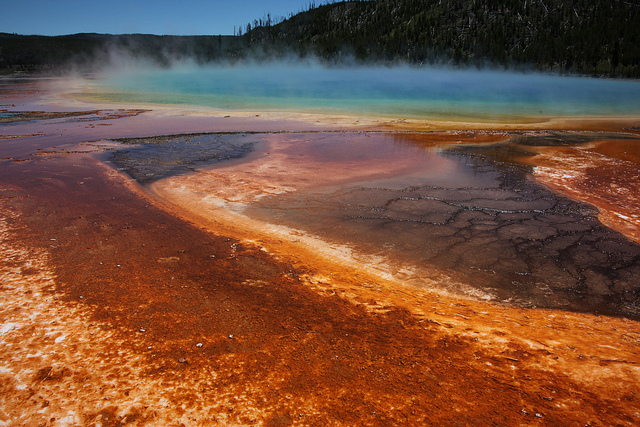
At Grand Prismatic Spring in Yellowstone National Park, brilliant orange and yellow microbial mats ring the turquoise blue water. Spreading outward from the scalding-hot pool is a thin whitish crust across which shallow water flows, depositing minerals as it cools. The water makes its way to the nearby Firehole River into which it sizzles and steams.
Across the glistening crust, bison tracks meander in the direction of the pine-covered hills. Humans cross this surface on boardwalks, but bison take their chances on the crust. Bison skeletons, boiled clean, have been found in hot springs, testifying to the risk.
Park visitors love to see the geysers, hot springs, and large animals, including the bison and elk. But in terms of the overall wellbeing of the biosphere, indeed, of their own well-being, they should probably consider the microbial mats, which are composed of abundant and diverse archaea and bacteria that thrive on the potent brew of chemicals and geothermal energy.
Everyone knows about bacteria, but many people do not know about archaea, one of the most ancient life forms on Earth. Their ignorance is understandable, because to acquire even a rudimentary knowledge of archaea requires a person to grapple with difficult science, the kind that shatters long-standing ideas. Such knowledge can feel unsettling at first, like walking on crust.
When they were first identified, scientists thought archaea were found only in hydrothermal environments, such as deep ocean vents and hot springs, but it is now known that they are ubiquitous, even living in the human gut. Although they seem to be simple, they are complex chemical powerhouses that are critically important to maintaining Earth’s biogeochemical cycles.
Originally classified as some kind of odd bacteria, they are now a third kingdom, the other two being bacteria that do not have a cell nucleus, and eukaryotes that do (animals, plants, etc.). In some ways archaea are more closely related to humans than they are to bacteria.
It was only twenty years ago that the first complete archaean genome was determined. The lead researcher on the paper, published in 1996, was Carl Woese, a microbiologist at the University of Illinois, Urbana-Champaign. Trained at the undergraduate level in mathematics and physics with his PhD in biophysics, he jokingly referred to himself as “a molecular biologist turned evolutionist.” His unconventional academic training enabled him to see microbiological problems with fresh eyes.
Woese began his genetic sequence research in the 1970s motivated by his desire to understand how evolution worked leading up to the emergence of genes, a point he called the Darwinian Threshold where the classical theory of evolution began. Because Darwin lived in the nineteenth century, he did not have the ability to study life at the molecular level; he was forced to look at whole organisms from which he formulated his idea of natural selection.
Working at the molecular level, Woese postulated that horizontal gene transfer between different organisms, instead of vertical transfer (e.g., descent from parent to child), could have led to rapid evolutionary change and the rise of complex organisms. Only then could natural selection come into play.
However, horizontal gene transfer does not end at that point. For example, it is a factor in the increasing problem of antibiotic resistance as genes from resistant bacteria are transferred to non-resistant bacteria. It also is at the heart of the burgeoning field of genetic engineering.
On the basis of his extensive study of ribosomal RNA (rRNA) using polymerase chain reaction, Woese and his colleagues redrew the tree of life, making archaea its own kingdom. This initially met with ridicule, but as supporting data mounted and gene-sequencing technology became more powerful, the ridicule turned to acceptance and then to praise.
Eventually, archaea would have been classified correctly with or without Woese. However, he advanced science considerably by opening up a new way of learning. Most microbes cannot be cultured in the laboratory. Woese showed that the sequencing of rRNA genes could prove the existence of a microbe without its being cultured. This had ramifications far beyond microbiology.
Yellowstone played a part in Woese’s research. He visited Octopus Spring in the 1980s where two of his students were researching archaea in hot alkaline water. Another student did important work on microbial mats at Mammoth Hot Springs.
It wasn’t Yellowstone’s megafauna (its bison, bear, elk, mountain lions, and wolves) that interested Woese. Bacteria and archaea were the true rulers of life in terms of their vast numbers. But everything was open to question. In an interview, he was asked to define life. “That’s the problem,” he replied. We can’t.”
Woese, who died in 2012 at the age of 84, is now considered a towering figure who revolutionized microbiology and ecology and reconfigured evolution as an interlinking web where genetic translation of information matters more then the shape of a bird’s beak or the appearance of wings. The implications of his work are profound, from how life originated on Earth to the nature of extraterrestrial life.
In A New Biology for a New Century, Woese said, “Our task now is to resynthesize biology; put the organism back into its environment; connect it again to its evolutionary past; and let us feel that complex flow that is organism, evolution, and environment united. The time has come for biology to enter the nonlinear world.”
Join in the conversation about evolution and Christian faith by visiting the BioLogos symposium at Patheos. Click here for more on Image’s BioLogos colloquy.
Kathleen L. Housley writes on the interconnection of the sciences and religion. She is the author of nine books, most recently the poetry collection Epiphanies (Wising Up) and the novel The Sage of Time and Chance (Wipf & Stock), based on Ecclesiastes.
The above Creative Commons image of a microbe pool in Yellowstone National Park and is attributed to Steve Jurvetson on Flickr.
Previous Post

August 5, 2015
Kent Haruf and the Tie that Binds
Next Post
August 7, 2015 The Day I Became Elijah
Browse Our Archives
Select a Category A. G. Harmon Alissa Wilkinson Allison Backous Art Authors Brad Fruhauff Bradford Winters Bryan Bliss Caroline Langston Chad Thomas Johnston Chris Hoke Christiana N. Peterson Culture D.G. Myers D.L. Mayfield Daniel Bowman Jr. David Griffith Elizabeth Duffy Faith Film Greg Wolfe Guest Contributor Interview Jan Vallone Jeffrey Overstreet Jessica Eddings-Roeser Jessica Mesman Griffith Kelly Foster Lindsey Crittenden Morgan Meis music Natalie Vestin Nick Olson Peggy Rosenthal Personal Reflection Poetry Friday Reflection Relationships Review Richard Chess Richard Cole Sara Zarr Shannon Huffman Polson Sonya Bilocerkowycz Tania Runyan Tony Woodlief Topical Categories Uncategorized Vic Sizemore Writing
Select a Month October 2018 September 2018 August 2018 July 2018 June 2018 May 2018 April 2018 March 2018 February 2018 January 2018 December 2017 November 2017 October 2017 September 2017 August 2017 July 2017 June 2017 May 2017 April 2017 March 2017 February 2017 January 2017 December 2016 November 2016 October 2016 September 2016 August 2016 July 2016 June 2016 May 2016 April 2016 March 2016 February 2016 January 2016 December 2015 November 2015 October 2015 September 2015 August 2015 July 2015 June 2015 May 2015 April 2015 March 2015 February 2015 January 2015 December 2014 November 2014 October 2014 September 2014 August 2014 July 2014 June 2014 May 2014 April 2014 March 2014 February 2014 January 2014 December 2013 November 2013 October 2013 September 2013 August 2013 July 2013 June 2013 May 2013 April 2013 March 2013 February 2013 January 2013 December 2012 November 2012 October 2012 September 2012 August 2012 July 2012 June 2012 May 2012 February 2008
Follow Us!
TAKE THE
Religious Wisdom Quiz
What does "Selah" (found in Psalms) most likely mean?
Select your answer to see how you score.
Amen Sing Pause/Reflect Hallelujah
Related posts from Good Letters

The Stars of the Earth Cry Out


Poetry Friday: “The Ordinary Time”
TRENDING AT PATHEOS Catholic

Rejecting Doom: Christian Hope And Human Action
Christianity is a religion of hope. We are to have hope and...

It’s What Comes From Within Which Matters
One of the most difficult things for us to understand is why...

Why I Choose the Eucharist Over the Sermon
Choose the Eucharist, Not the Sermon What are we supposed to get...

5 Design Elements Found in Spiritually Rooted Homes
Putting Spirituality Into Home Decor Our homes are more than our living...

Credo: A Story of God Told with the...
About 10 years ago, I began to imagine a personal "Credo" that...

The Anatomy of Divine Revelation in Catholic Thought
The claim that God has made Himself known to human beings is...
view all Catholic blogs
Ad-Free & Subscriber Log-In Subscription Support
- About Us
- 2026 Calendar
- Videos
- Podcasts
- Library of World Religions
- Faith In Media Tracker
- Advertise With Us
- Write for Us
- Privacy Policy
- Terms of Service
- Do Not Sell My Data
- Contact Us
- Radiant Digital
- Manage Newsletter Subscriptions
- Unsubscribe From Notifications
- Sitemap
Copyright 2008-2026, Patheos. All rights reserved.
Subscription Support Ad-Free & Subscriber Log-In
Follow Patheos