
BuddhistCatholicContemplativeEvangelicalGeneral ChristianHinduJewishLatter-day SaintMuslimNew VisionsProgressive Christian
Beliefs
- Buddhist
- Catholic
- Contemplative
- Evangelical
- General Christian
- Hindu
- Jewish
- Latter-day Saint
- More Voices
- Muslim
- New Visions
- Pagan
- Progressive Christian
Topics
- Religion News
- Food and Religion
- Sports and Religion
- Religious Art
- Religious Music and Entertainment
- Religious Events
- History and Religion
- Style and Religion
- Politics and Religion
- Women in Religion
- Recreation Outdoors and Religion
- Business Finance and Religion
- Careers Workplace and Religion
- Education and Religion
- Family Parenting and Religion
- Health Fitness and Religion
- Home and Religion
- Relationships and Religion
- Technology and Religion
- Travel and Religion
Columnists
- Buddhist Columnists
- Business Finance and Religion Columnists
- Careers Workplace and Religion Columnists
- Catholic Columnists
- Contemplative Columnists
- Education and Religion Columnists
- Evangelists Columnists
- Family Parenting and Religion Columnists
- General Christian Columnists
- Health Fitness and Religion Columnists
- Hindu Columnists
- History and Religion Columnists
- Home and Religion Columnists
- Jewish Columnists
- More Voices Columnists
- Latter Day Columnists
- Muslim Columnists
- New Visions Columnists
- Nonreligious Columnists
- Pagan Columnists
- Politics and Religion Columnists
- Progressive Columnists
- Recreation Outdoors and Religion Columnists
- Relationships and Religion Columnists
- Religion News Columnists
- Religious Art Columnists
- Religious Events Columnists
- Religious Music and Entertainment Columnists
- Sports and Religion Columnists
- Style and Religion Columnists
- Technology and Religion Columnists
- Travel and Religion Columnists
- Women in Religion Columnists
Resource Library
- 2026 Calendar
- Library of World Religions
- The 100 Most Holy Places on Earth
- Patheos Answers
- Podcasts
- Videos
- Faith Leaders Database
- Anglican Episcopalian
- Bahai
- Baptist
- Buddhism
- Christianity
- Confucianism
- Eastern Orthodoxy
- Hinduism
- Holiness and Pentecostal
- ISKCON
- Islam
- Judaism
- Lutheran
- Methodist
- The Church of Jesus Christ of Latter-day Saints
- New Age
- Paganism
- Presbytarian and Reformed
- Protestantism
- Religion Behind the Scenes
- Roman Catholic
- Scientology
- Shia Islam
- Sikhism
- Sufism
- Sunni Islam
- Taoism
- Zen
- See all religions
Research Tools
 Ad-Free & Subscriber Log-In Subscription Support
Ad-Free & Subscriber Log-In Subscription Support
Follow Patheos 

- Trending:
- Forgiveness
- |
- Marriage
- |
- Consciousness
- |
- Death Penalty
- |
- Election
- |
- Halloween
 Good Letters
-
Contributors
- Home
- Catholic
- Kent Haruf and the Tie that Binds
Kent Haruf and the Tie that Binds
Last updated on: August 5, 2015 at 1:00 am by Guest Contributor
Kent Haruf and the Tie that Binds 2015-07-28T14:51:43-07:00 Guest Contributor
Patheos Explore the world's faith through different perspectives on religion and spirituality! Patheos has the views of the prevalent religions and spiritualities of the world.
By Rebecca A. Spears
When you know people all your life you try to understand how it is for them. What you can’t understand you just accept. —Kent Haruf, The Tie that Binds
I’ve lived most of my life in cities with a population of a million or more, but once or twice I’ve lived in smaller communities of 25,000 or so, where I might run into people more than once. In big cities one person can’t know even a fraction of the inhabitants. So, most city-dwellers cultivate communities with family, friends, colleagues, and other fellow travelers.
How is this so different from life in small towns? In a city like Houston, I don’t have to just accept the people around me. If a relationship with a friend doesn’t suit me, I can move on to other friendships. If I suddenly stop writing and decide to desert my writing group, I might associate more with ice sculptors or entomologists or long-distance runners. Large communities allow people to be more selfish, defining and always seeking their own desires.
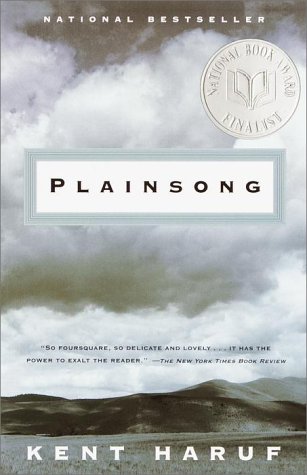
In the late Kent Haruf’s novel Plainsong, abandonment and acceptance are always in play. Victoria Roubideaux, a pregnant teen, suddenly finds herself homeless after her mother locks her out of the house. Maggie Jones, a teacher at her high school, takes her in and helps her. Through Maggie, Victoria eventually realizes that there is a place in the community for her, that people in it will love her like family. To get her to see the reality of her situation, Maggie speaks kindly but directly: “Honey…. Listen to me. You’re here now. This is where you are.”
The small, imperfect community of Holt, a fictional place east of Denver in the high plains of Colorado, is the setting for Haruf’s novels The Tie that Binds, Plainsong, Eventide, Benediction, and Our Souls at Night. Michael Rosenwald, a former student of Haruf, explains that the author got the idea for Holt “from Faulkner’s made-up place, Yoknapatawpha County. Kent knew everyone in Holt, where the train tracks were and who was on the wrong side of them.”
Of Haruf’s characters in their setting, Verlyn Klinkenberg notes that Haruf “never withdraws from these characters or the country they inhabit. To have called them into being at all implies a profound acceptance.”
What I admire in Kent Haruf’s novels, especially in Plainsong, are the ways in which characters in Holt must receive and deal with one another. Haruf’s characters—the likable and the unlikable, the bullies and the tenderhearted, the very old and the young—call up familiar figures. Readers see them in deep conversation or just shooting the breeze, whispering love or flirting, spreading gossip or talking harshly to others. Characters may engage in all-out conflict in one scene, then offer support to someone in need in another scene.
Early in the novel, teachers Maggie Jones and Tom Guthrie appear in the school’s copy room, discussing a problem student, during a brief scene that shows a range of interplay and dealings. When fellow teacher Irving Curtis abruptly walks in and eases up to Maggie, he whispers something objectionable to her. Maggie responds, “Don’t be such an ass.” Curtis simmers, saying he feels rejected. Guthrie offers, “You could shoot yourself.” Minutes later, after Maggie exits, Curtis says, “No shit, though. Just once I’d like to get her in a dark room.”
You want to leave her alone, Guthrie said.
No. I mean think about it…. I told you what Gary Rawlson said about her.
You told me, Guthrie said.
Do you believe it?
No. And neither does Rawlson, when he hasn’t been drinking.
Here, readers find gossip, insult, serious conversation, and humor in the plainspoken diction typical of Haruf’s characters. What is key is that, while the characters don’t shy away from speaking their minds, neither do they utterly condemn one other. They are accustomed to living among the tarnished, the cherished, the friendly, and even the barely tolerated inhabitants of Holt.
One of the most significant aspects of Plainsong is revealed in the way characters redefine and build family through abiding friendships, compassion, and kindness. Victoria is welcomed and supported throughout her pregnancy, first by Maggie Jones, and later by two old ranchers, Harold and Raymond McPheron.
Tom Guthrie and Maggie Jones grow to love each other, after Tom’s wife Ella withdraws from Tom and their sons Ike and Bobby, eventually leaving the family altogether. Maggie becomes the central figure among all these characters, helping them build an extended “family,” based on acceptance, love, and respect.
Holt is not an idyllic town, yet it offers a model for how we might receive and be with others who disappoint us but who also may show us a degree of love; it offers a model for how to live among others who radically differ from us in outlook or class or circumstances.
Kent Haruf has said, “We’d do better to follow the admonition of Jesus about loving our neighbors”; and in the novels his characters show us how to accept one another. And if they don’t always love the other, they don’t condemn and abandon their neighbors.
As for the radical self-centeredness I proposed earlier, I don’t engage in it too much. I long for a sense of community, and I’ve worked hard to build deep, stable relationships with the people around me in the big city. The longer I live, the more I find myself moving away from spitefulness and hardheartedness.
Michael Rosenwald says that Kent Haruf taught him “that stories have the power to exalt and transform.” Dwelling in Haruf’s Plainsong, I’ve seen how I might engage more with others who aren’t easy to associate with. While I don’t expect to become fast friends with my adversaries, perhaps we could have lunch together sometime.
Rebecca A. Spears, a poet and essayist, is the author of The Bright Obvious. Her poems and essays are included in If These Walls Could Speak: The Blanton Museum Poetry Project (University of Texas, Austin), TriQuarterly, Crazyhorse, Calyx, Verse Daily, Ars Medica, Birmingham Poetry Review, Nimrod, Relief, and other journals and anthologies. In Houston, she is a board member of Mutabilis Press and English Department Chair at an Orthodox Jewish high school, an experience that has made her look more deeply at her own faith.
Previous Post

August 4, 2015
Breaking Bad’s Walter White is My Shining Star
Next Post

August 6, 2015 Redrawing the Tree of Life in Yellowstone
Browse Our Archives
Select a Category A. G. Harmon Alissa Wilkinson Allison Backous Art Authors Brad Fruhauff Bradford Winters Bryan Bliss Caroline Langston Chad Thomas Johnston Chris Hoke Christiana N. Peterson Culture D.G. Myers D.L. Mayfield Daniel Bowman Jr. David Griffith Elizabeth Duffy Faith Film Greg Wolfe Guest Contributor Interview Jan Vallone Jeffrey Overstreet Jessica Eddings-Roeser Jessica Mesman Griffith Kelly Foster Lindsey Crittenden Morgan Meis music Natalie Vestin Nick Olson Peggy Rosenthal Personal Reflection Poetry Friday Reflection Relationships Review Richard Chess Richard Cole Sara Zarr Shannon Huffman Polson Sonya Bilocerkowycz Tania Runyan Tony Woodlief Topical Categories Uncategorized Vic Sizemore Writing
Select a Month October 2018 September 2018 August 2018 July 2018 June 2018 May 2018 April 2018 March 2018 February 2018 January 2018 December 2017 November 2017 October 2017 September 2017 August 2017 July 2017 June 2017 May 2017 April 2017 March 2017 February 2017 January 2017 December 2016 November 2016 October 2016 September 2016 August 2016 July 2016 June 2016 May 2016 April 2016 March 2016 February 2016 January 2016 December 2015 November 2015 October 2015 September 2015 August 2015 July 2015 June 2015 May 2015 April 2015 March 2015 February 2015 January 2015 December 2014 November 2014 October 2014 September 2014 August 2014 July 2014 June 2014 May 2014 April 2014 March 2014 February 2014 January 2014 December 2013 November 2013 October 2013 September 2013 August 2013 July 2013 June 2013 May 2013 April 2013 March 2013 February 2013 January 2013 December 2012 November 2012 October 2012 September 2012 August 2012 July 2012 June 2012 May 2012 February 2008
Follow Us!
TAKE THE
Religious Wisdom Quiz
What animal is commonly associated with Jesus?
Select your answer to see how you score.
Lion Fish Lamb Donkey
Related posts from Good Letters

On Writing Odes: Taking Time to Celebrate


A Conversation with Barbara Brown Taylor

Taking Our Chances with Choice
TRENDING AT PATHEOS Catholic

Rejecting Doom: Christian Hope And Human Action
Christianity is a religion of hope. We are to have hope and...

It’s What Comes From Within Which Matters
One of the most difficult things for us to understand is why...

Why I Choose the Eucharist Over the Sermon
Choose the Eucharist, Not the Sermon What are we supposed to get...

5 Design Elements Found in Spiritually Rooted Homes
Putting Spirituality Into Home Decor Our homes are more than our living...

Credo: A Story of God Told with the...
About 10 years ago, I began to imagine a personal "Credo" that...

The Anatomy of Divine Revelation in Catholic Thought
The claim that God has made Himself known to human beings is...
view all Catholic blogs
Ad-Free & Subscriber Log-In Subscription Support
- About Us
- 2026 Calendar
- Videos
- Podcasts
- Library of World Religions
- Faith In Media Tracker
- Advertise With Us
- Write for Us
- Privacy Policy
- Terms of Service
- Do Not Sell My Data
- Contact Us
- Radiant Digital
- Manage Newsletter Subscriptions
- Unsubscribe From Notifications
- Sitemap
Copyright 2008-2026, Patheos. All rights reserved.
Subscription Support Ad-Free & Subscriber Log-In
Follow Patheos