
BuddhistCatholicContemplativeEvangelicalGeneral ChristianHinduJewishLatter-day SaintMuslimNew VisionsProgressive Christian
Beliefs
- Buddhist
- Catholic
- Contemplative
- Evangelical
- General Christian
- Hindu
- Jewish
- Latter-day Saint
- More Voices
- Muslim
- New Visions
- Pagan
- Progressive Christian
Topics
- Religion News
- Food and Religion
- Sports and Religion
- Religious Art
- Religious Music and Entertainment
- Religious Events
- History and Religion
- Style and Religion
- Politics and Religion
- Women in Religion
- Recreation Outdoors and Religion
- Business Finance and Religion
- Careers Workplace and Religion
- Education and Religion
- Family Parenting and Religion
- Health Fitness and Religion
- Home and Religion
- Relationships and Religion
- Technology and Religion
- Travel and Religion
Columnists
- Buddhist Columnists
- Business Finance and Religion Columnists
- Careers Workplace and Religion Columnists
- Catholic Columnists
- Contemplative Columnists
- Education and Religion Columnists
- Evangelists Columnists
- Family Parenting and Religion Columnists
- General Christian Columnists
- Health Fitness and Religion Columnists
- Hindu Columnists
- History and Religion Columnists
- Home and Religion Columnists
- Jewish Columnists
- More Voices Columnists
- Latter Day Columnists
- Muslim Columnists
- New Visions Columnists
- Nonreligious Columnists
- Pagan Columnists
- Politics and Religion Columnists
- Progressive Columnists
- Recreation Outdoors and Religion Columnists
- Relationships and Religion Columnists
- Religion News Columnists
- Religious Art Columnists
- Religious Events Columnists
- Religious Music and Entertainment Columnists
- Sports and Religion Columnists
- Style and Religion Columnists
- Technology and Religion Columnists
- Travel and Religion Columnists
- Women in Religion Columnists
Resource Library
- 2026 Calendar
- Library of World Religions
- The 100 Most Holy Places on Earth
- Patheos Answers
- Podcasts
- Videos
- Faith Leaders Database
- Anglican Episcopalian
- Bahai
- Baptist
- Buddhism
- Christianity
- Confucianism
- Eastern Orthodoxy
- Hinduism
- Holiness and Pentecostal
- ISKCON
- Islam
- Judaism
- Lutheran
- Methodist
- The Church of Jesus Christ of Latter-day Saints
- New Age
- Paganism
- Presbytarian and Reformed
- Protestantism
- Religion Behind the Scenes
- Roman Catholic
- Scientology
- Shia Islam
- Sikhism
- Sufism
- Sunni Islam
- Taoism
- Zen
- See all religions
Research Tools
 Ad-Free & Subscriber Log-In Subscription Support
Ad-Free & Subscriber Log-In Subscription Support
Follow Patheos 

- Trending:
- Forgiveness
- |
- Marriage
- |
- Consciousness
- |
- Death Penalty
- |
- Election
- |
- Halloween
 Good Letters
-
Contributors
- Home
- Catholic
- Exile Among Exiles
Exile Among Exiles
Last updated on: May 12, 2016 at 1:46 pm by Elizabeth Duffy
Exile Among Exiles 2016-05-12T13:46:55-07:00 Elizabeth Duffy
Patheos Explore the world's faith through different perspectives on religion and spirituality! Patheos has the views of the prevalent religions and spiritualities of the world.
 My children attend public middle and high school; hence the school year always begins with the ritual of the sports physical. There’s a clinic at the orthopedic surgeon’s office: five doctors, three hundred students, all in a line waiting to have their nuts grabbed and their eyes checked.
At the end of the summer, the teenagers are well tanned, their skin darkened, hair bleached out so they resemble palominos, particularly the long-legged girls in small shorts. Their straight blond manes ruffle when people walk past. And the boys talk with a confidence and cadence I recognize from when I was in school, twenty years ago now.
Small-town boys have an easy banter. They insult each other, hug each other, yell threats across the room, and for some reason, the girls link arms and answer. They walk over to the group in pairs and say, “What are you yelling about?” scolding and flirting at the same time.
We mothers sit around the edge of the room, mostly silent, though occasionally I want to say to someone, “It stinks to wilt while they bloom, doesn’t it?”
When I was my daughter’s age, I thought I’d never die—that even if my body failed me, I’d find some way to live on, either by making something beautiful, or perhaps more honorably, by bearing children.
Currently, I’m thickening everywhere but my hair, which falls out by the handful in the shower while my daughter’s has simultaneously grown lustrous and thick. My face coarsens, my feet curl. I am increasingly sexless.
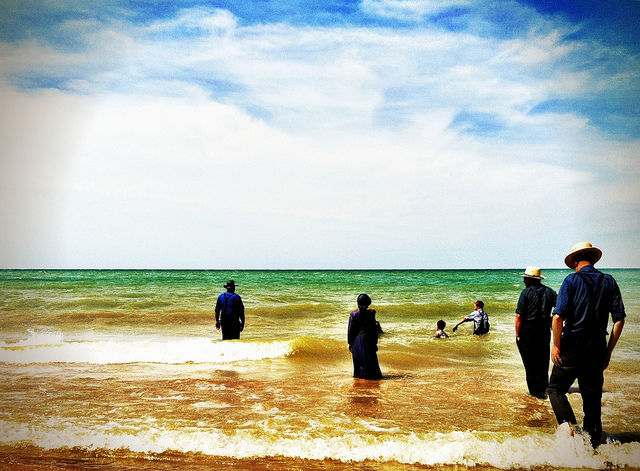
Into the crowded clinic came a small family, a mother, father, and teenaged son, all Mennonite. The son’s hand was wrapped in gauze, but through an opening at his fingertips, I could see that he’d destroyed it, crushed or mangled probably in some piece of machinery. One finger was in a splint, another was just gone. He was dirty, his hair in the telltale bowl cut. He wore suspenders, trousers, a button-down shirt, and a sideways glance at the hundreds of students laughing and flirting in bare legs and sandaled feet.
The Mennonite family headed to the X-ray department window, where the father asked the receptionist, “What’s going on here?”
“Sports physicals?” the receptionist asked back, as if to discern whether the answer could possibly ring any bells. Have you ever heard of this bureaucratic practice of making people visit the doctor before they can play organized sports? Have you ever heard of sports? They play them in high school. Do you know what high school is?
The boy with the mangled hand was handsome and aware. He surely knew what young men and women of their age often do in quiet corners. There was no naiveté in his glances, nor contempt, but incredible curiosity about how there could be so many near-grownups in one place with nothing to do but look forward to another year of physical familiarity, sport, and leisure. And here, he’d been doing the kind of work that can destroy your entire hand in a millisecond. What a curse to be aware that you’re dying while others go on living with impunity.
The receptionist quickly took the family back into the office in deference or respect.
The thing is, I don’t know how any of it works either—all the subtle machinations of small-town culture. I didn’t get it when I was young, and I don’t get it now. I always looked on the people who knew with awe and envy—and I mean knowing of any kind.
When I was younger, social knowledge was what I most wanted to attain, and I see my own kids now grasping in the same way I once did for certainty in this realm: Is it the clothes? The right phrases? The primo piece of technology? And how can I make it seem as though I invented this way of being and never knew otherwise?
My kids are not naturals with social knowledge either, and I’m glad because, selfishly, I want to share my exile with them. Or maybe it’s unselfishly, I don’t know—maybe a sense of exile is good for the soul, or at least it is an inevitable effect of being human. Knowing, after all, is what Eve wanted in the Garden, and what she got was exile and death.
The Mennonite family, having acquired knowledge of the good and evil pervading many modern societal issues, chooses to live apart for spiritual reasons. Those of us who are thickheaded and stubborn rely on time to relegate us to the periphery. We’re all exiled eventually.
The injustice is that, more often than not, we don’t get to choose our exile. Even the Mennonite boy will go home from this doctor’s visit having become someone else within his community, an exile among exiles. Who will he be with a mangled hand?
Exile always has a physical property—geography, family of origin, ability, age. “Wretched man that I am! Who will save me from this body of death?” (Romans 7:24) I suspect that it’s only when we consent to the exile we’ve been given, to the fact of our death, that we begin to transcend it.
I’m still learning how to give my consent. I see the Mennonite boy looking in on the scene in the orthopedic office, and I think, Brother, you are being taken where you do not want to go, and I know your heart.
Maybe if I can process my sorrow at the loss of youth early, my children will never know it existed, and we’ll all have a happy exile in the glorified body of Christ.
Elizabeth Duffy writes at Patheos: Elizabeth Duffy: Perspectives on Catholic Life, Family, and Culture and at bettyduffy.blogspot.com. She is a contributor to Living Faith/ Daily Catholic Devotions, and has work published or forthcoming from OSV, On Faith, The Catholic Educator, and Image.
Previous Post

August 19, 2015
Downturned Face, Upturned Eyes
Next Post
August 21, 2015 Gethsemane Companions
Browse Our Archives
Select a Category A. G. Harmon Alissa Wilkinson Allison Backous Art Authors Brad Fruhauff Bradford Winters Bryan Bliss Caroline Langston Chad Thomas Johnston Chris Hoke Christiana N. Peterson Culture D.G. Myers D.L. Mayfield Daniel Bowman Jr. David Griffith Elizabeth Duffy Faith Film Greg Wolfe Guest Contributor Interview Jan Vallone Jeffrey Overstreet Jessica Eddings-Roeser Jessica Mesman Griffith Kelly Foster Lindsey Crittenden Morgan Meis music Natalie Vestin Nick Olson Peggy Rosenthal Personal Reflection Poetry Friday Reflection Relationships Review Richard Chess Richard Cole Sara Zarr Shannon Huffman Polson Sonya Bilocerkowycz Tania Runyan Tony Woodlief Topical Categories Uncategorized Vic Sizemore Writing
Select a Month October 2018 September 2018 August 2018 July 2018 June 2018 May 2018 April 2018 March 2018 February 2018 January 2018 December 2017 November 2017 October 2017 September 2017 August 2017 July 2017 June 2017 May 2017 April 2017 March 2017 February 2017 January 2017 December 2016 November 2016 October 2016 September 2016 August 2016 July 2016 June 2016 May 2016 April 2016 March 2016 February 2016 January 2016 December 2015 November 2015 October 2015 September 2015 August 2015 July 2015 June 2015 May 2015 April 2015 March 2015 February 2015 January 2015 December 2014 November 2014 October 2014 September 2014 August 2014 July 2014 June 2014 May 2014 April 2014 March 2014 February 2014 January 2014 December 2013 November 2013 October 2013 September 2013 August 2013 July 2013 June 2013 May 2013 April 2013 March 2013 February 2013 January 2013 December 2012 November 2012 October 2012 September 2012 August 2012 July 2012 June 2012 May 2012 February 2008
Follow Us!
TAKE THE
Religious Wisdom Quiz
Who became king after David and built the first Temple in Jerusalem?
Select your answer to see how you score.
Absalom Adonijah Rehoboam Solomon
Related posts from Good Letters



Can a Racist Drive a Prius? Stereotypes and...

TRENDING AT PATHEOS Catholic

Creation, Preservation, and Teleology in Catholic Theology
As I write this, it is very early Monday morning. Like millions...

The Parable Of The Sower And The Word...
One of Christ’s most famous parables is that of the sower who...

Rejecting Doom: Christian Hope And Human Action
Christianity is a religion of hope. We are to have hope and...

Why I Choose the Eucharist Over the Sermon
Choose the Eucharist, Not the Sermon What are we supposed to get...

5 Design Elements Found in Spiritually Rooted Homes
Putting Spirituality Into Home Decor Our homes are more than our living...

Credo: A Story of God Told with the...
About 10 years ago, I began to imagine a personal "Credo" that...
view all Catholic blogs
Ad-Free & Subscriber Log-In Subscription Support
- About Us
- 2026 Calendar
- Videos
- Podcasts
- Library of World Religions
- Faith In Media Tracker
- Advertise With Us
- Write for Us
- Privacy Policy
- Terms of Service
- Do Not Sell My Data
- Contact Us
- Radiant Digital
- Manage Newsletter Subscriptions
- Unsubscribe From Notifications
- Sitemap
Copyright 2008-2026, Patheos. All rights reserved.
Subscription Support Ad-Free & Subscriber Log-In
Follow Patheos