
BuddhistCatholicContemplativeEvangelicalGeneral ChristianHinduJewishLatter-day SaintMuslimNew VisionsProgressive Christian
Beliefs
- Buddhist
- Catholic
- Contemplative
- Evangelical
- General Christian
- Hindu
- Jewish
- Latter-day Saint
- More Voices
- Muslim
- New Visions
- Pagan
- Progressive Christian
Topics
- Religion News
- Food and Religion
- Sports and Religion
- Religious Art
- Religious Music and Entertainment
- Religious Events
- History and Religion
- Style and Religion
- Politics and Religion
- Women in Religion
- Recreation Outdoors and Religion
- Business Finance and Religion
- Careers Workplace and Religion
- Education and Religion
- Family Parenting and Religion
- Health Fitness and Religion
- Home and Religion
- Relationships and Religion
- Technology and Religion
- Travel and Religion
Columnists
- Buddhist Columnists
- Business Finance and Religion Columnists
- Careers Workplace and Religion Columnists
- Catholic Columnists
- Contemplative Columnists
- Education and Religion Columnists
- Evangelists Columnists
- Family Parenting and Religion Columnists
- General Christian Columnists
- Health Fitness and Religion Columnists
- Hindu Columnists
- History and Religion Columnists
- Home and Religion Columnists
- Jewish Columnists
- More Voices Columnists
- Latter Day Columnists
- Muslim Columnists
- New Visions Columnists
- Nonreligious Columnists
- Pagan Columnists
- Politics and Religion Columnists
- Progressive Columnists
- Recreation Outdoors and Religion Columnists
- Relationships and Religion Columnists
- Religion News Columnists
- Religious Art Columnists
- Religious Events Columnists
- Religious Music and Entertainment Columnists
- Sports and Religion Columnists
- Style and Religion Columnists
- Technology and Religion Columnists
- Travel and Religion Columnists
- Women in Religion Columnists
Resource Library
- 2026 Calendar
- Library of World Religions
- The 100 Most Holy Places on Earth
- Patheos Answers
- Podcasts
- Videos
- Faith Leaders Database
- Anglican Episcopalian
- Bahai
- Baptist
- Buddhism
- Christianity
- Confucianism
- Eastern Orthodoxy
- Hinduism
- Holiness and Pentecostal
- ISKCON
- Islam
- Judaism
- Lutheran
- Methodist
- The Church of Jesus Christ of Latter-day Saints
- New Age
- Paganism
- Presbytarian and Reformed
- Protestantism
- Religion Behind the Scenes
- Roman Catholic
- Scientology
- Shia Islam
- Sikhism
- Sufism
- Sunni Islam
- Taoism
- Zen
- See all religions
Research Tools
 Ad-Free & Subscriber Log-In Subscription Support
Ad-Free & Subscriber Log-In Subscription Support
Follow Patheos 

- Trending:
- Forgiveness
- |
- Marriage
- |
- Consciousness
- |
- Death Penalty
- |
- Election
- |
- Halloween
 Good Letters
-
Contributors
- Home
- Catholic
- The Horseshoe Crab’s Evolutionary Success
The Horseshoe Crab’s Evolutionary Success
Last updated on: July 24, 2015 at 12:07 pm by Guest Contributor
The Horseshoe Crab’s Evolutionary Success 2015-07-24T12:07:05-07:00 Guest Contributor
Patheos Explore the world's faith through different perspectives on religion and spirituality! Patheos has the views of the prevalent religions and spiritualities of the world.
 By Kathleen L. Housley
This post was made possible through the support of a grant from The BioLogos Foundation’s Evolution and Christian Faith program. The opinions expressed are those of the author and do not necessarily reflect the views of BioLogos.
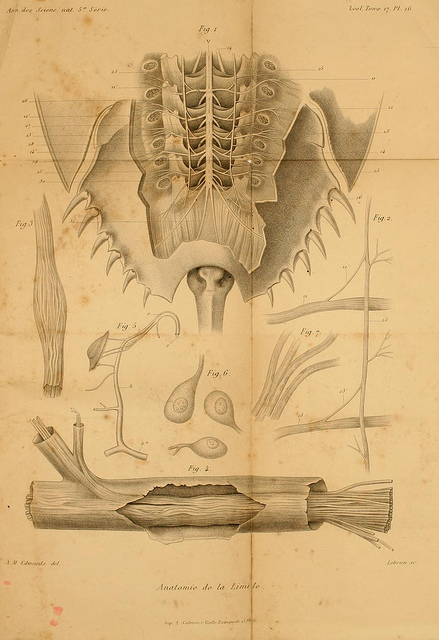
Horseshoe crabs are not on anyone’s list of favorite animals. Looking like slow-moving tanks, they hit the beaches of the Atlantic Ocean in late spring to spawn. The only thing about them that might be perceived as warm and fuzzy, garnering them a spot on the favorite animals list, is that they breed at twilight surrounded by soft sand and the sound of the surf. Thus they have done for 450 million years, evolving so slowly that a modern horseshoe crab is nearly the spitting image of a fossilized one.
The name of the horseshoe crab and the adjectives used to describe it are misnomers. It isn’t a crab, and its helmet-like shape only vaguely resembles a horseshoe. Beachgoers often describe them as primitive, crawling out of the dawn of time*.* But primitive is a value-laden term implying simplicity instead of complexity, and favoring the latter.
Horseshoe crabs have also been called living fossils, but that term is an oxymoron and should be deleted from the scientific lexicon. Not that the horseshoe crab cares what it is called and what labels are applied. During its long tenure on this planet, dinosaurs came and went, meteors crashed into the earth causing mass extinctions, volcanoes spread ash around the globe, and ice sheets buried the land. No matter—the horseshoe crab kept on going, living its humdrum life, and surviving as one of the fittest.
One aspect of evolution we sometimes neglect in our thinking is that not all life forms have needed Darwin’s “descent with modification” to the same degree to survive. In no way does this disprove the theory of evolution. In fact, Darwin recognized that lack of competition in a stable environment could remove the pressure on a species to evolve.
Nonetheless, some creationists have latched onto the horseshoe crab as a poster child for complex design, springing into unchanging totality on the fifth day of creation. They overlook God’s pronouncement that creation was good, not perfect. In Hebrew, the word good (tov) has the sense of interlinked effectiveness. When all of creation is working together, it leads to a fruitful tomorrow instead of a static today, and God is well pleased.
What is the secret of success for horseshoe crabs? What can this ancient-of-days creature share with us poor humans who have only walked on Earth in our modern Homo form for a measly 200,000 years or so?
First, they are generalists eating all sorts of things, primarily worms and mollusks, but not turning down a tasty small fish when the opportunity arises. Second, they are ecologically adaptable. They can live in warm or cold water under varying conditions of salinity, temperature, and oxygen levels.
Also, they are anatomically adaptable. For example, their legs are for walking and swimming, but they are also for grinding food (functioning like jaws) before delivering it to the mouth that is centralized between the five pairs of legs. Their gills (called book gills for their page-like structure) are for respiration but also help with swimming. They have nine eyes as well as photoreceptors, which enable them to see in low light.
Then there is their sharp spear of a tail that is actually an efficient tool for righting themselves if they get accidentally turned over on land. Since they swim with their shell below instead of above, the tail also acts as a kind of rudder. And in their favorite medium of mud, the tail shoves.
Most amazing is their unique way to battle bacteria in their bodies. They do not have hemoglobin, which uses iron, in their blood. Instead, they have hemocyanin, which uses copper; hence their blood is blue, not red. Even more amazing, the blood contains amebocytes that detect the tiniest amount of bacteria and the toxins they produce, and then coagulates them, rendering them harmless.
This attribute has not been lost on pharmaceutical companies, which test new drugs using horseshoe crab blood. Yes, they are actually caught, cut, bled, and released back into the ocean, although some die and many are weakened in the process. So we are all beholden to the horseshoe crab for our health. All this from a primitive living fossil that wasn’t created perfect but was certainly created good.
The relationship between simplicity and complexity is, well, complex. It is far easier to determine if a mathematical problem is simple or complex than it is to determine the same thing about a living being, even a single-celled bacteria. Too often our assessment of simplicity is more indicative of the limits of our knowledge than of reality.
So also lack of anatomical change (anatomy being what is preserved in the fossil record) does not indicate the absence of evolution. Add to this our human propensity of being fascinated, and often hoodwinked, by complexity, failing to see that one of the gauges of value should be functionality.
Does it work? Is it good? For the horseshoe crab, the answers are that it works and it is very good indeed.
Join in the conversation about evolution and Christian faith by visiting the BioLogos symposium at Patheos.
Kathleen L. Housley writes on the interconnection of the sciences and religion. She is the author of nine books, most recently the poetry collection Epiphanies (Wising Up) and the novel The Sage of Time and Chance (Wipf & Stock), based on Ecclesiastes.
Previous Post

July 23, 2015
Dear Patheos
Next Post
July 27, 2015 The Mystery and Terror of Retirement
Browse Our Archives
Select a Category A. G. Harmon Alissa Wilkinson Allison Backous Art Authors Brad Fruhauff Bradford Winters Bryan Bliss Caroline Langston Chad Thomas Johnston Chris Hoke Christiana N. Peterson Culture D.G. Myers D.L. Mayfield Daniel Bowman Jr. David Griffith Elizabeth Duffy Faith Film Greg Wolfe Guest Contributor Interview Jan Vallone Jeffrey Overstreet Jessica Eddings-Roeser Jessica Mesman Griffith Kelly Foster Lindsey Crittenden Morgan Meis music Natalie Vestin Nick Olson Peggy Rosenthal Personal Reflection Poetry Friday Reflection Relationships Review Richard Chess Richard Cole Sara Zarr Shannon Huffman Polson Sonya Bilocerkowycz Tania Runyan Tony Woodlief Topical Categories Uncategorized Vic Sizemore Writing
Select a Month October 2018 September 2018 August 2018 July 2018 June 2018 May 2018 April 2018 March 2018 February 2018 January 2018 December 2017 November 2017 October 2017 September 2017 August 2017 July 2017 June 2017 May 2017 April 2017 March 2017 February 2017 January 2017 December 2016 November 2016 October 2016 September 2016 August 2016 July 2016 June 2016 May 2016 April 2016 March 2016 February 2016 January 2016 December 2015 November 2015 October 2015 September 2015 August 2015 July 2015 June 2015 May 2015 April 2015 March 2015 February 2015 January 2015 December 2014 November 2014 October 2014 September 2014 August 2014 July 2014 June 2014 May 2014 April 2014 March 2014 February 2014 January 2014 December 2013 November 2013 October 2013 September 2013 August 2013 July 2013 June 2013 May 2013 April 2013 March 2013 February 2013 January 2013 December 2012 November 2012 October 2012 September 2012 August 2012 July 2012 June 2012 May 2012 February 2008
Follow Us!
TAKE THE
Religious Wisdom Quiz
What does Jesus say about storing up treasures on earth?
Select your answer to see how you score.
Treasure is godliness Store as much as possible Only store in banks Do not, because they are temporary
Related posts from Good Letters

Leonard Cohen’s Holy and Broken Hallelujah

Ready or Not for the Days of Awe


TRENDING AT PATHEOS Catholic

Rejecting Doom: Christian Hope And Human Action
Christianity is a religion of hope. We are to have hope and...

It’s What Comes From Within Which Matters
One of the most difficult things for us to understand is why...

Why I Choose the Eucharist Over the Sermon
Choose the Eucharist, Not the Sermon What are we supposed to get...

5 Design Elements Found in Spiritually Rooted Homes
Putting Spirituality Into Home Decor Our homes are more than our living...

Credo: A Story of God Told with the...
About 10 years ago, I began to imagine a personal "Credo" that...

The Anatomy of Divine Revelation in Catholic Thought
The claim that God has made Himself known to human beings is...
view all Catholic blogs
Ad-Free & Subscriber Log-In Subscription Support
- About Us
- 2026 Calendar
- Videos
- Podcasts
- Library of World Religions
- Faith In Media Tracker
- Advertise With Us
- Write for Us
- Privacy Policy
- Terms of Service
- Do Not Sell My Data
- Contact Us
- Radiant Digital
- Manage Newsletter Subscriptions
- Unsubscribe From Notifications
- Sitemap
Copyright 2008-2026, Patheos. All rights reserved.
Subscription Support Ad-Free & Subscriber Log-In
Follow Patheos