
BuddhistCatholicContemplativeEvangelicalGeneral ChristianHinduJewishLatter-day SaintMuslimNew VisionsProgressive Christian
Beliefs
- Buddhist
- Catholic
- Contemplative
- Evangelical
- General Christian
- Hindu
- Jewish
- Latter-day Saint
- More Voices
- Muslim
- New Visions
- Pagan
- Progressive Christian
Topics
- Religion News
- Food and Religion
- Sports and Religion
- Religious Art
- Religious Music and Entertainment
- Religious Events
- History and Religion
- Style and Religion
- Politics and Religion
- Women in Religion
- Recreation Outdoors and Religion
- Business Finance and Religion
- Careers Workplace and Religion
- Education and Religion
- Family Parenting and Religion
- Health Fitness and Religion
- Home and Religion
- Relationships and Religion
- Technology and Religion
- Travel and Religion
Columnists
- Buddhist Columnists
- Business Finance and Religion Columnists
- Careers Workplace and Religion Columnists
- Catholic Columnists
- Contemplative Columnists
- Education and Religion Columnists
- Evangelists Columnists
- Family Parenting and Religion Columnists
- General Christian Columnists
- Health Fitness and Religion Columnists
- Hindu Columnists
- History and Religion Columnists
- Home and Religion Columnists
- Jewish Columnists
- More Voices Columnists
- Latter Day Columnists
- Muslim Columnists
- New Visions Columnists
- Nonreligious Columnists
- Pagan Columnists
- Politics and Religion Columnists
- Progressive Columnists
- Recreation Outdoors and Religion Columnists
- Relationships and Religion Columnists
- Religion News Columnists
- Religious Art Columnists
- Religious Events Columnists
- Religious Music and Entertainment Columnists
- Sports and Religion Columnists
- Style and Religion Columnists
- Technology and Religion Columnists
- Travel and Religion Columnists
- Women in Religion Columnists
Resource Library
- 2026 Calendar
- Library of World Religions
- The 100 Most Holy Places on Earth
- Patheos Answers
- Podcasts
- Videos
- Faith Leaders Database
- Anglican Episcopalian
- Bahai
- Baptist
- Buddhism
- Christianity
- Confucianism
- Eastern Orthodoxy
- Hinduism
- Holiness and Pentecostal
- ISKCON
- Islam
- Judaism
- Lutheran
- Methodist
- The Church of Jesus Christ of Latter-day Saints
- New Age
- Paganism
- Presbytarian and Reformed
- Protestantism
- Religion Behind the Scenes
- Roman Catholic
- Scientology
- Shia Islam
- Sikhism
- Sufism
- Sunni Islam
- Taoism
- Zen
- See all religions
Research Tools
 Ad-Free & Subscriber Log-In Subscription Support
Ad-Free & Subscriber Log-In Subscription Support
Follow Patheos 

- Trending:
- Forgiveness
- |
- Marriage
- |
- Consciousness
- |
- Death Penalty
- |
- Election
- |
- Halloween
 Good Letters
-
Contributors
- Home
- Catholic
- Poets and Pope Embrace our Planet
Poets and Pope Embrace our Planet
Last updated on: July 28, 2015 at 9:34 am by Peggy Rosenthal
Poets and Pope Embrace our Planet 2015-07-28T09:34:02-07:00 Peggy Rosenthal
Patheos Explore the world's faith through different perspectives on religion and spirituality! Patheos has the views of the prevalent religions and spiritualities of the world.
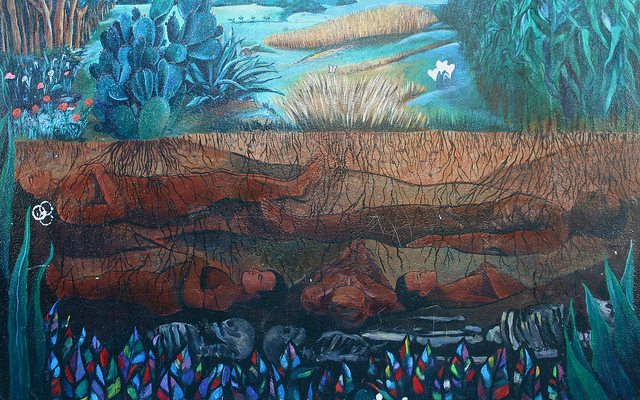 Poets have no problem seeing the world evolving within God’s care.
Okay, that’s too general a statement. Let’s just take some of the poets in the special issue of Image (#85) on “Evolution and the Imago Dei.” (And since Pope Francis’s encyclical Laudato Sì came out nearly the same time as Image, I hear the Pope conversing with the poets.)
Poet Pattiann Rogers has for decades traced the minutiae of a natural world alive in unexpected ways. I reach for her collection Song of the World Becoming whenever I want to be drawn afresh into nature’s secret life. Here in Image, in “The Moss Method,” it’s the wondrous protective quality of mosses that Rogers burrows her language into.
They can soothe the knife-edges of stones
with frothy leaf by leaf of gray-green life
and burned-ground mosses cover destruction,
charred stumps, trees felled and blackened.
Cosmopolitan mosses likewise salve
sidewalk cracks, crumbling walls.…
I believe they could comfort the world
with their ministries.
As the moss “soothes” and “salves,” Rogers caresses the moss in its multiple forms and ministries.
“The entire material universe speaks of God’s love, his boundless affection for us. Soil, water, mountains: everything is, as it were, a caress of God.” — Laudato Sì ¶84
§
One by one leaves spindle in the wind,
the clock runs down, the cricket’s
chirr continues. Each year I try
to catch the moment the chirring ceases
and silence takes on its winter timbre.
Each year I miss…
Margaret Gibson, here in “Middle Distance, Morning,” muses on her tenuous relation to a natural world that keeps eluding her. Yet,
…no, I’m not lonely,…not
in the midst of all my relations,
as an old woman called the living world
around her…
“In this universe, shaped by open and intercommunicating systems, we can discern countless forms of relationship and participation. This leads us to think of the whole as open to God’s transcendence, within which it develops. Faith allows us to interpret the meaning and the mysterious beauty of what is unfolding.” Laudato Sì ¶79
§
“Because all creatures are connected, each must be cherished with love and respect, for all of us as living creatures are dependent on one another.” Laudato Sì ¶42
Kathleen Housley’s dependence on other living creatures, in “The Microbiome and the Boson,” actually defines her essence, which is a “consortium” of “mitochondria.” Playing on Psalm 39’s “I am fearfully and wonderfully made,” she writes: “I am fearfully and wonderfully provisional.”
“Provisional” because life’s web is never fixed or final. “The Spirit of God has filled the universe with possibilities and therefore, from the very heart of things, something new can always emerge.” Laudato Sì ¶80
§
“The world… is a web of relationships. Creatures tend towards God, and in turn it is proper to every living being to tend towards other things, so that throughout the universe we can find any number of constant and secretly interwoven relationships.” Laudato Sì ¶240
Watch how Richard Chess images these “interwoven relationships” in “When God Dreamed Eve through Adam.” Adam’s very language, on first seeing Eve, embraces—even emerges from—the newly created universe:
When he took a few steps back
to appraise her with the mind of sun,
the heart of moon, to praise her
With the applause of leaves bestirred,
to seduce her with the iridescence
of lizard skin, to navigate into the current of her
And be powered and transported like a fish
through a diaphanous river’s shadow and light,
to know her with every cell, every molecule, all
The atoms and elements that spun into this inception—
with all creation pulsing
in his temples…
With all creation pulsing in his temples, in our temples, how can we let ourselves inflict harm on the created world? This isn’t where Richard Chess is going. But it’s where the Pope goes:
“Since everything is closely interrelated, and today’s problems call for a vision capable of taking into account every aspect of the global crisis, I suggest that we now consider some elements of an integral ecology.” Laudato Sì ¶137
Integral. Web. Interrelated. These terms for the interconnectedness within all of nature first entered popular discourse with Rachel Carson’s classic 1962 book Silent Spring:
“The earth’s vegetation is part of a web of life in which there are intimate and essential relations between plants and animals.” The “balance of nature” is “a complex, precise, and highly integrated system of relationships between living things which cannot safely be ignored any more than the law of gravity can be defied with impunity by a man perched on the edge of a cliff.”
Pope Francis’s vision carries on Carson’s: “We are free to apply our intelligence towards things evolving positively—or towards adding new ills, new causes of suffering and real setbacks.” Laudato Sì ¶79
§
“The continued acceleration of changes affecting humanity and the planet is coupled today with a more intensified pace of life and work which might be called ‘rapidification.’ Although change is part of the working of complex systems, the speed with which human activity has developed contrasts with the naturally slow pace of biological evolution. Moreover, the goals of this rapid and constant change are not necessarily geared to the common good… Change is something desirable, yet it becomes a source of anxiety when it causes harm to the world…” Laudato Sì ¶18
Evolution implies time. Here, Pope Francis is concerned about a human-caused speeding up of the time that the natural world “naturally” takes for change. In “Return to the Beginning,” Jeanne Murray Walker plays with another distortion of time: running it backwards.
The scrambled eggs, already fried and fragrant
on a plate, slip back into their shells…
The house remembers when it was imagined…
So geese,
who honked across this troubled sky last fall,
welcome back! This chance to undo it all.
Walker knows she’s playing with the impossible: the “chance to undo it all.” But in real life, in the reality of the natural world, we have no chance to undo whatever harm we’ve inflicted. Or do we?
Peggy Rosenthal is director of Poetry Retreats and writes widely on poetry as a spiritual resource. Her books include Praying through Poetry: Hope for Violent Times (Franciscan Media) and The Poets’ Jesus (Oxford). See Amazon for full list. She also teaches an online course, “Poetry as a Spiritual Practice,” through Image’s Glen Online program*.*
This royalty free image is of a mural in San Francisco, the image is attributed to Nagarjun Kandukuru on flickr.
Previous Post
July 27, 2015
The Mystery and Terror of Retirement
Next Post
July 29, 2015 Bullets in My House
Browse Our Archives
Select a Category A. G. Harmon Alissa Wilkinson Allison Backous Art Authors Brad Fruhauff Bradford Winters Bryan Bliss Caroline Langston Chad Thomas Johnston Chris Hoke Christiana N. Peterson Culture D.G. Myers D.L. Mayfield Daniel Bowman Jr. David Griffith Elizabeth Duffy Faith Film Greg Wolfe Guest Contributor Interview Jan Vallone Jeffrey Overstreet Jessica Eddings-Roeser Jessica Mesman Griffith Kelly Foster Lindsey Crittenden Morgan Meis music Natalie Vestin Nick Olson Peggy Rosenthal Personal Reflection Poetry Friday Reflection Relationships Review Richard Chess Richard Cole Sara Zarr Shannon Huffman Polson Sonya Bilocerkowycz Tania Runyan Tony Woodlief Topical Categories Uncategorized Vic Sizemore Writing
Select a Month October 2018 September 2018 August 2018 July 2018 June 2018 May 2018 April 2018 March 2018 February 2018 January 2018 December 2017 November 2017 October 2017 September 2017 August 2017 July 2017 June 2017 May 2017 April 2017 March 2017 February 2017 January 2017 December 2016 November 2016 October 2016 September 2016 August 2016 July 2016 June 2016 May 2016 April 2016 March 2016 February 2016 January 2016 December 2015 November 2015 October 2015 September 2015 August 2015 July 2015 June 2015 May 2015 April 2015 March 2015 February 2015 January 2015 December 2014 November 2014 October 2014 September 2014 August 2014 July 2014 June 2014 May 2014 April 2014 March 2014 February 2014 January 2014 December 2013 November 2013 October 2013 September 2013 August 2013 July 2013 June 2013 May 2013 April 2013 March 2013 February 2013 January 2013 December 2012 November 2012 October 2012 September 2012 August 2012 July 2012 June 2012 May 2012 February 2008
Follow Us!
TAKE THE
Religious Wisdom Quiz
What did Jesus do for Lazarus in Bethany?
Select your answer to see how you score.
Fed him Healed his blindness Raised him from the dead Turned him invisible
Related posts from Good Letters


On Writing Odes: Taking Time to Celebrate

Poetry Friday: "The Burned Butterfly"

A Conversation with Alicia Ostriker: Part 1
TRENDING AT PATHEOS Catholic

The Parable Of The Sower And The Word...
One of Christ’s most famous parables is that of the sower who...

Rejecting Doom: Christian Hope And Human Action
Christianity is a religion of hope. We are to have hope and...

Why I Choose the Eucharist Over the Sermon
Choose the Eucharist, Not the Sermon What are we supposed to get...

5 Design Elements Found in Spiritually Rooted Homes
Putting Spirituality Into Home Decor Our homes are more than our living...

Credo: A Story of God Told with the...
About 10 years ago, I began to imagine a personal "Credo" that...

The Anatomy of Divine Revelation in Catholic Thought
The claim that God has made Himself known to human beings is...
view all Catholic blogs
Ad-Free & Subscriber Log-In Subscription Support
- About Us
- 2026 Calendar
- Videos
- Podcasts
- Library of World Religions
- Faith In Media Tracker
- Advertise With Us
- Write for Us
- Privacy Policy
- Terms of Service
- Do Not Sell My Data
- Contact Us
- Radiant Digital
- Manage Newsletter Subscriptions
- Unsubscribe From Notifications
- Sitemap
Copyright 2008-2026, Patheos. All rights reserved.
Subscription Support Ad-Free & Subscriber Log-In
Follow Patheos