
BuddhistCatholicContemplativeEvangelicalGeneral ChristianHinduJewishLatter-day SaintMuslimNew VisionsProgressive Christian
Beliefs
- Buddhist
- Catholic
- Contemplative
- Evangelical
- General Christian
- Hindu
- Jewish
- Latter-day Saint
- More Voices
- Muslim
- New Visions
- Pagan
- Progressive Christian
Topics
- Religion News
- Food and Religion
- Sports and Religion
- Religious Art
- Religious Music and Entertainment
- Religious Events
- History and Religion
- Style and Religion
- Politics and Religion
- Women in Religion
- Recreation Outdoors and Religion
- Business Finance and Religion
- Careers Workplace and Religion
- Education and Religion
- Family Parenting and Religion
- Health Fitness and Religion
- Home and Religion
- Relationships and Religion
- Technology and Religion
- Travel and Religion
Columnists
- Buddhist Columnists
- Business Finance and Religion Columnists
- Careers Workplace and Religion Columnists
- Catholic Columnists
- Contemplative Columnists
- Education and Religion Columnists
- Evangelists Columnists
- Family Parenting and Religion Columnists
- General Christian Columnists
- Health Fitness and Religion Columnists
- Hindu Columnists
- History and Religion Columnists
- Home and Religion Columnists
- Jewish Columnists
- More Voices Columnists
- Latter Day Columnists
- Muslim Columnists
- New Visions Columnists
- Nonreligious Columnists
- Pagan Columnists
- Politics and Religion Columnists
- Progressive Columnists
- Recreation Outdoors and Religion Columnists
- Relationships and Religion Columnists
- Religion News Columnists
- Religious Art Columnists
- Religious Events Columnists
- Religious Music and Entertainment Columnists
- Sports and Religion Columnists
- Style and Religion Columnists
- Technology and Religion Columnists
- Travel and Religion Columnists
- Women in Religion Columnists
Resource Library
- 2026 Calendar
- Library of World Religions
- The 100 Most Holy Places on Earth
- Patheos Answers
- Podcasts
- Videos
- Faith Leaders Database
- Anglican Episcopalian
- Bahai
- Baptist
- Buddhism
- Christianity
- Confucianism
- Eastern Orthodoxy
- Hinduism
- Holiness and Pentecostal
- ISKCON
- Islam
- Judaism
- Lutheran
- Methodist
- The Church of Jesus Christ of Latter-day Saints
- New Age
- Paganism
- Presbytarian and Reformed
- Protestantism
- Religion Behind the Scenes
- Roman Catholic
- Scientology
- Shia Islam
- Sikhism
- Sufism
- Sunni Islam
- Taoism
- Zen
- See all religions
Research Tools
 Ad-Free & Subscriber Log-In Subscription Support
Ad-Free & Subscriber Log-In Subscription Support
Follow Patheos 

- Trending:
- Forgiveness
- |
- Marriage
- |
- Consciousness
- |
- Death Penalty
- |
- Election
- |
- Halloween
 Good Letters
-
Contributors
- Home
- Catholic
- Having Enough: Jacob, Esau, and the Great Books
Having Enough: Jacob, Esau, and the Great Books
Last updated on: July 30, 2015 at 1:00 am by Guest Contributor
Having Enough: Jacob, Esau, and the Great Books 2015-07-28T09:59:19-07:00 Guest Contributor
Patheos Explore the world's faith through different perspectives on religion and spirituality! Patheos has the views of the prevalent religions and spiritualities of the world.
 Guest post by Jonathan Hiskes
It feels silly to say I studied the classics because of slick marketing copy, but that’s what happened. When I was seventeen, I had no idea what to do with the glossy college viewbooks that began showing up in the mail. They offered up images of interchangeable gothic lecture halls, sunlit quads, and cheering, face-painted football crowds. They offered up equally sunny portrayals of happy, high-earning alumni in successful careers.
Amid that flurry came a flyer bearing names like Homer, Plato, Machiavelli, Descartes, Nietzsche, and Locke—names I knew nothing about, beyond some vague sense of their importance. It advertised a yearlong honors seminar on “Developments in the History of Western Thought” at Loyola University Chicago. The flyer had a message about asking big questions or thinking deep thoughts or some such language calibrated to appeal to pretentious high-school seniors. It probably had more gothic spires or Greek columns.
I was just as intrigued by what wasn’t there: no mention of MCAT scores or graduate-school acceptance rates or first-year average salaries. Spending a year studying classical texts seemed less intimidating than committing to a lifetime in medicine or law or anything else. I chose Loyola largely on the basis of that flyer.
The year began not with Homer or Plato but with a book I had actually heard of—the Book of Genesis. Our professors urged us to read it not as the infallible voice of truth, a literal account of science and history. Nor did they present it as a mere anthropological artifact, reflecting the biases of its authors and nothing more. They were introducing the idea of a great book, a text that yields up riches to both trained scholars and attentive novices.
At least that was the idea. When I sat down in my dorm room to read, twelve years of protestant Christian schooling and Sunday school classes came roaring back, drowning out any new word I might have heard. I had been taught to read the Bible as a package of practical moral lessons. Noah’s rainbow taught us about God’s love. The Tower of Babel taught us about the sin of pride. The Genesis stories in our assigned reading felt familiar and stale. I fought my eyes from glazing over on every page.
I realized how much I’d missed when one of our professors lectured about Jacob, the son of Isaac, scion of the nation of Israel. My Sunday school teachers portrayed Jacob as a sort of plucky underdog, but this professor described a ruthless, vile character. Jacob slid into the world clutching his twin brother’s heel, the second son in a culture in which the first-born inherited everything. From the moment of his birth, Jacob clawed after the position and privilege that his birth-rank denied him. He cheated his brother Esau and lied to his father on his deathbed. After fleeing home to live with his uncle Laban, he traded further deceptions with him.
Then our professor, Mark McIntosh, told a story I’d never heard before. After Jacob flees to his uncle, after he takes on wives and fathers children and builds a small fortune in livestock, he returns to his homeland years later. He brings lavish gifts for his brother: cattle, goats, sheep, donkeys, and camels, an elaborate peace offering to atone for the wealth he stole. He sends servants ahead with the animals and keeps his favorite wife, Rachel, in back with her child. If Esau and his men respond with a bloodbath, he wants them to escape.
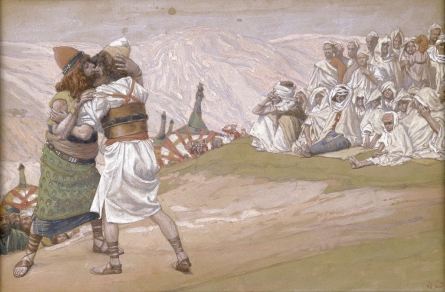
Finally, Jacob returns to his brother. Esau runs to embrace him, and kisses him, and together they weep. To the gifts, Esau says, “I have enough, my brother; keep that thou hast unto thyself.”
It was a line I’d never noticed. Reading in my dorm room, I must have skimmed right over it. Here in the lecture hall, our professor was repeating the phrase with what looked like tears in his eyes: “I have enough.”
Those three words, he said, form a profoundly radical statement. They cut against the grain of the dominant culture, then and now. In pagan wisdom literature, McIntosh said, wealth must be stolen. The transformative claim of Genesis is that creatures generate wealth when they meet in communion—divine and human, human and human, plant and earth. The creative potential baked into the universe means we aren’t damned to a dog-eat-dog world.
At the end of that year, I was surprised to hear one of our professors say that this twelve-credit seminar should be the beginning of our study in the classics, not the end. I was still naive enough to think I could learn something as vast as the history of Western thought in a year. And I was still discovering how the notion of “great books” is complicated by questions of power and patriarchy: who gets to decide the canon, whose texts survive the ravages of history, and on.
I’ve been trying to understand why that story stays with me. As an eighteen-year-old full of nerves and worry, I could dimly sense the power of those words and why they excited my professor so deeply. Now, years later, I’m still wondering at their potential for changing my orientation to the world. To say “I have enough” is to renounce striving as a primary mode of being. It is to replace an economics of scarcity with an economics of abundance. It is to replace a posture of fear with a posture of trust.
Those words stay with me mostly as an idea I’ve failed to live up to. I still live hunched with worry and longing most of the time. But I hold on to them like a mantra. They are not a solution to striving but a possibility. They are promise I dearly want to trust, a window opening to reveal a picture of two brothers reuniting after years of conflict, embracing under the desert sun, with enough livestock, land, and kinship to go around.
Jonathan Hiskes writes at the Simpson Center for the Humanities at the University of Washington. Find his work at Jonathanhiskes.com.
This public domain image depicts the “The Meeting of Esau and Jacob” (watercolor circa 1896–1902 by James Tissot).
Previous Post
July 29, 2015
Bullets in My House
Next Post

July 31, 2015 Wrestling with Sunday Mornings
Browse Our Archives
Select a Category A. G. Harmon Alissa Wilkinson Allison Backous Art Authors Brad Fruhauff Bradford Winters Bryan Bliss Caroline Langston Chad Thomas Johnston Chris Hoke Christiana N. Peterson Culture D.G. Myers D.L. Mayfield Daniel Bowman Jr. David Griffith Elizabeth Duffy Faith Film Greg Wolfe Guest Contributor Interview Jan Vallone Jeffrey Overstreet Jessica Eddings-Roeser Jessica Mesman Griffith Kelly Foster Lindsey Crittenden Morgan Meis music Natalie Vestin Nick Olson Peggy Rosenthal Personal Reflection Poetry Friday Reflection Relationships Review Richard Chess Richard Cole Sara Zarr Shannon Huffman Polson Sonya Bilocerkowycz Tania Runyan Tony Woodlief Topical Categories Uncategorized Vic Sizemore Writing
Select a Month October 2018 September 2018 August 2018 July 2018 June 2018 May 2018 April 2018 March 2018 February 2018 January 2018 December 2017 November 2017 October 2017 September 2017 August 2017 July 2017 June 2017 May 2017 April 2017 March 2017 February 2017 January 2017 December 2016 November 2016 October 2016 September 2016 August 2016 July 2016 June 2016 May 2016 April 2016 March 2016 February 2016 January 2016 December 2015 November 2015 October 2015 September 2015 August 2015 July 2015 June 2015 May 2015 April 2015 March 2015 February 2015 January 2015 December 2014 November 2014 October 2014 September 2014 August 2014 July 2014 June 2014 May 2014 April 2014 March 2014 February 2014 January 2014 December 2013 November 2013 October 2013 September 2013 August 2013 July 2013 June 2013 May 2013 April 2013 March 2013 February 2013 January 2013 December 2012 November 2012 October 2012 September 2012 August 2012 July 2012 June 2012 May 2012 February 2008
Follow Us!
TAKE THE
Religious Wisdom Quiz
What New Testament letter includes the "fruit of the Spirit"?
Select your answer to see how you score.
James Hebrews Ephesians Galatians
Related posts from Good Letters

Leonard Cohen’s Holy and Broken Hallelujah

Ready or Not for the Days of Awe


TRENDING AT PATHEOS Catholic

Rejecting Doom: Christian Hope And Human Action
Christianity is a religion of hope. We are to have hope and...

It’s What Comes From Within Which Matters
One of the most difficult things for us to understand is why...

Why I Choose the Eucharist Over the Sermon
Choose the Eucharist, Not the Sermon What are we supposed to get...

5 Design Elements Found in Spiritually Rooted Homes
Putting Spirituality Into Home Decor Our homes are more than our living...

Credo: A Story of God Told with the...
About 10 years ago, I began to imagine a personal "Credo" that...

The Anatomy of Divine Revelation in Catholic Thought
The claim that God has made Himself known to human beings is...
view all Catholic blogs
Ad-Free & Subscriber Log-In Subscription Support
- About Us
- 2026 Calendar
- Videos
- Podcasts
- Library of World Religions
- Faith In Media Tracker
- Advertise With Us
- Write for Us
- Privacy Policy
- Terms of Service
- Do Not Sell My Data
- Contact Us
- Radiant Digital
- Manage Newsletter Subscriptions
- Unsubscribe From Notifications
- Sitemap
Copyright 2008-2026, Patheos. All rights reserved.
Subscription Support Ad-Free & Subscriber Log-In
Follow Patheos