
BuddhistCatholicContemplativeEvangelicalGeneral ChristianHinduJewishLatter-day SaintMuslimNew VisionsProgressive Christian
Beliefs
- Buddhist
- Catholic
- Contemplative
- Evangelical
- General Christian
- Hindu
- Jewish
- Latter-day Saint
- More Voices
- Muslim
- New Visions
- Pagan
- Progressive Christian
Topics
- Religion News
- Food and Religion
- Sports and Religion
- Religious Art
- Religious Music and Entertainment
- Religious Events
- History and Religion
- Style and Religion
- Politics and Religion
- Women in Religion
- Recreation Outdoors and Religion
- Business Finance and Religion
- Careers Workplace and Religion
- Education and Religion
- Family Parenting and Religion
- Health Fitness and Religion
- Home and Religion
- Relationships and Religion
- Technology and Religion
- Travel and Religion
Columnists
- Buddhist Columnists
- Business Finance and Religion Columnists
- Careers Workplace and Religion Columnists
- Catholic Columnists
- Contemplative Columnists
- Education and Religion Columnists
- Evangelists Columnists
- Family Parenting and Religion Columnists
- General Christian Columnists
- Health Fitness and Religion Columnists
- Hindu Columnists
- History and Religion Columnists
- Home and Religion Columnists
- Jewish Columnists
- More Voices Columnists
- Latter Day Columnists
- Muslim Columnists
- New Visions Columnists
- Nonreligious Columnists
- Pagan Columnists
- Politics and Religion Columnists
- Progressive Columnists
- Recreation Outdoors and Religion Columnists
- Relationships and Religion Columnists
- Religion News Columnists
- Religious Art Columnists
- Religious Events Columnists
- Religious Music and Entertainment Columnists
- Sports and Religion Columnists
- Style and Religion Columnists
- Technology and Religion Columnists
- Travel and Religion Columnists
- Women in Religion Columnists
Resource Library
- 2026 Calendar
- Library of World Religions
- The 100 Most Holy Places on Earth
- Patheos Answers
- Podcasts
- Videos
- Faith Leaders Database
- Anglican Episcopalian
- Bahai
- Baptist
- Buddhism
- Christianity
- Confucianism
- Eastern Orthodoxy
- Hinduism
- Holiness and Pentecostal
- ISKCON
- Islam
- Judaism
- Lutheran
- Methodist
- The Church of Jesus Christ of Latter-day Saints
- New Age
- Paganism
- Presbytarian and Reformed
- Protestantism
- Religion Behind the Scenes
- Roman Catholic
- Scientology
- Shia Islam
- Sikhism
- Sufism
- Sunni Islam
- Taoism
- Zen
- See all religions
Research Tools
 Ad-Free & Subscriber Log-In Subscription Support
Ad-Free & Subscriber Log-In Subscription Support
Follow Patheos 

- Trending:
- Forgiveness
- |
- Marriage
- |
- Consciousness
- |
- Death Penalty
- |
- Election
- |
- Halloween
 Good Letters
-
Contributors
- Home
- Catholic
- God Has Got to Be Real
God Has Got to Be Real
Last updated on: May 12, 2016 at 1:50 pm by Caroline Langston
God Has Got to Be Real 2016-05-12T13:50:17-07:00 Caroline Langston
Patheos Explore the world's faith through different perspectives on religion and spirituality! Patheos has the views of the prevalent religions and spiritualities of the world.
God became man, so that man might become God. —St. Athanasius
*What you find-ah / What you feel now / What you know-a / To be real —*Cheryl Lynn
God is at home. It is we who have gone out for a walk. —Meister Eckhart
 By Caroline Langston
How do you talk about God to people who don’t believe that he even exists?
The strategies of argument, of theodicy, would seem to have worn thin at this cultural juncture. The old C.S. Lewis argument about Jesus having to be a liar, a lunatic, or who he said he was rings fairly hollow in a world where everyone seems to have gone mad.
I am not much given to arguing, anyhow. I am grown weary by the low metaphysical ceilings of my Christian brothers and sisters, both conservatives and liberals: the punishing and endless quests toward notions of purity (on the Right) and social justice (on the Left)—as though these mediated theologies were nothing more than elaborated means of sorting and exclusion.
Which is not to say that I do not believe that we are somehow excused from repenting of Structural Sins, or that I think the country is just fine the way it is. But too often, there is plenty of posturing and in-group signaling—even around such fun Christian buzz-phrases as the recently popular avowal that “We are all broken.”
And yet I find God unexpectedly breaks through, nonetheless. Here, offered for your consideration, are three (true) stories, encounters (for who else are the members of God’s body, but us, even when we don’t yet know it?):
1) My friend and former work colleague is a grandmother, African-American, Baptist. For years, as a volunteer, she has run the scholarship fund for young people at her African-American church.
The Sunday morning after the Emmanuel AME shootings in Charleston, my friend walked into the sanctuary after her Sunday school class and experienced a shock of recognition: Sitting in the pew was another former colleague of ours that she had not seen in a while, a white woman who did not attend the church, but who just thought, at that time of racial tension, that it was right to show up, be there, and sit as an act of reparation.
2) Among my neighborhood friends whose social lives have, like ours, periodically clustered around the local Catholic church and its school, was a couple who were about the best conversationalists ever at the January Casino Night: the wife, a straightforward auburn-haired Brooklynite from a big Irish Catholic family (think Alice McDermott, but funny), and her far older husband, a soft-spoken Midwesterner with an oblique humor about a painful upbringing and with memories of Vietnam that he shared with me once, over a beer, in the basement parish hall.
They had been together for a decade and a half when they adopted two children from Ethiopia, a brother and sister. Their faces shone with unexpected surprise at the riches that had arrived in their arms—and the father, with great seriousness, enrolled his son in the scouts’ den my husband and I led, making it clear that he wanted his son to try the tasks and skills that he himself had learned, like the knot-tying.
Then the father became sick, and sicker still, before getting better. And then, unexpectedly and swiftly, he died. The whole community came to the parish for the funeral and shared an afternoon drink at a party afterward that was both bright and sad at once. We are still mourning him, amidst the joy that his wife and children continue to bring to us.
There was still the matter of the son, whose hair needed cutting—and suddenly there stood up another neighbor of ours, the African-American husband in an interracial couple, who guided the boy to the barber shop, and thus to the whole world it entails in black culture. Who, for the space of an afternoon, became the surrogate father.
That kind man’s name is Joseph.
3) My brother said to me once that he felt like the Kristen Wiig character in the movie Bridesmaids—the one who could never get it right, the one for whom plans and good intentions kept going awry.
After my mother had disappeared decisively into her Alzheimer’s, when the final moving-out phase of my mother’s house had fallen to him, he was left in charge of a modest, almost-empty fifties house, its emptiness even more plain with his footsteps on bare linoleum echoing against pine-paneled walls.
There was still my father’s safe: a heavy steel console, old-school, with walls a third of a foot thick—the kind of thing that might have fallen on the Road Runner’s head in a Looney Tunes cartoon. It was filled with silver dollars and old legal documents and had literally been built behind the wall of the closet in the room that my brothers had shared. My brother had been on the verge of leaving it behind for whomever would buy the house.
Are you sure you want to do that? a good friend of his said. It was your father’s safe.
Yes, my brother said to him. It will be impossible to get it out. Might as well forget it.
Oh, come on now, the friend insisted. It’s worth a try. The following weekend, at a family reunion, this friend enlisted the help of a handful of cousins to attempt to get the safe out.
They struggled, at first, one time and another, to pull the safe out of its odd horizontal positioning in the bedroom closet. There was some question whether they would have to cut into the wall to get the safe free. And then at last, they managed to motion it out just so, and the weight of memory and decades came forth—our father, no less, returned to my brother, given back.
Tell me that there is no God in those stories.
A native of Yazoo City, Mississippi, Caroline Langston is a convert to the Eastern Orthodox Church. She is a widely published writer and essayist, a winner of the Pushcart Prize, and a commentator for NPR’s All Things Considered.
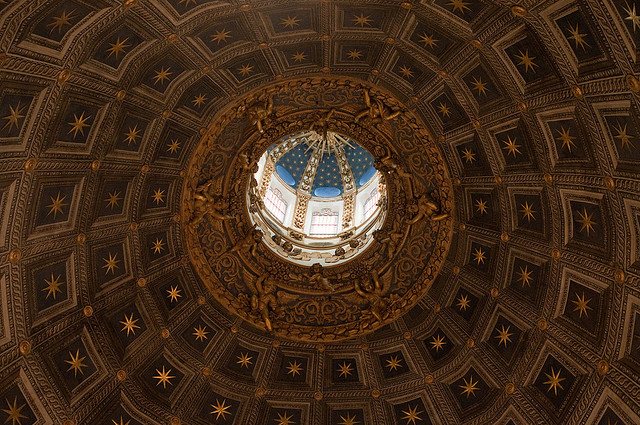
This Creative Commons image is of the Siena Cathedral Dome attributed to srslyguys on Flickr.
Previous Post

July 17, 2015
The Eighth Day: Reclaiming a Neglected Novel
Next Post

July 21, 2015 A Bug Night of the Soul
Browse Our Archives
Select a Category A. G. Harmon Alissa Wilkinson Allison Backous Art Authors Brad Fruhauff Bradford Winters Bryan Bliss Caroline Langston Chad Thomas Johnston Chris Hoke Christiana N. Peterson Culture D.G. Myers D.L. Mayfield Daniel Bowman Jr. David Griffith Elizabeth Duffy Faith Film Greg Wolfe Guest Contributor Interview Jan Vallone Jeffrey Overstreet Jessica Eddings-Roeser Jessica Mesman Griffith Kelly Foster Lindsey Crittenden Morgan Meis music Natalie Vestin Nick Olson Peggy Rosenthal Personal Reflection Poetry Friday Reflection Relationships Review Richard Chess Richard Cole Sara Zarr Shannon Huffman Polson Sonya Bilocerkowycz Tania Runyan Tony Woodlief Topical Categories Uncategorized Vic Sizemore Writing
Select a Month October 2018 September 2018 August 2018 July 2018 June 2018 May 2018 April 2018 March 2018 February 2018 January 2018 December 2017 November 2017 October 2017 September 2017 August 2017 July 2017 June 2017 May 2017 April 2017 March 2017 February 2017 January 2017 December 2016 November 2016 October 2016 September 2016 August 2016 July 2016 June 2016 May 2016 April 2016 March 2016 February 2016 January 2016 December 2015 November 2015 October 2015 September 2015 August 2015 July 2015 June 2015 May 2015 April 2015 March 2015 February 2015 January 2015 December 2014 November 2014 October 2014 September 2014 August 2014 July 2014 June 2014 May 2014 April 2014 March 2014 February 2014 January 2014 December 2013 November 2013 October 2013 September 2013 August 2013 July 2013 June 2013 May 2013 April 2013 March 2013 February 2013 January 2013 December 2012 November 2012 October 2012 September 2012 August 2012 July 2012 June 2012 May 2012 February 2008
Follow Us!
TAKE THE
Religious Wisdom Quiz
What Christian group is known for their "Circuit Riders" in history?
Select your answer to see how you score.
Baptists Lutherans Anglicans Methodists
Related posts from Good Letters


Leonard Cohen’s Holy and Broken Hallelujah

Ready or Not for the Days of Awe

TRENDING AT PATHEOS Catholic

Rejecting Doom: Christian Hope And Human Action
Christianity is a religion of hope. We are to have hope and...

It’s What Comes From Within Which Matters
One of the most difficult things for us to understand is why...

Why I Choose the Eucharist Over the Sermon
Choose the Eucharist, Not the Sermon What are we supposed to get...

5 Design Elements Found in Spiritually Rooted Homes
Putting Spirituality Into Home Decor Our homes are more than our living...

Credo: A Story of God Told with the...
About 10 years ago, I began to imagine a personal "Credo" that...

The Anatomy of Divine Revelation in Catholic Thought
The claim that God has made Himself known to human beings is...
view all Catholic blogs
Ad-Free & Subscriber Log-In Subscription Support
- About Us
- 2026 Calendar
- Videos
- Podcasts
- Library of World Religions
- Faith In Media Tracker
- Advertise With Us
- Write for Us
- Privacy Policy
- Terms of Service
- Do Not Sell My Data
- Contact Us
- Radiant Digital
- Manage Newsletter Subscriptions
- Unsubscribe From Notifications
- Sitemap
Copyright 2008-2026, Patheos. All rights reserved.
Subscription Support Ad-Free & Subscriber Log-In
Follow Patheos