
BuddhistCatholicContemplativeEvangelicalGeneral ChristianHinduJewishLatter-day SaintMuslimNew VisionsProgressive Christian
Beliefs
- Buddhist
- Catholic
- Contemplative
- Evangelical
- General Christian
- Hindu
- Jewish
- Latter-day Saint
- More Voices
- Muslim
- New Visions
- Pagan
- Progressive Christian
Topics
- Religion News
- Food and Religion
- Sports and Religion
- Religious Art
- Religious Music and Entertainment
- Religious Events
- History and Religion
- Style and Religion
- Politics and Religion
- Women in Religion
- Recreation Outdoors and Religion
- Business Finance and Religion
- Careers Workplace and Religion
- Education and Religion
- Family Parenting and Religion
- Health Fitness and Religion
- Home and Religion
- Relationships and Religion
- Technology and Religion
- Travel and Religion
Columnists
- Buddhist Columnists
- Business Finance and Religion Columnists
- Careers Workplace and Religion Columnists
- Catholic Columnists
- Contemplative Columnists
- Education and Religion Columnists
- Evangelists Columnists
- Family Parenting and Religion Columnists
- General Christian Columnists
- Health Fitness and Religion Columnists
- Hindu Columnists
- History and Religion Columnists
- Home and Religion Columnists
- Jewish Columnists
- More Voices Columnists
- Latter Day Columnists
- Muslim Columnists
- New Visions Columnists
- Nonreligious Columnists
- Pagan Columnists
- Politics and Religion Columnists
- Progressive Columnists
- Recreation Outdoors and Religion Columnists
- Relationships and Religion Columnists
- Religion News Columnists
- Religious Art Columnists
- Religious Events Columnists
- Religious Music and Entertainment Columnists
- Sports and Religion Columnists
- Style and Religion Columnists
- Technology and Religion Columnists
- Travel and Religion Columnists
- Women in Religion Columnists
Resource Library
- 2026 Calendar
- Library of World Religions
- The 100 Most Holy Places on Earth
- Patheos Answers
- Podcasts
- Videos
- Faith Leaders Database
- Anglican Episcopalian
- Bahai
- Baptist
- Buddhism
- Christianity
- Confucianism
- Eastern Orthodoxy
- Hinduism
- Holiness and Pentecostal
- ISKCON
- Islam
- Judaism
- Lutheran
- Methodist
- The Church of Jesus Christ of Latter-day Saints
- New Age
- Paganism
- Presbytarian and Reformed
- Protestantism
- Religion Behind the Scenes
- Roman Catholic
- Scientology
- Shia Islam
- Sikhism
- Sufism
- Sunni Islam
- Taoism
- Zen
- See all religions
Research Tools
 Ad-Free & Subscriber Log-In Subscription Support
Ad-Free & Subscriber Log-In Subscription Support
Follow Patheos 

- Trending:
- Forgiveness
- |
- Marriage
- |
- Consciousness
- |
- Death Penalty
- |
- Election
- |
- Halloween
 Good Letters
-
Contributors
- Home
- Catholic
- Beauty, Christian Love, and Gay Marriage
Beauty, Christian Love, and Gay Marriage
Last updated on: July 14, 2015 at 9:27 am by Morgan Meis
Beauty, Christian Love, and Gay Marriage 2015-07-14T09:27:48-07:00 Morgan Meis
Patheos Explore the world's faith through different perspectives on religion and spirituality! Patheos has the views of the prevalent religions and spiritualities of the world.
Justice Anthony Kennedy, in the recent Supreme Court ruling legalizing same-sex marriage, wrote the following concluding paragraph:
No union is more profound than marriage, for it embodies the highest ideals of love, fidelity, devotion, sacrifice, and family. In forming a marital union, two people become something greater than once they were. As some of the petitioners in these cases demonstrate, marriage embodies a love that may endure even past death. It would misunderstand these men and women to say they disrespect the idea of marriage. Their plea is that they do respect it, respect it so deeply that they seek to find its fulfillment for themselves. Their hope is not to be condemned to live in loneliness, excluded from one of civilization’s oldest institutions. They ask for equal dignity in the eyes of the law. The Constitution grants them that right.
Quite a few commentators have noted the beauty and elegance of this statement’s prose (not a given for Justice Kennedy, who’s been known to drift toward the purple with his pen). Jordan Weissmann, for instance, titled a post for Slate “The Beautiful Closing Paragraph of Justice Kennedy’s Gay Marriage Ruling.”
Weissman wrote, “one of the most beautiful passages you’ll likely read in a court case. I teared up. So did a few other Slate staffers.”
Here’s another post title from Chris Greenberg at Boston.com. “The beautiful ending of the Supreme Court’s gay marriage ruling will make you want to fall in love.”
I doubt that’s ever been said of a Supreme Court ruling, that it makes a person want to fall in love. Something strange, then, seems to have come out of this ruling, something that promotes beauty and love. When the world unexpectedly gives forth expressions of beauty and love in whatever guise, the Christian person ought to take special notice.
It is notable that the fight for gay marriage has had as its most vociferous champion a Catholic (who is also gay) by the name of Andrew Sullivan. This was back in the early 1980s. Here’s how Sullivan remembers those early days:
I remember one of the first TV debates I had on the then-strange question of civil marriage for gay couples. It was Crossfire*, as I recall, and Gary Bauer’s response to my rather earnest argument after my* TNR cover story on the matter was laughter. “This is the loopiest idea ever to come down the pike,” he joked. “Why are we even discussing it?”
The crux of Sullivan’s argument for gay marriage was not to attack the institution of marriage, but to argue for the importance and dignity of marriage. He was arguing, in short, as a Christian. He was arguing that marriage is a place where God’s injunction that we love one another becomes concrete. Therefore, all human beings who are capable of loving ought to have access to this institution.
Here’s how Sullivan puts it:
But some things you know deep in your heart: that all human beings are made in the image of God; that their loves and lives are equally precious; that the pursuit of happiness promised in the Declaration of Independence has no meaning if it does not include the right to marry the person you love; and has no force if it denies that fundamental human freedom to a portion of its citizens.
To argue, as a Christian, that gay people should be debarred from the institution of marriage is, at its core, to argue that they are less than human. Sullivan’s response to that is the following:
We are not disordered or sick or defective or evil— at least no more than our fellow humans in this vale of tears. We are born into family; we love; we marry; we take care of our children; we die. No civil institution is related to these deep human experiences more than civil marriage and the exclusion of gay people from this institution was a statement of our core inferiority not just as citizens but as human beings.
One of the conservative arguments against marriage has been that the extension of marriage to gays somehow devalues this august institution. Interestingly, Justice Kennedy’s ruling, along the lines of Sullivan’s arguments above, is one of the more traditional defenses of marriage you’re likely to hear.
This signals that something profound has happened. When deep conservatism and radical newness come together in such moving ways, the work of the Spirit is always afoot. When a genial blowhard like Justice Kennedy suddenly pens words that are for the ages, you know there is something greater behind the pen.
Here are just a few more beautiful words from Andrew Sullivan:
I think of the gay kids in the future who, when they figure out they are different, will never know the deep psychic wound my generation—and every one before mine—lived through: the pain of knowing they could never be fully part of their own family, never be fully a citizen of their own country. I think, more acutely, of the decades and centuries of human shame and darkness and waste and terror that defined gay people’s lives for so long. And I think of all those who supported this movement who never lived to see this day, who died in the ashes from which this phoenix of a movement emerged. This momentous achievement is their victory too—for marriage, as Kennedy argued, endures past death.
As law, Kennedy’s words are meant to take the institution of marriage seriously. As poetry, Justice Kennedy’s beautiful words are meant to elevate and extend the idea of marriage as a means by which human beings can know and share love. This is Christianity as Christ lived it and preached it and passed it down.
Morgan Meis is the critic-at-large for The Smart Set. He has a PhD in Philosophy and is a founding member of Flux Factory, an arts collective in New York. He has written for n+1, The Believer, Harper’s Magazine, and The Virginia Quarterly Review. He won the Whiting Award in 2013. Morgan is also an editor at 3 Quarks Daily, and a winner of a Creative Capital | Warhol Foundation Arts Writers grant. A book of Morgan’s selected essays can be found here. He can be reached at [email protected].
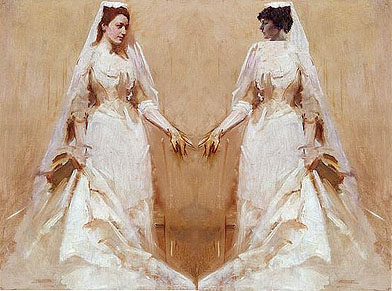
Image: “The Wedding Couple” by Abbott Handerson Thayer
Previous Post

July 13, 2015
Airbnb and the Art of Hospitality
Next Post

July 15, 2015 A Conversation with Artist Natalie Settles, Part 1
Browse Our Archives
Select a Category A. G. Harmon Alissa Wilkinson Allison Backous Art Authors Brad Fruhauff Bradford Winters Bryan Bliss Caroline Langston Chad Thomas Johnston Chris Hoke Christiana N. Peterson Culture D.G. Myers D.L. Mayfield Daniel Bowman Jr. David Griffith Elizabeth Duffy Faith Film Greg Wolfe Guest Contributor Interview Jan Vallone Jeffrey Overstreet Jessica Eddings-Roeser Jessica Mesman Griffith Kelly Foster Lindsey Crittenden Morgan Meis music Natalie Vestin Nick Olson Peggy Rosenthal Personal Reflection Poetry Friday Reflection Relationships Review Richard Chess Richard Cole Sara Zarr Shannon Huffman Polson Sonya Bilocerkowycz Tania Runyan Tony Woodlief Topical Categories Uncategorized Vic Sizemore Writing
Select a Month October 2018 September 2018 August 2018 July 2018 June 2018 May 2018 April 2018 March 2018 February 2018 January 2018 December 2017 November 2017 October 2017 September 2017 August 2017 July 2017 June 2017 May 2017 April 2017 March 2017 February 2017 January 2017 December 2016 November 2016 October 2016 September 2016 August 2016 July 2016 June 2016 May 2016 April 2016 March 2016 February 2016 January 2016 December 2015 November 2015 October 2015 September 2015 August 2015 July 2015 June 2015 May 2015 April 2015 March 2015 February 2015 January 2015 December 2014 November 2014 October 2014 September 2014 August 2014 July 2014 June 2014 May 2014 April 2014 March 2014 February 2014 January 2014 December 2013 November 2013 October 2013 September 2013 August 2013 July 2013 June 2013 May 2013 April 2013 March 2013 February 2013 January 2013 December 2012 November 2012 October 2012 September 2012 August 2012 July 2012 June 2012 May 2012 February 2008
Follow Us!
TAKE THE
Religious Wisdom Quiz
What did Pharaoh’s daughter find floating in the river?
Select your answer to see how you score.
Baby Moses A golden idol A scroll A fish
Related posts from Good Letters

Morning in a Forgotten Neighborhood



TRENDING AT PATHEOS Catholic

Creation, Preservation, and Teleology in Catholic Theology
As I write this, it is very early Monday morning. Like millions...

The Parable Of The Sower And The Word...
One of Christ’s most famous parables is that of the sower who...

Rejecting Doom: Christian Hope And Human Action
Christianity is a religion of hope. We are to have hope and...

Why I Choose the Eucharist Over the Sermon
Choose the Eucharist, Not the Sermon What are we supposed to get...

5 Design Elements Found in Spiritually Rooted Homes
Putting Spirituality Into Home Decor Our homes are more than our living...

Credo: A Story of God Told with the...
About 10 years ago, I began to imagine a personal "Credo" that...
view all Catholic blogs
Ad-Free & Subscriber Log-In Subscription Support
- About Us
- 2026 Calendar
- Videos
- Podcasts
- Library of World Religions
- Faith In Media Tracker
- Advertise With Us
- Write for Us
- Privacy Policy
- Terms of Service
- Do Not Sell My Data
- Contact Us
- Radiant Digital
- Manage Newsletter Subscriptions
- Unsubscribe From Notifications
- Sitemap
Copyright 2008-2026, Patheos. All rights reserved.
Subscription Support Ad-Free & Subscriber Log-In
Follow Patheos