
BuddhistCatholicContemplativeEvangelicalGeneral ChristianHinduJewishLatter-day SaintMuslimNew VisionsProgressive Christian
Beliefs
- Buddhist
- Catholic
- Contemplative
- Evangelical
- General Christian
- Hindu
- Jewish
- Latter-day Saint
- More Voices
- Muslim
- New Visions
- Pagan
- Progressive Christian
Topics
- Religion News
- Food and Religion
- Sports and Religion
- Religious Art
- Religious Music and Entertainment
- Religious Events
- History and Religion
- Style and Religion
- Politics and Religion
- Women in Religion
- Recreation Outdoors and Religion
- Business Finance and Religion
- Careers Workplace and Religion
- Education and Religion
- Family Parenting and Religion
- Health Fitness and Religion
- Home and Religion
- Relationships and Religion
- Technology and Religion
- Travel and Religion
Columnists
- Buddhist Columnists
- Business Finance and Religion Columnists
- Careers Workplace and Religion Columnists
- Catholic Columnists
- Contemplative Columnists
- Education and Religion Columnists
- Evangelists Columnists
- Family Parenting and Religion Columnists
- General Christian Columnists
- Health Fitness and Religion Columnists
- Hindu Columnists
- History and Religion Columnists
- Home and Religion Columnists
- Jewish Columnists
- More Voices Columnists
- Latter Day Columnists
- Muslim Columnists
- New Visions Columnists
- Nonreligious Columnists
- Pagan Columnists
- Politics and Religion Columnists
- Progressive Columnists
- Recreation Outdoors and Religion Columnists
- Relationships and Religion Columnists
- Religion News Columnists
- Religious Art Columnists
- Religious Events Columnists
- Religious Music and Entertainment Columnists
- Sports and Religion Columnists
- Style and Religion Columnists
- Technology and Religion Columnists
- Travel and Religion Columnists
- Women in Religion Columnists
Resource Library
- 2026 Calendar
- Library of World Religions
- The 100 Most Holy Places on Earth
- Patheos Answers
- Podcasts
- Videos
- Faith Leaders Database
- Anglican Episcopalian
- Bahai
- Baptist
- Buddhism
- Christianity
- Confucianism
- Eastern Orthodoxy
- Hinduism
- Holiness and Pentecostal
- ISKCON
- Islam
- Judaism
- Lutheran
- Methodist
- The Church of Jesus Christ of Latter-day Saints
- New Age
- Paganism
- Presbytarian and Reformed
- Protestantism
- Religion Behind the Scenes
- Roman Catholic
- Scientology
- Shia Islam
- Sikhism
- Sufism
- Sunni Islam
- Taoism
- Zen
- See all religions
Research Tools
 Ad-Free & Subscriber Log-In Subscription Support
Ad-Free & Subscriber Log-In Subscription Support
Follow Patheos 

- Trending:
- Forgiveness
- |
- Marriage
- |
- Consciousness
- |
- Death Penalty
- |
- Election
- |
- Halloween
 Good Letters
-
Contributors
- Home
- Catholic
- Art on Fire: The Life and Work of Melissa Weinman, Part 2
Art on Fire: The Life and Work of Melissa Weinman, Part 2
Last updated on: July 9, 2015 at 2:51 pm by Guest Contributor
Art on Fire: The Life and Work of Melissa Weinman, Part 2 2015-07-09T14:51:32-07:00 Guest Contributor
Patheos Explore the world's faith through different perspectives on religion and spirituality! Patheos has the views of the prevalent religions and spiritualities of the world.
By Richard Cole
 Continued from yesterday.
When Weinman completed her fellowship in Europe, she came back to the U.S., where she began a new life that included marriage, the birth of two daughters, and a new chapter in her pilgrim faith.
“I think I’m a Christian, but I don’t know how to do it.” This was how she approached an Episcopal priest in her neighborhood, looking for spiritual direction. Although he was on the point of retirement, he agreed to meet with her once a week, and for the next year, they discussed Christian teachings and the Bible.
During this period, she created “Study for Christ,” a charcoal and conté crayon drawing of a young, muscular man with close-cropped hair. “I drew Jesus as kind of a tough guy, but that was alright, because that’s what I needed in this very uncertain world.”
The drawing marked a turning point in both her art and faith. “By drawing Jesus, I came into relationship with Jesus,” she says, acknowledging that, in many ways, she was no longer the artist who had painted the suffering saints.
“It’s weird to look back at the person I was then, how angry and resentful. I used those images to gain attention but also to illustrate their suffering. The paintings were dark, and I thought that a painting could redeem suffering, and that was noble. But now I began to shed that person.”
As her faith evolved, she reconsidered the power of art. “In the past, I thought it was art that was saving, but now I realized that it was light, the spiritual light, that was saving.”
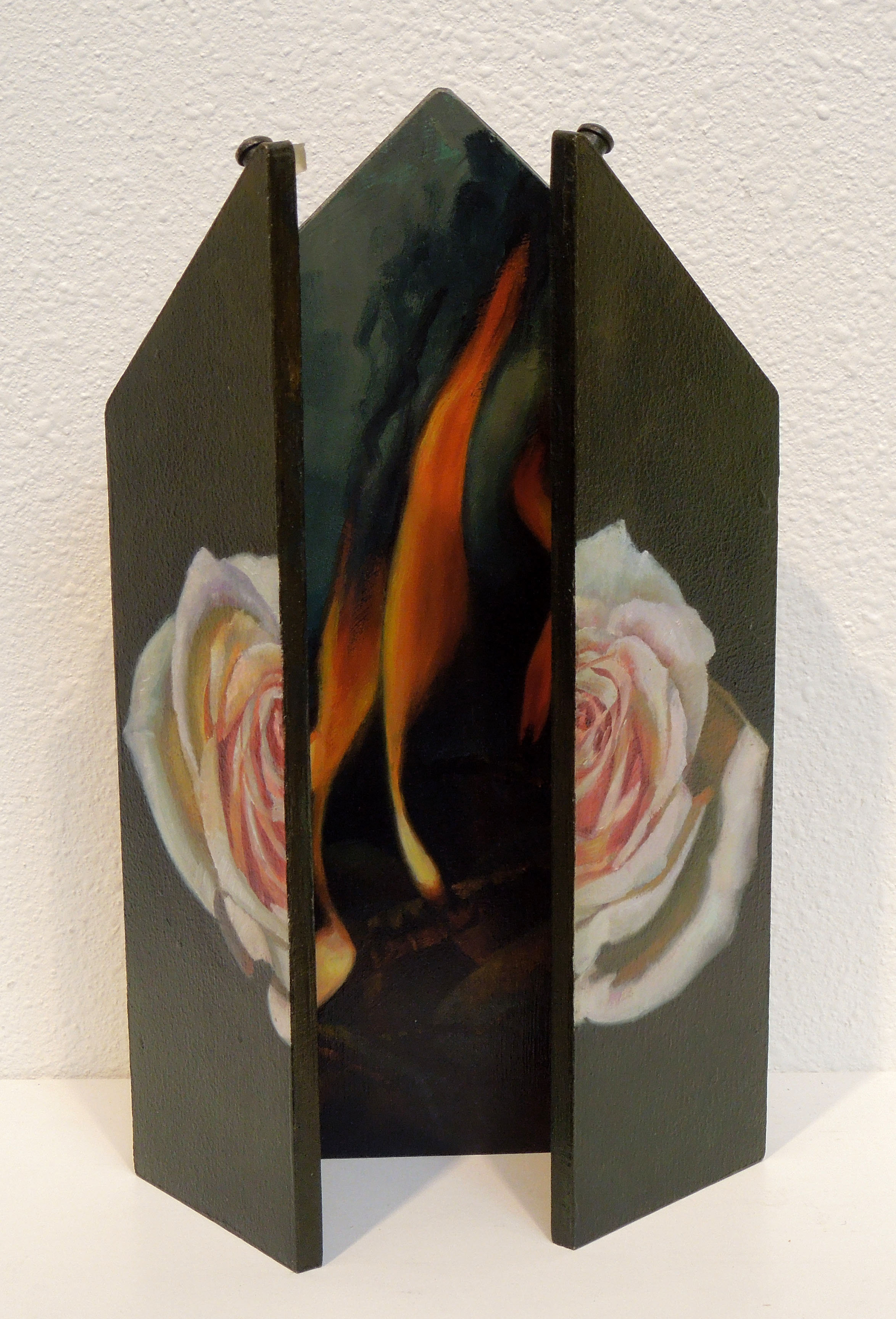
This new understanding found expression in a visual vocabulary she calls rosefire. The first examples were a series of triptychs designed as altarpieces. On the outside of the panels when the triptych is closed, she painted pink and white roses. On the inside of the panels when the triptych is opened, we see burning branches. “I was trying to represent the many layers of unfolding and unconditional love—I would call it divine love. There are many dimensions to it. Sometimes it’s a light whisper, sometimes deeper and less fleeting. On the outside, it might look like only a rose, but open it and you can see the fire, the passion inside.”
This imagery has been expanded in a new series of rosefire paintings showcased in the Spring 2015 issue of Ruminate magazine. She has, in her words, “combusted the roses” with no separation between rose and fire. “Some people could say that the rose is love and the fire is spirit,” she explains. “That’s two separate abstractions. But to me, this love and the painting itself is an experience, so I put the rose and fire together. Later I was happy to find that this combined imagery was also used by T.S. Eliot at the end of his Four Quartets when he wrote that ‘the fire and the rose are one.’”
Beauty took a beating in twentieth century art, but we’re seeing a comeback of the beautiful in the work of painters like Weinman who acknowledge beauty as a central, even essential, aspect of their art.
“Beauty is love in physical form,” she says. “I’m not interested in illustration anymore, like those paintings I made of the saints. I believe now that art and the beautiful in art can create an experience for the viewer, and that experience can be transformational.”
This view is echoed by critics such as Peter Schjeldahl in his essay “Notes on Beauty”:
An experience of beauty may be intense, leaving a permanent impression, or quite mild and soon all but forgotten. But it always resembles a conversion experience, the mind’s joyful capitulation to a recovered or new belief. The merely attractive (pretty, glamorous) and merely pleasing (lovely, delectable) are not beauty, because they lack the element of belief and the feeling of awe that announces it.
Certainly Weinman has succeeded in avoiding what is merely attractive or pleasing. In the rosefire paintings, she uses darkness as a major part of the painting similar to the way that Japanese and Chinese painters have used the “emptiness” of white space to complete their compositions. At the same time, this darkness points us to the light.
“I feel that the reason we keep certain paintings, calling them masterpieces, is that they enact an archetypal drama, a healing in the viewer,” Weinman says. “So this is why artists need to aim high; this is our gift to others, this healing. That’s my hope.”
Richard Cole is a painter and the author of two books of poetry: The Glass Children and Success Stories. He has also written a memoir, Catholic by Choice, published by Loyola Press.
Previous Post

July 8, 2015
Art on Fire: The Life and Work of Melissa Weinman, Part 1
Next Post
July 10, 2015 My Evolving Identity
Browse Our Archives
Select a Category A. G. Harmon Alissa Wilkinson Allison Backous Art Authors Brad Fruhauff Bradford Winters Bryan Bliss Caroline Langston Chad Thomas Johnston Chris Hoke Christiana N. Peterson Culture D.G. Myers D.L. Mayfield Daniel Bowman Jr. David Griffith Elizabeth Duffy Faith Film Greg Wolfe Guest Contributor Interview Jan Vallone Jeffrey Overstreet Jessica Eddings-Roeser Jessica Mesman Griffith Kelly Foster Lindsey Crittenden Morgan Meis music Natalie Vestin Nick Olson Peggy Rosenthal Personal Reflection Poetry Friday Reflection Relationships Review Richard Chess Richard Cole Sara Zarr Shannon Huffman Polson Sonya Bilocerkowycz Tania Runyan Tony Woodlief Topical Categories Uncategorized Vic Sizemore Writing
Select a Month October 2018 September 2018 August 2018 July 2018 June 2018 May 2018 April 2018 March 2018 February 2018 January 2018 December 2017 November 2017 October 2017 September 2017 August 2017 July 2017 June 2017 May 2017 April 2017 March 2017 February 2017 January 2017 December 2016 November 2016 October 2016 September 2016 August 2016 July 2016 June 2016 May 2016 April 2016 March 2016 February 2016 January 2016 December 2015 November 2015 October 2015 September 2015 August 2015 July 2015 June 2015 May 2015 April 2015 March 2015 February 2015 January 2015 December 2014 November 2014 October 2014 September 2014 August 2014 July 2014 June 2014 May 2014 April 2014 March 2014 February 2014 January 2014 December 2013 November 2013 October 2013 September 2013 August 2013 July 2013 June 2013 May 2013 April 2013 March 2013 February 2013 January 2013 December 2012 November 2012 October 2012 September 2012 August 2012 July 2012 June 2012 May 2012 February 2008
Follow Us!
TAKE THE
Religious Wisdom Quiz
Who led the Israelites out of Egypt?
Select your answer to see how you score.
Aaron Moses Caleb Joshua
Related posts from Good Letters

Taking Our Chances with Choice


TRENDING AT PATHEOS Catholic

Creation, Preservation, and Teleology in Catholic Theology
As I write this, it is very early Monday morning. Like millions...

The Parable Of The Sower And The Word...
One of Christ’s most famous parables is that of the sower who...

Rejecting Doom: Christian Hope And Human Action
Christianity is a religion of hope. We are to have hope and...

Why I Choose the Eucharist Over the Sermon
Choose the Eucharist, Not the Sermon What are we supposed to get...

5 Design Elements Found in Spiritually Rooted Homes
Putting Spirituality Into Home Decor Our homes are more than our living...

Credo: A Story of God Told with the...
About 10 years ago, I began to imagine a personal "Credo" that...
view all Catholic blogs
Ad-Free & Subscriber Log-In Subscription Support
- About Us
- 2026 Calendar
- Videos
- Podcasts
- Library of World Religions
- Faith In Media Tracker
- Advertise With Us
- Write for Us
- Privacy Policy
- Terms of Service
- Do Not Sell My Data
- Contact Us
- Radiant Digital
- Manage Newsletter Subscriptions
- Unsubscribe From Notifications
- Sitemap
Copyright 2008-2026, Patheos. All rights reserved.
Subscription Support Ad-Free & Subscriber Log-In
Follow Patheos