
BuddhistCatholicContemplativeEvangelicalGeneral ChristianHinduJewishLatter-day SaintMuslimNew VisionsProgressive Christian
Beliefs
- Buddhist
- Catholic
- Contemplative
- Evangelical
- General Christian
- Hindu
- Jewish
- Latter-day Saint
- More Voices
- Muslim
- New Visions
- Pagan
- Progressive Christian
Topics
- Religion News
- Food and Religion
- Sports and Religion
- Religious Art
- Religious Music and Entertainment
- Religious Events
- History and Religion
- Style and Religion
- Politics and Religion
- Women in Religion
- Recreation Outdoors and Religion
- Business Finance and Religion
- Careers Workplace and Religion
- Education and Religion
- Family Parenting and Religion
- Health Fitness and Religion
- Home and Religion
- Relationships and Religion
- Technology and Religion
- Travel and Religion
Columnists
- Buddhist Columnists
- Business Finance and Religion Columnists
- Careers Workplace and Religion Columnists
- Catholic Columnists
- Contemplative Columnists
- Education and Religion Columnists
- Evangelists Columnists
- Family Parenting and Religion Columnists
- General Christian Columnists
- Health Fitness and Religion Columnists
- Hindu Columnists
- History and Religion Columnists
- Home and Religion Columnists
- Jewish Columnists
- More Voices Columnists
- Latter Day Columnists
- Muslim Columnists
- New Visions Columnists
- Nonreligious Columnists
- Pagan Columnists
- Politics and Religion Columnists
- Progressive Columnists
- Recreation Outdoors and Religion Columnists
- Relationships and Religion Columnists
- Religion News Columnists
- Religious Art Columnists
- Religious Events Columnists
- Religious Music and Entertainment Columnists
- Sports and Religion Columnists
- Style and Religion Columnists
- Technology and Religion Columnists
- Travel and Religion Columnists
- Women in Religion Columnists
Resource Library
- 2026 Calendar
- Library of World Religions
- The 100 Most Holy Places on Earth
- Patheos Answers
- Podcasts
- Videos
- Faith Leaders Database
- Anglican Episcopalian
- Bahai
- Baptist
- Buddhism
- Christianity
- Confucianism
- Eastern Orthodoxy
- Hinduism
- Holiness and Pentecostal
- ISKCON
- Islam
- Judaism
- Lutheran
- Methodist
- The Church of Jesus Christ of Latter-day Saints
- New Age
- Paganism
- Presbytarian and Reformed
- Protestantism
- Religion Behind the Scenes
- Roman Catholic
- Scientology
- Shia Islam
- Sikhism
- Sufism
- Sunni Islam
- Taoism
- Zen
- See all religions
Research Tools
 Ad-Free & Subscriber Log-In Subscription Support
Ad-Free & Subscriber Log-In Subscription Support
Follow Patheos 

- Trending:
- Forgiveness
- |
- Marriage
- |
- Consciousness
- |
- Death Penalty
- |
- Election
- |
- Halloween
 Good Letters
-
Contributors
- Home
- Catholic
- Art on Fire: The Life and Work of Melissa Weinman, Part 1
Art on Fire: The Life and Work of Melissa Weinman, Part 1
Last updated on: July 13, 2015 at 11:42 am by Guest Contributor
Art on Fire: The Life and Work of Melissa Weinman, Part 1 2015-07-13T11:42:03-07:00 Guest Contributor
Patheos Explore the world's faith through different perspectives on religion and spirituality! Patheos has the views of the prevalent religions and spiritualities of the world.
By: Richard Cole
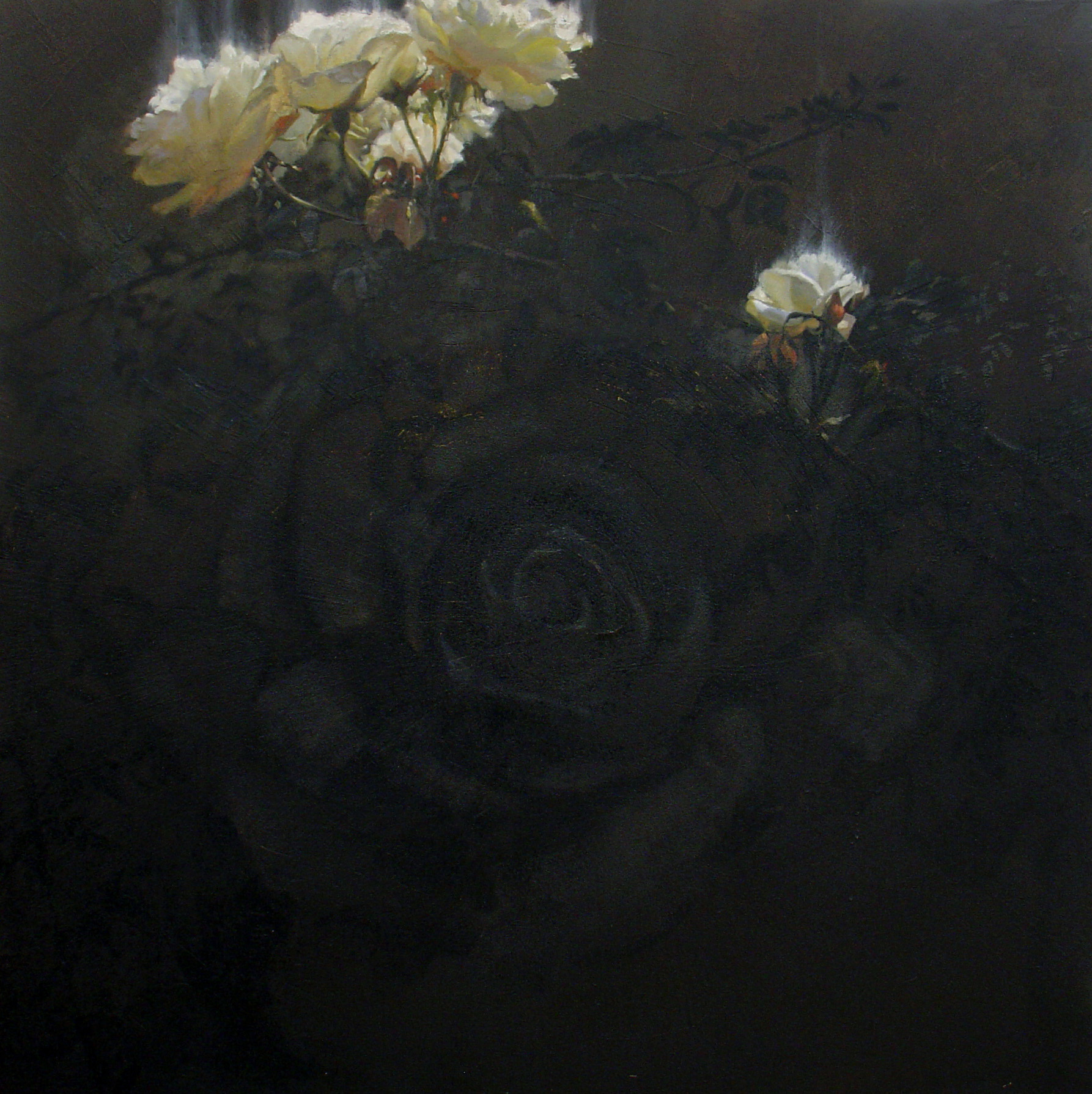 In a recent painting by Melissa Weinman, a small, white rose floats over darkness. The rose is in full blossom, almost blown, and crowned by a pale fire rising from its petals like mist.
The effect is arresting, almost hallucinatory, but this is not an image that is merely unusual—a pretty flower on fire. Instead, the painting holds us in abeyance. We enjoy both what we can see and what escapes us. We have the sense that this is not the odd, passing moment but a steady state, something more than physical that is burning with something more than fire.
The painting’s title, “Even the Night Shall Be Light About Me,” a quote from Psalm 139, directs us to think in terms of sacred art. But to better understand this image and the beauty it portrays, we also need to approach it as art deeply informed by the spiritual life of the artist.
The notion that “painters paint themselves,” at least in physical ways, has been around since the days of Da Vinci and Michelangelo. But in the twenty-first century, critics and viewers in general are wary of considering art as any kind of spiritual autobiography.
Certainly, the hazards of this approach are obvious. Art that tries to be spiritual can be like political art, often preaching to the choir and justifying clichés or sloppy craft in the name of a Higher Purpose. Besides, the devil has the best music, as Luther said, and spiritual growth doesn’t necessarily lead to artistic growth. We can all think of painters and other creatives where the work is brilliant but the personal life is questionable—and vice versa.
Weinman has long been recognized for her representational paintings and figurative studies. I would argue, however, that we can’t really understand what she is doing as a painter without considering her life of faith.
Looking at the body of her work over thirty years, I believe that it reflects an evolving relationship with the divine, based partly on her life experiences and partly through prayer and study. The result is a career where, as she puts it, her paintings have influenced her faith even as her faith has helped change the scope and direction of her painting.
Born in a small town on the Minnesota prairie, Weinman says that she grew up in her mother’s art studio. “My mother didn’t give me formal lessons in art, but she taught me to see, to take in the world through my eyes. She was always saying ‘Now look at that!’ and what she was pointing out was always beautiful.”
After completing a double major in art and Chinese at Bowdoin College, Weinman earned an MFA at the University of Southern California. Although raised as a Methodist, she had drifted away from the faith of her childhood.
At the same time, she never lost sight of the larger questions involved with faith such as mortality, impermanence, and the possibility of an absolute truth. At USC, she worked on a series of vanitas images, large pastel drawings that contained references to Raphael’s fresco “School of Athens”: cut flowers, a skull, and so forth. Her thesis show included paintings of twin images—the same model pictured twice, with one figure confronting the other, as if, as she puts it, “a voice of conscience.”
By the 1990s, Weinman had developed a successful career as an art teacher at the university level and she was gaining attention for her figurative work, especially for a series of paintings of saints and martyrs done in an original, some would say quirky, style.
Her Saint Sebastian was shot with arrows but wearing camouflage cutoffs. Clare was depicted in front of TV screens and holding a little TV set with a burning candle inside. The images were often dark—Agatha with a bloody shirt, her breasts shorn, Lawrence burned horribly by fire, and Lucy holding her eyeballs that had been gouged out in what looks like a silver platter.
Most viewers assumed that these paintings represented a faith that was, if not Catholic, certainly Christian, but that was not the case, according to Weinman. “I was dancing around Christianity because I’d been painting these martyred saints,” she says, “but I felt Christians were really kind of spooky. I was trying to be very postmodern at the time, making visual puns and playing off how bizarre their stories were.”
When Weinman learned that Lucy is the patron saint of vision, she created a triptych of the saint with a bunch of carrots in the left-hand panel and an eye chart on the right. But as she kept learning more about the saints’ lives, her attitude began to change. “I became very moved by them, by their suffering, and it began to seem wrong, somehow, to be punning and playing like that.”
In 1997, Weinman went to Europe to study art on a two-month fellowship. Although her professional career was moving ahead, she had just ended a long-standing relationship and she felt that her personal life had reached the end of a chapter. “Something had started turning inside me,” she says, “but I didn’t know what it was.”
On a cold evening while traveling to Germany, she found herself alone in a church and then she knelt and began to pray. “I was amazed at what I was doing. Growing up, I had the notion that Jesus was God and God was scary because He judged everyone,” she says.
In the church, however, she felt a presence behind her. “It’s like that saying ‘I have your back.’ I felt that all I needed to do was lean back into this presence and I would have the strength to do the right thing from then on.”
In the days that followed, this sense of presence remained, and she was drawn in particular to the image of Mary of Mercy, known in Germany as the Schutzmantelmadonna (sheltering-cloak Madonna). “I felt this immense grace from Mary,” she says, “that I was safe and I felt loved and welcomed.”
Later she would paint a large triptych of the Schutzmantelmadonna, her cloak spread over a crowd of men and women, including the artist herself in a painter’s smock. At the bottom of several portraits she painted of Mary, she inscribed in German, “Mary Helped Me.” One of the portraits was donated to hang in a Marian Pilgrimage chapel in Schwandorf.
To be continued tomorrow.
Richard Cole is a painter and the author of two books of poetry: The Glass Children and Success Stories. He has also written a memoir, Catholic by Choice, published by Loyola Press.
Previous Post
July 7, 2015
Morning Prayer and The New York Times
Next Post

July 9, 2015 Art on Fire: The Life and Work of Melissa Weinman, Part 2
Browse Our Archives
Select a Category A. G. Harmon Alissa Wilkinson Allison Backous Art Authors Brad Fruhauff Bradford Winters Bryan Bliss Caroline Langston Chad Thomas Johnston Chris Hoke Christiana N. Peterson Culture D.G. Myers D.L. Mayfield Daniel Bowman Jr. David Griffith Elizabeth Duffy Faith Film Greg Wolfe Guest Contributor Interview Jan Vallone Jeffrey Overstreet Jessica Eddings-Roeser Jessica Mesman Griffith Kelly Foster Lindsey Crittenden Morgan Meis music Natalie Vestin Nick Olson Peggy Rosenthal Personal Reflection Poetry Friday Reflection Relationships Review Richard Chess Richard Cole Sara Zarr Shannon Huffman Polson Sonya Bilocerkowycz Tania Runyan Tony Woodlief Topical Categories Uncategorized Vic Sizemore Writing
Select a Month October 2018 September 2018 August 2018 July 2018 June 2018 May 2018 April 2018 March 2018 February 2018 January 2018 December 2017 November 2017 October 2017 September 2017 August 2017 July 2017 June 2017 May 2017 April 2017 March 2017 February 2017 January 2017 December 2016 November 2016 October 2016 September 2016 August 2016 July 2016 June 2016 May 2016 April 2016 March 2016 February 2016 January 2016 December 2015 November 2015 October 2015 September 2015 August 2015 July 2015 June 2015 May 2015 April 2015 March 2015 February 2015 January 2015 December 2014 November 2014 October 2014 September 2014 August 2014 July 2014 June 2014 May 2014 April 2014 March 2014 February 2014 January 2014 December 2013 November 2013 October 2013 September 2013 August 2013 July 2013 June 2013 May 2013 April 2013 March 2013 February 2013 January 2013 December 2012 November 2012 October 2012 September 2012 August 2012 July 2012 June 2012 May 2012 February 2008
Follow Us!
TAKE THE
Religious Wisdom Quiz
Who said: "Yet I hold this against you: You have forsaken the love you had at first"?
Select your answer to see how you score.
The Spirit Jesus (to the church in Ephesus) John An angel
Related posts from Good Letters

Taking Our Chances with Choice
The Problem with Spiritual Fruits

TRENDING AT PATHEOS Catholic

Creation, Preservation, and Teleology in Catholic Theology
As I write this, it is very early Monday morning. Like millions...

The Parable Of The Sower And The Word...
One of Christ’s most famous parables is that of the sower who...

Rejecting Doom: Christian Hope And Human Action
Christianity is a religion of hope. We are to have hope and...

Why I Choose the Eucharist Over the Sermon
Choose the Eucharist, Not the Sermon What are we supposed to get...

5 Design Elements Found in Spiritually Rooted Homes
Putting Spirituality Into Home Decor Our homes are more than our living...

Credo: A Story of God Told with the...
About 10 years ago, I began to imagine a personal "Credo" that...
view all Catholic blogs
Ad-Free & Subscriber Log-In Subscription Support
- About Us
- 2026 Calendar
- Videos
- Podcasts
- Library of World Religions
- Faith In Media Tracker
- Advertise With Us
- Write for Us
- Privacy Policy
- Terms of Service
- Do Not Sell My Data
- Contact Us
- Radiant Digital
- Manage Newsletter Subscriptions
- Unsubscribe From Notifications
- Sitemap
Copyright 2008-2026, Patheos. All rights reserved.
Subscription Support Ad-Free & Subscriber Log-In
Follow Patheos