
BuddhistCatholicContemplativeEvangelicalGeneral ChristianHinduJewishLatter-day SaintMuslimNew VisionsProgressive Christian
Beliefs
- Buddhist
- Catholic
- Contemplative
- Evangelical
- General Christian
- Hindu
- Jewish
- Latter-day Saint
- More Voices
- Muslim
- New Visions
- Pagan
- Progressive Christian
Topics
- Religion News
- Food and Religion
- Sports and Religion
- Religious Art
- Religious Music and Entertainment
- Religious Events
- History and Religion
- Style and Religion
- Politics and Religion
- Women in Religion
- Recreation Outdoors and Religion
- Business Finance and Religion
- Careers Workplace and Religion
- Education and Religion
- Family Parenting and Religion
- Health Fitness and Religion
- Home and Religion
- Relationships and Religion
- Technology and Religion
- Travel and Religion
Columnists
- Buddhist Columnists
- Business Finance and Religion Columnists
- Careers Workplace and Religion Columnists
- Catholic Columnists
- Contemplative Columnists
- Education and Religion Columnists
- Evangelists Columnists
- Family Parenting and Religion Columnists
- General Christian Columnists
- Health Fitness and Religion Columnists
- Hindu Columnists
- History and Religion Columnists
- Home and Religion Columnists
- Jewish Columnists
- More Voices Columnists
- Latter Day Columnists
- Muslim Columnists
- New Visions Columnists
- Nonreligious Columnists
- Pagan Columnists
- Politics and Religion Columnists
- Progressive Columnists
- Recreation Outdoors and Religion Columnists
- Relationships and Religion Columnists
- Religion News Columnists
- Religious Art Columnists
- Religious Events Columnists
- Religious Music and Entertainment Columnists
- Sports and Religion Columnists
- Style and Religion Columnists
- Technology and Religion Columnists
- Travel and Religion Columnists
- Women in Religion Columnists
Resource Library
- 2026 Calendar
- Library of World Religions
- The 100 Most Holy Places on Earth
- Patheos Answers
- Podcasts
- Videos
- Faith Leaders Database
- Anglican Episcopalian
- Bahai
- Baptist
- Buddhism
- Christianity
- Confucianism
- Eastern Orthodoxy
- Hinduism
- Holiness and Pentecostal
- ISKCON
- Islam
- Judaism
- Lutheran
- Methodist
- The Church of Jesus Christ of Latter-day Saints
- New Age
- Paganism
- Presbytarian and Reformed
- Protestantism
- Religion Behind the Scenes
- Roman Catholic
- Scientology
- Shia Islam
- Sikhism
- Sufism
- Sunni Islam
- Taoism
- Zen
- See all religions
Research Tools
 Ad-Free & Subscriber Log-In Subscription Support
Ad-Free & Subscriber Log-In Subscription Support
Follow Patheos 

- Trending:
- Forgiveness
- |
- Marriage
- |
- Consciousness
- |
- Death Penalty
- |
- Election
- |
- Halloween
 Good Letters
-
Contributors
- Home
- Catholic
- A Conversation with Artist Natalie Settles, Part 2
A Conversation with Artist Natalie Settles, Part 2
Last updated on: May 12, 2016 at 1:51 pm by Guest Contributor
A Conversation with Artist Natalie Settles, Part 2 2016-05-12T13:51:43-07:00 Guest Contributor
Patheos Explore the world's faith through different perspectives on religion and spirituality! Patheos has the views of the prevalent religions and spiritualities of the world.
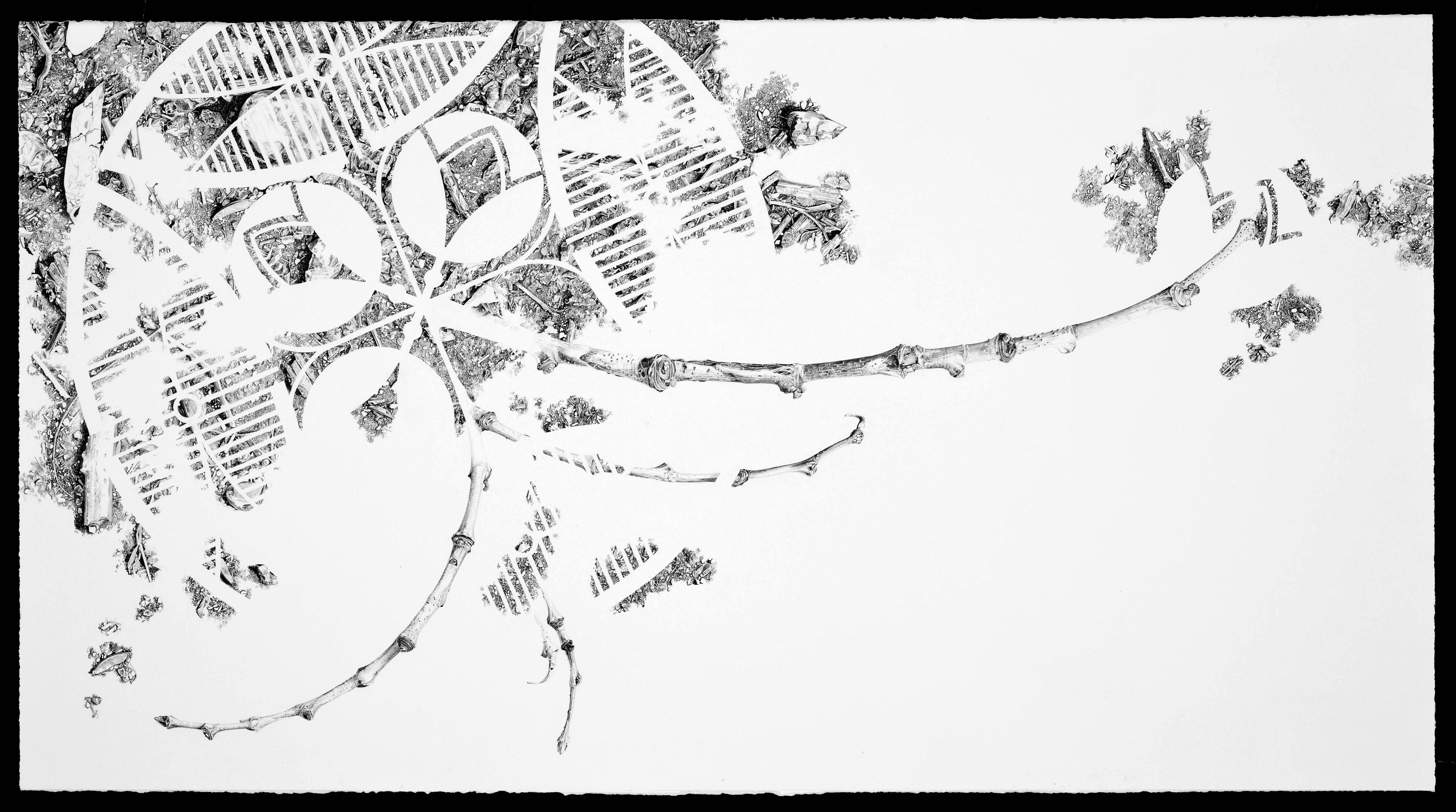
By Natalie Settles
Continued from yesterday.
Image: Natalie, a lot of your recent artwork is temporary—that is, it’s drawn directly onto gallery walls and when the show is over, only photos are left. Can you speak to this?
Natalie Settles: Yes, these are works with lifespans. In fact, the installations are typically up for the same amount of time over which the lifecycle of a small annual plant would play out.
When viewers encounter one of these temporary works, they’re usually enamored with the scale and detail and take their time moving throughout the gallery, drinking it all in. Sometime toward the end of their visit with the work it hits them in the gut—this won’t last. The work will need to die. And so they stand and drink it in now with a kind of presence that comes from knowing this may be the last time they see and experience this space as it is—the last time they feel the presence of this work.
I know this kind of attention from the times I’ve spent with loved ones who have a terminal disease and whom I know I will never see again once we part ways. It is the feeling of visiting a remarkable place and knowing you will likely never return to it. These moments have a kind of vividness and apparentness that is unmatched. It’s the sort of attention I hope I grow to give to more moments of my life.
Often the works are painted over in my absence, and even when I’ve been present, curators have frequently insisted that I not paint over the work myself—they feel I should not destroy what I have made. If they feel this way, I honor it and let them paint it over. I provide them with the ritual process they must observe. The first step is this: “Stop, look. Yours are the last eyes to see this work.”
I find these works teach me a lot about the beauty and power of things that you cannot keep—which is everything.
Image: You incorporate stylized decorative elements alongside specimen-like biological drawings. What drew you to put these together?
NS: The stylized elements are quotes from Victorian-era decorative arts designers. I began making this work while living in Cambridge, England, where I discovered the connection between Victorian design and early evolutionary biology.
The designers and biologists of that era had been in dialogue with and they both had a keen interest in modular forms that were variations on a theme. They borrowed and lent ideas in both directions. My borrowing imagery from this era became a touchstone back to a time when art and evolutionary biology were integrally intertwined.
The distinct appeal of grafting the stylized patterns onto drawings of actual plant matter was linking up idealized forms with pieces of a plant that had lived in the contingencies of a particular time and place. The plant matter had the battle scars, growth history, and contorted form to prove it.
This of course speaks to the ideal of a genome playing amid the demands of other living and nonliving members of an individual’s environment. And this gets to a grander underlying sense of a whole playing out through the snarl of bumped and bruised moments.
Image: You use a limited palette – —lots of black and white with occasional reds and oranges. Why is that?
NS: I find black and white to be an incredibly rich palette—there are bright whites, warm whites, cool whites, putty whites. I prefer the ringing clarity of photo white (the purest white possible) against which I can cast other whites.
Likewise, blacks provide a rich range from the deepest bone black to brown black, blue black, and the opalescent gray of solid graphite, along with the full range of grays down to tones so subtle they’re hard to detect.
My work leans heavily on form and often features the substrate and negative space as much and more than anything that’s drawn. I find that the contrast of black and white is the most compelling way to create this kind of interplay. Added to this, I often play between matte and gloss media—shifting textures rather than colors. Though all the work is two dimensional, for me it comes from a very sculptural mindset; contrast, tone, and finish are the backbone of this approach.
Red is primal, vivid, and powerful. It embodies both strength and weakness, as it is lifeblood and also the trail left by a wound. I love how its visceral earthiness interacts with the plant-based drawings to cast the discussion to a broader range of life beyond the literal life of plants. Red transmutes sticks and bark into bones and flesh.
Orange I have less excuse for, except that it is another color when I need one. Its prime virtue is that it has perhaps the fewest cultural associations and so a kind of unfettered freshness and can hold its own with red.
Overall, one of my greatest pleasures is drawing with minerals—graphite and watercolor—on plant matter—paper. In this way, I am making images of dirt and plants with dirt and plants.
Join in the conversation about evolution and Christian faith by visiting the BioLogos symposium at Patheos. Click here for more on Image’s BioLogos colloquy.
Natalie Settles has exhibited nationally and internationally since 1999. Her work intermingles the histories, inquiries, and forms of art and science and has lead to collaborative projects with researchers in biochemistry, botany, physiology, and developmental and evolutionary biologies. Settles was a 2008 Wisconsin Arts Board Fellow. Her wall drawing environment entitled “Ornament and Architecture” was featured in the 2011 Pittsburgh Biennial. In 2012 she served as Assistant Curator and essayist for The Andy Warhol Museum’s Factory Direct exhibition of artist-industry collaborations, and from 2011 to 2014, she was Artist in Residence with the Tonsor Laboratory for Plant Evolutionary Genetics at the University of Pittsburgh. Settles continues her collaborative work with evolutionary biologist Stephen Tonsor and other biologists and technologists on a digitally evolving cast-light “wallpaper” that is both a work of art and a system of scientific experimentation. She is based in Pittsburgh, Pennsylvania, and you can visit her website here.
Previous Post

July 15, 2015
A Conversation with Artist Natalie Settles, Part 1
Next Post

July 17, 2015 The Eighth Day: Reclaiming a Neglected Novel
Browse Our Archives
Select a Category A. G. Harmon Alissa Wilkinson Allison Backous Art Authors Brad Fruhauff Bradford Winters Bryan Bliss Caroline Langston Chad Thomas Johnston Chris Hoke Christiana N. Peterson Culture D.G. Myers D.L. Mayfield Daniel Bowman Jr. David Griffith Elizabeth Duffy Faith Film Greg Wolfe Guest Contributor Interview Jan Vallone Jeffrey Overstreet Jessica Eddings-Roeser Jessica Mesman Griffith Kelly Foster Lindsey Crittenden Morgan Meis music Natalie Vestin Nick Olson Peggy Rosenthal Personal Reflection Poetry Friday Reflection Relationships Review Richard Chess Richard Cole Sara Zarr Shannon Huffman Polson Sonya Bilocerkowycz Tania Runyan Tony Woodlief Topical Categories Uncategorized Vic Sizemore Writing
Select a Month October 2018 September 2018 August 2018 July 2018 June 2018 May 2018 April 2018 March 2018 February 2018 January 2018 December 2017 November 2017 October 2017 September 2017 August 2017 July 2017 June 2017 May 2017 April 2017 March 2017 February 2017 January 2017 December 2016 November 2016 October 2016 September 2016 August 2016 July 2016 June 2016 May 2016 April 2016 March 2016 February 2016 January 2016 December 2015 November 2015 October 2015 September 2015 August 2015 July 2015 June 2015 May 2015 April 2015 March 2015 February 2015 January 2015 December 2014 November 2014 October 2014 September 2014 August 2014 July 2014 June 2014 May 2014 April 2014 March 2014 February 2014 January 2014 December 2013 November 2013 October 2013 September 2013 August 2013 July 2013 June 2013 May 2013 April 2013 March 2013 February 2013 January 2013 December 2012 November 2012 October 2012 September 2012 August 2012 July 2012 June 2012 May 2012 February 2008
Follow Us!
TAKE THE
Religious Wisdom Quiz
True or False: In Revelation, there are ten elders seated around God's throne.
Select your answer to see how you score.
TRUE FALSE
Related posts from Good Letters

A Conversation with Alicia Ostriker: Part 1
A Conversation with Alicia Ostriker: Part 2

A Conversation with Welcome Wagon’s Vito Aiuto, Part...
A Conversation with Welcome Wagon’s Vito Aiuto, Part...
TRENDING AT PATHEOS Catholic

Rejecting Doom: Christian Hope And Human Action
Christianity is a religion of hope. We are to have hope and...

It’s What Comes From Within Which Matters
One of the most difficult things for us to understand is why...

Why I Choose the Eucharist Over the Sermon
Choose the Eucharist, Not the Sermon What are we supposed to get...

5 Design Elements Found in Spiritually Rooted Homes
Putting Spirituality Into Home Decor Our homes are more than our living...

Credo: A Story of God Told with the...
About 10 years ago, I began to imagine a personal "Credo" that...

The Anatomy of Divine Revelation in Catholic Thought
The claim that God has made Himself known to human beings is...
view all Catholic blogs
Ad-Free & Subscriber Log-In Subscription Support
- About Us
- 2026 Calendar
- Videos
- Podcasts
- Library of World Religions
- Faith In Media Tracker
- Advertise With Us
- Write for Us
- Privacy Policy
- Terms of Service
- Do Not Sell My Data
- Contact Us
- Radiant Digital
- Manage Newsletter Subscriptions
- Unsubscribe From Notifications
- Sitemap
Copyright 2008-2026, Patheos. All rights reserved.
Subscription Support Ad-Free & Subscriber Log-In
Follow Patheos