
BuddhistCatholicContemplativeEvangelicalGeneral ChristianHinduJewishLatter-day SaintMuslimNew VisionsProgressive Christian
Beliefs
- Buddhist
- Catholic
- Contemplative
- Evangelical
- General Christian
- Hindu
- Jewish
- Latter-day Saint
- More Voices
- Muslim
- New Visions
- Pagan
- Progressive Christian
Topics
- Religion News
- Food and Religion
- Sports and Religion
- Religious Art
- Religious Music and Entertainment
- Religious Events
- History and Religion
- Style and Religion
- Politics and Religion
- Women in Religion
- Recreation Outdoors and Religion
- Business Finance and Religion
- Careers Workplace and Religion
- Education and Religion
- Family Parenting and Religion
- Health Fitness and Religion
- Home and Religion
- Relationships and Religion
- Technology and Religion
- Travel and Religion
Columnists
- Buddhist Columnists
- Business Finance and Religion Columnists
- Careers Workplace and Religion Columnists
- Catholic Columnists
- Contemplative Columnists
- Education and Religion Columnists
- Evangelists Columnists
- Family Parenting and Religion Columnists
- General Christian Columnists
- Health Fitness and Religion Columnists
- Hindu Columnists
- History and Religion Columnists
- Home and Religion Columnists
- Jewish Columnists
- More Voices Columnists
- Latter Day Columnists
- Muslim Columnists
- New Visions Columnists
- Nonreligious Columnists
- Pagan Columnists
- Politics and Religion Columnists
- Progressive Columnists
- Recreation Outdoors and Religion Columnists
- Relationships and Religion Columnists
- Religion News Columnists
- Religious Art Columnists
- Religious Events Columnists
- Religious Music and Entertainment Columnists
- Sports and Religion Columnists
- Style and Religion Columnists
- Technology and Religion Columnists
- Travel and Religion Columnists
- Women in Religion Columnists
Resource Library
- 2026 Calendar
- Library of World Religions
- The 100 Most Holy Places on Earth
- Patheos Answers
- Podcasts
- Videos
- Faith Leaders Database
- Anglican Episcopalian
- Bahai
- Baptist
- Buddhism
- Christianity
- Confucianism
- Eastern Orthodoxy
- Hinduism
- Holiness and Pentecostal
- ISKCON
- Islam
- Judaism
- Lutheran
- Methodist
- The Church of Jesus Christ of Latter-day Saints
- New Age
- Paganism
- Presbytarian and Reformed
- Protestantism
- Religion Behind the Scenes
- Roman Catholic
- Scientology
- Shia Islam
- Sikhism
- Sufism
- Sunni Islam
- Taoism
- Zen
- See all religions
Research Tools
 Ad-Free & Subscriber Log-In Subscription Support
Ad-Free & Subscriber Log-In Subscription Support
Follow Patheos 

- Trending:
- Forgiveness
- |
- Marriage
- |
- Consciousness
- |
- Death Penalty
- |
- Election
- |
- Halloween
 Good Letters
-
Contributors
- Home
- Catholic
- A Conversation with Artist Natalie Settles, Part 1
A Conversation with Artist Natalie Settles, Part 1
Last updated on: May 12, 2016 at 1:52 pm by Guest Contributor
A Conversation with Artist Natalie Settles, Part 1 2016-05-12T13:52:20-07:00 Guest Contributor
Patheos Explore the world's faith through different perspectives on religion and spirituality! Patheos has the views of the prevalent religions and spiritualities of the world.
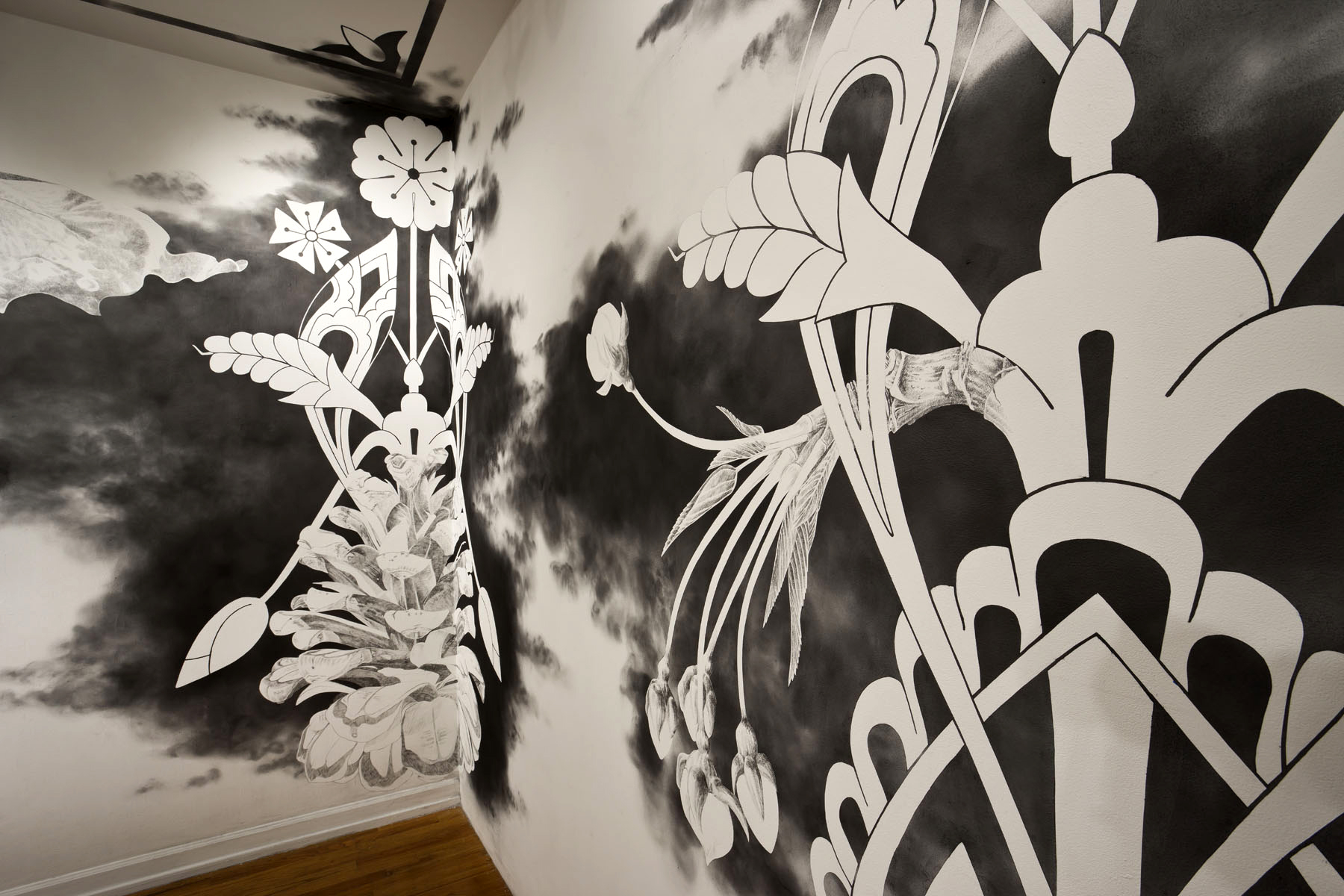
By Natalie Settles
This post was made possible through the support of a grant from The BioLogos Foundation’s Evolution and Christian Faith program. The opinions expressed are those of the author and do not necessarily reflect the views of BioLogos.
Artist Natalie Settles, featured in the most recent issue of Image*, “Evolution and the Imago Dei” , has long been fascinated by the biological sciences. She makes drawings and installation art that mix highly detailed botanical and zoological imagery with highly stylized forms, like Victorian decorative motifs. Her installation works are interactive; they use a gallery space to create an ecosystem in which the viewer becomes a participant. We asked her about her interest in the sciences, the temporary nature of her work, and the way she uses color.*
Image: In his profile of you in Image, Mark Sprinkle writes about your collaboration with Stephen Tonsor, an evolutionary biologist at the University of Pittsburgh. How did that come about?
Natalie Settles: We met up when I contacted him about his work and research after I’d been living here in Pittsburgh for about a year and a half.
I moved to Pittsburgh from Madison, Wisconsin, where I had been in personal and professional community with a range of folks in art and science through my graduate school experience and life there for nearly ten years. Madison plays host to one of the powerhouse universities for biological and other sciences, and so I had become accustomed to being immersed in a community full of science and scientists.
When I came to Pittsburgh, the culture was much more diverse and the culture of science much less pervasive, though still present. While I plugged into the art scene and began going to shows, I also noticed myself perusing the websites of the various biology labs and even wandering out of the studio to catch interesting lectures in the university bio departments. After a year and a half there came a tipping point when I knew I needed to either consider this a curious but distracting habit and set it aside, or engage my interest more intentionally.
I’d noticed a lab whose work seemed to be driven by some of the broader questions that motivated my own studio practice—life in the margins, forms shaped by place, the ideal and the compromised, things that are compelling and powerful and also fleeting. This was Steve’s lab.
One evening while we were walking the hilly streets of Pittsburgh, a friend urged me to get in touch with Steve to see what would happen. The next day I emailed him and told him I was an artist and was interested in his work. A couple days later, we met for a two-hour chat over coffee; now, four years later, the rest is history.
Image: You’ve been involved in several recent initiatives geared towards bringing art and science into dialogue, including the National Academy of Sciences’ DASER forum. It’s not hard to imagine a lot of common ground between artists and scientists—attention to the details of the physical world, and also love of big ideas and big questions. But what are the challenges? Are there things that make it hard to talk to each other?
NS: I think for a lot of people the connections between the practices and inquiries of art and science are hard to make, and even the few connections that may seem quick and easy on the surface are not in practice.
I’ve now been doing some form of work that interacts with the sciences for fifteen years and what keeps coming home to me is how cyclical the process is: First you find a connection, push as far as you can until it breaks. Then you get dumbfounded when nothing seems to fit, work, or connect anymore. Finally, just when you’re about to lose hope, the connection between the two reforms and refigures in some amazing new way.
It’s a bit like working a Rubik’s cube—you’ve got to be willing to make a meaningful mess out of things in order to get to a better place.
Concretely, the language and cultural values of the two fields are pretty different. The solitary studio pursuit and the communal life of the lab are intriguing and informatively different. It also takes a tremendous amount of experience and patience to understand rigor in the context of each field and to be able to detect and pursue it. Even funding creates challenging imbalances, as funding for the sciences is at an order of magnitude higher than it is at for art. There’s much more of course, but I’ll stop there.
Image: Tonsor has written that it was his “devotion to mystery and the sacred in life” that led him into science in the first place. Did you and he talk about faith much? Did that inform your connection?
NS: Perhaps it did subconsciously, as there was a Native American teaching poem on the front page of his lab website that told me this was a person who could think about his work in a broader sense. However, the overt faith dialogue developed much later in the four years that we’ve worked together.
Faith had always been a part of my thinking when it came to working amid the concerns of art and science. My earliest in-depth conversations with scientists had been with people whose faith drove them to their work, and whom I had met in faith communities.
Faith was the basis of our interaction that preceded any discussion of our lines of work and inquiry into the world. Faith served as a home base we could always return to when we got lost in the tangles between and in our fields.
With Steve, our dialogue started from the other end—beginning with the distinctive qualities of our work and the cultures of our fields, and converging on faith. It took us perhaps two years or more to find a language to connect on the notions of faith and spirituality, as our paths to the life of faith evolved through very different kinds of experience, leaving in behind different sets of loaded and meaningful words and images.
In many ways our process of learning to talk about faith with one another had many of the same qualities as our learning to speak across disciplines.
To be continued tomorrow.
Natalie Settles has exhibited nationally and internationally since 1999. Her work intermingles the histories, inquiries, and forms of art and science and has lead to collaborative projects with researchers in biochemistry, botany, physiology, and developmental and evolutionary biologies. Settles was a 2008 Wisconsin Arts Board Fellow. Her wall drawing environment entitled “Ornament and Architecture” was featured in the 2011 Pittsburgh Biennial. In 2012 she served as Assistant Curator and essayist for The Andy Warhol Museum’s Factory Direct exhibition of artist-industry collaborations, and from 2011 to 2014, she was Artist in Residence with the Tonsor Laboratory for Plant Evolutionary Genetics at the University of Pittsburgh. Settles continues her collaborative work with evolutionary biologist Stephen Tonsor and other biologists and technologists on a digitally evolving cast-light “wallpaper” that is both a work of art and a system of scientific experimentation. She is based in Pittsburgh, Pennsylvania, and you can visit her website here.
Previous Post
July 14, 2015
Beauty, Christian Love, and Gay Marriage
Next Post
July 16, 2015 A Conversation with Artist Natalie Settles, Part 2
Browse Our Archives
Select a Category A. G. Harmon Alissa Wilkinson Allison Backous Art Authors Brad Fruhauff Bradford Winters Bryan Bliss Caroline Langston Chad Thomas Johnston Chris Hoke Christiana N. Peterson Culture D.G. Myers D.L. Mayfield Daniel Bowman Jr. David Griffith Elizabeth Duffy Faith Film Greg Wolfe Guest Contributor Interview Jan Vallone Jeffrey Overstreet Jessica Eddings-Roeser Jessica Mesman Griffith Kelly Foster Lindsey Crittenden Morgan Meis music Natalie Vestin Nick Olson Peggy Rosenthal Personal Reflection Poetry Friday Reflection Relationships Review Richard Chess Richard Cole Sara Zarr Shannon Huffman Polson Sonya Bilocerkowycz Tania Runyan Tony Woodlief Topical Categories Uncategorized Vic Sizemore Writing
Select a Month October 2018 September 2018 August 2018 July 2018 June 2018 May 2018 April 2018 March 2018 February 2018 January 2018 December 2017 November 2017 October 2017 September 2017 August 2017 July 2017 June 2017 May 2017 April 2017 March 2017 February 2017 January 2017 December 2016 November 2016 October 2016 September 2016 August 2016 July 2016 June 2016 May 2016 April 2016 March 2016 February 2016 January 2016 December 2015 November 2015 October 2015 September 2015 August 2015 July 2015 June 2015 May 2015 April 2015 March 2015 February 2015 January 2015 December 2014 November 2014 October 2014 September 2014 August 2014 July 2014 June 2014 May 2014 April 2014 March 2014 February 2014 January 2014 December 2013 November 2013 October 2013 September 2013 August 2013 July 2013 June 2013 May 2013 April 2013 March 2013 February 2013 January 2013 December 2012 November 2012 October 2012 September 2012 August 2012 July 2012 June 2012 May 2012 February 2008
Follow Us!
TAKE THE
Religious Wisdom Quiz
How old was Jesus when He started His ministry?
Select your answer to see how you score.
28 35 30 21
Related posts from Good Letters

A Conversation with Alicia Ostriker: Part 1

A Conversation with Alicia Ostriker: Part 2

The Stars of the Earth Cry Out

A Conversation with Welcome Wagon’s Vito Aiuto, Part...
TRENDING AT PATHEOS Catholic

Rejecting Doom: Christian Hope And Human Action
Christianity is a religion of hope. We are to have hope and...

It’s What Comes From Within Which Matters
One of the most difficult things for us to understand is why...

Why I Choose the Eucharist Over the Sermon
Choose the Eucharist, Not the Sermon What are we supposed to get...

5 Design Elements Found in Spiritually Rooted Homes
Putting Spirituality Into Home Decor Our homes are more than our living...

Credo: A Story of God Told with the...
About 10 years ago, I began to imagine a personal "Credo" that...

The Anatomy of Divine Revelation in Catholic Thought
The claim that God has made Himself known to human beings is...
view all Catholic blogs
Ad-Free & Subscriber Log-In Subscription Support
- About Us
- 2026 Calendar
- Videos
- Podcasts
- Library of World Religions
- Faith In Media Tracker
- Advertise With Us
- Write for Us
- Privacy Policy
- Terms of Service
- Do Not Sell My Data
- Contact Us
- Radiant Digital
- Manage Newsletter Subscriptions
- Unsubscribe From Notifications
- Sitemap
Copyright 2008-2026, Patheos. All rights reserved.
Subscription Support Ad-Free & Subscriber Log-In
Follow Patheos