
BuddhistCatholicContemplativeEvangelicalGeneral ChristianHinduJewishLatter-day SaintMuslimNew VisionsProgressive Christian
Beliefs
- Buddhist
- Catholic
- Contemplative
- Evangelical
- General Christian
- Hindu
- Jewish
- Latter-day Saint
- More Voices
- Muslim
- New Visions
- Pagan
- Progressive Christian
Topics
- Religion News
- Food and Religion
- Sports and Religion
- Religious Art
- Religious Music and Entertainment
- Religious Events
- History and Religion
- Style and Religion
- Politics and Religion
- Women in Religion
- Recreation Outdoors and Religion
- Business Finance and Religion
- Careers Workplace and Religion
- Education and Religion
- Family Parenting and Religion
- Health Fitness and Religion
- Home and Religion
- Relationships and Religion
- Technology and Religion
- Travel and Religion
Columnists
- Buddhist Columnists
- Business Finance and Religion Columnists
- Careers Workplace and Religion Columnists
- Catholic Columnists
- Contemplative Columnists
- Education and Religion Columnists
- Evangelists Columnists
- Family Parenting and Religion Columnists
- General Christian Columnists
- Health Fitness and Religion Columnists
- Hindu Columnists
- History and Religion Columnists
- Home and Religion Columnists
- Jewish Columnists
- More Voices Columnists
- Latter Day Columnists
- Muslim Columnists
- New Visions Columnists
- Nonreligious Columnists
- Pagan Columnists
- Politics and Religion Columnists
- Progressive Columnists
- Recreation Outdoors and Religion Columnists
- Relationships and Religion Columnists
- Religion News Columnists
- Religious Art Columnists
- Religious Events Columnists
- Religious Music and Entertainment Columnists
- Sports and Religion Columnists
- Style and Religion Columnists
- Technology and Religion Columnists
- Travel and Religion Columnists
- Women in Religion Columnists
Resource Library
- 2026 Calendar
- Library of World Religions
- The 100 Most Holy Places on Earth
- Patheos Answers
- Podcasts
- Videos
- Faith Leaders Database
- Anglican Episcopalian
- Bahai
- Baptist
- Buddhism
- Christianity
- Confucianism
- Eastern Orthodoxy
- Hinduism
- Holiness and Pentecostal
- ISKCON
- Islam
- Judaism
- Lutheran
- Methodist
- The Church of Jesus Christ of Latter-day Saints
- New Age
- Paganism
- Presbytarian and Reformed
- Protestantism
- Religion Behind the Scenes
- Roman Catholic
- Scientology
- Shia Islam
- Sikhism
- Sufism
- Sunni Islam
- Taoism
- Zen
- See all religions
Research Tools
 Ad-Free & Subscriber Log-In Subscription Support
Ad-Free & Subscriber Log-In Subscription Support
Follow Patheos 

- Trending:
- Forgiveness
- |
- Marriage
- |
- Consciousness
- |
- Death Penalty
- |
- Election
- |
- Halloween
 Good Letters
-
Contributors
- Home
- Catholic
- The Thing Itself: Art and Poverty, Part 2
The Thing Itself: Art and Poverty, Part 2
Last updated on: June 9, 2015 at 4:37 pm by Gregory Wolfe
The Thing Itself: Art and Poverty, Part 2 2015-06-09T16:37:32-07:00 Gregory Wolfe
Patheos Explore the world's faith through different perspectives on religion and spirituality! Patheos has the views of the prevalent religions and spiritualities of the world.
Continued from yesterday.
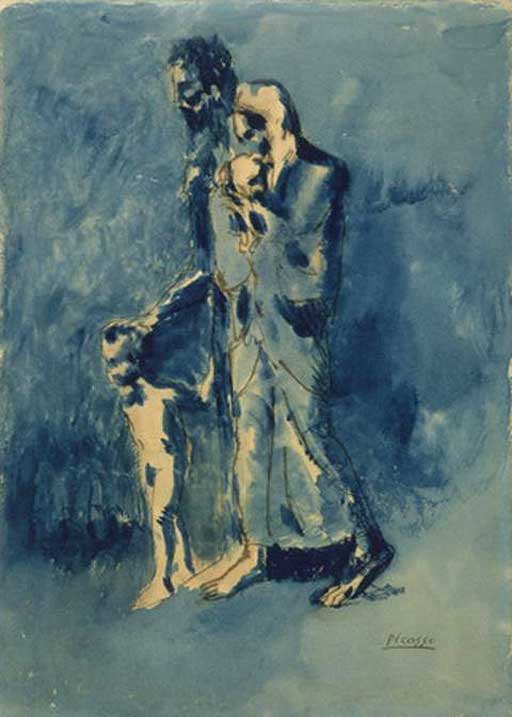 How should we treat the poor?
Among those who work on behalf of them, it has become a truism that our first obligation toward our less fortunate brothers and sisters is to first recognize and celebrate their humanity. What is less often recognized is the vital role that art can play in such a process. Roberta Ahmanson in the interview she gave recently for Image spoke about how she, as a patron of the arts, has worked to serve homeless families through a nonprofit called Village of Hope:
I think people might say that the Village of Hope doesn’t need stained-glass windows; they need food, job training, tutoring, beds for the babies. But Jim [the founder] intuitively understood that the places you bring people to speak to them about their own value. When you…put them in a box like a prison cell, you have just said, “We think you are a prisoner.”
[So, Jim] built the House of Hope for abused women and their children…in the arts and crafts style, with nineteen bedroom suites, and as he was developing the idea of the Village of Hope, he was already thinking about how to make something more beautiful. Then I came alongside him, and we went for it. It is probably the only homeless shelter in the world that has stained-glass windows and an eighteen-foot vase and Albert Paley gates, and they are all very proud of it.
One reason that the art at Village of Hope is so powerful is that its beauty speaks equally to the humanity of the helpers and of those being helped. It isn’t “socially conscious” art—another example of moral high-mindedness gone awry. The problem with socially conscious art is that, by attempting to address social ills directly, it begins with the notion that it already has the answers and merely needs to dramatize them. The results are predictably didactic and inert.
It seems to me that the artists who are best equipped to speak to the problem of poverty start from their own poverty—an acute awareness of their limits as well as their deepest needs, questions, and anxieties. This awareness entails a recognition that the artist does not stand apart or above but is implicated like everyone else. As Albert Camus wrote in his notebooks: “A guilty conscience needs to confess. A work of art is a confession, and I must bear witness.”
While a work of art is, in essence, a fiction or construct—a “nothing” that does nothing—it has an obligation to bear the imprint of reality (like those water tanks deep underground that scientists use to capture the passing of rare subatomic particles). Needless to say, art does not in itself alleviate the suffering that poverty entails, but it remains one of the most compelling means by which we can be turned from distraction and denial and enabled to dwell for a time among those we would pass by.
One of my favorite quotations is from Fr. Luigi Giussani, who once made the disconcerting statement that “the beggar is the protagonist of history.” There’s something crazily hyperbolic in that idea—particularly for someone raised in a culture that is addicted to the success story of the self-made person—but it has grown on me. So many of the protagonists of the most enduring stories are pilgrims in search of something they need, some meaning they need to discover. In the end, the beggar, like Saint Francis, knows that everything is a gift and therefore must be shared.
The artist is a beggar because she is empty, waiting to be filled. But the artist is also, to take up that central preoccupation of Pope Francis, someone who is driven to go out to the margins of society in order to learn what the margin can teach those at the center. That is certainly the biblical narrative from Abraham onward. King Lear learns it on the blasted heath—a margin if there ever was one—in the company of Poor Tom the beggar.
Is man no more than this? Consider him well. Thou
owest the worm no silk, the beast no hide, the sheep no wool, the cat no perfume. Ha! Here’s three on ’s are sophisticated! Thou art the thing itself: unaccommodated man is no more but such a poor bare, forked animal as thou art. Off, off, you lendings!
come unbutton here.
Confronted by a picture of human nakedness, the ultimate image of poverty, Lear recognizes his own sophistication—a pun that not only glances at his dependence on the trappings of civilization but also at the sophistry that such power tempts us to practice. Sensing at last his own dependence on the clothes that are in the end only lendings, accommodations, he seeks to identify himself completely with his poor brother.
No doubt art itself can become a form of sophistication and sophistry, detached from the ache of real human neediness, but the enduring masterpieces, I would argue, recognize their own ultimate poverty, leaving room for the possibility of grace. Shakespeare’s language ultimately points beyond itself, toward “the thing itself.” The richness and complexity of artistic forms reproduce the maze of circumstance through which we live and move, but in the end art’s goal is simplicity—Lear embracing Poor Tom, Dante the pilgrim gazing up at the stars.
Art helps us imagine the lives of others, including the lives of the poor, but it also helps us confess our personal forms of poverty. It may even make us receptive to the idea that our very neediness points toward the existence of that which can fill the heart—which after all is the hungriest part of us.
Gregory Wolfe is the founder of Image and serves as Writer in Residence and Director of the MFA in Creative Writing program at Seattle Pacific University. His books include Beauty Will Save the World and Intruding Upon the Timeless. Follow him on Twitter: @Gregory_Wolfe.
Painting above: Le pauvreté, (Poverty), Pablo Picasso, 1903.
Previous Post

June 8, 2015
The Thing Itself: Art and Poverty, Part 1
Next Post
June 10, 2015 The Eucharist: Eat, Eat!
Browse Our Archives
Select a Category A. G. Harmon Alissa Wilkinson Allison Backous Art Authors Brad Fruhauff Bradford Winters Bryan Bliss Caroline Langston Chad Thomas Johnston Chris Hoke Christiana N. Peterson Culture D.G. Myers D.L. Mayfield Daniel Bowman Jr. David Griffith Elizabeth Duffy Faith Film Greg Wolfe Guest Contributor Interview Jan Vallone Jeffrey Overstreet Jessica Eddings-Roeser Jessica Mesman Griffith Kelly Foster Lindsey Crittenden Morgan Meis music Natalie Vestin Nick Olson Peggy Rosenthal Personal Reflection Poetry Friday Reflection Relationships Review Richard Chess Richard Cole Sara Zarr Shannon Huffman Polson Sonya Bilocerkowycz Tania Runyan Tony Woodlief Topical Categories Uncategorized Vic Sizemore Writing
Select a Month October 2018 September 2018 August 2018 July 2018 June 2018 May 2018 April 2018 March 2018 February 2018 January 2018 December 2017 November 2017 October 2017 September 2017 August 2017 July 2017 June 2017 May 2017 April 2017 March 2017 February 2017 January 2017 December 2016 November 2016 October 2016 September 2016 August 2016 July 2016 June 2016 May 2016 April 2016 March 2016 February 2016 January 2016 December 2015 November 2015 October 2015 September 2015 August 2015 July 2015 June 2015 May 2015 April 2015 March 2015 February 2015 January 2015 December 2014 November 2014 October 2014 September 2014 August 2014 July 2014 June 2014 May 2014 April 2014 March 2014 February 2014 January 2014 December 2013 November 2013 October 2013 September 2013 August 2013 July 2013 June 2013 May 2013 April 2013 March 2013 February 2013 January 2013 December 2012 November 2012 October 2012 September 2012 August 2012 July 2012 June 2012 May 2012 February 2008
Follow Us!
TAKE THE
Religious Wisdom Quiz
Who does Paul describe as his true son in the faith?
Select your answer to see how you score.
Titus Timothy Philemon Onesimus
Related posts from Good Letters




Can a Racist Drive a Prius? Stereotypes and...
TRENDING AT PATHEOS Catholic

Rejecting Doom: Christian Hope And Human Action
Christianity is a religion of hope. We are to have hope and...

It’s What Comes From Within Which Matters
One of the most difficult things for us to understand is why...

Why I Choose the Eucharist Over the Sermon
Choose the Eucharist, Not the Sermon What are we supposed to get...

5 Design Elements Found in Spiritually Rooted Homes
Putting Spirituality Into Home Decor Our homes are more than our living...

Credo: A Story of God Told with the...
About 10 years ago, I began to imagine a personal "Credo" that...

The Anatomy of Divine Revelation in Catholic Thought
The claim that God has made Himself known to human beings is...
view all Catholic blogs
Ad-Free & Subscriber Log-In Subscription Support
- About Us
- 2026 Calendar
- Videos
- Podcasts
- Library of World Religions
- Faith In Media Tracker
- Advertise With Us
- Write for Us
- Privacy Policy
- Terms of Service
- Do Not Sell My Data
- Contact Us
- Radiant Digital
- Manage Newsletter Subscriptions
- Unsubscribe From Notifications
- Sitemap
Copyright 2008-2026, Patheos. All rights reserved.
Subscription Support Ad-Free & Subscriber Log-In
Follow Patheos